MinusX, PromptQL and TextQL vs Data Workers: AI data analyst tools answer the question, Data Workers makes the answer right
MinusX, PromptQL and TextQL answer data questions. Data Workers runs the back office that makes the answers right: pipelines, quality, schema, access and cost, with receipts.
MinusX, PromptQL and TextQL are analytics agents: they answer the question. Data Workers is the agentic data platform that runs the back office behind the answer, so the tables, definitions and pipelines it reads from are right. That is the whole comparison, and the rest of this page is the proof.
Here is the world most buyers of AI data analyst tools live in. A founder or an operations lead asks a question in MinusX Explore, tags a PromptQL bot in a shared thread, or opens a thread with TextQL's Ana. The agent writes SQL, runs Python, builds a chart, and posts the answer to Slack. Over time it learns the business: MinusX in its Knowledge Base, PromptQL in a shared wiki, TextQL in its Ontology. The better the context, the better the answer.
Underneath every one of those answers sits the same estate: Fivetran or Airbyte landing data, dbt models, an Airflow DAG, a warehouse like Snowflake, BigQuery or Postgres. When a sync duplicates rows or a source renames a column, the analytics agent reads the broken table and answers confidently. Nobody in that thread owns the pipeline.
Data Workers covers the whole data lifecycle. It catches the break, fixes it at the source, verifies the result downstream and leaves a receipt on every change. It also runs the jobs around the answer: data quality, schema changes, access requests, cost cleanup and migrations, with one context, one approval flow and one audit trail. Keep the analytics agent your people like. Data Workers makes sure what it reads is right.
Key takeaways
- •Answers vs the back office. MinusX, PromptQL and TextQL turn plain-English questions into SQL, charts, dashboards and reports. Data Workers keeps the data under those answers correct, and fixes it when it isn't.
- •Each one is strong on its own ground. MinusX is an open-source agentic BI tool built around its agent. PromptQL is multiplayer AI with a shared wiki and bots that act as the person who asked. TextQL pairs its analyst Ana with an enterprise Ontology and long-running Agents.
- •None of them owns the pipeline. Their docs describe answering, alerting and writing artifacts or SaaS records. Changing dbt models, Airflow runs, connectors and warehouse objects behind approvals sits outside all three.
- •Data Workers covers the whole lifecycle across Snowflake, BigQuery, Databricks, Postgres, dbt, Airflow and Fivetran. Every action is approved or reversible and leaves a tamper-evident receipt.
- •Keep your analytics agent, or consolidate. Most teams keep the tool their business users already ask. Some consolidate everyday questions onto the Data Workers Insights agent once one governed context serves both.
If you are weighing what these tools cost, our agentic data industry pricing report covers PromptQL's OLU and TextQL's ACU billing in detail. For why text-to-SQL depends on governed context, read why text-to-SQL fails without a semantic layer and our guide to text-to-SQL tools for enterprise data teams.
Two roads from the same starting point
Every product on this page starts from the same idea: point an AI agent at company data. The difference is what each one points the agent at.
Analytics agents point it at the question. The goal is the best answer, the fastest chart and "insights on tap" for people who don't write SQL. Success is measured in answer accuracy and adoption.
Data Workers points it at the work behind the question. The goal is an AI-native data engineering back office: long-running, general data engineering tasks across quality, incidents, pipelines, schema, access, security and cost. Success is measured in closed incidents, verified fixes and receipts.
Both roads are useful. They meet at one place: an analytics agent is only as right as the tables and definitions under it. That is where Data Workers does its job.
MinusX
What it is. MinusX calls itself an "open source agentic business intelligence platform for founders," with the line "your data stack, staffed by agents." It started as an AI analyst inside Metabase and is now its own BI tool, built "from the ground up for agents, not a chatbot bolted on to a BI tool." You can run the open-source version yourself or use MinusX Cloud.
Where it's strong. The agent lives on every page: Explore, Questions, Dashboards and Reports. Its docs say "every action produces a visible, editable artifact," so a founder can ask for a revenue chart, a filter and a weekly report and see each one built. A Knowledge Base holds whitelisted tables, metric definitions and business rules, and evals measure the agent's accuracy against them. A Slack bot and an MCP server (search schemas, run queries, read questions and dashboards) bring answers to wherever people work. Its README notes it is "designed to work with or without dbt."
Where it stops. MinusX writes BI artifacts. Its docs list alerts as "coming soon," its Slack agent is "optimized for read/query workflows," and its connections cover Postgres, BigQuery, Athena, ClickHouse, DuckDB, files and Google Sheets, with Snowflake and Databricks listed as coming soon. Nothing in its docs covers changing a pipeline, a dbt model or a warehouse grant.
The role swap. MinusX is where a small team asks the question. Data Workers makes sure the warehouse it asks is right.
PromptQL
What it is. PromptQL, from Hasura, describes itself as "a multiplayer AI for your team that maintains a shared context wiki." The homepage leads with "the world's first multiplayer bot experience": bots that can run around the clock on their own isolated computer, with features noted as in beta. It connects to databases (Postgres, Snowflake, BigQuery, Databricks and more) and to SaaS tools like GitHub, Slack, Salesforce and Google Workspace.
Where it's strong. Collaboration. Several people join one thread, tag each other and the agent, and correct the answer together, and that context lands in a shared wiki so the next answer is better. For data teams it "writes code to answer real business questions" over data where it lives, with no data movement. Its permissions model is careful: "A bot acts as the person who asked. It uses that person's access to connected data and tools," and sharing a bot doesn't share your access. Alerts watch an artifact on each run, and pre-authorized actions can open a Linear ticket, send a Slack message or post a Salesforce note.
Where it stops. PromptQL's actions are rules that fire "any write endpoint an integration exposes," with "no approval prompt; the rule's pre-authorized." That suits business workflows. Its incident guide writes a briefing (owner, on-call, suspicious deploys, runbook) for software incidents and stops there. Its docs don't cover data pipeline repair, blast radius on warehouse changes, rollback or verification downstream.
The role swap. PromptQL is where the team works out the answer together. Data Workers is the crew that fixes the data the answer depends on.
TextQL
What it is. TextQL builds around Ana, "TextQL's AI agent: think of her like a data analyst you just hired." Ana writes SQL, runs Python, searches the web and produces charts, dashboards, reports and files. Around her sit the Ontology (a governed layer of metric definitions, entities and conventions), Data Apps, long-running Agents, 50+ connectors and Sandcastles, its sandbox infrastructure for data agents. TextQL sells to large enterprises with complex estates, including legacy ERPs.
Where it's strong. Depth of context at enterprise scale. The Ontology syncs from GitHub, has role-based access per folder and recently reached version 3.0. Agents run on a schedule, a cron, a Slack command or a webhook, query only the connectors assigned to them and publish findings to a Feed, Slack or DMs. Each can watch "one slice of your business: revenue trends, pipeline health, data quality." Its homepage says agents "watch, decide, and write back into the source system," and Ana can call external tools over HTTP MCP servers.
Where it stops. TextQL's agent docs describe outputs as Feed posts, Slack messages and DMs. Write-back appears as a business workflow step in a source system, and the docs don't describe how a change to a dbt model, an Airflow DAG or a connector is scoped, approved, rolled back or verified. An agent watching pipeline health reports what it sees; the repair still lands with the data team.
The role swap. TextQL's Ana answers on a governed Ontology. Data Workers keeps the data under that Ontology correct and fixes it at the source.
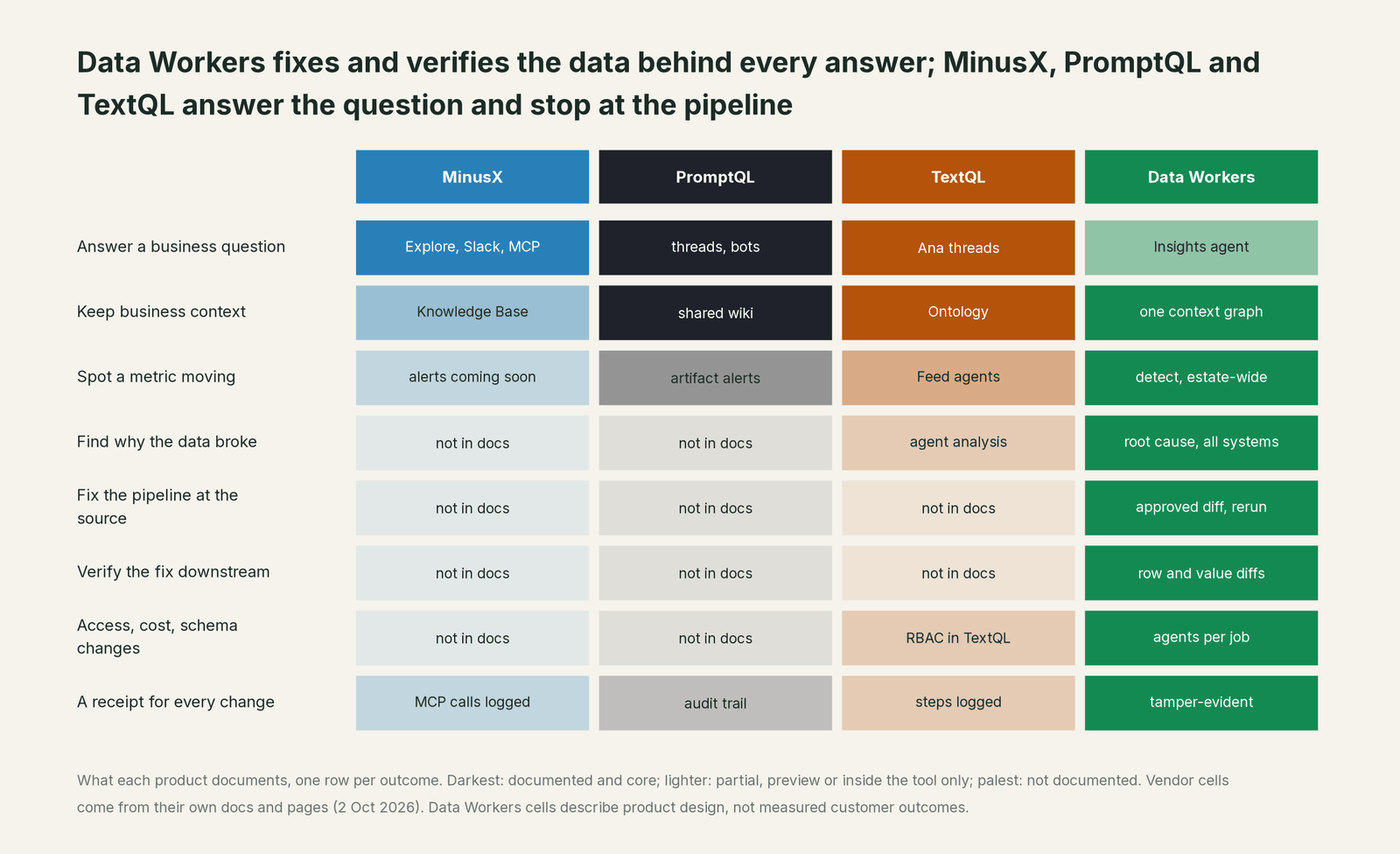
The comparison in one table
| Job | MinusX | PromptQL | TextQL | Data Workers |
|---|---|---|---|---|
| Answer a business question | Agent on every page, Slack, MCP | Multiplayer threads and bots | Ana threads, Data Apps | Insights agent over governed definitions |
| Keep business context | Knowledge Base and evals | Shared wiki, built as you work | Ontology, synced from GitHub | One context graph across the estate, with provenance |
| Spot a metric moving | Alerts listed as coming soon | Alerts on an artifact | Agents posting to a Feed | Detection across warehouses, dbt, orchestration and BI |
| Act | Writes questions, dashboards and docs | Pre-authorized SaaS writes as the asker | Write-back in business workflows | Approval-gated changes to dbt, Airflow, connectors and the warehouse |
| Find why the data broke | Not in its docs | Not in its docs | Agent analysis of a slice | Root cause traced across systems |
| Fix at the source and verify | Not in its docs | Not in its docs | Not in its docs | Proposed diff or rerun, then checks on the changed tables |
| Access, cost, schema, migrations | Table whitelisting in MinusX | Asker's own permissions | RBAC inside TextQL | Specialist agents for each job |
| Pricing model | Free OSS; per user and team plans with agent credits | Per user, then consumption in OLUs | Platform fee plus compute in ACUs | Flat platform fee, unlimited seats, no usage meter |
One incident, six systems
Here is a Monday most analytics-agent users will recognize. It's an illustrative example.
- •Sunday 23:10. A Fivetran re-sync of the Stripe connector lands duplicate refund rows in Snowflake.
- •Monday 02:00. Airflow runs dbt. The run passes, and
fct_net_revenuenow counts some refunds twice. - •09:05. The CFO asks the analytics agent in Slack why net revenue fell 6% last week. The agent queries
fct_net_revenue, reads the governed definition of net revenue and answers: refunds spiked. The SQL is correct. The table is wrong.
| Step | What the analytics agent sees | What Data Workers does |
|---|---|---|
| Fivetran re-sync of Stripe refunds | Nothing; ingestion is upstream of its job. | Flags refund volume at twice its baseline and a failed uniqueness check on refund_id at 06:30. |
| dbt writes double-counted refunds | A table it trusts, matched to the metric definition in its context. | Traces the cause to the re-sync and maps the blast radius: one model, three dashboards and every answer on net revenue. |
| The fix | Not its job. | Proposes a dbt diff that dedupes on refund_id and adds a unique test. The on-call analytics engineer approves it at 07:15. |
| Backfill and verify | Not its job. | Starts the three-day backfill through the orchestrator with its undo recorded first, then re-checks the quality assertions and the dbt tests. |
| The CFO's question at 09:05 | Reads the corrected table and answers correctly. | Records a tamper-evident receipt: what broke, who approved what, what changed and how to undo it. The new unique test stops the same break next time. |
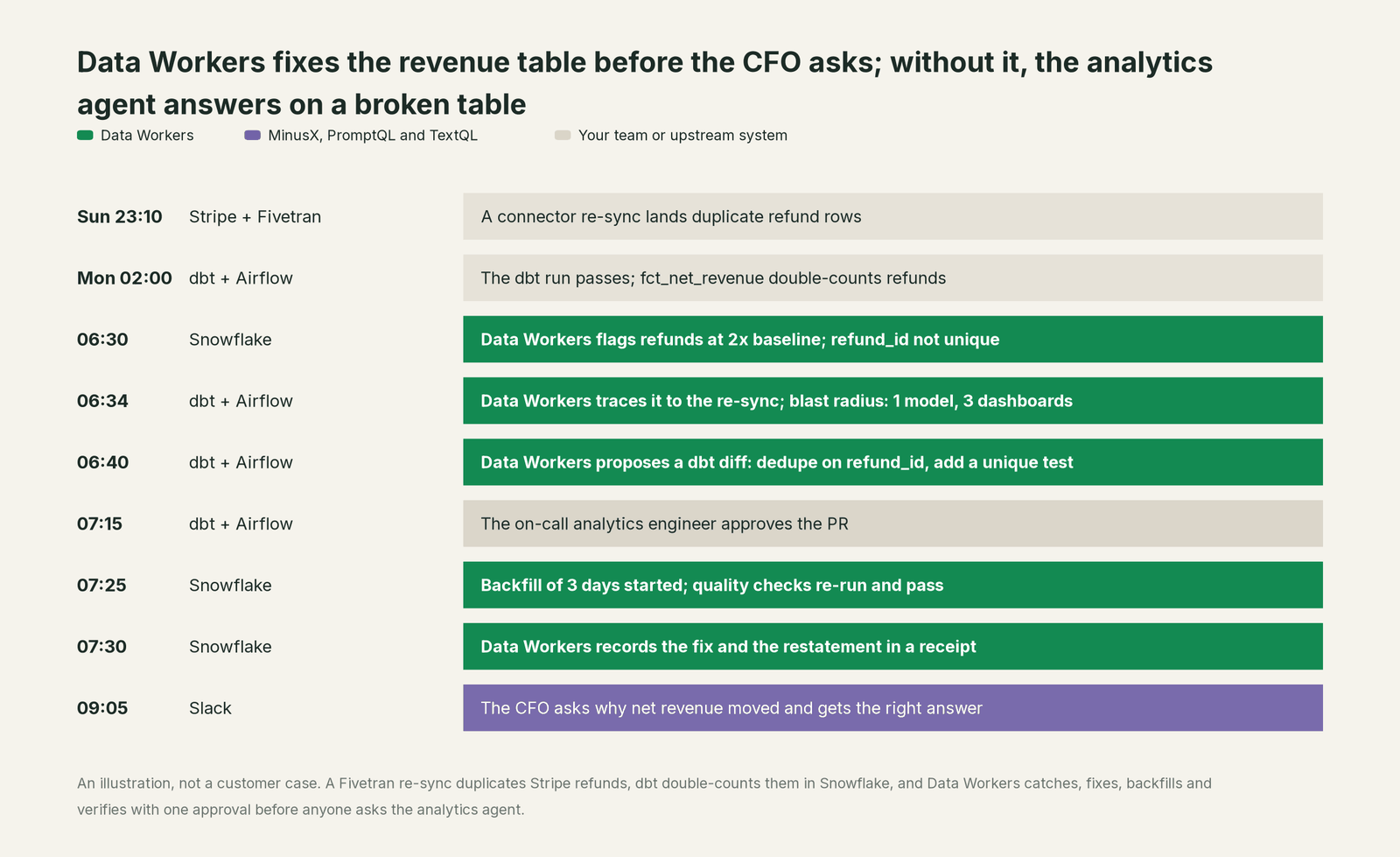
The analytics agent did its job well in both versions of this Monday. It wrote the right SQL against the right definition. The difference is the table. Without Data Workers, the CFO gets a confident wrong answer and the data team spends Tuesday explaining it. With Data Workers, one engineer spends one approval and the answer is right before anyone asks.
Why doesn't MinusX, PromptQL or TextQL just do this itself?
Because each one is built for a different job, and each made a sensible choice about risk.
The product is the answer and the person asking it. All three optimize for the business user's experience: fast, accurate, trustworthy answers in a thread, a dashboard or Slack. Their roadmaps follow that buyer: better context capture, richer artifacts, more collaboration, longer-running agents that report back.
Their write paths are scoped to that job. MinusX writes the BI artifacts it owns. PromptQL acts with the asker's own permissions and fires pre-authorized writes into SaaS tools. TextQL agents publish findings and can write back into a source system as part of a business workflow. Each of those designs keeps the blast radius small and the security review short, which is right for an analytics product.
Running the data back office is a different product category. Changing a dbt model, rerunning an Airflow task, editing a Fivetran connector or a warehouse grant needs blast-radius scoping before every change, approvals that vary by domain, rollback, a receipt an auditor can read, context about every other system in the estate, and liability for changes inside tools the vendor doesn't own. It also needs a different buyer: the data platform team, who answers for the pipeline at 06:30, not the executive asking the question at 09:05.
That is the product Data Workers is. It doesn't compete for the thread where people ask questions. It runs the work that makes the thread's answers right.
One platform across the data lifecycle
Answering questions is one stage of a data team's lifecycle. The same team also keeps context current, writes quality checks, handles incidents, changes pipelines, manages schema changes and migrations, grants access, protects sensitive data, cuts spend and keeps model inputs healthy. Each point tool adds another console, another contract and another handoff. Data Workers covers the whole lifecycle with one context, one approval flow and one audit trail.
We score the same ten stages on every comparison page, so you can compare tools across pages. Each analytics agent leads on its home stage, Analytics & Insights, and TextQL's Ontology comes close on Catalog & Context. Data Workers covers all ten.
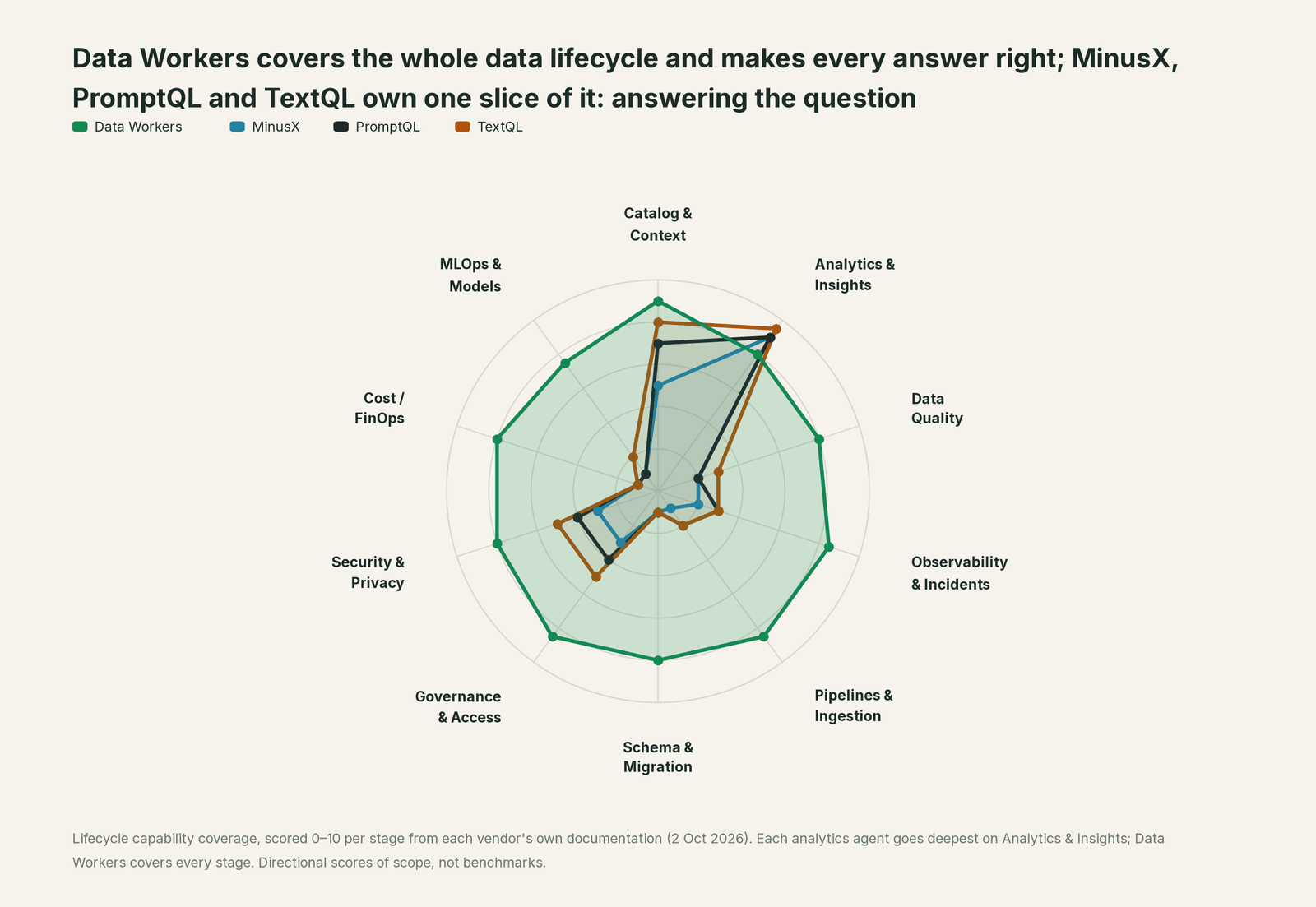
| Stage | Data Workers | MinusX | PromptQL | TextQL | Why we scored it this way |
|---|---|---|---|---|---|
| Catalog & Context | 9 | 5 | 7 | 8 | MinusX learns context in a Knowledge Base, PromptQL in a shared wiki and TextQL in its Ontology, each for its own agent. Data Workers keeps one governed graph across warehouses, dbt, orchestration and BI, with provenance on every fact. |
| Analytics & Insights | 8 | 9 | 9 | 9.5 | The home stage for all three: plain-English questions to SQL, Python, charts, dashboards and reports. Data Workers' Insights agent answers too, through the same governed definitions. |
| Data Quality | 8 | 2 | 2 | 3 | MinusX evals measure agent accuracy, not data health; TextQL agents can watch a data-quality slice and post findings. Data Workers writes, runs and repairs checks and dbt tests. |
| Observability & Incidents | 8.5 | 2 | 3 | 3 | MinusX alerts are listed as coming soon; PromptQL alerts watch an artifact; TextQL agents post to a Feed. Data Workers detects, diagnoses, fixes and verifies data incidents. |
| Pipelines & Ingestion | 8.5 | 1 | 2 | 2 | All three read from pipelines' output. Data Workers changes the pipeline, triggers the rerun behind approval and checks the result. |
| Schema & Migration | 8 | 1 | 1 | 1 | None documents schema-change handling or migrations. Data Workers catches upstream schema changes before the dbt run and plans platform moves in waves. |
| Governance & Access | 8.5 | 3 | 4 | 5 | PromptQL acts with the asker's own permissions; TextQL has role-based access on its Ontology and connectors; MinusX whitelists tables. Data Workers proposes least-privilege grants on your platforms. |
| Security & Privacy | 8 | 3 | 4 | 5 | Each secures its own product, with self-hosted, BYOC or VPC options. Data Workers flags new sensitive column names in pull request review and leaves a tamper-evident receipt on every change. |
| Cost / FinOps | 8 | 1 | 1 | 1 | None of the three manages warehouse spend. Data Workers traces Snowflake credits to the dbt model behind them and drafts the fix for its owner. |
| MLOps & Models | 7.5 | 1 | 1 | 2 | TextQL's Python sandbox supports modelling work; none manages model inputs. Data Workers keeps the data under models healthy and connects to MLflow and W&B. |
The scores measure scope, meaning what each product covers, not answer quality. They're directional scores of scope, not benchmarks, and the reasoning is shown so you can check every line against each vendor's docs.
Which to keep, which to consolidate
Keep your analytics agent and add Data Workers. This is the natural starting point for most teams. Your business users already ask MinusX, PromptQL or TextQL, and they trust the experience. Data Workers sits on the same warehouse and dbt project and keeps both healthy, so every answer gets more reliable without anyone changing where they ask. The analytics agent keeps answering; Data Workers does the work behind it.
Keep one context, not two. All three tools build context for their own agent: a Knowledge Base, a wiki, an Ontology. Data Context Wizard builds one governed graph from your warehouses, dbt manifest, orchestration and BI metadata, with source, author, confidence and observation time on every fact. Bring your existing definitions in as a source and keep them yours. The more your analytics agent's context matches the graph your pipelines run on, the fewer answers drift.
Consolidate everyday questions when one context serves both. Some teams want one platform, one approval flow and one audit trail for answers and operations. The Insights agent answers business questions through the governed semantic layer, pre-registers its analysis plan and checks a surprising number before reporting it. When that covers what your people ask, consolidation is an option. If your business users rely on PromptQL's multiplayer threads, MinusX's dashboards or TextQL's Data Apps, keep them for that.
| If you run | Keep it for | Data Workers adds |
|---|---|---|
| MinusX | Fast answers and dashboards for a small team, self-hosted if you like | Correct tables under every chart, data quality, incidents and schema changes |
| PromptQL | Multiplayer threads, a team wiki and bots for business workflows | The data engineering back office its bots read from |
| TextQL | Ana, the Ontology and Data Apps across a large, legacy-heavy estate | Fixes at the source, verified downstream, with receipts across every platform |
Either way, nothing moves. Data Workers stores metadata and scrubbed facts about your data, not copies of your tables.
How they work together
The three tools and Data Workers meet in the warehouse. The analytics agent reads tables and definitions; Data Workers keeps them right. Beyond that shared ground, each tool has a documented surface Data Workers connects through today, over MCP or the tool's API:
- •MinusX exposes an MCP server with tools to search schemas, run queries and read questions and dashboards. Data Workers can read which tables and saved questions the business depends on, which sharpens the blast radius of every change.
- •PromptQL connects to your databases and SaaS tools and can hand work to coding agents like Claude Code or Codex. Every Data Workers agent is itself an MCP server those coding agents can call.
- •TextQL offers a REST API, webhook triggers for its Agents, and MCP client support for HTTP servers. For example, a Data Workers alert can call a TextQL agent's webhook, so the Feed explains a restatement in business terms.
Every connection starts in observe mode (L1), and autonomy moves up one domain at a time. Spellbook Data Catalog (in preview) is where people review, approve and roll back agent work; Approval requests also reach the team in Slack or email.
Autonomy guardrails
Analytics agents manage risk by keeping writes inside their own product or behind the asker's permissions. Data Workers lets agents change production data systems, under graded, reversible control, because that is how a broken table gets fixed before the question arrives.
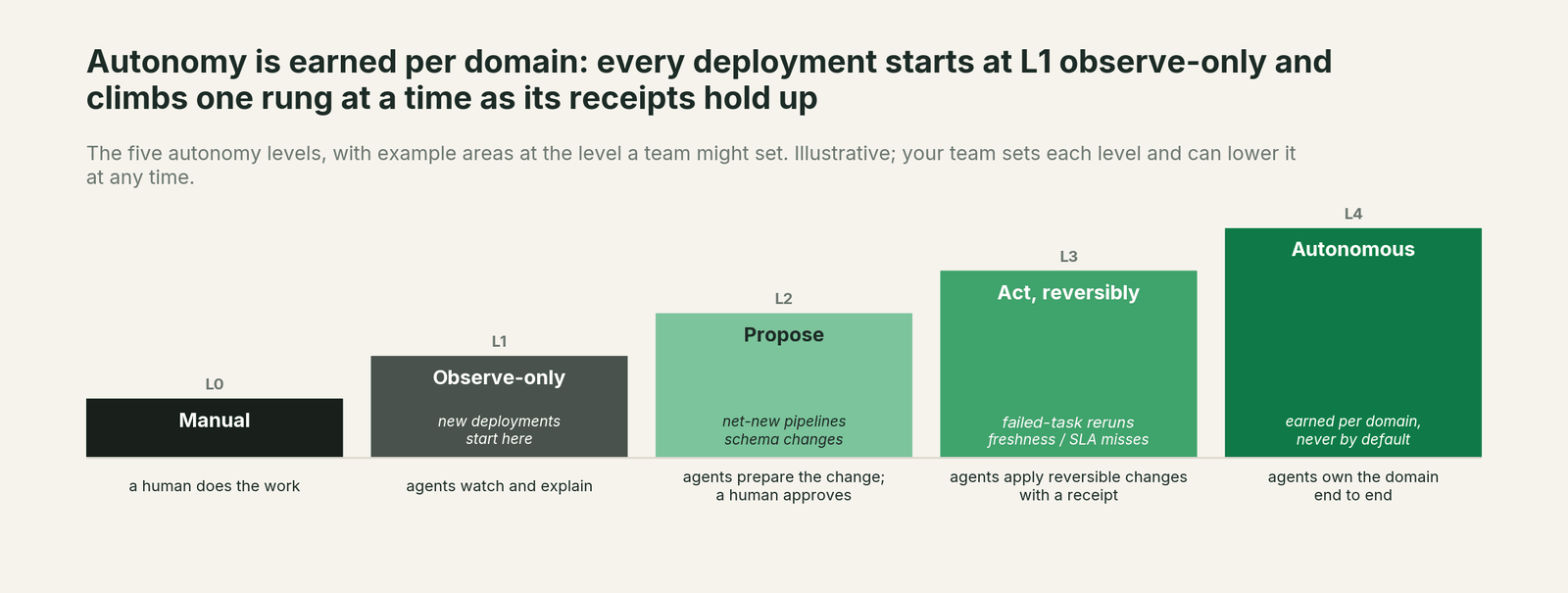
- •Autonomy is set per domain, from L1 observe to L4 autonomous. Duplicate-row fixes can run at L3 (act, reversibly) while schema changes stay at L2 (propose).
- •New deployments start observe-only. You extend autonomy one domain at a time as the receipts earn trust.
- •Every write is scoped before it runs, with blast radius computed across platforms, including the dashboards and saved questions downstream.
- •Every action is approved or reversible and leaves a tamper-evident receipt.
- •No agent can approve or promote its own work. This is enforced in code, not left to a prompt.
- •Least privilege. Data Workers acts with the grants you give it, through each platform's own permission system.
What it costs
The three tools price around usage. MinusX's open-source edition is free with your own LLM keys; MinusX Cloud is $40 per user per month with agent credits, or $600 a month for a 20-user Team plan. PromptQL's Team plan starts at $40 per user per month at cost during an introductory period, and Enterprise starts at $1,000 a month on consumption in OLUs with a monthly minimum. TextQL's Team plan is $250 a month plus compute in ACUs, with Enterprise priced on request.
Data Workers is priced the other way round. The Apache 2.0 core is free. The pilot is $7,500 one-time, credited in full against your first year. Scale starts at $1,000 a month and Enterprise at $3,000 a month, both billed annually. Seats are unlimited, there's no usage meter, and there's no markup on model spend because you bring your own model. See pricing.
The bills don't compete. Your analytics agent's bill grows with the questions people ask. Data Workers is a flat platform fee whether it fixes five broken tables a month or fifty. The useful question is how many hours your data team spends today explaining or correcting numbers an analytics agent reported from a broken table.
The case for your CFO
The outcome. Today an analytics agent turns questions into answers, and the data team turns wrong answers into apologies and fixes. Data Workers closes that gap for the data domains you allow: breaks are caught at the source, fixed behind approval and verified, so the numbers executives read in Slack are right before they ask.
The risk story. Data Workers starts observe-only (L1): it reads and reports. At propose (L2) every fix is a draft a person approves. At act reversibly (L3) it runs only changes it can undo, and only in domains you've moved up. Autonomous (L4) is a per-domain choice, never a default. Every write is scoped before it runs, no agent approves its own work, and every receipt records who or what acted, why, what it touched and how to undo it. Zero migration: your data stays where it is.
Why now. Analytics agents are putting your warehouse in front of every executive, every day. The more people trust a confident answer, the more a broken table costs. The back office has to move at the speed of the front office.
The first win. The handful of metrics your leadership asks the analytics agent about most, watched end to end from source to table, with fixes in propose mode.
What stays the same. Your analytics agent, its threads and context, your warehouse, dbt, Airflow, Fivetran and the coding agent your engineers already use.
The path. Start with a pilot. See pricing; the pilot is credited in full against the first year.
The sentence to repeat upstairs: "We keep the AI analyst our people like for answers; Data Workers makes sure the data behind every answer is right, and fixes it with a receipt when it isn't."
The fastest first win: the metrics leadership asks about
Pick the five to ten metrics your executives ask the analytics agent about every week: net revenue, bookings, churn, active customers. Data Workers maps each one back through the dbt models, the Airflow DAG and the connectors that feed it, then watches the whole path with that domain in propose mode. Each break arrives in the Spellbook inbox with the root cause, the proposed diff or rerun and its blast radius, including the saved questions and dashboards that read the table. When your team has approved those proposals as-is for a few weeks, move the domain up to reversible actions. The Schema Evolution agent and the Data Change Review agent are usually the next two to turn on, so source changes are caught before the dbt run.
What each Data Workers product does here
Autonomous Data-Conductor. The Conductor owns an outcome, a correct table under every answer, rather than a step. It runs detect, diagnose, fix, review, verify and remember across the estate and directs the right agents.
Data-Agents Swarm. 20+ specialist agents in the Data-Agents Swarm, including the Incident Debugging agent, quality, pipelines, schema, access, cost and the Insights agent for business questions. Each agent is an MCP server.
Data Context Wizard. One governed graph across warehouses, dbt, orchestration and BI through 50+ connectors, with provenance on every fact.
Spellbook Data Catalog. The control plane for agent work: one inbox to approve, steer, send back or roll back, asset pages across the estate and an authority guard that stops any agent approving its own work.
FAQ
What are the best AI data analyst tools in 2026? MinusX, PromptQL and TextQL are three strong options with different buyers: MinusX for founders and small teams who want open-source agentic BI, PromptQL for teams who want multiplayer threads and a shared wiki, TextQL for large enterprises who want an Ontology across complex estates. Whichever you pick, the answers depend on the data underneath, which is the job Data Workers does.
Is Data Workers a PromptQL alternative or a TextQL alternative? For everyday questions it can be: the Insights agent answers through governed definitions. Most teams use Data Workers alongside their analytics agent, because Data Workers runs the work behind the answers: quality, incidents, pipelines, schema, access and cost.
Why does my AI analyst give confident wrong numbers? Usually the SQL is right and the table is wrong: a duplicate sync, a renamed column, a late load or a changed definition upstream. Better context helps the agent pick the right table. It can't fix a broken one. Data Workers catches and fixes those breaks at the source and verifies the result.
TextQL agents can write back to source systems. Isn't that the same thing? It's a different scope. TextQL's write-back serves business workflows, and its agent docs describe findings published to a Feed, Slack or DMs. Data Workers changes dbt models, Airflow runs, connectors and warehouse objects with blast-radius scoping, approvals by domain, rollback, downstream verification and a receipt on every change.
PromptQL bots can take actions. Why add Data Workers? PromptQL's actions are pre-authorized writes into tools like Linear, Slack and Salesforce, run with the asker's permissions. Data Workers runs data engineering work under an estate-wide approval policy, with the platform team's grants and a verification step before an incident closes.
Does Data Workers work with MinusX, PromptQL or TextQL? Yes, through the warehouse they share and over each tool's MCP server or API today. Data Workers keeps the tables and definitions they read correct, and reads which questions and dashboards depend on each table to scope every change.
Will our business users have to switch tools? No. They keep asking where they ask today. Data Workers works behind the scenes, and its review and approval surface is for the data team.
Is Data Workers open source? The Data Workers core is Apache 2.0 and free to run. See pricing for what the platform adds.
Sources
Vendor capabilities, statuses and pricing are current as of October 2, 2026, from each vendor's own pages and documentation. MinusX: homepage, pricing, the GitHub repository and README and its docs on the agent, MCP and Slack integrations, alerts and connections. PromptQL: homepage, pricing, docs, bots, taking action, alerts, incident triage, for data teams and How to Build a Company Brain (August 18, 2026). TextQL: homepage, pricing, Agents, Sandcastles, and its docs on Ana, Agents, MCP and the Ontology. Product names and statuses change quickly; if we've got something wrong, tell us and we'll fix it.