Alkera vs Data Workers: An Agent for the Engineer, a Platform for the Estate
A technical comparison for platform owners: Alkera puts a careful agent in each engineer's IDE; Data Workers governs every change across the data estate.
If you own a data platform, your engineers are already picking their own agents. One of them may be Alkera. It parses every SQL statement before it runs, traces column-level lineage and asks before it writes anything risky. Its docs call it "a data engineering agent", and since this summer its homepage calls it "One agentic platform. Your entire data stack."
You're the person who has to say yes to it, and to the next agent, and the one after that. Your estate is Fivetran or Airbyte landing data in Snowflake, BigQuery or Databricks, dbt building the models, Airflow running the DAGs and Looker or Tableau on top. When one engineer's change breaks another team's model at 2 a.m., the question lands on you: who approved it, what else did it touch, and how do we put it right.
Alkera gives each engineer a careful agent. Data Workers gives the platform owner one governed loop that every engineer's agent, Alkera included, feeds into. Data Workers is the agentic data platform: a catalog that works as the control plane, one context graph across the estate, a loop that detects, diagnoses, fixes, reviews and verifies, and autonomy set per domain. Every change is approved or reversible and leaves a receipt.
For the quick, lane-by-lane grading with a citation on every cell, see our Data Workers vs Alkera scorecard. This page is the deep technical comparison for the platform team: how each product is built, where each one stops and how they fit together.
Key takeaways
- •Alkera is an agent in one engineer's terminal or IDE, documented as a CLI and an IDE extension, with a careful effects model and column-level lineage. Its product page now describes self-healing pipelines on hosted workers; its docs and changelog don't cover them (checked Oct 2, 2026).
- •Data Workers is a platform for the estate. Spellbook Data Catalog is the control plane, the Data Context Wizard keeps one graph across every system, and the Autonomous Data-Conductor runs the loop with approvals and receipts.
- •Alkera leads on pipeline authoring inside the IDE. We say so, and our own scorecard says so.
- •Data Workers leads on what happens around and after the change: blast radius across other teams' models, DAGs and dashboards, incidents traced and fixed with one approval, access, warehouse cost, migration and audit.
- •Every Data Workers agent is an MCP server. Alkera documents no MCP surface, so other agents can't call it and it can't call theirs.
- •You can keep Alkera. The two meet in git and in the warehouse, and Data Workers reviews Alkera's pull requests like anyone else's.
Six things a platform team gets on top of Alkera
1. A catalog that works as the control plane. Spellbook Data Catalog, in preview, puts every proposed change from every agent in one inbox: approve, steer, send back or roll back. Asset pages cover the whole estate. In Alkera's docs, approval modes are set per session, including a Bypass mode. Its site adds org-level caps for the self-healing flow.
2. One context graph for the estate. The Data Context Wizard builds one graph from your warehouses, dbt projects, orchestration and BI. Every fact carries its source, author, confidence and the time it was observed. Alkera's knowledge base is scoped to a project, with team sharing off by default.
3. A loop that owns the outcome. The Autonomous Data-Conductor picks up a failure, traces the cause, has the right agent propose the fix where the problem started, and checks the result downstream once a named human approves.
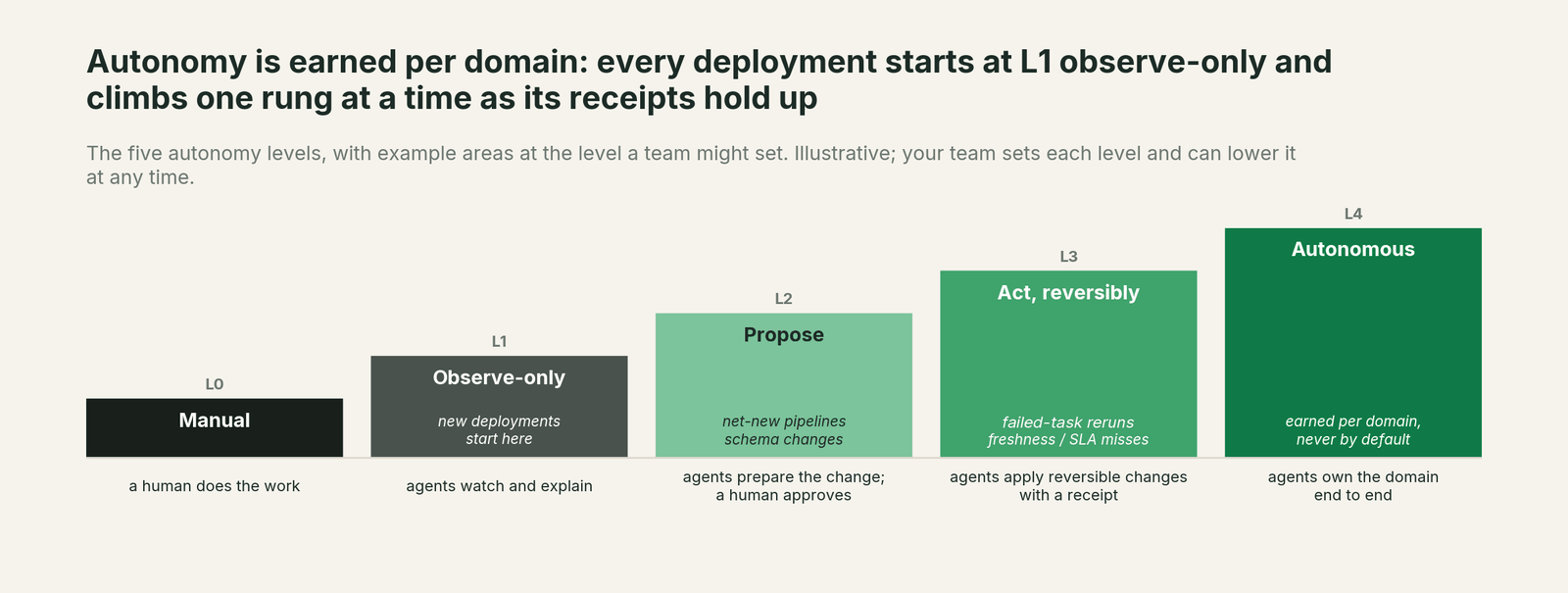
4. Guardrails per domain. You set autonomy per domain on the L0 to L4 ladder, from observe to autonomous. No agent can approve its own work, and every change is approved or reversible and leaves a receipt.
5. The back office. Least-privilege access requests behind approvals, Snowflake credits traced to the dbt model behind them with the fix drafted for its owner, legacy migrations planned in waves and parity-checked, and audit evidence built from receipts.
6. MCP from the ground up. Each Data Workers agent is an MCP server, reachable from Claude Code, Codex or Cursor, and other tools' MCP servers feed the loop.
Behind all six are the 20+ specialist agents of the Data-Agents Swarm, one context graph and your team's coding agent as the way in.
One change, one incident, five systems
Here is a scenario a platform team could run into. It's an illustration, not a customer case.
- •Tue 15:40. An engineer asks Alkera in Cursor to retype
amounttonumeric(12,2)and renamecust_idtocustomer_idinfct_orders, a dbt model on Snowflake. Alkera rates the change "potentially breaking", lists the downstream models and tests in the project and asks for approval. Its Review sub-agent checks the diff. - •15:55. Data Workers' Change Review agent comments on the GitHub pull request. A finance team's incremental model, in a different dbt project, still joins on
cust_id. The Airflow DAGorders_dailyruns it, and a Looker explore reads it. Data Workers proposes a companion fix as a diff to that model's owner. - •16:05. The engineer's PR merges. The companion fix waits for its owner.
- •Wed 02:00.
orders_dailyfails on the finance model. The 02:20 retry fails too. - •02:21. Data Workers opens an incident, links the failure to the rename and the waiting companion fix, and puts both in the Spellbook inbox with the blast radius.
- •02:40. The on-call engineer approves the companion fix. It merges and the DAG reruns.
- •03:10. The dbt tests pass. Data Workers checks revenue by region in the Looker explore against Snowflake and files the receipt.
| Step | What Alkera sees (per its docs and site) | What Data Workers does |
|---|---|---|
| The change in dbt | Column-level blast radius inside the project it was opened in, an approval prompt and a Review sub-agent | Change Review checks the PR against the estate graph, including the other team's project, the DAG and the explore |
| The other team's model | Outside the project's lineage. Warehouse lineage refreshes when triggered or on a job someone schedules | Already in the graph. The companion fix is proposed before anything breaks |
| The overnight failure | Its product page describes detecting job failures on hosted workers; the docs don't cover it | Opens the incident and links it to the change that caused it |
| The fix | Its product page describes root-cause analysis, a patch tested in an isolated copy and a PR for approval | One approval in Spellbook; the DAG reruns and the dbt tests pass |
| The dashboard | Looker is on its homepage integration wall; its docs say BI plugins are "coming soon" | Connected to Looker over its API or MCP today, it checks the explore and links it in the receipt |
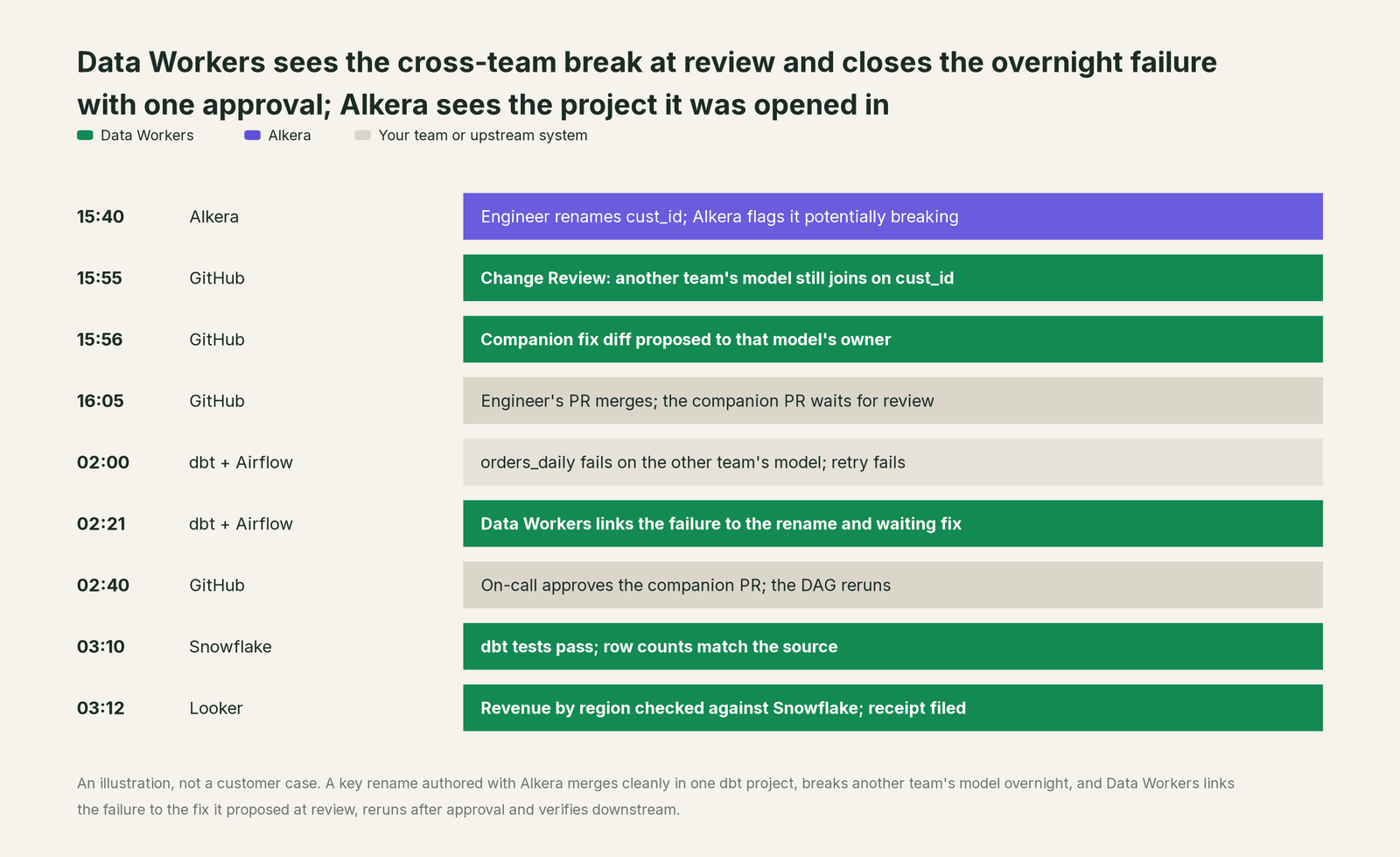
The careful change was the easy part. The hard part was the other team's model, the 2 a.m. failure and the question from finance. That's the part a platform owns.
What Alkera covers, as of October 2026
Alkera's docs describe it as "a data engineering agent. It makes changes to the queries, transformations, and models in your pipeline reliably and safely." Its homepage, rewritten this summer, says "One agentic platform. Your entire data stack." Here is what its documentation and product pages say it ships, checked on October 2, 2026.
| Area | What Alkera ships | Status (Oct 2026) |
|---|---|---|
| Surfaces | CLI, and an IDE extension for VS Code and Open VSX editors (Cursor, Windsurf) | Documented |
| Browser and desktop apps | A browser interface (launch post) and a desktop app for local repairs (self-healing page) | Launch post and site only |
| Notebook and compute | Graph-planned notebook with per-cell CPU and GPU | Homepage and launch post |
| Warehouses and databases | Snowflake, BigQuery, Databricks, Redshift, Postgres, MySQL, ClickHouse, Trino, SQLAlchemy, DuckDB, SQLite | Documented |
| Transform and orchestration | dbt project folder (read-only plugin); Airflow via base URL and API token | Documented |
| BI | Looker, Tableau, Sigma and Hex on the homepage integration wall | Docs say plugins are "coming soon" |
| Column-level lineage | Table and column grain, certainty tiers, blast radius rated breaking, potentially breaking or non-breaking | Documented |
| Effects and approvals | Read, Write, Destroy and Egress from parsed SQL and shell; five modes including Bypass | Documented |
| Knowledge base | Project-scoped, team and generated catalog lanes, stale-source flags | Documented; team sync off by default |
| Teams and roles | Member and Admin per team | Documented |
| SSO, SCIM, org audit log | OIDC and SAML SSO, SCIM 2.0; an audit log of role and model-provider changes | Enterprise plan |
| Self-healing pipelines | Failure detection, Datadog alerts, root-cause analysis, isolated testing, a PR per fix, Slack approvals, org caps, hosted workers | Product page only; not in docs or changelog |
| Rollback | No recovery mechanism described for Write-class changes | Not documented |
| Warehouse cost and migration | Per-member model budgets only | Not on the site or in the docs |
| MCP | No server or client surface | Not documented |
| Pricing | No public pricing; Enterprise through sales | Not published |
Alkera is moving fast, from an agent in the IDE toward a platform. The newer pieces are on its product pages ahead of its documentation, so ask for the docs when you evaluate them.
Every tool owns a slice. Data Workers covers the whole lifecycle
Authoring pipelines is one stage of a data team's lifecycle. The same team keeps context current, answers questions, checks quality, handles incidents, manages schema change and migrations, governs access, protects sensitive data, cuts spend and keeps the data under models healthy. Each point tool adds another console, another contract and another handoff. Data Workers covers the whole lifecycle with one context, one approval flow and one audit trail.
We score the same ten stages on every comparison page so you can compare tools across pages. Alkera goes deepest on pipelines, its home stage, and draws level on schema blast radius.
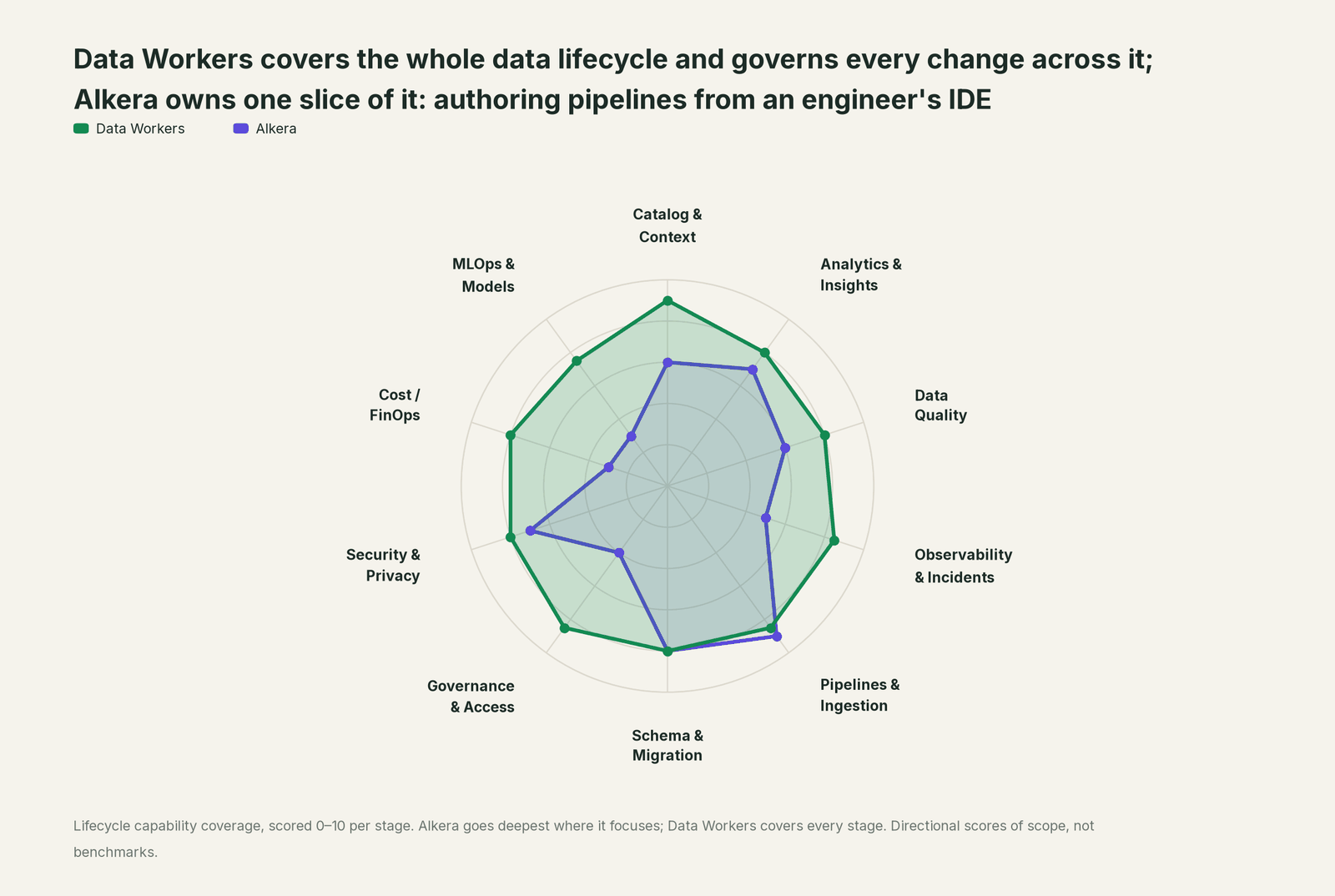
| Stage | Data Workers | Alkera | Why we scored it this way |
|---|---|---|---|
| Catalog & Context | 9 | 6 | Alkera keeps a project-scoped knowledge base with trust and stale-source flags; team sharing is off by default. Data Workers keeps one context graph across every platform. |
| Analytics & Insights | 8 | 7 | Alkera has graph-planned notebooks with CPU and GPU cells; its docs list BI plugins as coming soon. Data Workers answers questions over the same governed graph. |
| Data Quality | 8 | 6 | Alkera's Review sub-agent checks nulls, duplicates and fan-out; scheduled tests are on its product page. Data Workers writes, runs and repairs checks behind approvals. |
| Observability & Incidents | 8.5 | 5 | Alkera's site describes detection and root-cause analysis; its docs don't cover them. Data Workers opens the incident, traces it and proposes the fix. |
| Pipelines & Ingestion | 8.5 | 9 | Alkera's home stage: effect-gated authoring in the CLI and IDE, with dbt and Airflow plugins. Data Workers proposes pipeline changes as approval-gated diffs for the owner to merge. |
| Schema & Migration | 8 | 8 | Level on blast radius: Alkera rates column-level changes as breaking or not. Data Workers adds DAGs and BI, and plans legacy migrations in waves. |
| Governance & Access | 8.5 | 4 | Alkera governs its own agent: effect classes, approval modes, Member and Admin roles. Data Workers proposes least-privilege grants on your platforms. |
| Security & Privacy | 8 | 7 | Alkera keeps secrets out of the agent's context and offers self-hosted installs. Data Workers adds a privacy check on pull requests and an audit trail across every agent. |
| Cost / FinOps | 8 | 3 | Alkera budgets model spend per member. Data Workers traces Snowflake credits to the query and dbt model behind them and drafts the fix for its owner. |
| MLOps & Models | 7.5 | 3 | Alkera runs GPU notebook cells. Data Workers keeps the data under models healthy and connects to MLflow and W&B. |
These are directional scores of scope, not benchmarks. For autonomy-level grading with a citation on every cell, see the scorecard.
Alkera vs Data Workers on the outcomes a platform owner buys
The lifecycle view shows breadth. This view scores eight outcomes a platform owner pays for. Alkera leads on two: help inside one engineer's IDE and pipeline authoring. Data Workers leads on the other six.
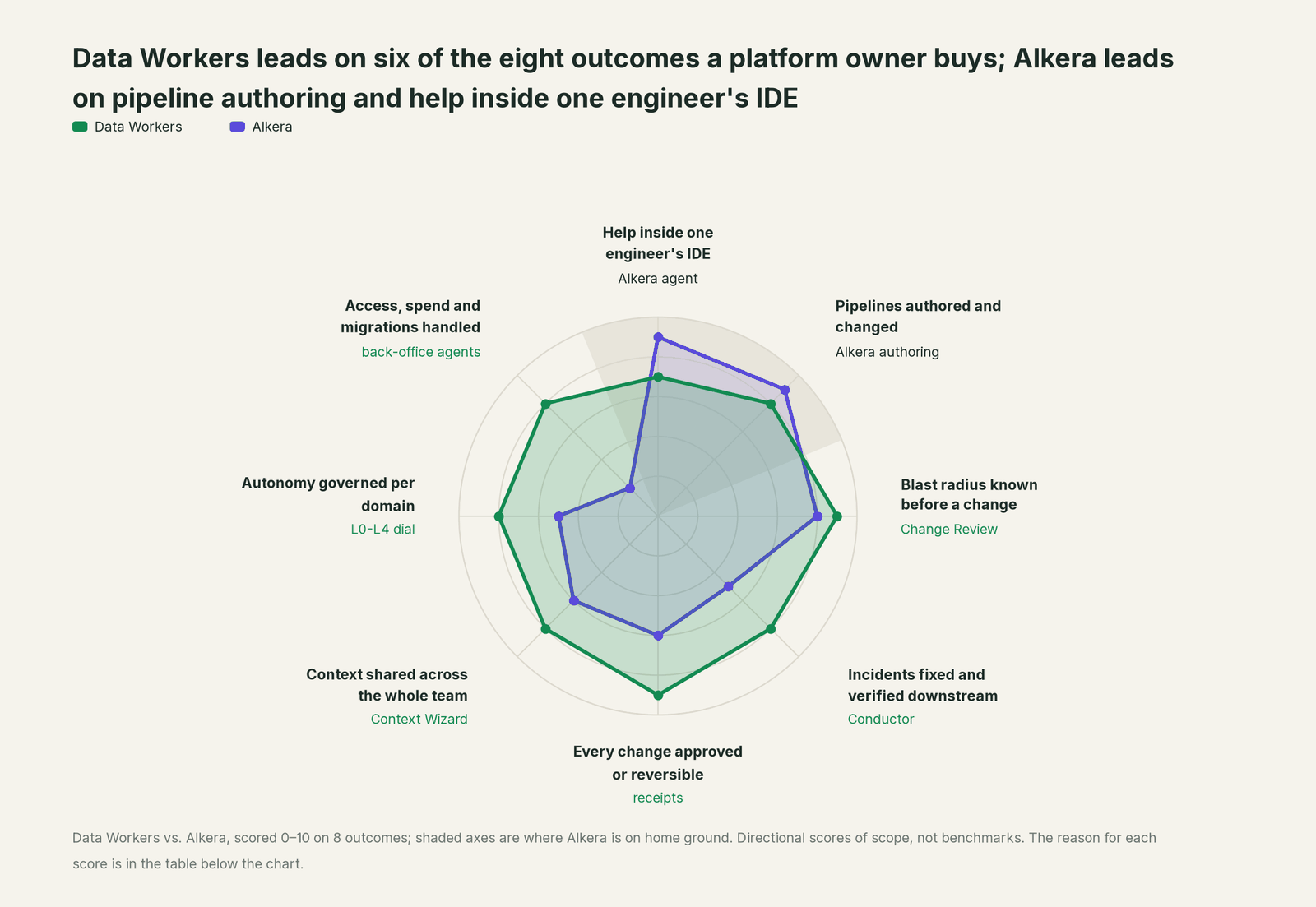
| Outcome | Data Workers | Alkera | Why we scored it this way |
|---|---|---|---|
| Help inside one engineer's IDE | 7 | 9 | Alkera's home turf: an agent in the CLI and IDE extension that parses every statement before it runs. Data Workers reaches the IDE through your coding agent over MCP. |
| Pipelines authored and changed | 8 | 9 | Alkera writes and applies changes with effect-gated approvals and a Review sub-agent. Our Pipeline Building agent proposes changes as approval-gated diffs for the owner to merge. |
| Blast radius known before a change | 9 | 8 | Alkera rates column-level impact in the project it was opened in. Our Change Review agent also reaches other teams' models, Airflow DAGs and dashboards. |
| Incidents fixed and verified downstream | 8 | 5 | Alkera's self-healing flow is on its product page; its docs and changelog don't cover it. The Conductor traces, proposes the fix and checks downstream after approval. |
| Every change approved or reversible | 9 | 6 | Alkera asks before writes, and Bypass mode approves everything; no rollback is documented. Every Data Workers change is approved or reversible and leaves a receipt. |
| Context shared across the whole team | 8 | 6 | Alkera's knowledge base is project-scoped and team sync is off by default. The Context Wizard keeps one graph with source and time on every fact. |
| Autonomy governed per domain | 8 | 5 | Alkera's docs set approval modes per session; its site adds org caps for self-healing. We set autonomy per domain for every agent, and none can approve its own work. |
| Access, spend and migrations handled | 8 | 2 | Warehouse cost, access requests and migration don't appear in Alkera's docs or site. Our Access, Cost and Migration agents propose changes behind approvals. |
The scores measure scope (what each side covers), not answer quality. They're our directional judgments, and we've shown the reasoning for every line.
Where Alkera stops
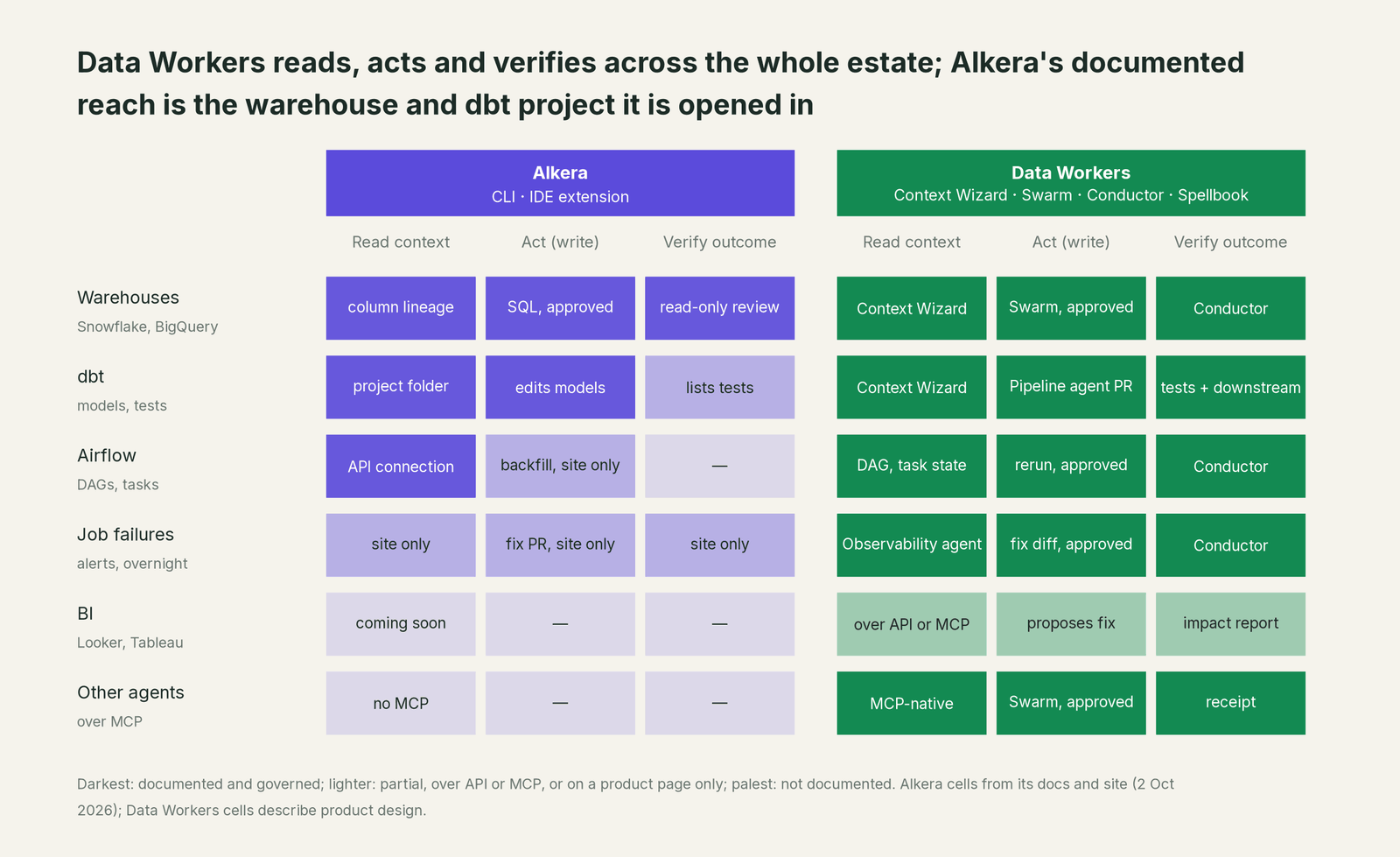
Each point below comes from Alkera's own documentation or product pages, checked on October 2, 2026.
State lives in the project. Connections, chats, results and knowledge belong to a project and sit in a .alkera/ directory that its install guide says never to commit. Team knowledge sync needs both an org switch and a project switch, and it shares team entries, not the generated catalog. A second team's dbt project is a second, separate graph.
Lineage refreshes when asked. dbt, DuckDB and SQLite are re-read when their files change. Warehouse lineage refreshes when someone triggers it or schedules a refresh job, because Alkera chooses not to spend warehouse money keeping the graph fresh. That's a sensible default for one engineer, and a gap for an estate.
Approvals are set per session in the docs. An UPDATE or DELETE without a WHERE clause escalates to Destroy, which prompts a human in every mode except Bypass. Alkera's self-healing page adds per-action settings and org caps; the docs don't describe them.
No documented rollback. Alkera defines Write as "changes state, recoverable" and describes no recovery step. Its self-healing page leans on testing a patch in an isolated copy and gating the merge.
The back office isn't in scope. Access provisioning, warehouse cost work and legacy migration don't appear in the docs or on the site. BI plugins are "coming soon" in the docs.
No MCP. Alkera documents no MCP server or client. Other agents can't call it, and it can't call theirs.
Why doesn't Alkera just do this itself?
Because it's built to be a great agent for one engineer, and that design is right for that job.
Alkera's choices all point the same way. State lives in a project folder, so an engineer can open a repo and start without anyone provisioning anything. The agent connects as the engineer, so the warehouse's own grants apply unchanged. Lineage doesn't poll the warehouse, so a laptop session never runs up a bill. Sub-agents are read-only helpers to one main agent. Every one of those is a good decision for an authoring tool, and its effects model is one of the most careful we've read.
Running writes to production across a whole estate is a different product. It needs blast-radius scoping across systems the engineer never opened, approvals that a platform owner sets for every agent and person, rollback for the agents that act, receipts that an auditor can read, and live context about every other system: the other team's dbt project, the DAG, the dashboard, the grants. It also means taking responsibility for changes in tools Alkera doesn't own. Alkera's self-healing page shows it heading toward part of that. Building the rest means becoming a platform with a control plane, which is a different company bet.
That platform is the product Data Workers is. We built the control plane first, and every agent, ours or yours, plugs into it.
Where the two overlap
| Job to be done | Alkera | Data Workers | What we recommend |
|---|---|---|---|
| Writing a new model or pipeline | Agent in the CLI or IDE | Pipeline Building agent, as an approval-gated diff for the owner to merge | Keep Alkera in the IDE if engineers like it |
| Blast radius before a change | Column-level, inside the project | Change Review across projects, DAGs and dashboards | Data Workers for the platform view |
| Reviewing the change before merge | Review sub-agent in the author's session | Data Change Review agent on the PR | Both; Data Workers reviews every author's PR |
| Team knowledge and conventions | Project knowledge base | Context Wizard graph, estate-wide | Data Workers |
| Data quality tests | Review checks; scheduled tests on its product page | Quality rules, anomaly detection, repairs | Data Workers |
| Detecting a failure overnight | Described on its product page | Observability and Incidents agents | Data Workers |
| Fixing and verifying an incident | Described on its product page | Conductor proposes, a human approves, checks run downstream | Data Workers |
| Undoing a change | Not documented | Approved or reversible, with a receipt | Data Workers |
| Access requests | Not documented | Access & Governance and Identity agents | Data Workers |
| Cost cleanup | Per-member model budgets | Cost Savings & Data Cleanup agent | Data Workers |
| Migrations | Not documented | Data Migration agent | Data Workers |
| Audit evidence | Org audit log of role and model changes | Receipts for every change on every system | Data Workers |
What it costs
Alkera doesn't publish pricing as of October 2026. Enterprise features (self-hosting, SSO and SCIM, the org audit log) are sold through sales, and its Enterprise page describes a monthly budget per member. Ask Alkera how usage is metered before you model a team rollout.
Data Workers publishes its rate card. The Apache 2.0 core is free. A pilot is $7,500 one-time. Scale starts at $1,000 a month and Enterprise at $3,000 a month, billed annually. Seats are unlimited, there's no usage meter, and there's no markup on model spend because you bring your own model. See pricing for what each plan includes.
The fastest first win: Change Review on every pull request
Turn on the Data Change Review agent for every dbt pull request, including the ones Alkera opens. It runs propose-only, so it changes nothing. It shows what a project-scoped graph can't: the other teams' models, the DAGs and the dashboards each change reaches. Engineers keep their IDE and their agent.
The second step is failed and late loads in one domain, in propose mode. Each incident lands in the Spellbook inbox with the root cause, the proposed fix and its blast radius. When your team has approved those proposals unchanged for a few weeks, move that domain up a level. The autonomous data platform playbook covers the full sequence.
What each Data Workers product adds
Autonomous Data-Conductor. The orchestrator that owns an outcome: detect, diagnose, fix, review, verify and remember. It scopes the blast radius before anything changes, routes the fix to the right agent and checks the result downstream after approval.
Data-Agents Swarm. 20+ specialist agents. Next to an authoring agent, the ones that matter most are the Data Change Review agent, the Pipeline Building agent, the Incident Debugging agent, the Schema Evolution agent, and the back-office agents: Data Access & Governance, Cost Savings & Data Cleanup and Data Migration. The cost agent's 25 to 40% spend reduction and the migration agent's 4 to 8 week timeline are design targets.
Data Context Wizard. One governed graph across warehouses, dbt, orchestration and BI. Snowflake, BigQuery, Databricks and dbt connect natively; Looker and Tableau connect over their API or MCP today. Every fact carries its source, author, confidence and observed time.
Spellbook Data Catalog. The control plane for agent work, in preview. Every proposed change from every agent lands in one inbox, asset pages cover the whole estate, and an authority guard enforced in code stops any agent from approving its own work.
Autonomy guardrails and security
Alkera handles agent risk inside the session, with a mode the engineer chooses. Data Workers handles it at the platform, with autonomy the platform owner sets.
- •Autonomy is set per domain, on the ladder from L1 observe through L2 propose and L3 reversible action to L4 autonomous.
- •New deployments start observe-only. You extend autonomy one domain at a time as the receipts earn trust.
- •Every write is scoped before it runs, with blast radius computed across platforms. Anything irreversible needs a named human to approve it.
- •Every change is approved or reversible and leaves a receipt: what changed and where, who approved it, the checks that ran and whether they passed, and when.
- •No agent can approve or promote its own work. The guard sits in the write path, enforced in code.
- •Least privilege. Data Workers acts with the grants you give it, through each platform's own permission system.
"Our engineers already have an agent that asks before it writes"
If the agent is Alkera, it knows the project's lineage, parses what it's about to run and asks before it destroys anything. That's real care, and we'd keep it.
It still answers to the engineer who opened it. Five engineers running five careful agents give you five project graphs, five sets of approval settings and no single place to see, approve or undo what changed. Nobody sets autonomy for the estate, and the next agent can't read what the last one learned.
Data Workers is that place. It takes what your engineers ship, from any agent, and runs the loop around it: review before merge, detection overnight, a fix at the source, a check downstream and a receipt. Every Data Workers agent is an MCP server, so your team reaches it from the coding agent they already use.
How it fits together
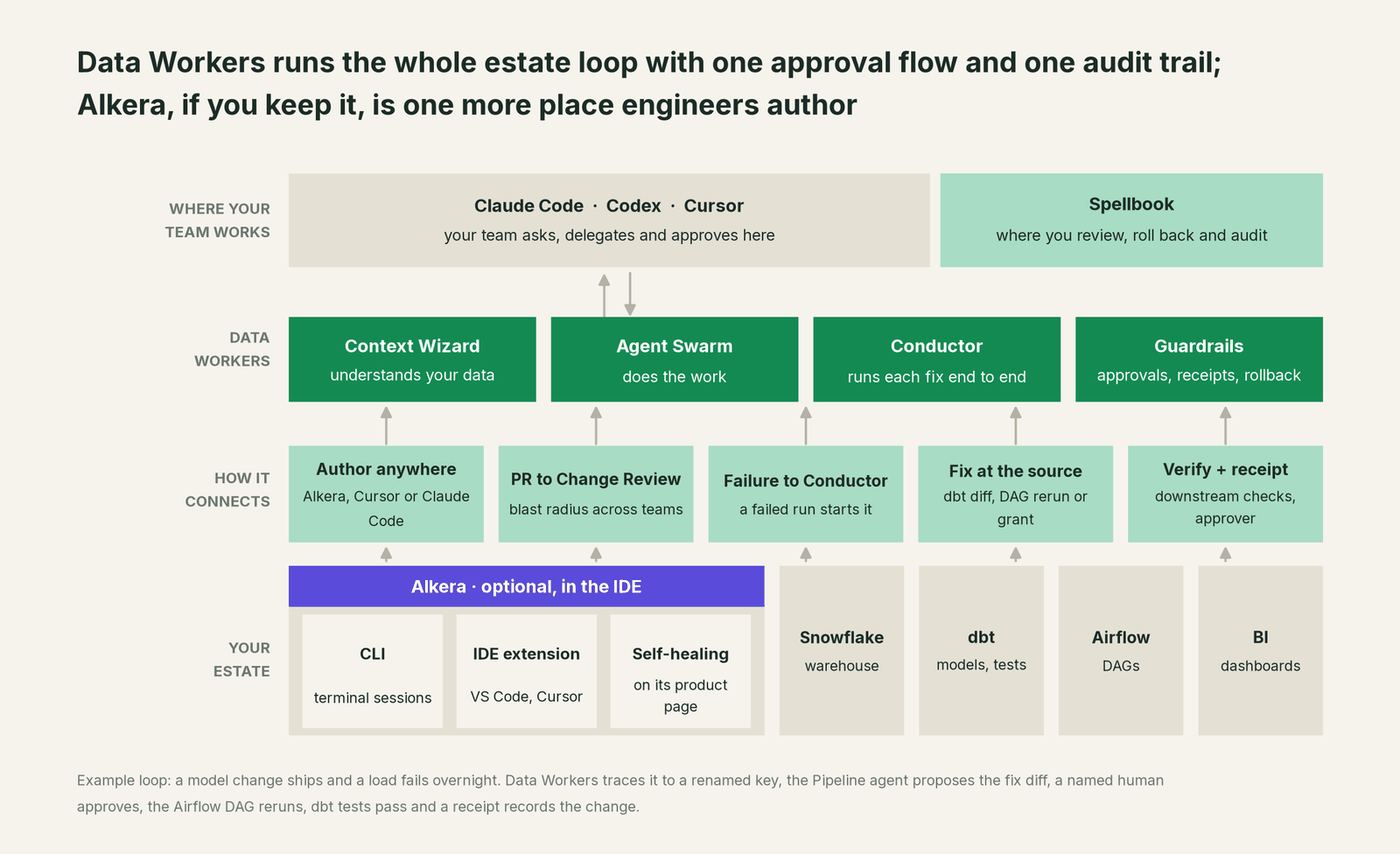
Nothing changes about where your engineers write code. Connect Data Workers to your warehouses, dbt projects and orchestrator; there's no migration. Every agent starts observe-only, and the first thing you see is the blast radius of this week's pull requests across the estate. For teams evaluating authoring agents side by side, see how Data Workers compares with Altimate and Recce. For the wiring on specific tools, see Data Workers with dbt, Data Workers with Airflow, and the platform guides for Snowflake and Databricks.
When Alkera alone is enough
If you're a small team on a young estate, the only bottleneck is writing SQL, and incidents, access, cost and migration belong to someone else, an authoring agent covers it. Data Workers is built for the team that owns what happens after the merge, across every project and every system.
The case for your CFO
The outcome. Your engineers will keep adopting agents; that's the direction of the whole data engineering category. The business outcome Data Workers buys is that you can say yes to all of them: one queue and one audit trail for every change any agent makes, so a bad change is caught at review instead of on the revenue dashboard.
The risk story. At L1 agents only observe. At L2 they propose and a named human approves. At L3 they take reversible actions in the domains you choose, and L4 is fully autonomous where you've decided it's safe. Anything irreversible always needs a person. Every change leaves a receipt with what changed, where, who approved it and which checks passed. There's no migration: Data Workers connects to the warehouse, dbt and Airflow you already run.
Why now. Point agents are adding their own control planes: hosted workers, Slack approvals, org caps and budgets, each in its own console. Choose the control plane before every tool brings its own.
The first win. Change Review on every pull request, propose-only, in the first weeks.
What stays the same. Your warehouse, dbt, Airflow and BI. Engineers keep their IDE and their agent, Alkera included, and the coding agent stays the way in.
The pilot path. Start with a pilot (pricing). The $7,500 pilot is credited in full against the first year.
The sentence to repeat upstairs: "Alkera makes each engineer's change safer; Data Workers makes the estate safer, with one context graph, one approval inbox and one audit trail across every agent and every system."
FAQ
What is the Alkera alternative for a platform team? Data Workers. It covers authoring through approval-gated diffs, then governs everything around the change: review across projects, incidents traced and fixed with one approval, access, cost, migration and receipts. Engineers can keep Alkera in their IDE.
Alkera now describes self-healing pipelines. Doesn't that close the gap? Its product page describes detection, root-cause analysis, isolated testing and a PR per fix on hosted workers. Its docs and changelog don't cover the flow yet as of October 2, 2026, so ask for them. Then ask whether the loop reaches other teams' projects, BI, access and warehouse cost.
Alkera asks before anything destructive. Why do we need more? It does, per session or per project setting. The platform question is who sets those rules for every agent, where every proposed change lands, and how you undo one. Data Workers answers all three in one place.
Can we keep Alkera and add Data Workers? Yes. Data Workers reviews every PR against the estate, whoever or whatever wrote it, and runs the loop after the merge. The two meet in git and in the warehouse. There's no Alkera connector to install.
Does Data Workers act on its own? Only as far as you allow, per domain. New deployments start at observe, and fixes are proposed for a named human to approve until you move a domain up the ladder.
How much does Data Workers cost? Scale from $1,000 a month and Enterprise from $3,000 a month, billed annually, with a $7,500 one-time pilot. Seats are unlimited and there's no usage meter. See pricing.
Is Data Workers open source? The core is Apache 2.0 and free to run, and each agent is an MCP server. The platform adds the Conductor, governed writes and Spellbook.
Sources
Sources for Alkera capabilities and statuses, current as of October 2, 2026: the docs index, docs home, installation, quickstart, changelog, agent and tools, plugins and connections, lineage, knowledge base, teams, the homepage, self-healing pipelines, column-level lineage, knowledge base feature page, Enterprise, the trust center, the sitemap, the Open VSX listing and the YC launch post. Data Workers: our Alkera scorecard and pricing. Product names and statuses change quickly; if we've got something wrong, tell us and we'll fix it.