The agentic data platform for media and advertising data teams
How Data Workers keeps impression, click and attribution data right for partner billing, checks the suppression data behind every audience, guards clean room tables, and leaves a receipt on every change.
For a media or ad-tech data team, Data Workers, the agentic data platform, keeps impression, click and attribution data right from the event stream to the partner invoice: its agents catch duplicated or late logs, trace what they reach and propose the fix before the delivery report or the billing close reads them. The same agents keep suppression tables fresh, turn a failing suppression test into a diagnosed incident, and check that the tables you share in clean rooms stay what partners expect, under a named person's approval, with a receipt on every change.
Media runs on counts two companies must agree on: a publisher's impressions are an SSP's revenue and an advertiser's invoice.
Key takeaways
- •Impression and click data that reconciles. Uniqueness and volume checks and lateness baselines on the tables behind delivery reports and invoices, with a diagnosed incident and a proposed fix before partners see the numbers.
- •Suppression data under watch. Suppression tables get freshness SLAs, and a failing suppression test the owner reports becomes a diagnosed incident with its lineage to every audience.
- •Clean room tables that don't surprise partners. A column change on a table shared through Snowflake Data Clean Rooms, AWS Clean Rooms or LiveRamp is found, with its impact, before the collaboration reads it.
- •Controls mapped to the rule's text. Named approvals, scoped access, privacy checks on pull requests and a tamper-evident audit trail line up with CCPA/CPRA, GDPR and the amended COPPA Rule; your privacy team decides what satisfies each rule.
- •Nothing migrates. Kafka, the warehouse, dbt, Airflow and Looker stay put; the agents run in your infrastructure.
The media and ad-tech data reality
A typical estate runs an ad server and the platforms around it (Google Ad Manager, Magnite, The Trade Desk), a consent platform writing TCF or GPP strings (OneTrust, Sourcepoint), clean rooms (LiveRamp, Snowflake Data Clean Rooms, AWS Clean Rooms, InfoSum), and event streams through Kafka or Kinesis. Data lands in Snowflake, BigQuery or Databricks, is modelled in dbt on an Airflow schedule, and is read in Looker or Tableau, with MMM in Python on top.
The IAB's State of Data 2026 (Feb 2, 2026) says the systems used to measure marketing performance "are under strain", naming "Privacy regulation, signal loss, platform-embedded optimization, and fragmented data environments". AI adds a trust problem: in IAB research published Aug 21, 2025, "70% of marketers reported at least one AI incident" and "40% had to pause or pull ads".
What hurts:
- •Event volume and replays. Streams deliver at least once, so a restart or a late file means duplicates or gaps.
- •Partner billing reconciliation. Your ad server count, the SSP's report and the invoice must agree within tolerance.
- •Consent signal propagation. An opt-out signal has to reach the suppression table before the next audience build.
- •Clean room data contracts. A renamed column on a shared table breaks a partner's query template.
- •MMM inputs that drift, and children's data that needs retention limits.
Three use cases
1. Impression logs that reconcile with partners (worked example). Data Workers puts uniqueness and volume checks and recorded lateness baselines on the fact tables behind delivery reports and invoices (run_quality_check, get_anomalies, set_sla), watches the Kafka topics and Kafka Connect connectors that feed them for consumer lag and connector status, and traces any break across stream, warehouse and dbt with trace_cross_platform_lineage. Fixes arrive as a diff for the model owner to merge; raw-row cleanups are proposed for the owner to apply. Run it at L2 propose.
2. Suppression that holds before every audience build. Sourcepoint writes GPP strings and opt-out preference signals onto page events, a dbt model your team owns decodes them into a suppression table in Databricks, and a second model builds the audience published into an AWS Clean Rooms collaboration. By design, consent is recorded in your consent platform and decoded in your models; Data Workers checks the data that results. It puts a freshness SLA on the suppression table (set_sla), and when the owner reports a failing test such as "no suppressed ID in the audience", it becomes a diagnosed incident traced to every audience the table feeds, records what "opted out of sale or sharing" means with define_business_rule, and its pull request review flags new audience columns whose names or annotations look like emails, phone numbers, IP addresses or birth dates (it reads names, not values). This domain runs at L1 observe or L2 propose. Sourcepoint connects over its API today.
3. Clean room tables and measurement inputs that hold their shape. In Snowflake Data Clean Rooms, a data offering is "a live view of the source data, not a snapshot", and partners run JinjaSQL templates against it. Data Workers catches source-table changes in the dbt manifest diff and in pull requests, checks a proposed change with check_compatibility, and names the templates, MMM inputs and Looker Explores it reaches before anyone merges. The same checks cover tables you register for AWS Clean Rooms, which reads data "from that data's original location and applies built-in analysis rules", and the data you bring into LiveRamp Clean Room, whose July 2026 release notes (published Sep 2, 2026) add SHA-256 hashed MAIDs and phone numbers as identifier types for ID resolution, in limited release. Snowflake is a native integration; AWS Glue, AWS Clean Rooms and LiveRamp connect over their APIs today.
Worked example: a Kafka replay the night before the delivery report
This is an illustrative example. An ad-supported streaming service logs ad impressions from its players to a Kafka topic, ad_impressions. Kafka Connect sinks the topic into Snowflake, an Airflow DAG builds fct_impressions_daily in dbt at 02:00, a Looker schedule sends advertiser delivery reports at 06:00, and the monthly close reconciles the same table against the SSP's report. The delivery-and-billing domain is at L2 propose.
| Time | System | What happens |
|---|---|---|
| Fri 21:41 | Kafka Connect | A worker restarts; the sink re-delivers from the last committed offset |
| 21:44 | Data Workers | Consumer lag spike and recovery recorded on the topic |
| Sat 02:00 | Airflow + dbt | The DAG builds fct_impressions_daily; it succeeds |
| 02:14 | Snowflake | run_quality_check fails uniqueness on impression_id; get_anomalies flags volume above baseline |
| 02:19 | Data Workers | get_root_cause ties the duplicates to the re-delivered window, 21:41 to 22:20 |
| 02:23 | Data Workers | blast_radius_analysis: the 06:00 delivery report, invoice staging, the SSP reconciliation |
| 02:27 | Data Workers | Dedupe diff on the staging model proposed with dry-run counts and rollback; raw-row cleanup proposed |
| 02:28 | PagerDuty + Slack | The ad-data on-call is paged with the diagnosis and the proposal |
| 02:46 | Spellbook | The on-call reviews and approves; the model owner merges |
| 02:52 | Airflow | Data Workers queues the dbt rebuild; counts match the topic's distinct keys |
| 06:00 | Looker | Advertiser delivery reports send correct counts |
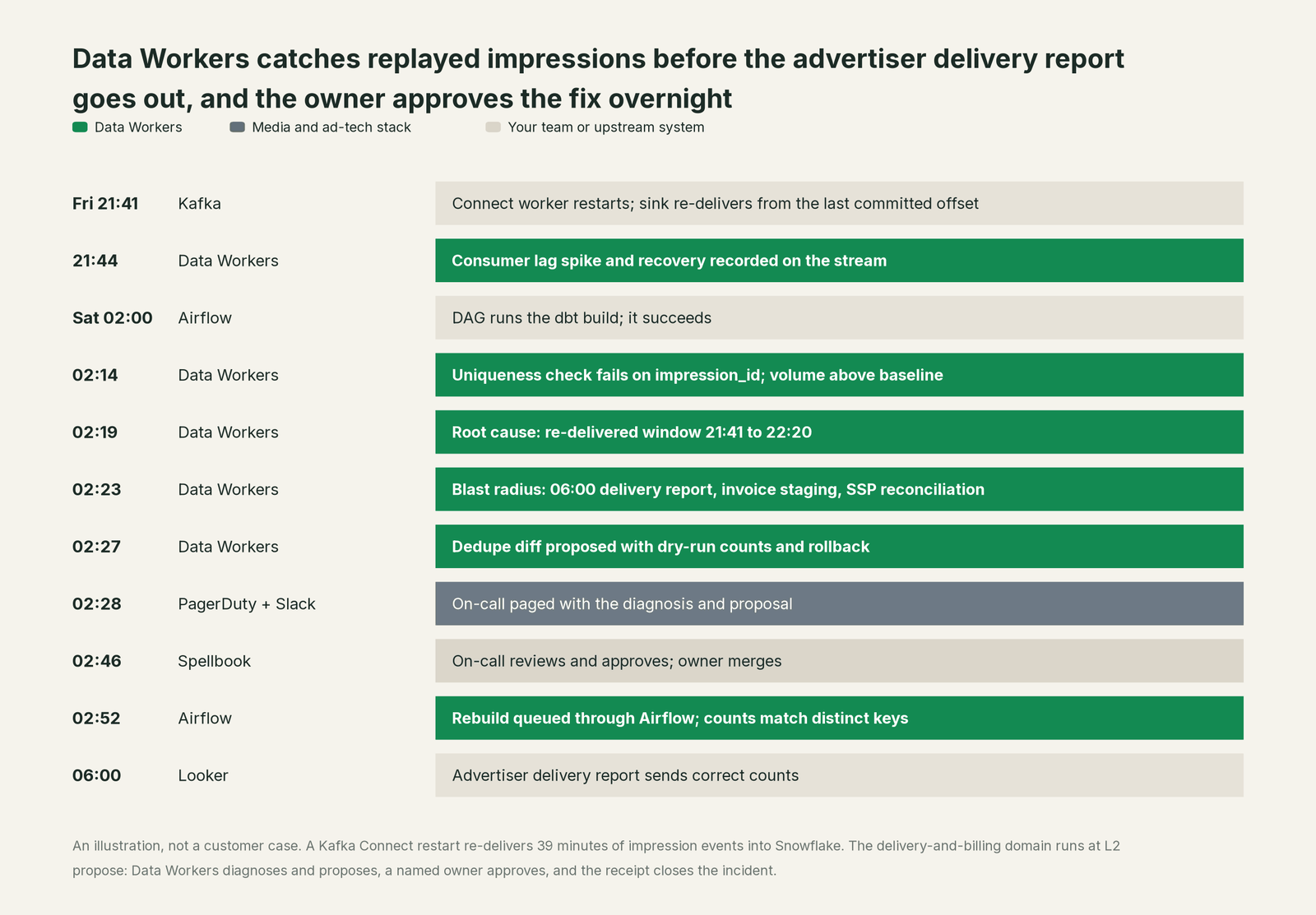
Without the agents, the delivery reports overstate Friday night's impressions and month-end turns up a discrepancy to explain to an advertiser. With them, the on-call approves one diff, and the receipt holds the diff, approver, lineage path and rollback plan. Every system in the example is a native integration. Data Workers on Snowflake, you're on Apache Kafka, you're on Airflow and Data Workers + dbt cover the wiring.
Governance and regulation
Compliance belongs to your controls, people and counsel; Data Workers supplies controls and evidence wherever agents touch data. Not legal advice.
CCPA/CPRA. Civil Code section 1798.120 gives a consumer the right "to direct a business that sells or shares personal information about the consumer to third parties not to sell or share" it. Under section 7025 of the CPPA regulations, a business that sells or shares personal information "shall process any opt-out preference signal" that meets the rule's requirements "as a valid request to opt-out of sale/sharing". The CPPA's updated regulations, effective January 1, 2026, add risk assessments, cybersecurity audits and rules for automated decisionmaking technology. Data Workers' side: freshness SLAs on suppression tables, suppression test failures diagnosed, lineage of personal data for the risk assessment, and an audit trail of every agent action.
State privacy laws. IAB Tech Lab's Global Privacy Protocol, designed "to streamline the transmission of privacy, consent, and consumer choice signals from sites and apps to ad tech providers", finalized state sections for Maryland, Indiana, Kentucky and Rhode Island after a public comment period that ended Dec 1, 2025. Each new section is a new field your models must decode; Data Workers checks the tables they produce on every load.
GDPR. Article 5(1)(c) limits personal data to what is "adequate, relevant and limited to what is necessary", Article 17 gives the right to erasure "without undue delay", and Article 21 lets a person object to processing for direct marketing. Data Workers erases a person from its own context graph with a tombstone in the audit chain, and lineage shows which of your tables hold the person's data for your erasure process.
COPPA. The FTC's amended rule, published Apr 22, 2025 and effective Jun 23, 2025, gives regulated entities until April 22, 2026 to comply with most changes. Section 312.10 allows keeping a child's personal information "for only as long as is reasonably necessary to fulfill the specific purpose(s) for which the information was collected" and requires "a written data retention policy". Data Workers' side: its pull request review flags new audience columns whose names or annotations look like birth dates or contact details, your team's classification tool or the data owner confirms them, lineage shows where data from kids' content flows, and access can require a stated purpose, recorded in the hash chain.
Where it runs and who approves. The agents run in your infrastructure on every tier with your credentials and model key; your data stays in your systems, and the hosted Autonomous Data-Conductor sees workflow metadata only (VPC or air-gapped, where does our data go?). provision_access scopes requests to the columns needed with a 90-day default expiry and routes anything that needs review to a named owner, and generate_audit_report exports the trail. Each domain sits on the ladder L0 manual, L1 observe, L2 propose, L3 act reversibly, L4 autonomous; approvals go to a named person, an unanswered request expires and escalates, and no agent can promote its own work (how approvals work, is it safe?). How Data Workers handles PII and SOX, HIPAA, GDPR and the EU AI Act cover the full mapping.
What changes for the media data team
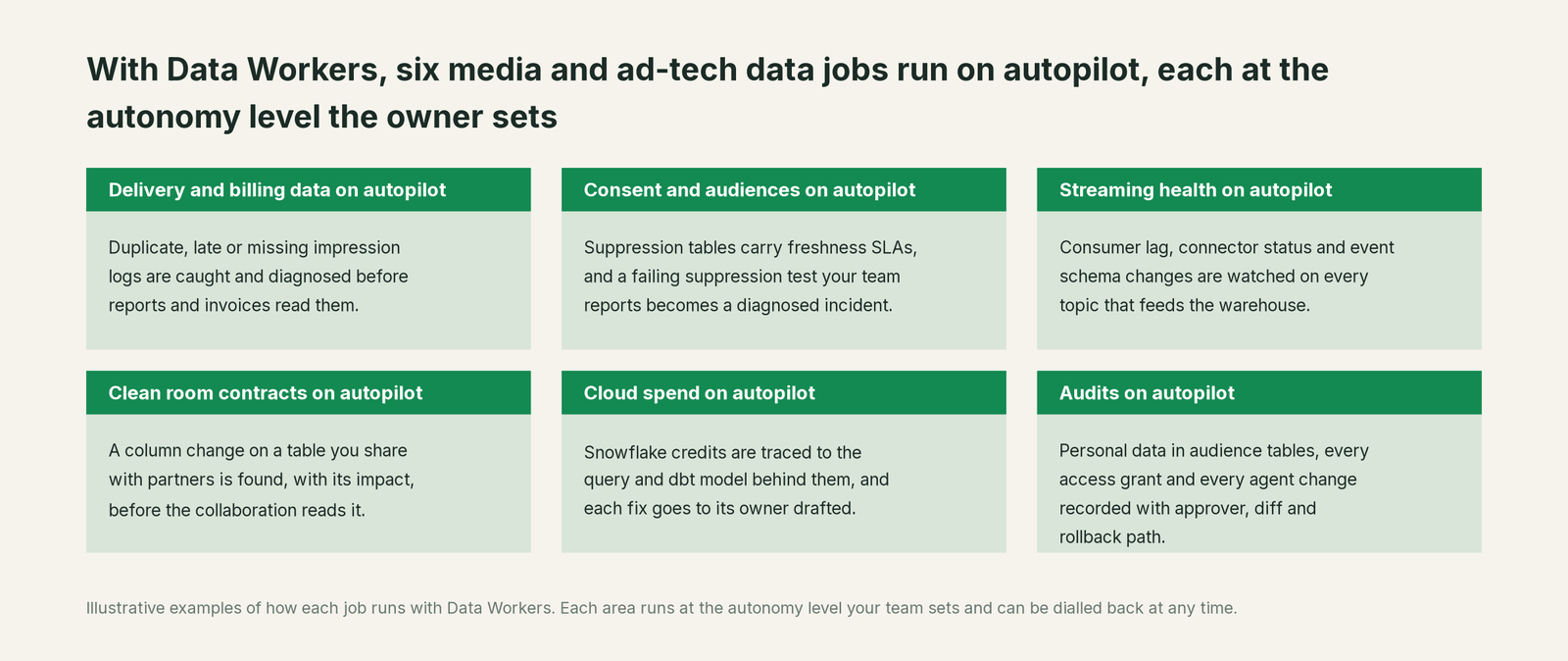
Six jobs move onto autopilot at the level each owner sets. People own the decisions: which domains climb the ladder, who approves, what counts as a billable impression and what "opted out" means (who owns the agents, autonomy levels L0 to L4, will Data Workers replace my data team?).
The alternatives media teams weigh
Build it yourselves. A strong team can wire a coding agent to MCP servers for Snowflake and dbt; the work is the approvals, blast radius, rollback and receipts around it (build it ourselves?).
Observability, catalogs and consent platforms. Observability is the smoke alarm, a catalog the inventory, a consent platform the record of choice. Data Workers is the crew that takes their signals, diagnoses, proposes the fix and verifies it (vs data observability, vs a data catalog).
Platform-native agents and clean rooms. Snowflake made its managed MCP server and Cortex Agents generally available on Nov 4, 2025, and Databricks made Genie One generally available on Jun 16, 2026. They are excellent inside their platform, as clean rooms are at governed collaboration. An impression crosses the player, Kafka, the warehouse, dbt, the clean room and the partner's report, and Data Workers works across all of them (on Databricks, you're on Looker).
The retail and e-commerce and SaaS and tech pages map the same controls to their own data, and AI for data infrastructure in media covers the category.
The case for your CFO
The outcome is revenue that reconciles. A replayed hour of logs overstates delivery, a dropped file understates it, and either ends in credits, makegoods or a dispute.
The risk story: at L2 propose every change waits for a named owner, raw-data cleanups are proposals your team applies, and every change carries a receipt.
Why now: the CPPA regulations took effect on January 1, 2026 and the amended COPPA Rule's main compliance date passed on April 22, 2026, so the evidence has to exist anyway.
The first win: uniqueness, volume and freshness checks with incident diagnosis on the delivery and billing tables for one month-end close, with nothing migrated.
Start with a pilot ($7,500 one-time, credited in full against the first year). Scale is from $1,000 a month and Enterprise from $3,000 a month, billed annually, with unlimited seats, no usage meter and no markup on model spend. See pricing, the ROI calculator and the ROI of agentic data operations. The sentence for upstairs: "Our impression, consent and partner data now has a crew that catches breaks before invoices and audiences read them, and every fix has a receipt."
FAQ
Can Data Workers read our Google Ad Manager, Magnite or The Trade Desk data? Yes. Data Workers watches the tables their logs and reports land in, and connects to the platforms over their APIs or MCP servers today. Snowflake, BigQuery, Databricks, Kafka, dbt, Airflow, Looker and Tableau are native among 50+ connectors; see Data Workers integrations and what is an agentic data platform?.
Will an agent delete duplicate impressions on its own? No. Data cleanups such as dedupes are proposed with dry-run counts for the owner to approve and apply. Model fixes arrive as a diff for the owner to merge.
Where does consent fit? By design, consent is recorded in your consent platform and TCF or GPP strings are decoded in your models, so each person's choice has one source of truth. Data Workers checks the data that results: freshness SLAs on suppression tables, any suppression test failure your team reports diagnosed, every check recorded.
Can it see inside our clean room collaborations? It watches the tables you share into them and the results you bring back, in your own warehouse and catalog. What partners can run stays governed by the clean room's own templates and analysis rules.
How does it help with event-volume cloud costs? The cost agent traces Snowflake credits to the query and dbt model behind them through query tags, sums recent BigQuery job bytes into an account-level total, and drafts warehouse settings and guardrails for the owner to apply after a dependency check. Savings of 25 to 40% are a design target; see how to measure AI data agents.
Sources
- •IAB, "State of Data 2026: The AI-Powered Measurement Transformation" (Feb 2, 2026): https://www.iab.com/insights/2026-state-of-data-report/ (checked Oct 2, 2026)
- •IAB, "AI Adoption Is Surging in Advertising, but Is the Industry Prepared for Responsible AI?" (Aug 21, 2025): https://www.iab.com/insights/ai-adoption-is-surging-in-advertising-but-is-the-industry-prepared-for-responsible-ai/ (checked Oct 2, 2026)
- •Snowflake, Overview of Snowflake Data Clean Rooms: https://docs.snowflake.com/en/user-guide/cleanrooms/overview (checked Oct 2, 2026)
- •AWS, What is AWS Clean Rooms?: https://docs.aws.amazon.com/clean-rooms/latest/userguide/what-is.html (checked Oct 2, 2026)
- •LiveRamp, July 2026 LiveRamp Clean Room Release Notes (published Sep 2, 2026): https://docs.liveramp.com/connect-2/en/july-2026-liveramp-clean-room-release-notes.html (checked Oct 2, 2026)
- •California Civil Code section 1798.120 (amended by Stats. 2024, Ch. 940, effective Jan 1, 2025): https://leginfo.legislature.ca.gov/faces/codes_displaySection.xhtml?lawCode=CIV§ionNum=1798.120 (checked Oct 2, 2026)
- •California Privacy Protection Agency, CCPA updates, cybersecurity audits, risk assessments, ADMT and insurance regulations (effective Jan 1, 2026), including approved text of section 7025: https://cppa.ca.gov/regulations/ccpa_updates.html (checked Oct 2, 2026)
- •IAB Tech Lab, Global Privacy Protocol: https://iabtechlab.com/gpp/ (checked Oct 2, 2026)
- •GDPR, Regulation (EU) 2016/679, Articles 5, 17 and 21, EUR-Lex: https://eur-lex.europa.eu/eli/reg/2016/679/oj (checked Oct 2, 2026)
- •Federal Trade Commission, Children's Online Privacy Protection Rule, 90 FR 16918 (Apr 22, 2025; effective Jun 23, 2025; compliance date Apr 22, 2026): https://www.federalregister.gov/documents/2025/04/22/2025-05904/childrens-online-privacy-protection-rule (checked Oct 2, 2026)
- •Snowflake, Snowflake-managed MCP server GA release note (Nov 4, 2025): https://docs.snowflake.com/en/release-notes/2025/other/2025-11-04-cortex-agents-mcp (checked Oct 2, 2026)
- •Databricks, Genie One launch press release (Jun 16, 2026): https://www.databricks.com/company/newsroom/press-releases/databricks-launches-genie-one-all-new-agentic-coworker-every-team (checked Oct 2, 2026)
- •Data Workers security page (last updated Sep 10, 2026): https://dataworkers.io/security/ (checked Oct 2, 2026)
- •Data Workers pricing: https://dataworkers.io/pricing/ (checked Oct 2, 2026)
- •Data Workers open-source repository, tool registrations: https://github.com/DataWorkersProject/dataworkers-claw-community (checked Oct 2, 2026)