The agentic data platform for retail and e-commerce data teams
How Data Workers keeps inventory, price, promotion and order data fresh and right through peak season, traces classified card and personal data to every copy, and leaves a receipt on every change.
For a retail or e-commerce data team, Data Workers, the agentic data platform, keeps inventory, price, promotion and order data fresh and correct through peak season: its agents catch the broken feed, trace what it reaches and propose the fix before the next storefront import. The same agents trace classified card numbers and personal data to every copy and check that opt-outs reach every audience, under a named person's approval, with a receipt on every change.
Retail runs on feeds: stock from the WMS, prices from the ERP, orders from the OMS, all read by the storefront. When one is wrong on Cyber Monday, customers see it before the data team does.
Key takeaways
- •Peak-season freshness, owned end to end. SLAs on inventory, price and promotion tables, schema changes caught in the dbt manifest diff and on every load's quality check, and a proposed fix before the next import.
- •PCI scope, kept honest. Once your team marks a column as card data, lineage shows every copy, and masking is proposed for the owner to apply.
- •Opt-outs that arrive on time. The suppression table gets a freshness SLA, and a failing opt-out test your team reports becomes a diagnosed incident.
- •Controls mapped to the rule's text. Named approvals, scoped access and a tamper-evident audit trail line up with PCI DSS v4.0.1, the CCPA regulations and GDPR; your compliance team decides what satisfies each rule.
- •Nothing migrates. Your commerce platform, ERP, warehouse, dbt and BI stay put; the agents run in your infrastructure.
The retail data reality
A typical estate runs a commerce platform (Shopify Plus, Salesforce Commerce Cloud, Adobe Commerce or SAP Commerce), an ERP (SAP S/4HANA, Oracle or NetSuite), POS, an OMS and a WMS such as Manhattan or Blue Yonder, with clickstream from GA4, Segment or Snowplow. Data lands in Snowflake, BigQuery or Databricks, is modelled in dbt, read in Looker or Tableau, and a CDP builds audiences.
The U.S. Census Bureau's estimate for the second quarter of 2026, as first released on Aug 18, 2026, put e-commerce at $340.2 billion, seasonally adjusted, up 12.2% from a year earlier while total retail rose 6.7%, and "17.1 percent of total sales". A Sep 28, 2026 notice on the release says revised estimates will be published on Nov 19, 2026.
What hurts:
- •Peak-season freshness. Black Friday shrinks the tolerance on inventory, price and promotion feeds to one load cycle; a stale available-to-sell table means false sell-outs or oversells.
- •Schema drift from releases. WMS, OMS and storefront teams ship on their own calendars, and a renamed field lands as a null column.
- •Opt-out propagation. A California opt-out has to reach the suppression table before the next audience build.
- •PCI scope creep. Customers paste card numbers into chat and order notes, and those strings follow support data into the warehouse.
- •Cost spikes and reconciliation. Clickstream volume pushes spend up at peak, and orders, returns and revenue must agree between the OMS and finance.
Three use cases
1. Peak-season inventory, price and promotion feeds. Data Workers sets quality SLAs on the tables the storefront reads (set_sla, run_quality_check), tracks their lateness against baselines the team records, catches schema changes in the dbt manifest diff, pull requests and quality-check profiles, and measures what a break reaches (assess_impact on the schema agent, blast_radius_analysis). When a feed breaks, diagnose_incident and get_root_cause find the cause, Data Workers proposes the fix as a diff for the model owner to merge, and create_jira_sm_ticket opens the Jira Service Management ticket. Run it at L2 propose through peak; the worked example below is this use case.
2. Card data where it shouldn't be. Support conversations from Zendesk land in Databricks through Fivetran, and a customer's card number rides along in a free-text column. The support lead reports it, trace_cross_platform_lineage finds every model and extract that copies the column, and request_governance_review opens a trackable review with the owner. Data Workers proposes a masking policy as a dry run; masking always needs approval, and your team applies it. This domain stays at L1 observe or L2 propose. Zendesk and Fivetran connect over their APIs today.
3. Opt-outs that reach every audience. Segment events land in Snowflake, a suppression table records opt-outs and Global Privacy Control signals, a dbt model builds the paid-social audience, and Hightouch syncs it to ad platforms. Data Workers puts a freshness SLA on the suppression table, turns a failing dbt test your team reports (no suppressed ID in the audience) into a diagnosed incident, records what "opted out" means with define_business_rule, and maps where personal data flows for your risk assessments. Recording the opt-out and running the sync stay with your consent platform and your team; Data Workers checks that what the sync sends is right. Segment and Hightouch connect over their APIs today.
Worked example: a WMS rename on Cyber Monday
This is an illustration, not a customer case. A retailer's inventory DAG in Google's Managed Service for Apache Airflow (called Cloud Composer until Apr 15, 2026) loads a Manhattan Active Warehouse Management export into BigQuery on a quarter-hour schedule. A dbt model, available_to_sell, feeds the Salesforce Commerce Cloud inventory import on the half hour and a Looker sell-through dashboard. The inventory domain is at L2 propose for peak.
| Time | System | What happens |
|---|---|---|
| Sun 22:00 | Manhattan WMS | A release renames on_hand_qty to on_hand_units in the DC export |
| Mon 00:15 | Managed Airflow | The DAG loads the file; on_hand_qty lands null |
| 00:16 | BigQuery + dbt | Data Workers flags a null spike on the SLA'd table |
| 00:18 | BigQuery + dbt | Rename found; impact: the 00:30 Commerce Cloud import and two Looker Explores |
| 00:21 | BigQuery + dbt | Model diff proposed with blast radius and rollback; Jira Service Management ticket opened with create_jira_sm_ticket |
| 00:24 | Spellbook | The inventory on-call reviews and approves |
| 00:26 | BigQuery + dbt | The model owner merges the diff |
| 00:27 | Managed Airflow | Data Workers queues the dbt rebuild; counts match Sunday by DC |
| 00:30 | Commerce Cloud | The import reads correct units; no false sell-outs |
| 00:31 | Spellbook | Receipt written and posted as a comment on the ticket; the on-call resolves it |
| 07:00 | Looker | The sell-through dashboard reads verified tables |
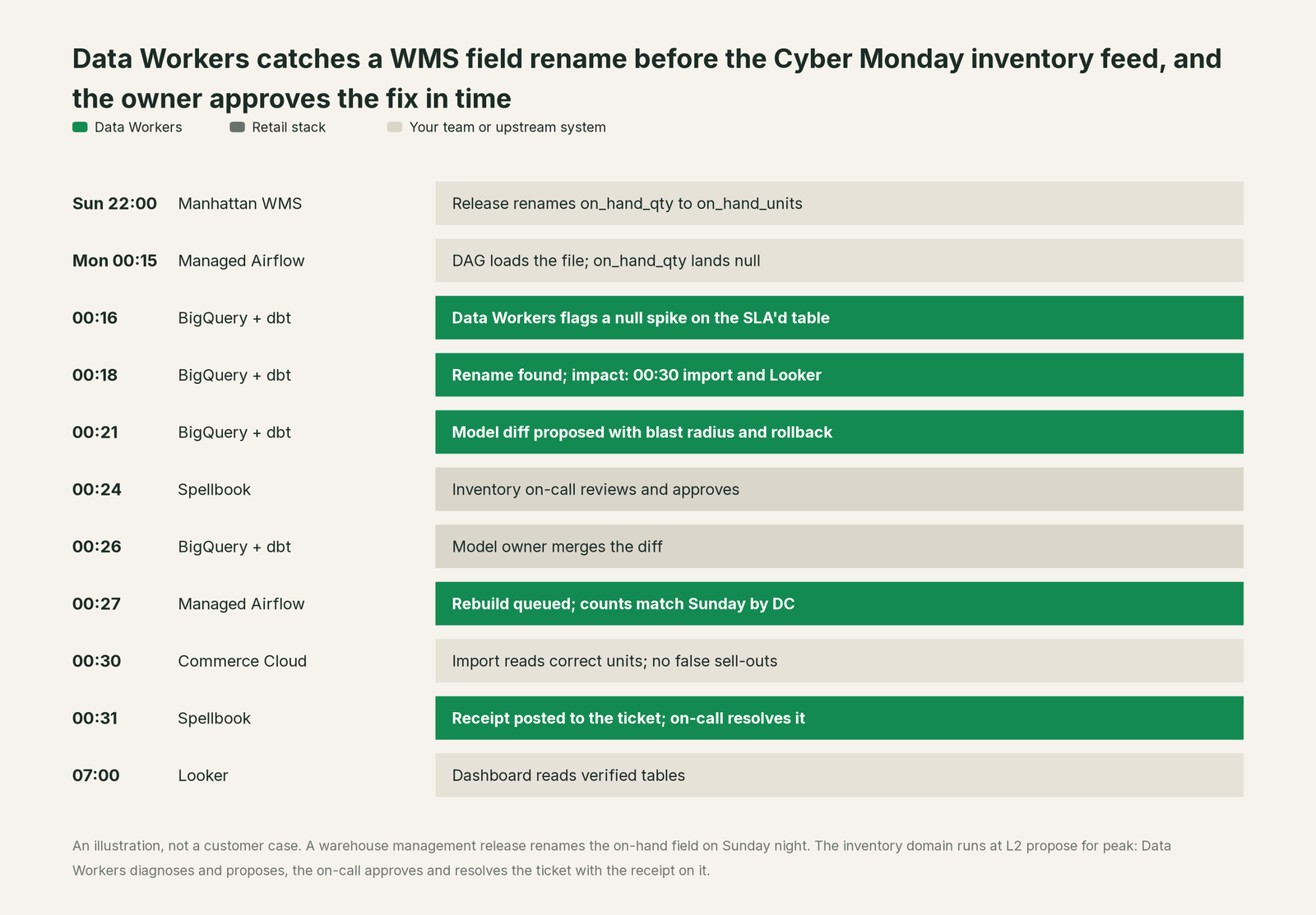
Without the agents, the 00:30 import publishes zero stock for every SKU in the affected DCs. With them, the on-call approves one diff, and the receipt records it. Manhattan and Commerce Cloud connect over their APIs today; BigQuery, Managed Airflow, dbt, Looker and Jira Service Management are native integrations. Data Workers on Google Cloud and Data Workers + dbt cover the wiring.
Governance and regulation
Data Workers doesn't make a retailer compliant; your controls, people and assessors do. It supplies controls and evidence where agents touch data. Not legal advice.
PCI DSS v4.0.1. The PCI Security Standards Council published v4.0.1 on Jun 11, 2024 as a limited revision with "no additional or deleted requirements", and confirmed it does not change "the 31 March 2025 effective date for the new requirements" introduced in v4.0. The standard asks you to protect stored account data (Requirement 3), restrict access by need to know (Requirement 7) and log and monitor access (Requirement 10). Data Workers' side: lineage shows every copy of a column your team marks as card data, provision_access scopes requests to the columns needed with a 90-day default expiry and routes anything that needs review to a named owner, and every agent action lands in a hash-chained audit trail that generate_audit_report exports.
CCPA/CPRA and the CPPA regulations. The California Privacy Protection Agency's updated regulations took effect on January 1, 2026, after approval by the Office of Administrative Law on Sep 22, 2025. They require "certain businesses to conduct risk assessments and complete annual cybersecurity audits" and implement consumers' rights to access and opt out of businesses' use of automated decision-making technology. Data Workers' side: lineage of personal data for the risk assessment, freshness SLAs on opt-out tables, and an audit trail of every agent action.
GDPR. For EU customers, Article 17 gives the right to erasure "without undue delay". Data Workers erases a person from its own context graph and writes a tombstone into the audit chain; erasure in your warehouse stays your process, and lineage shows which tables hold the person's data. How Data Workers handles PII and SOX, HIPAA, GDPR and the EU AI Act cover the full mapping, including SOX change management for listed retailers.
Where it runs and who approves. The agents run in your infrastructure on every tier with your credentials and model key; your data stays in your systems, and the hosted Autonomous Data-Conductor sees workflow metadata only (VPC or air-gapped, where does our data go?). Each domain sits on one ladder, L0 manual, L1 observe, L2 propose, L3 act reversibly, L4 autonomous; approvals go to a named person, an unanswered request expires and escalates, and no agent can promote its own work (how approvals work, is it safe?).
What changes for the retail data team
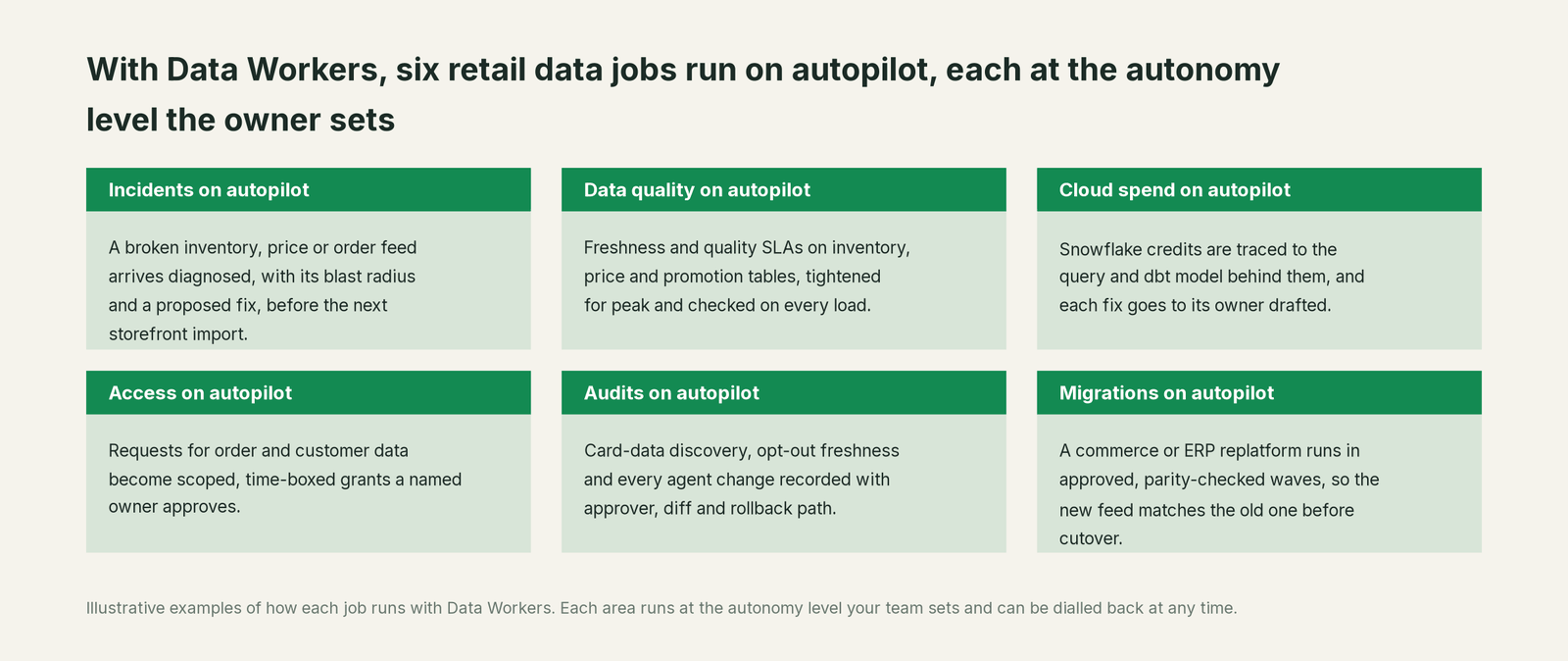
Six jobs move onto autopilot at the level each owner sets; the cost agent takes its numbers from Snowflake query tags and the BigQuery Jobs API. People still own the decisions: which domains climb the ladder, who approves, and what each business rule means (who owns the agents, will Data Workers replace my data team?).
The alternatives retail teams weigh
Build it yourselves. A strong team can wire a coding agent to MCP servers for BigQuery and dbt. The work is everything around it: approvals to the right owner, blast radius, rollback, receipts and context about every other system (build it ourselves?).
Observability, catalogs and consent platforms. Observability is a good smoke alarm, a catalog holds the inventory, and a consent platform records the customer's choice. Data Workers is the crew and the control plane: it takes their signals, diagnoses, proposes the fix, verifies it and leaves the receipt on the ticket for your team to close (vs data observability, vs a data catalog).
Platform-native agents. Snowflake made its managed MCP server and Cortex Agents generally available on Nov 4, 2025, and Databricks made Genie One generally available on Jun 16, 2026. They are excellent inside their platform. A retail feed crosses the WMS, orchestrator, warehouse, commerce platform and BI, and Data Workers works across all of them (on Snowflake, on Databricks).
The financial services and healthcare and life sciences pages map the same controls to their rules, and the guide to data governance for e-commerce covers GDPR, CCPA and peak season from the governance side.
The case for your CFO
The outcome is revenue that doesn't leak through bad data at peak. A stale inventory feed shows false sell-outs on the busiest day of the year, a wrong promotion price gives margin away, and a missed opt-out is regulatory exposure.
The risk story: at L2 propose every change waits for the on-call, masking is always a proposal your team applies, and every change carries a receipt with the diff, the approver and the rollback path.
Why now: e-commerce keeps growing faster than retail overall, and the CPPA's risk-assessment and cybersecurity-audit regulations took effect on January 1, 2026, so the evidence has to exist anyway.
The first win: freshness SLAs and incident diagnosis on the inventory and price feeds for one peak season, with nothing migrated.
Start with a pilot ($7,500 one-time, credited in full against the first year). Scale is from $1,000 a month and Enterprise from $3,000 a month, billed annually, with unlimited seats, no usage meter and no markup on model spend. See pricing, the ROI calculator and the ROI of agentic data operations. The sentence for upstairs: "Our inventory, pricing and consent data now has a crew that fixes breaks before customers see them, and every fix has a receipt."
FAQ
Can Data Workers watch our Shopify or Salesforce Commerce Cloud feeds? Yes. Data Workers watches the tables those platforms read and write in your warehouse, and connects to the platforms themselves over their APIs or MCP servers today. Snowflake, BigQuery, Databricks, dbt, Airflow, Google's Managed Airflow, Looker and Tableau are native among 50+ connectors; see Data Workers integrations and what is an agentic data platform?.
Will an agent change production data during our holiday freeze? Only at the level you set. Run inventory and pricing at L2 propose through peak, and the agents diagnose and propose while nothing changes until the named on-call approves. You can drop any domain to L1 observe for the freeze, and the org-wide stop halts all autonomous dispatch.
Does Data Workers put us in PCI scope? Your assessor decides scope. The agents run in your infrastructure with the access you grant, and the hosted Conductor never sees rows. Data Workers does not sample your tables for card numbers: its pull request review reads column names and annotations, not values. When your team or its classification tool finds card data outside your cardholder data environment, lineage shows every copy so your team can remove or mask it.
Can it push opt-outs to our ad platforms? The sync stays with your CDP or reverse ETL tool. Data Workers makes sure the suppression table is fresh and the audience is right before the sync runs, and records every check and change.
How does it help with Black Friday cloud costs? The cost agent traces Snowflake credits to the query and dbt model behind them through query tags and drafts warehouse settings and guardrails for the owner to apply after a dependency check. Savings of 25 to 40% are a design target; see how to measure AI data agents.
Sources
- •U.S. Census Bureau, Quarterly Retail E-Commerce Sales, 2nd Quarter 2026 (release CB26-133, Aug 18, 2026; special notice of revision dated Sep 28, 2026, revised estimates due Nov 19, 2026): https://www.census.gov/retail/ecommerce.html (checked Oct 2, 2026)
- •PCI Security Standards Council, "Just Published: PCI DSS v4.0.1" (Jun 11, 2024): https://blog.pcisecuritystandards.org/just-published-pci-dss-v4-0-1 (checked Oct 2, 2026)
- •California Privacy Protection Agency, CCPA updates, cybersecurity audits, risk assessments and ADMT regulations (effective Jan 1, 2026; OAL approval Sep 22, 2025): https://cppa.ca.gov/regulations/ccpa_updates.html (checked Oct 2, 2026)
- •GDPR, Regulation (EU) 2016/679, Article 17, EUR-Lex: https://eur-lex.europa.eu/eli/reg/2016/679/oj (checked Oct 2, 2026)
- •Data Workers security page (last updated Sep 10, 2026): https://dataworkers.io/security/ (checked Oct 2, 2026)
- •Data Workers pricing: https://dataworkers.io/pricing/ (checked Oct 2, 2026)
- •Data Workers product pages: https://dataworkers.io/product/autonomous-data-conductor/ and https://dataworkers.io/product/spellbook-data-catalog/ (checked Oct 2, 2026)
- •Snowflake, Snowflake-managed MCP server GA release note (Nov 4, 2025): https://docs.snowflake.com/en/release-notes/2025/other/2025-11-04-cortex-agents-mcp (checked Oct 2, 2026)
- •Databricks, Genie One launch press release (Jun 16, 2026): https://www.databricks.com/company/newsroom/press-releases/databricks-launches-genie-one-all-new-agentic-coworker-every-team (checked Oct 2, 2026)
- •Google Cloud, Managed Service for Apache Airflow release notes (Apr 15, 2026 entry: "Cloud Composer is evolving to become Managed Service for Apache Airflow"): https://cloud.google.com/composer/docs/release-notes (checked Oct 2, 2026)
- •Manhattan Associates, warehouse management solutions (Manhattan Active Warehouse Management): https://www.manh.com/solutions/warehouse-management (checked Oct 2, 2026)
- •Data Workers open-source repository, tool registrations: https://github.com/DataWorkersProject/dataworkers-claw-community (checked Oct 2, 2026)