One back office across Snowflake, Databricks and BigQuery
Many estates run two or three warehouses, and each vendor's own tools stop at the edge of their platform. Data Workers puts one set of agents, one set of standards and one audit trail across Snowflake, Databricks and BigQuery, and traces lineage between them.
Before and after
| Today | With Data Workers |
|---|---|
| A separate console, agent and rulebook for each warehouse | One set of agents across Snowflake, Databricks and BigQuery |
| Lineage that ends at the edge of each platform | Lineage traced across platforms, so a change in one is followed into the others |
| Standards written and chased separately per platform | One standard with a named owner, and a view of how far each domain meets it |
| An audit trail per vendor, stitched together for the auditor | One tamper-evident audit trail for every agent action |
| A move or sync trusted until a dashboard breaks | Tables compared across warehouses to confirm it did what it should |
Most estates end up with more than one warehouse: an acquisition, an AI team on Databricks, product analytics in BigQuery. The data work does not split along the same lines. A column change in one platform lands in a dashboard fed from another, and the person asking "what breaks?" has to open three consoles to answer. Choosing a native tool for each platform multiplies the back office instead of automating it. For the hands-on view, see Snowflake and Databricks lineage traced as one path.
How it works
1. Connect all three and see one estate
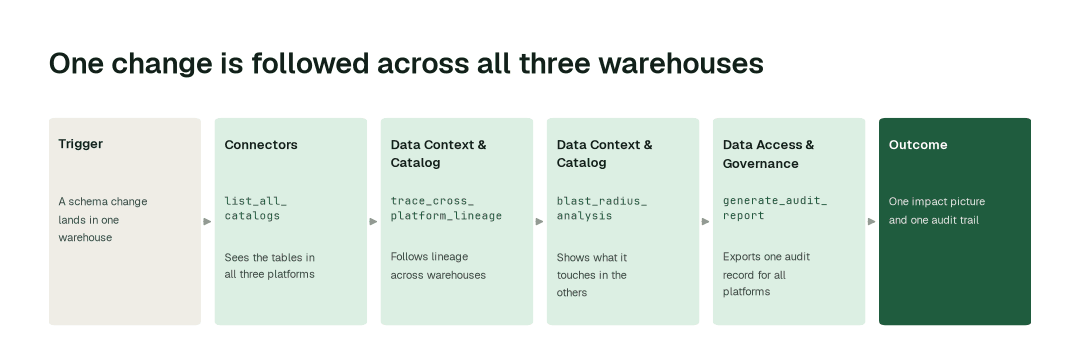
The Connectors Agent (list_all_catalogs) discovers what each platform holds, through list_snowflake_tables, list_databricks_tables and list_bigquery_tables. The Data Context & Catalog Agent (search_across_platforms) then finds every copy of a table across them. Each question runs inside the warehouse that owns the data, and nothing is copied into a new platform. The agents start by watching and suggesting.
2. Follow every change across platforms
The Data Context & Catalog Agent (trace_cross_platform_lineage) joins lineage from source through dbt and SQL to the dashboard, across warehouses. Before a change ships, blast_radius_analysis shows what it touches in the other platforms. The Data Context Wizard marks the authoritative table for each concept, so agents and analysts stop reading the wrong copy. After a move or a sync, a table is compared across warehouses to confirm it landed intact.
3. Hold every platform to one standard and one audit trail
Autopilot Standards let you write a rule once, with a named owner and exceptions that expire, and show per domain how far it is met. The Autonomous Data-Conductor coordinates the agents and shows in one view what each is doing and what waits for approval. Every action takes the same approval path, and the Data Access & Governance Agent (generate_audit_report) exports the evidence pack in one step.
The impact metrics we move
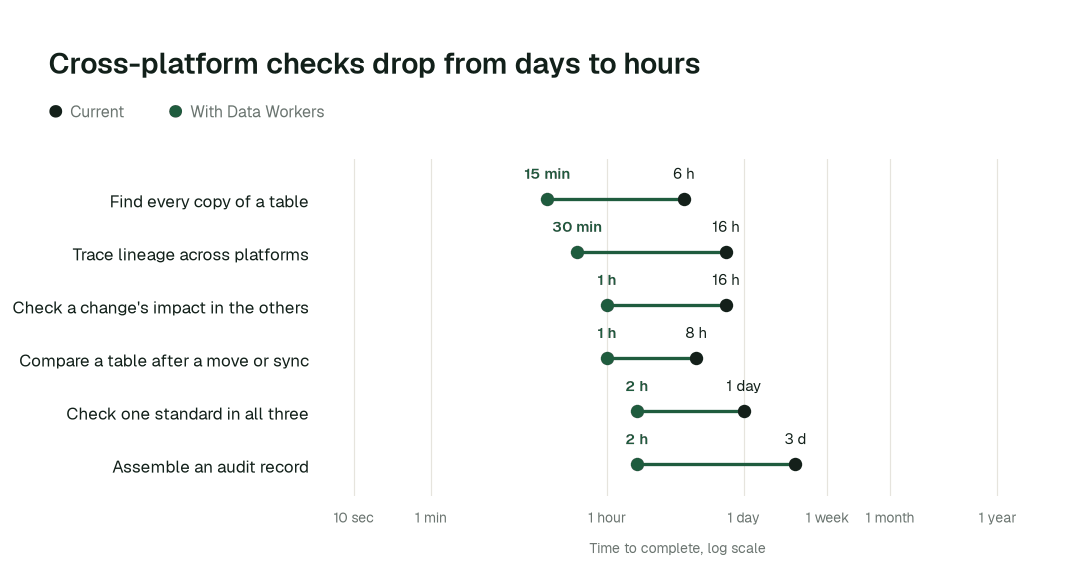
- •Impact check across platforms: from about 2 days to under 1 h
- •Table comparison after a move or sync: from about 1 day to 1 h
- •Audit record across platforms: from about 2 weeks to 2 h
Where teams start
- •Snowflake and Databricks side by side. Lineage and impact traced between the two for one shared domain.
- •BigQuery beside the core warehouse. Product or marketing analytics in BigQuery tied back to the models that feed it.
- •After an acquisition. Two estates, two stacks, one view of both before any consolidation.
- •A move or sync in flight. Tables compared across warehouses to confirm the move did what it should.
- •Usage and query history. Read from each platform side by side, to see where the work and the spend sit.
What powers it
The Data-Agents Swarm does the work. The Connectors Agent reads each platform, the Data Context & Catalog Agent traces lineage and impact, and the Data Access & Governance Agent produces the audit evidence. The Data Context Wizard holds the shared understanding of what each table means and which source is trusted. Autopilot Routines and Standards keep the upkeep running, the Autonomous Data-Conductor coordinates it, and the Spellbook Data Catalog records the result. You see this in data discovery, in post-acquisition transformation and in agent governance and audit.
The climb: from assisted to autonomous to agentic
Agents start by watching and suggesting: tracing lineage and drafting impact checks for people to read. On evidence, a domain can move to agents acting after approval, with a named owner raising the level. L0 to L2 run today; L3 and L4 are where a domain can go as its track record builds. See our thesis.
The pilot
- •Scope. Two of your three platforms and one domain that spans them.
- •First week. We connect read-only and confirm together what the agents can see on your warehouses. Agents start by watching and suggesting, and nothing changes.
- •By week two. Lineage, impact checks and table comparisons run on the shared domain, and a named approver signs off on anything that changes data.
- •At day 30. We review the impact metrics against your baseline:
- •Impact check across platforms: from about 2 days to under 1 h
- •Table comparison after a move or sync: from about 1 day to 1 h
- •Audit record across platforms: from about 2 weeks to 2 h
- •Cost. Start with a pilot ($7,500 one-time, credited in full against the first year). Scale is from $1,000 a month and Enterprise from $3,000 a month, billed annually, with unlimited seats, no usage meter and no markup on model spend. See pricing.
FAQ
Do we have to move data or pick one warehouse? No. Each question runs inside the warehouse that owns the data, and nothing is copied into a new platform.
Does it replace the tools each vendor ships? No. Your engineers keep using them. The agents cover the work that crosses platforms, which a single vendor's tools do not see. For where each vendor's tools stop, see what Data Workers adds on Snowflake, Databricks and Google Cloud.
Which stacks does it work with? Snowflake, Databricks and BigQuery, plus the dbt and Airflow estates around them, through 50+ connectors. Our three-way comparison covers how the platforms differ.
What if an agent is wrong? Every proposal shows the full change, what it would affect and how to undo it. If people start reverting an agent's changes, that domain pauses itself.
Who approves changes? The owner of each domain names the approver, and only that owner can raise how much the agents do on their own.