How pharmacy benefits data teams go fully agentic and autonomous
Going fully agentic and autonomous does not mean letting an agent send a rebate invoice or change a drug price. For pharmacy benefit data teams, it means climbing from agents that assist, to agents that keep claims, formulary, pricing and rebate data current and tied out under your governance, to a data back office that largely runs itself: landing the weekly pricing and NDC files, reconciling rebates to claims before the invoice goes out, keeping per-contract client reports correct and leaving the evidence plan sponsors ask for, while named approvers sign off on every invoice, price, client financial report and audit response. This is what that climb looks like, step by step.
Key takeaways
- •Who this is for. The data teams inside pharmacy benefit managers, health plans with in-house pharmacy and specialty pharmacies: the people who run pharmacy claims, formulary and pricing files, rebate and manufacturer invoicing, and the client and transparency reporting built on top.
- •The problem today. A pricing file changes every week, the NDC reference data moves under it, and a quarter of rebate invoicing then takes weeks to reconcile against claims. Client reports carry per-contract logic that nobody can fully see, and every plan sponsor audit or transparency request becomes a project, on data full of PHI.
- •What changes. Pricing and NDC files are checked on arrival and their impact on live claims logic and contracts is shown the same day. Rebate-eligible claims are tied to invoice units every morning, not once at quarter close. Client reports are checked against each contract's rules, and evidence for an audit comes from live lineage.
- •What stays with your people. Rebate invoices, client-facing financial reports, pricing changes and audit responses. Agents prepare the tie-out, the diff and the evidence; a named approver issues, changes and signs.
- •The result. A pharmacy benefits data team that spends its time on better client analytics and formulary insight, and can show where any number in an invoice or a report came from.
The PRD for agentic pharmacy benefits data teams
This is the requirements document we would write with you for your team. Everything below expands on it.
| Who | Pharmacy claims data, formulary and pricing data, rebate and contract analytics, client reporting and PBM analytics teams at pharmacy benefit managers, health plans with in-house pharmacy and specialty pharmacies |
| The job | Rebates tied to claims before the invoice goes out, and every price change traced before it reaches a claim. |
| Environment | A pharmacy claims adjudication platform and NCPDP claim files; eligibility and plan design data; NDC reference data, price compendium and MAC list files; rebate contract and invoicing systems; Snowflake or Databricks; dbt; Airflow or Dagster; Tableau or Looker; client portals and reporting packages. |
| Constraints | Rebate invoices, client-facing financial reports, pricing changes and audit responses always go to a named approver. Pharmacy claims are PHI. Client contracts define the logic, and the logic differs by client. |
| Success is measured by | Rebate reconciliation: from about 3 weeks to about a day; Weekly pricing file change checked: from about 6 h to 15 min; Audit evidence pack: from about a week to about 3 h; lineage and docs upkeep closed autonomously 87% of the time. |
| Owned by | A Head of PBM Data, with rebate finance, pricing and client reporting leads as named approvers. |
| Pilot scope | Rebate-to-claims tie-out for one manufacturer group and one quarter at L2. |
What going fully agentic and autonomous means for pharmacy benefits data teams
- •Put your data pipeline on autopilot. Weekly pricing files and NDC reference updates are landed, checked and mapped on arrival, so a changed price or a replaced NDC never reaches a claim, a contract line or a client report unseen.
- •Run the data back office without the busywork. The work that fills the week today moves to agents: diffing price files, chasing rebate variances between claims and invoices, and assembling lineage for every audit request.
- •Scale data without scaling headcount. A new client, a new manufacturer contract or a new specialty product arrives without the data team growing with it, because tie-outs, contract checks and documentation run on their own.
- •Get the plumbing off your plate. A pharmacy benefits data team that ships client analytics and formulary insight instead of reconciling the same rebate file one more quarter.
Who this is for
The data side of the pharmacy benefit. At a pharmacy benefit manager, it sits between claims operations, clinical and formulary teams, contracting and client service, and owns the pipelines behind adjudicated claims, formulary and price files, rebate invoicing and client reporting. At a health plan with in-house pharmacy, it is often a smaller group that does the same work for one book of business. At a specialty pharmacy, it ties dispensing, patient program and manufacturer data together.
The titles: Head of PBM Data, Director of Pharmacy Analytics, Rebate Analytics Lead, Formulary and Pricing Data Manager, Client Reporting Lead and the engineers who report to them. These teams do not decide what a drug costs or what a manufacturer owes. They make sure the people who do are working from data that is complete, current and explainable.
The shift
A pharmacy benefit moves on files. A price compendium and MAC lists change weekly, the FDA's National Drug Code Directory is updated daily, and claims follow the NCPDP Telecommunication Standard that pharmacies and processors use to adjudicate them. Rebates then depend on tying those claims, by NDC and by contract, to what a manufacturer is invoiced. The public Medicaid program shows the shape of the problem: manufacturers pay rebates to states on a quarterly cycle, and the quarter's invoice rests on utilization data that has to tie. Commercial rebates run on your own contracts, with your own terms.
Each link in that chain is a place for a quiet error. A replaced NDC falls off a contract line. A claim reversal posts after the invoice cut-off. A client's contract nets an admin fee differently from the next client's, and the report that shows it is built by hand. Agents are well suited to the unglamorous half of this problem. They can compare what the file, the claim and the contract each say, every day, across every client, and tell a named person when they differ. They should not decide what a rebate is owed, what a price should be or what a client is told. The line between the two is the design of this playbook.
The product you ship
- •Adjudicated pharmacy claims: paid, rejected and reversed claims by member, pharmacy, drug and date, delivered to analytics and reporting on time.
- •Formulary and pricing data: formulary status, tiers and coverage rules, plus price and MAC list history by NDC, versioned so you can show what was in force on a given fill date.
- •Drug reference data: NDC to product, labeler and package, with replaced and inactive codes tracked.
- •Rebate data: rebate-eligible claims by manufacturer, contract and quarter, the invoice files built from them and the dispute and payment history.
- •Client reporting: per-contract financial and utilization reports, guarantees and reconciliations that plan sponsors rely on.
- •Transparency and audit data: the lineage, definitions and change history behind every number a sponsor, auditor or regulator asks about.
- •Specialty pharmacy data (where you dispense): referrals, dispenses, patient program enrollment and manufacturer data-sharing files.
Where the week goes
- •The pricing file changes every week. A new price list lands, rows move, some NDCs drop out, and the question is which claims, contracts and client reports read the changed prices.
- •NDC reference data keeps moving. Products are replaced, repackaged and inactivated, and the old code still appears on claims.
- •Rebate reconciliation takes weeks. Claims, reversals, contract terms and invoice units are tied by hand, and a variance means chasing it back through every step.
- •Client reporting runs on per-contract logic. The same measure is calculated differently for each client, and the rules live in a mix of contracts, SQL and spreadsheets.
- •Sponsors and auditors ask for proof. Transparency and audit requests need a number traced from a report back to source claims, and the data team assembles it each time.
- •Definitions are contested. Gross cost, net cost, rebate share and guarantee each have a version in finance, client service and analytics.
- •PHI limits who can see what. Pharmacy claims identify members and conditions, so access requests are slow and every grant needs a record.
Add it up and upkeep is most of the team's week. Here is how a typical week splits today, and once agents own the back office:
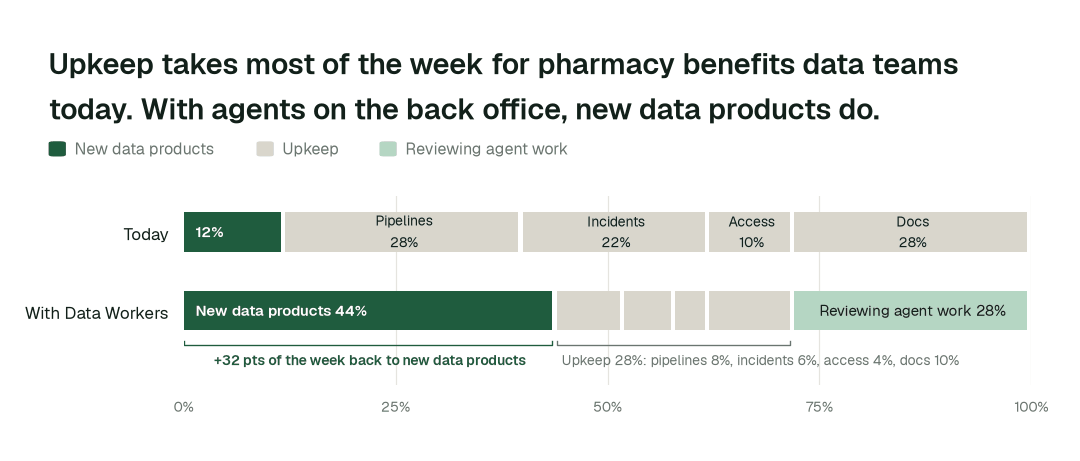
Time spent on new data products moves from 12% of the week to 44%. Most of the rest becomes review: people steer and approve agent work instead of doing it by hand.
Then and now
| Work | Today | With Data Workers |
|---|---|---|
| Weekly pricing file | Loaded and trusted | Checked on arrival, impact on claims logic and contracts shown |
| NDC reference update | Found when a claim fails to match | Mapped on arrival, replaced codes tied to contract lines |
| Rebate reconciliation | Weeks, at quarter close | Claims tied to invoice units every morning |
| Client report logic | Rebuilt per contract by hand | Checked against each contract's rules, differences flagged |
| Audit or transparency request | A project | Evidence generated from live lineage |
| Access to PHI | Tickets and spreadsheets | Scoped by role, every grant logged |
These are the impact metrics we move for pharmacy benefits data teams:
- •Rebate reconciliation: from about 3 weeks to about a day
- •Weekly pricing file change checked: from about 6 h to 15 min
- •Audit evidence pack: from about a week to about 3 h
Across the routine work in this domain:
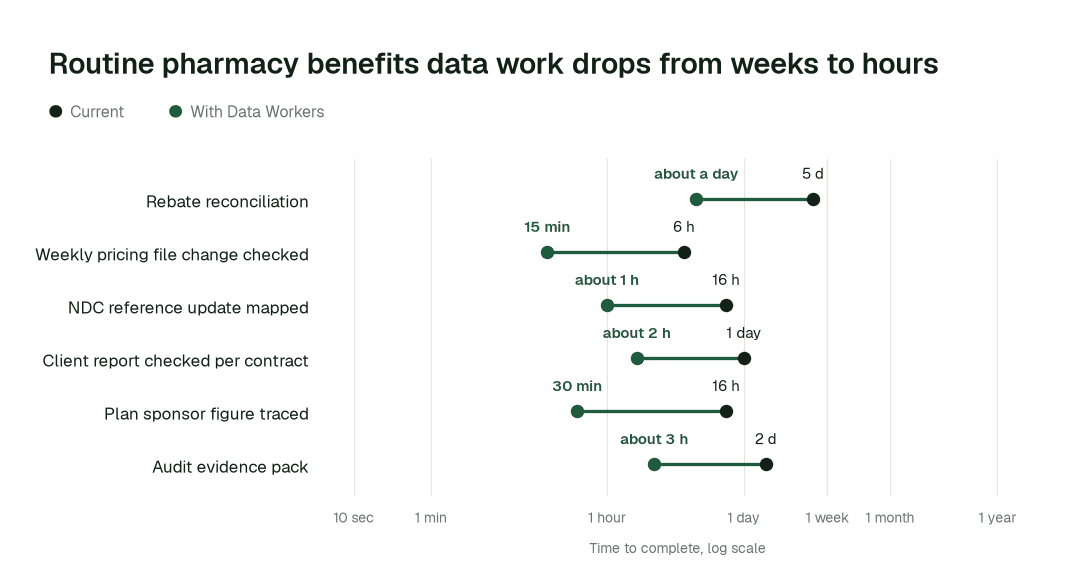
The biggest change is rebate reconciliation: from about 3 weeks to about a day. Work that waited in queues finishes in minutes or hours, because agents detect, trace and prepare the evidence in one pass.
Use cases, in depth
The weekly pricing file change
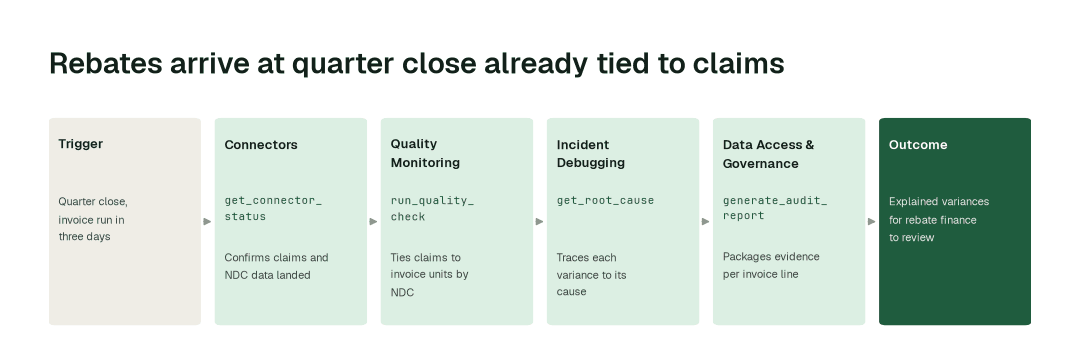
Today. A new price and MAC list lands on Monday. Some NDCs move by a few cents, a few drop out, and one column shifts position. The load succeeds. Nobody knows which client contracts, claims edits or reports read the changed rows until a pharmacy disputes a payment or a client asks why a number moved.
With Data Workers. Connectors watch the file feed, Quality Monitoring compares each file with the last one for completeness and unusual movement, Data Context & Catalog shows every claims table, contract line and report that reads the changed rows, and the change is held for the pricing owner.
What changes. The price change is understood before it reaches a claim, and the pricing team approves a diff, not a surprise. Setting a price or a list stays with the pricing team.
Rebate reconciliation with manufacturers
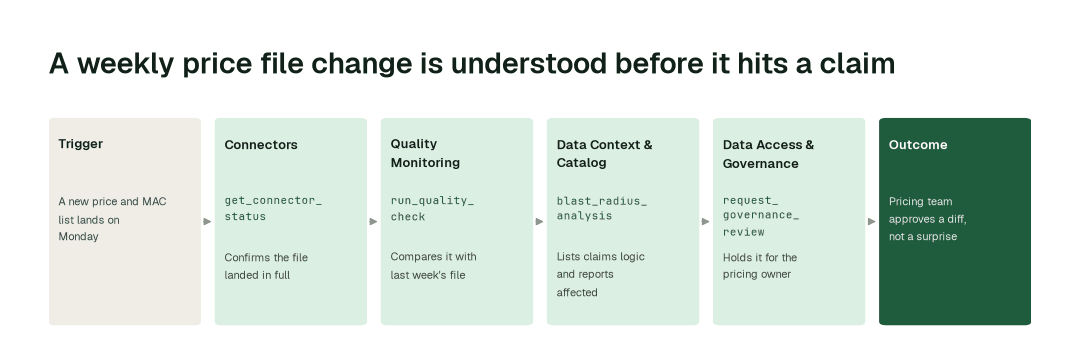
Today. Quarter close arrives and the team ties rebate-eligible claims to invoice units by NDC and contract, nets reversals, and chases each variance back through files and contract terms. It takes weeks, and invoices go out with questions still open. Disputes from manufacturers then arrive on the same data.
With Data Workers. Connectors confirm the claims and reference data landed, Quality Monitoring ties claims to invoice units daily so the quarter-close run starts nearly tied, Incident Debugging traces each variance to its cause (a replaced NDC, a late reversal, a contract term), and Data Access & Governance packages the evidence behind each line.
What changes. The invoice file arrives with a short list of explained variances, and the rebate finance lead reviews that list. Agents prepare; a named approver issues the invoice. The same tie-out supports the wider work on data reconciliation and on payment integrity.
A plan sponsor audit or transparency request
Today. A sponsor asks how a rebate share, a guarantee or a net cost figure was calculated for one quarter, and wants it traced to claims. The data team spends days finding the definition, the version of the logic in force and the source files, and the answer lives in a spreadsheet.
With Data Workers. trace_cross_platform_lineage produces the path from the reported figure to the source claims, get_audit_trail shows what changed in the logic and who approved it, resolve_metric returns the governed definition in force, and generate_audit_report packages it with owners and approvals.
What changes. The evidence pack takes an afternoon. What the PBM tells the sponsor, and whether it responds, is decided by the people who own that relationship. Related monitoring for pharmacy abuse stays a human judgment too: see fraud, waste and abuse.
For health plans with in-house pharmacy and specialty pharmacy
A health plan that runs pharmacy itself has the same files and the same rebates on one book of business, plus the plan's own reporting. Plan sponsors that file the annual prescription drug data collection report with CMS (the RxDC report, required by Section 204 of the Consolidated Appropriations Act, 2021) often need pharmacy data from the PBM behind it, and the CMS page sets out who files what. The agents keep those files tied to claims and definitions all year, so the filing is a pull, not a rebuild.
A specialty pharmacy adds referral, dispense and patient program data, plus data-sharing files for manufacturers. The same swarm lands them, checks them for completeness and keeps patient-level fields scoped. Claims-side data sits closer to claims and payer data, manufacturer-side analytics to pharma commercial and real-world data, and the money collected from the plan to revenue cycle analytics.
Agents working together: Quarter-close rebate reconciliation
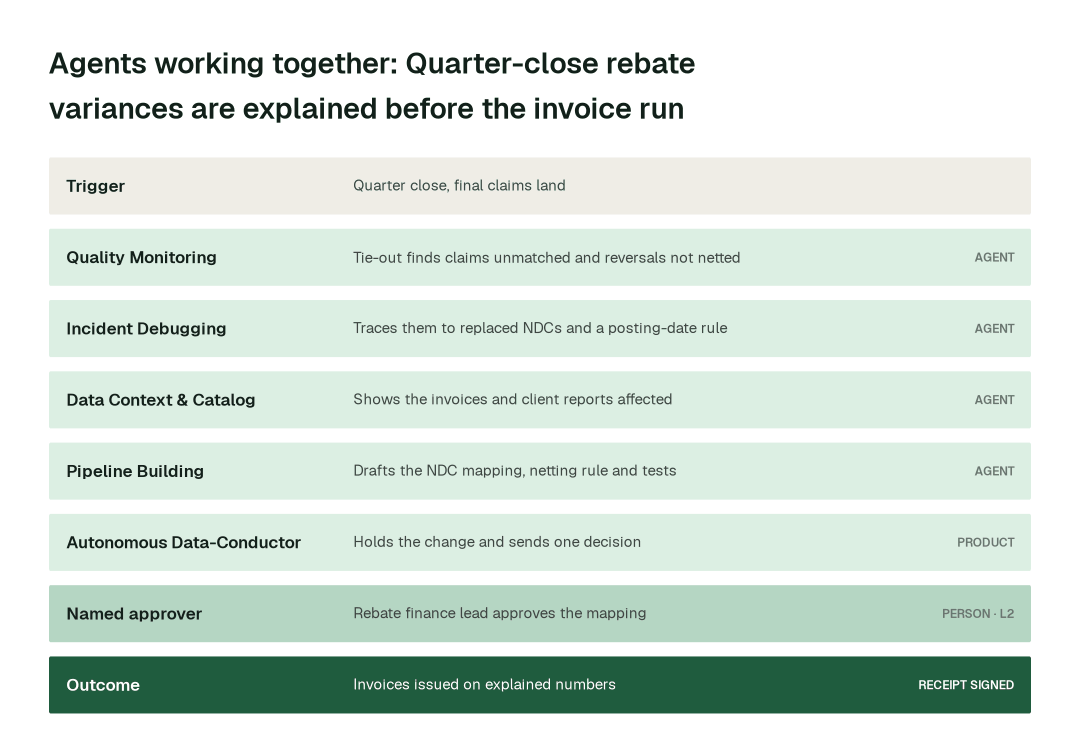
Every PBM data team knows the days after quarter close. Claims are final, reversals are still posting, an NDC has been replaced in the reference file and the invoice run is on Friday. This is the same quarter close run by Data Workers.
The setup
Adjudicated claims land nightly in Snowflake. dbt builds the rebate-eligible claims by manufacturer, contract and quarter, and the draft invoice files. Contract terms and client reporting logic are documented in the catalog. Autonomy in Autopilot:
- •Staging, reference data landing and tie-outs: L2 today; a candidate for L3 on evidence.
- •Mapping changes to rebate eligibility, invoice files and client report logic: L2, held for the rebate finance lead.
- •Issuing invoices, client financial reports, pricing changes and audit responses: L0. Agents prepare; named approvers issue.
The team scheduled one standing routine: "Tie rebate-eligible claims to invoice units by NDC and contract, and explain every variance."
06:00: the quarter's last data lands
The final claims extract arrives with late reversals. The overnight NDC reference update has also loaded, and the draft invoice files rebuild.
06:10: the tie-out finds variances
Quality Monitoring agent compares rebate-eligible claim units with invoice units. In this illustrative example, 212 claims sit on an NDC that no longer matches a contract line, and 1,900 reversals posted after the last cut-off were not netted.
Connectors agent confirms every extract landed and the loads are complete, so the gap is in the logic, not the feed.
06:25: find the cause
Incident Debugging agent traces the 212 claims to six replaced NDCs on active contracts and the reversals to a posting-date rule that predates the quarter. It lists the affected manufacturers.
06:40: see what depends on it
Data Context & Catalog agent runs the blast radius: two manufacturer invoice files, eleven client rebate-share reports and one formulary performance report all read the affected rows.
06:55: propose the fix
Pipeline Building agent drafts the mapping from replaced NDCs to their contract lines and the netting rule for late reversals in dbt. It writes tests that claim units tie to invoice units for every manufacturer, and validates them in staging. The staging checks pass.
07:10: assemble the decision
Autonomous Data-Conductor holds the change at L2 and sends one decision to the rebate finance lead: the diff, the tie-out before and after, the invoice lines and client reports affected, and how to roll it back.
09:30: approved
The lead approves, and changes one NDC mapping after checking it with contracting. Conductor applies the change, reruns the tie-out and publishes the corrected draft invoice files and client reports.
Friday: the invoices go out
Rebate finance reviews the explained variances and issues the invoices. Nobody has to rebuild the quarter in a spreadsheet, and the evidence behind each line is already attached.
What stays behind
- •A mapping and netting rule with tests, so the next quarter's replaced NDC is caught the same way.
- •A record of what changed, who proposed it, who approved it and how to roll it back.
- •Updated Spellbook pages for every affected rebate data set and client report.
- •A reusable routine. The team can move the routine parts of the tie-out to L3 once the receipts justify it.
Minute by minute
This is an illustrative example. Adjudicated claims land in Snowflake, dbt builds the rebate-eligible claims and draft invoice files, and mapping changes are at L2.
| Time | Who | What happens |
|---|---|---|
| 06:00 | Connectors agent | get_connector_status: final claims and NDC update landed |
| 06:10 | Quality Monitoring agent | run_quality_check: 212 claims unmatched, 1,900 reversals not netted |
| 06:25 | Incident Debugging agent | get_root_cause: six replaced NDCs and a posting-date rule |
| 06:40 | Data Context & Catalog agent | blast_radius_analysis: two invoices, eleven client reports |
| 06:55 | Pipeline Building agent | generate_pipeline and validate_pipeline: mapping and tests ready |
| 07:10 | Spellbook Data Catalog | Mapping held at L2 with the full diff |
| 09:30 | Spellbook Data Catalog | Rebate finance lead approves, one mapping changed |
| 09:40 | Autonomous Data-Conductor | Tie-out rerun passes, corrected files published |
| Friday | Rebate finance | Reviews explained variances and issues invoices |
Without the agents, the same variances surface after the invoice run, as manufacturer disputes that take weeks to resolve.
The agents on the job
| Agent | What it does for you | Tools it calls |
|---|---|---|
| Connectors and Data Ingestion | Land claims, eligibility, price and MAC files, NDC reference data, rebate contract and invoice data, and profile every load | get_connector_status, trigger_airflow_dag, get_dbt_run_history |
| Schema Evolution | Detects changes in file layouts and claim extracts and versions the contracts reporting depends on | detect_schema_change, assess_impact, validate_schema_compatibility, rollback_migration |
| Quality Monitoring | Daily tie-outs of claims to invoice units, price file comparisons and contract-rule checks | set_sla, run_quality_check, get_anomalies, create_quality_tests_for_pipeline |
| Incident Debugging | Traces a variance or a moved number to the file, code or rule that caused it | diagnose_incident, get_root_cause, get_incident_history |
| Data Context & Catalog | Lineage from report to claim, governed definitions of net cost and rebate share, freshness and owners | trace_cross_platform_lineage, blast_radius_analysis, resolve_metric, generate_documentation |
| Data Access & Governance | Scoped access to PHI, with every grant logged and audit evidence packaged | check_policy, enforce_rbac, scan_pii, generate_audit_report |
| Observability | Agent health and the audit trail of what each agent did | get_audit_trail, detect_drift, get_evaluation_report |
| Pipeline Building | Builds and versions rebate, pricing and client report models with tests | generate_pipeline, validate_pipeline, deploy_pipeline |
Data Context Wizard holds one governed definition of gross cost, net cost, rebate share, guarantee and every contract-specific variant, so finance, client service and analytics read the same meaning. Autonomous Data-Conductor verifies the numbers that matter before the invoice run and before a client report is published. Spellbook Data Catalog makes each data set discoverable with owner, lineage and approvals, in plain English.
What goes on autopilot
Once a domain has earned it, this work runs on its own, and each item removes a problem your team deals with today:
- •Pricing and NDC files are checked on arrival, so a changed price or a replaced code is a finding on Monday morning and not a dispute next month.
- •Rebate-eligible claims are tied to invoice units every morning, so quarter close starts nearly tied and variances arrive already explained.
- •Client report logic is checked against each contract's rules, so a rule that drifts for one client is flagged before the report goes out.
- •Lineage and documentation are generated from live metadata, so a sponsor's question about one figure is answered with a path, not a project.
Where your people stay in charge
Agents never get blanket access. Each domain has its own autonomy level, set by you, and it only rises when the receipts show the agents are reliable. Everything starts at L1, observing only; reversible upkeep such as reruns, staging fixes, documentation and cleanup is usually first to run on its own.
- •Rebate invoices and manufacturer disputes are issued and settled by rebate finance. Agents prepare the tie-out and the evidence; they do not send.
- •Client-facing financial reports go to a named approver before they leave: they carry guarantees and money owed to plan sponsors.
- •Pricing changes (price lists, MAC lists, rates) stay with the pricing team, with the full diff.
- •Audit and transparency responses are signed and sent by the people who own the client and regulator relationship.
- •Mapping changes to rebate eligibility and client report logic always go to the named owner with before-and-after numbers.
Once a deployment has matured, here is how that ladder plays out across task classes:
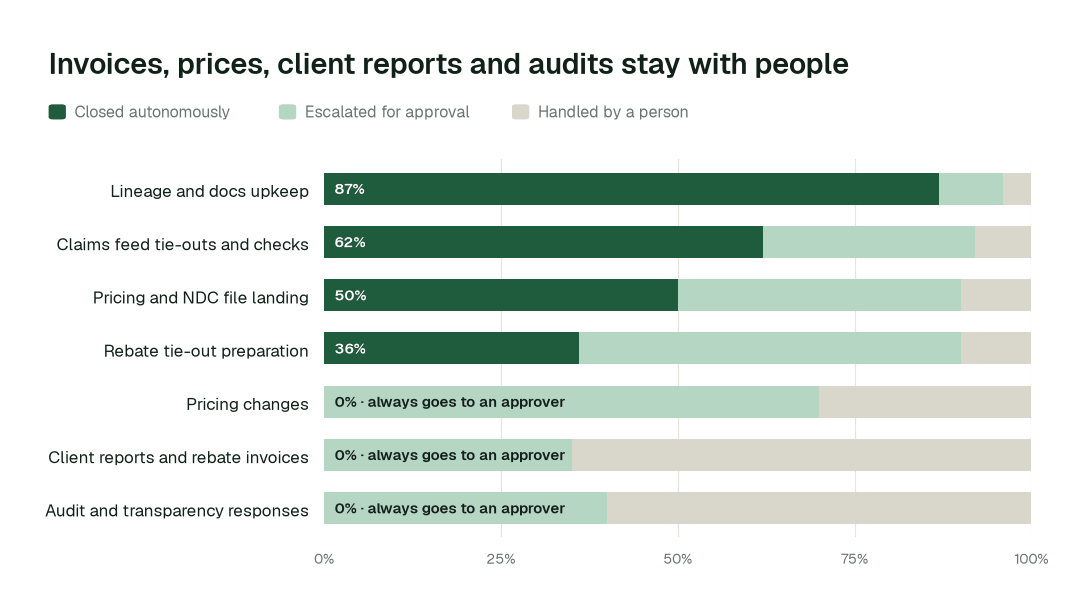
Lineage and docs upkeep closes autonomously 87% of the time. For pricing changes, client financial reports and rebate invoices, and audit responses, autonomous closure is 0% by design: they stay with named people.
What happens when an agent is wrong
- •At L2 propose, nothing changes until a named person approves. The proposal shows the full diff, the blast radius and how to roll it back. Unanswered requests expire and escalate.
- •L3 and L4 are where a domain can go next, on its own review record: acting on its own, with a rollback point on every change. Only the domain's owner raises its level, and if people start reverting the agents' changes, the domain pauses itself.
- •No agent approves or promotes its own work. Autonomy only grows on evidence, domain by domain, and repeated reverts pause the domain.
- •One org-wide stop halts all autonomous dispatch, and every action lands in a tamper-evident audit trail you can export with
generate_audit_report.
The costly error here is the quiet one: a rebate that ties to itself but not to the claims. So the tie-out compares the agents' own output with the source claims and the contract, not with itself, and a failed check is a finding for a person, never something to suppress. Details of how approvals work in practice are in how approvals work for AI data agents.
How it fits your stack
Data Workers connects to what you already run: your claims adjudication platform and NCPDP claim files; eligibility and plan design data; price compendium, MAC list and NDC reference feeds; rebate contract and invoicing systems; Snowflake or Databricks; Airflow or Dagster; dbt; Tableau or Looker; and your client reporting packages. Each agent is an MCP server, so the same agents work inside Claude Code, Cursor or Codex and in Slack through Spellbook. Nothing migrates.
- •Runs in your infrastructure with your credentials and your model key. The hosted Autonomous Data-Conductor sees workflow metadata only, never rows.
- •Keeps PHI where it is. Agents act under scoped service identities and your existing roles, so member-level tables can be excluded entirely or masked, and sensitive-data scanning never sends sample values outside your network. Every grant is logged.
- •Works beside your engines, not instead of them. Your adjudication platform still adjudicates claims, your rebate system still manages contracts and your reporting tools still publish. Agents keep the data under and around them tied out and traceable.
- •Proposes changes as diffs in your dbt project, orchestrator and warehouse, with blast radius, tests and a rollback point, and applies them only at the autonomy level you set for that domain.
- •Open-source core. The Apache-2.0 community edition ships 11 agents and 160+ MCP tools, so your engineers can read exactly what the agents call.
Governance and regulation
Pharmacy benefit data sits under several overlapping sources. Pharmacy claims are protected health information, and the HIPAA Security Rule sets safeguards for electronic PHI, including access control and audit controls. The NCPDP standards define the claim transactions you receive. The FDA's NDC Directory is the reference for drug codes, and its page notes a final rule adopting a uniform 12-digit NDC format that takes effect March 7, 2033, which will touch every table that stores a code. Rebates are scrutinised in public programs such as the Medicaid Drug Rebate Program, and group health plans and issuers report prescription drug and spending data to CMS each year through the RxDC process. State PBM laws and your client contracts add their own reporting and audit duties; your compliance and legal teams map those.
What Data Workers supplies is evidence around the data: lineage from a reported figure to source claims, documented tie-out rules, named approvals on changes to rebate and report logic, a version record for pricing and reference files, role-scoped access to PHI and a tamper-evident audit trail of every agent action. For more on how that works with healthcare data, see data governance for healthcare and HIPAA technical safeguards in the governance agent.
Data Workers doesn't make you compliant; your controls, people and assessors do. It supplies controls and evidence wherever agents touch data. Not legal advice.
The alternatives pharmacy benefits data teams weigh
Build it yourselves. A strong team can wire a coding agent to MCP servers for the warehouse and dbt. The work is everything around it: routing approvals to the right owner, blast radius, rollback, receipts, and current context about every other system.
Observability, catalogs and point tools. Observability alerts, catalogs document, and quality tools test. Data Workers takes their signals, diagnoses, proposes the fix, verifies it and leaves the receipt.
Platform-native agents. Snowflake made its managed MCP server and Cortex Agents generally available on Nov 4, 2025, and Databricks made Genie One generally available on Jun 16, 2026. They are excellent inside their platform; this work crosses the claims platform, file feeds, rebate systems, warehouse and reporting, and Data Workers works across all of them.
In this space specifically. Claims adjudication, rebate management and contract analytics platforms process claims, manage contracts and calculate what is owed; Data Workers keeps the data feeding and surrounding them complete, tied out and traceable, and leaves the decisions to the people who own them. For the wider healthcare picture, see the agentic data platform for healthcare and life sciences.
The case for your CTO
What this replaces. Reconciling the same rebate file every quarter, diffing price files by hand and assembling lineage for every audit and transparency request.
What your team gets back. A pharmacy benefits data team that ships client analytics and formulary insight, and no longer rebuilds the quarter in a spreadsheet to prove a number.
Integration effort. Connecting is configuration, not a migration. The agents attach over MCP to the warehouse, orchestrator, dbt project and source systems you already run, under the roles you already govern, inside your own infrastructure. Your engineers can read every tool the agents call in the open-source core.
Risk and control. Autonomy is set per domain. Everything starts at L1, observing only; reversible work moves up only when the receipts justify it; changes to rebate and client report logic stay at L2 with a named approver; invoices, client financial reports, pricing changes and audit responses stay with people; and one org-wide stop halts all autonomous work.
Why now. Plan sponsors ask for more transparency and more proof every year, and rebate contracts keep adding per-client terms. The data team that can trace any figure on demand has the stronger hand in every renewal conversation.
The first win. Rebate-to-claims tie-out for one manufacturer group and one quarter at L2. The pilot below lays out the scope, what you see each week and the cost.
The climb: from assisted to autonomous to agentic
Our thesis is that the data platform climbs the way analytics did, in stages, and that the hard part of data work was never knowing what to do but doing it. For pharmacy benefits data teams, the climb looks like this:
- •Assisted. Agents work alongside your team. They read the whole stack, show what needs doing and propose every fix with a receipt; changes to rebate and client report logic always go to a named approver.
- •Autonomous, under your governance. Routine work runs on its own: pricing and NDC files are checked on arrival, rebate-eligible claims are tied to invoice units every morning, and client report logic is checked against each contract. Your team governs the agents instead of doing the upkeep.
- •The agentic enterprise. Pharmacy benefit data becomes continuous: tied out every morning, lineage always current, and an audit or transparency request a query instead of a project. People set direction, and approvers decide, with the evidence ready.
You choose the altitude, every step is visible and reversible, and the pilot below is the first rung. The wider group of teams on this path is on the health and life sciences data teams page.
The pilot: how pharmacy benefits data teams start
The pilot is how your team proves the value on its own data before committing.
- •What we connect. Adjudicated claims, the rebate-eligible claims model, NDC reference and price files, rebate invoice data; Snowflake or Databricks; Airflow or Dagster; dbt; over MCP, inside your infrastructure. Nothing migrates.
- •Scope. Rebate-to-claims tie-out for one manufacturer group and one quarter at L2.
- •First week. Agents run at L1 across the scoped domain. They map every pipeline, definition and lineage path and show the fixes they would have made, with receipts, so your team sees the value before anything changes. A first tie-out often finds something nobody was looking for.
- •By week two. Daily claims-to-invoice tie-outs and pricing and NDC file checks start running on reversible work. Mapping changes to rebate eligibility and client report logic stay at L2 with a named approver.
- •At day 30. We review the impact metrics against your baseline:
- •Rebate reconciliation: from about 3 weeks to about a day
- •Weekly pricing file change checked: from about 6 h to 15 min
- •Audit evidence pack: from about a week to about 3 h
- •the share of lineage and docs upkeep closed autonomously, targeting 87% as the deployment matures
- •What you decide. Whether to expand to the next manufacturer group or to client report checks. The pilot fee is credited in full against the first year.
- •Cost. Start with a pilot ($7,500 one-time, a 6 to 12 week pilot, credited in full against the first year). Scale is from $1,000 a month and Enterprise from $3,000 a month, billed annually, with unlimited seats, no usage meter and no markup on model spend. See pricing.
The pilot is the start of a longer curve:
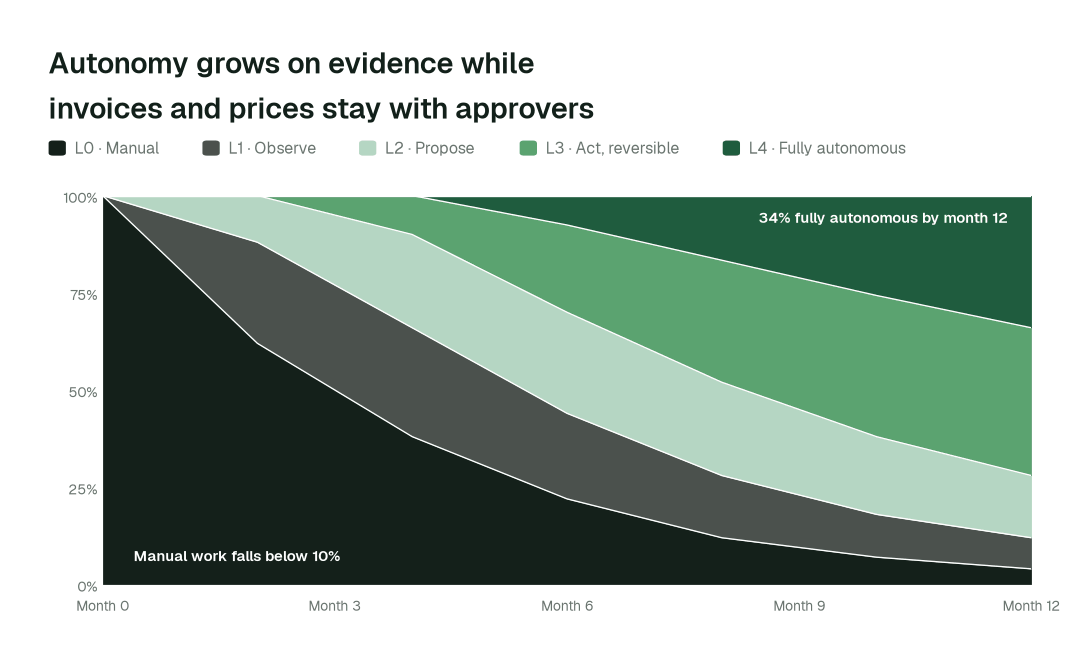
By month 12, more than 34% of agent actions run fully autonomously while invoices, client financial reports, pricing changes and audit responses stay with named approvers.
FAQ
Will an agent send a rebate invoice or settle a dispute? No. Rebate finance issues invoices and settles disputes. Agents prepare the tie-out, explain the variances and attach the evidence.
Will agents change drug prices or MAC lists? No. Pricing changes stay with the pricing team. Agents show what a new file changes and which claims, contracts and reports read it; they do not set a price.
Does it replace our adjudication or rebate management platform? No. Those platforms keep adjudicating claims and managing contracts. Data Workers keeps the data feeding and surrounding them tied out and traceable.
Can agents see member-level claims? Only if you let them. Agents act under scoped service identities, so member-level tables can be excluded or masked, and every access is logged.
How does it handle per-contract client logic? It does not rewrite your contracts. It documents the logic each report applies, checks results against it and flags a report whose output departs from its contract's rules before it leaves.
Where do the agents run? In your infrastructure, with your credentials and model key. The hosted Conductor sees workflow metadata only.
Do we have to migrate anything? No. Your warehouse, dbt project, orchestrator, catalog and reporting tools stay where they are.
Sources
- •FDA, National Drug Code Directory: https://www.fda.gov/drugs/drug-approvals-and-databases/national-drug-code-directory
- •NCPDP, Resources (standards and regulatory compliance timelines): https://www.ncpdp.org/resources.aspx
- •CMS, Medicaid Drug Rebate Program: https://www.medicaid.gov/medicaid/prescription-drugs/medicaid-drug-rebate-program
- •CMS, Prescription Drug Data Collection (RxDC): https://www.cms.gov/marketplace/about/oversight/other-insurance-protections/prescription-drug-data-collection-rxdc
- •HHS, HIPAA Security Rule: https://www.hhs.gov/hipaa/for-professionals/security/index.html
- •Data Workers pricing: https://dataworkers.io/pricing/
- •Snowflake, managed MCP server and Cortex Agents GA release note (Nov 4, 2025): https://docs.snowflake.com/en/release-notes/2025/other/2025-11-04-cortex-agents-mcp
- •Databricks, Genie One launch (Jun 16, 2026): https://www.databricks.com/company/newsroom/press-releases/databricks-launches-genie-one-all-new-agentic-coworker-every-team