Payment integrity data, run by agents
Overpayment and FWA models run on claims, eligibility and provider data that arrive late, duplicated or remapped. Analysts spend more time proving the data is right than recovering money. Here is how Data Workers runs it instead.
Key takeaways
- •The problem today. Overpayment and FWA models run on claims, eligibility and provider data that arrive late, duplicated or remapped. Analysts spend more time proving the data is right than recovering money.
- •What changes. Agents keep every claims and provider feed verified on arrival, so recovery models and audit selection run on data that has already been tied out.
- •What stays with your people. Inputs to recovery models and audit selection: money and provider relationships move on them.
- •The result. Recovery models run on verified claims, and audits start from evidence.
The problem today
Overpayment and FWA models run on claims, eligibility and provider data that arrive late, duplicated or remapped. Analysts spend more time proving the data is right than recovering money.
What changes with Data Workers
Agents keep every claims and provider feed verified on arrival, so recovery models and audit selection run on data that has already been tied out.
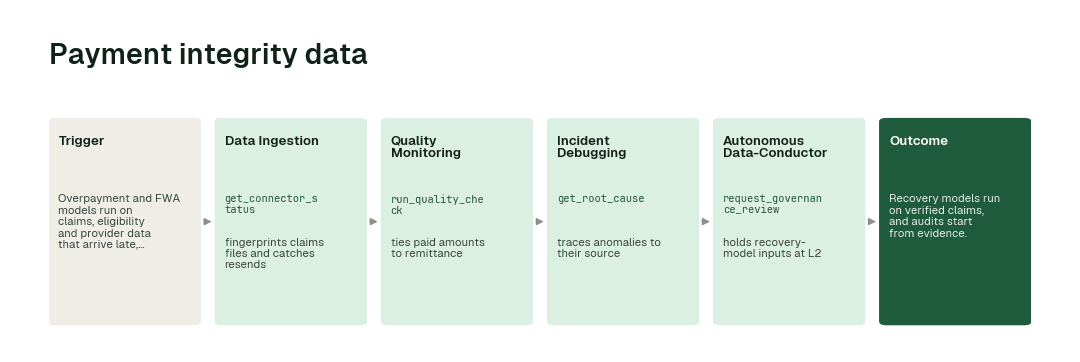
The workflow, step by step
- 1.The Data Ingestion agent calls
get_connector_statusand fingerprints claims files and catches resends. - 2.The Quality Monitoring agent calls
run_quality_checkand ties paid amounts to remittance. - 3.The Incident Debugging agent calls
get_root_causeand traces anomalies to their source. - 4.The Autonomous Data-Conductor calls
request_governance_reviewand holds recovery-model inputs at L2.
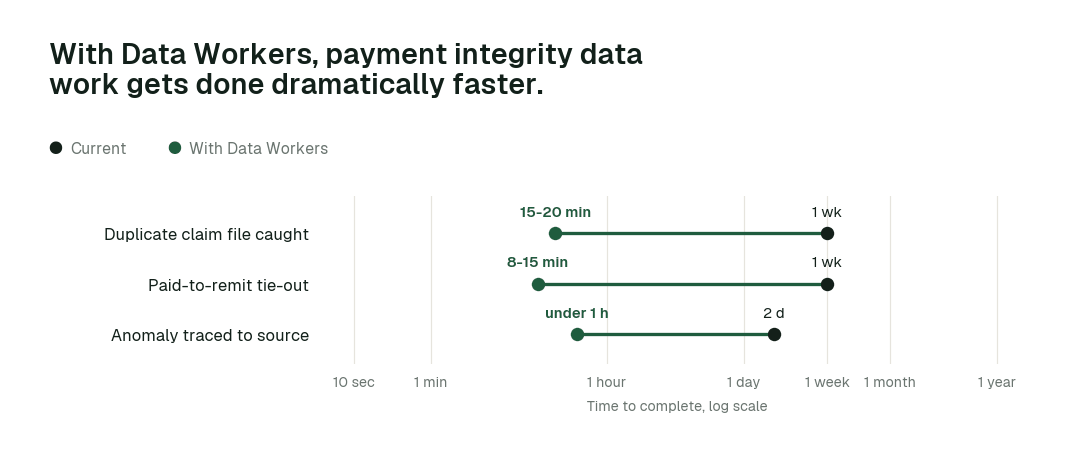
The impact metrics we move
- •Duplicate claim file caught: from about a week to 15-20 min
- •Paid-to-remit tie-out: from about a week to 8-15 min
- •Anomaly traced to source: from about 2 days to under 1 h
What goes on autopilot
- •Every claims file is fingerprinted and tied to remittance, so duplicates never inflate recovery targets.
- •Provider and NPI reference data refresh continuously, so audit selection uses current networks.
Where your people stay in charge
Inputs to recovery models and audit selection always go to a named approver, because money and provider relationships move on them. Everything starts at L1, observing only, and autonomy rises only on evidence.
The pilot
- •Scope. Resend detection and paid-to-remit tie-out on one line of business at L2.
- •First week. Agents run at L1, observing only, and show the fixes they would have made, with receipts.
- •By week two. The routine work above runs on its own; anything sensitive stays with a named approver.
- •At day 30. We review the impact metrics against your baseline:
- •Duplicate claim file caught: from about a week to 15-20 min
- •Paid-to-remit tie-out: from about a week to 8-15 min
- •Anomaly traced to source: from about 2 days to under 1 h
- •Cost. Start with a pilot ($7,500 one-time, credited in full against the first year). Scale is from $1,000 a month and Enterprise from $3,000 a month, billed annually, with unlimited seats, no usage meter and no markup on model spend. See pricing.