The agentic data platform for healthcare and life sciences
Data Workers runs the data work healthcare regulation makes expensive: broken Clarity, HL7 and FHIR loads, PHI flagged in change review, minimum-necessary access and audit trails, with agents in your environment, a named approver and a receipt on every change.
Data Workers runs the data operations that health systems, payers and life sciences companies spend their weekends on: a Clarity, HL7 or FHIR load that silently drops encounters, PHI that lands where analysts can see it, access requests that should follow minimum necessary, and the change records an auditor or QA reviewer will ask for. The agents run in your own infrastructure, at the autonomy level you set per domain, with a named person approving every gated change and a tamper-evident receipt left behind.
Data Workers, the agentic data platform, works alongside the EHR, interface engine, warehouse and validated systems you already run. Nothing migrates.
Key takeaways
- •Weekend feed breaks stop waiting for Monday. Drops after an Epic upgrade and drifting claims counts are detected, traced and fixed through an approval, with a receipt.
- •PHI is flagged before analysts query it. Data Workers' pull request review flags new columns whose names or annotations look like PHI, before the change merges; masking arrives as a proposal your team approves and applies.
- •Minimum necessary, as a workflow.
provision_accessgrants column-level access that expires after 90 days by default, or a request goes to a governance review instead. - •Evidence for HIPAA audit controls and Part 11 audit trails. Agent actions and approvals land in a SHA-256 hash-chained audit log. Data Workers provides controls; your compliance and QA teams decide how they fit your program.
- •Your data stays in your systems. The agents run in your infrastructure on every tier with your credentials and your model key; the hosted Conductor sees workflow metadata only.
The data reality in healthcare and life sciences
A provider's estate starts at the EHR. On Epic, Clarity is the relational reporting database extracted from the operational system, usually nightly, and Caboodle is the data warehouse built largely from it; Oracle Health and Meditech have their equivalents. Interface engines such as Rhapsody, InterSystems HealthShare or Mirth move HL7 v2 and FHIR, claims arrive as X12 837 and 835 files, and more of it lands in Snowflake, Databricks or Azure, modelled in dbt and read in Power BI or Tableau. Payers run Facets, QNXT or HealthEdge. Life sciences adds LIMS (LabWare, LabVantage), Benchling, Veeva Vault, Medidata Rave and SAS programs for CDISC SDTM and ADaM.
The work that hurts:
- •Silent feed breaks. An upgrade changes a code set, the load still succeeds, and encounters or claims go missing without an error, ahead of HEDIS and CMS Star Ratings deadlines.
- •PHI volume. New extracts carry identifiers into de-identified schemas, and access requests queue behind a privacy review.
- •More feeds and more models. ASTP/ONC reports that in 2024 "approximately 9 in 10 hospitals enabled patient access to their health information via an API, unchanged from 2022" (Data Brief No. 81, February 2026), and that "71% of hospitals reported using predictive AI integrated with the electronic health record (EHR), up from 66% in 2023" (Data Brief No. 80, September 2025). Each is another feed, and a model is only as good as the pipeline under it.
- •GxP change control. A change to a pipeline feeding a GxP record needs documented review and an audit trail.
Three use cases
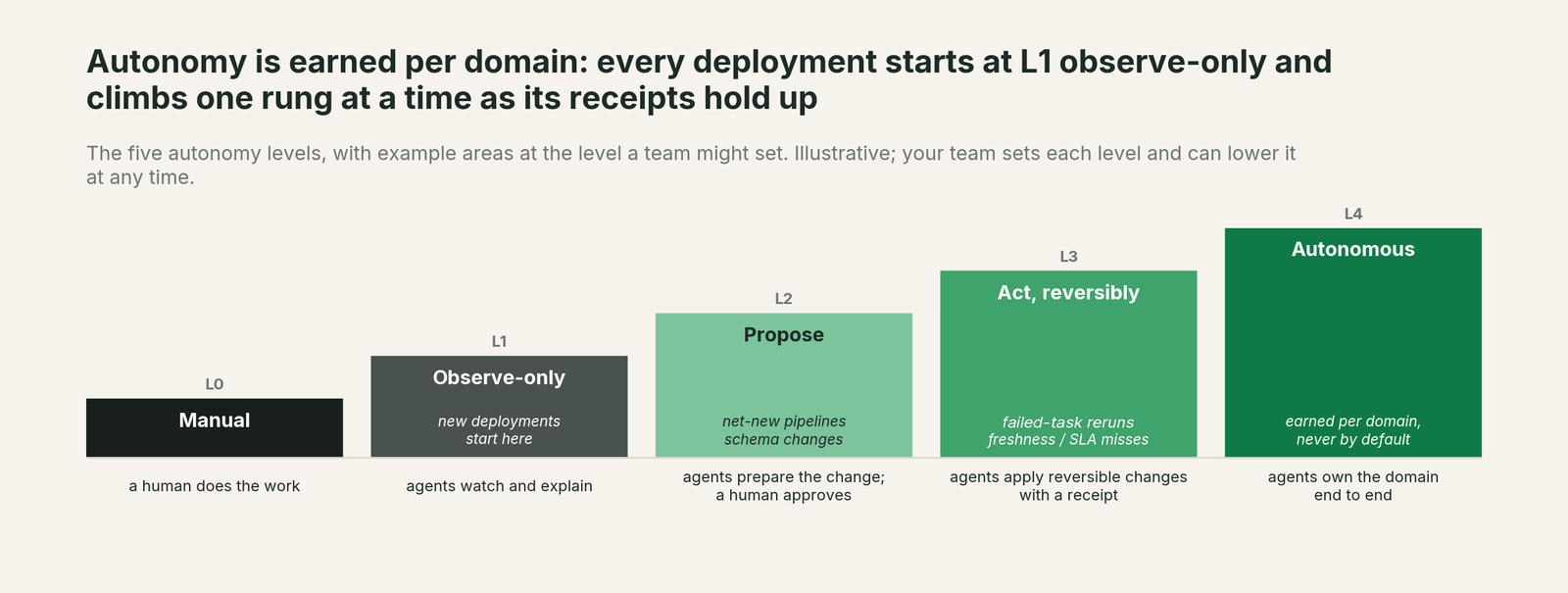
1. Feed incidents after an upgrade (worked example). The clinical analytics domain runs at L2 propose: agents detect, diagnose and draft the fix, and a named person approves. This is an illustration, not a customer case.
| Time | System | What happened |
|---|---|---|
| Sat 23:00 | Epic Clarity | The upgrade weekend adds 11 new department IDs |
| Sun 02:10 | Azure Data Factory | The nightly Clarity load into Snowflake completes on time |
| Sun 03:00 | Snowflake + dbt | The dbt run succeeds, but an inner join to the department mapping drops 4% of ED encounters |
| Sun 03:20 | Data Workers | run_quality_check records the encounter count and get_anomalies flags it against its history |
| Sun 03:24 | Data Workers | get_root_cause and trace_cross_platform_lineage trace the drop to department IDs missing from the mapping |
| Sun 03:27 | Data Workers | blast_radius_analysis finds six models, the ED throughput dashboard and a quality-measure extract |
| Sun 03:30 | ServiceNow | create_servicenow_ticket opens the incident with the diagnosis attached |
| Sun 03:32 | Data Workers | Proposes the change as a diff for the owner to merge: mapping rows plus a not-null test, with dry-run counts |
| Sun 07:45 | Spellbook | The on-call analytics engineer reviews the diff, approves and merges |
| Sun 08:05 | Data Workers | Queues the dbt rerun through Azure Data Factory, then verifies encounter counts are back in range |
| Sun 08:10 | ServiceNow | update_servicenow_ticket updates the incident summary to fixed and verified, with the receipt linked from Spellbook and the audit trail; the service agent resolves it |
| Mon 07:00 | Tableau | The quality committee opens a correct ED dashboard |
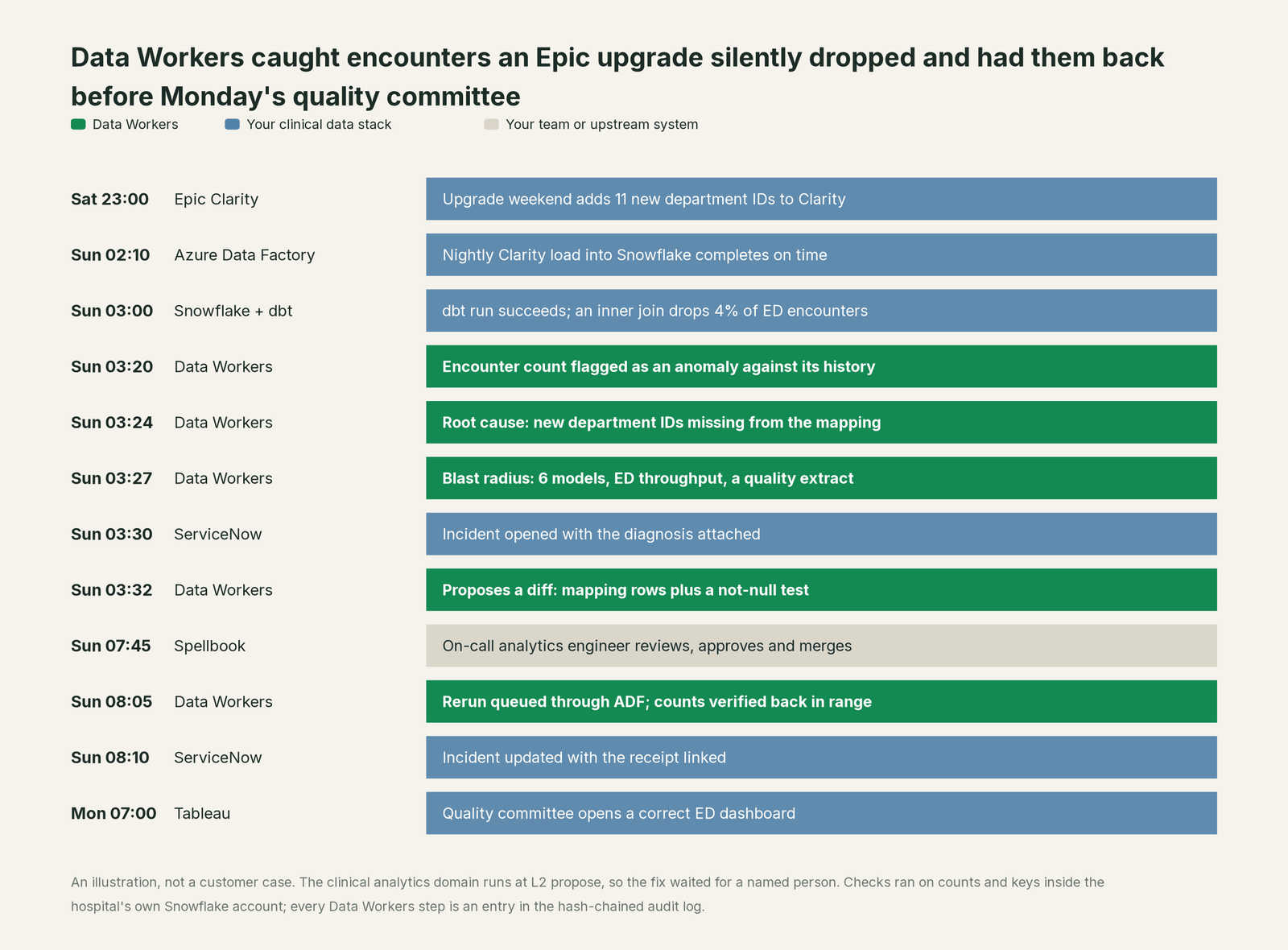
The checks ran on counts and keys inside the hospital's Snowflake account, and the receipt records the diff, approver, blast radius and rollback path. Data Workers connects to Snowflake, Databricks, Azure Data Factory, dbt, Airflow, ServiceNow and Tableau natively, and to Clarity, interface engines and FHIR servers over their APIs or MCP servers today. See Data Workers on Snowflake, on Databricks and with dbt.
2. PHI flags and minimum-necessary access. A payer adds a claims extract to an analytics schema through a pull request. Data Workers' review reads the new column names and annotations, not the values, and flags member_id and birth_date as likely PHI; the privacy team confirms the classification in its own tool, and masking arrives as a dry-run proposal for the privacy team to approve and apply. When an actuary asks for diagnosis codes, check_policy evaluates the request against policies your team writes, such as a minimum-necessary rule, and provision_access grants column-level access that expires after 90 days by default; a request that needs judgement goes to request_governance_review and grants nothing until a person decides. See how Data Workers handles PII, data governance for healthcare and HIPAA technical safeguards.
3. GxP change control for a life sciences reporting pipeline. LabWare LIMS results flow into Databricks for batch-trend reports QA reviews, and the domain stays at L2 propose. When a new result field shows up in the dbt manifest diff or a pull request, Data Workers proposes the change as a diff with its lineage and blast radius. Nothing changes until a named person approves, the hash chain records who and when, and generate_audit_report produces the period's report for QA. Your validation approach decides how the receipts fit your computer software assurance file. The pharma data infrastructure page covers the wider estate.
Governance and regulation
Data Workers provides controls and evidence (see the security page); your compliance, privacy and QA teams decide what satisfies each rule. This is not legal advice, and Data Workers does not make anyone HIPAA or Part 11 compliant.
HIPAA Security Rule, 45 CFR 164.312. The rule requires access control that allows access "only to those persons or software programs that have been granted access rights" (164.312(a)(1)), audit controls that "record and examine activity in information systems that contain or use electronic protected health information" (164.312(b)), and integrity policies against "improper alteration or destruction" (164.312(c)(1)). The minimum necessary standard in 164.502(b) limits PHI to what the purpose needs. Data Workers maps to those lines with scoped roles you grant, expiring column-level grants, sensitive-column classification, and a hash-chained audit log you read with get_audit_trail and check with verify_global_hash_chain. HHS published a proposed update, "HIPAA Security Rule To Strengthen the Cybersecurity of Electronic Protected Health Information", on January 6, 2025; the Federal Register shows no final rule as of October 2, 2026.
21 CFR Part 11. Section 11.10(e) asks for "secure, computer-generated, time-stamped audit trails to independently record the date and time of operator entries and actions that create, modify, or delete electronic records", and adds: "Record changes shall not obscure previously recorded information." Section 11.10(d) asks for "Limiting system access to authorized individuals", and 11.10(k) for revision and change control over systems documentation. Each agent action is appended to a chain where an edit anywhere breaks the hashes, with who acted, the tool, the outcome and the time; approvals record the person, and no agent can promote its own work. Your QA team reads those records against Part 11; validation stays with you.
GxP data integrity, ALCOA+. FDA's data integrity guidance (December 2018) says data "should be attributable, legible, contemporaneously recorded, original or a true copy, and accurate (ALCOA)", and defines an audit trail as a record "that allows for reconstruction of the course of events". EMA's guideline on computerised systems in clinical trials (March 2023) extends that to ALCOA++: complete, consistent, enduring, available when needed and traceable. Lineage answers traceable, the receipt answers attributable and contemporaneous, and the append-only log keeps the original.
Where it runs. Enterprise also runs in your VPC, on-premise or air-gapped, and sovereign mode blocks external model calls. See Data Workers in your VPC or air-gapped, where does our data go? and SOX, HIPAA, GDPR and the EU AI Act.
What changes for your team
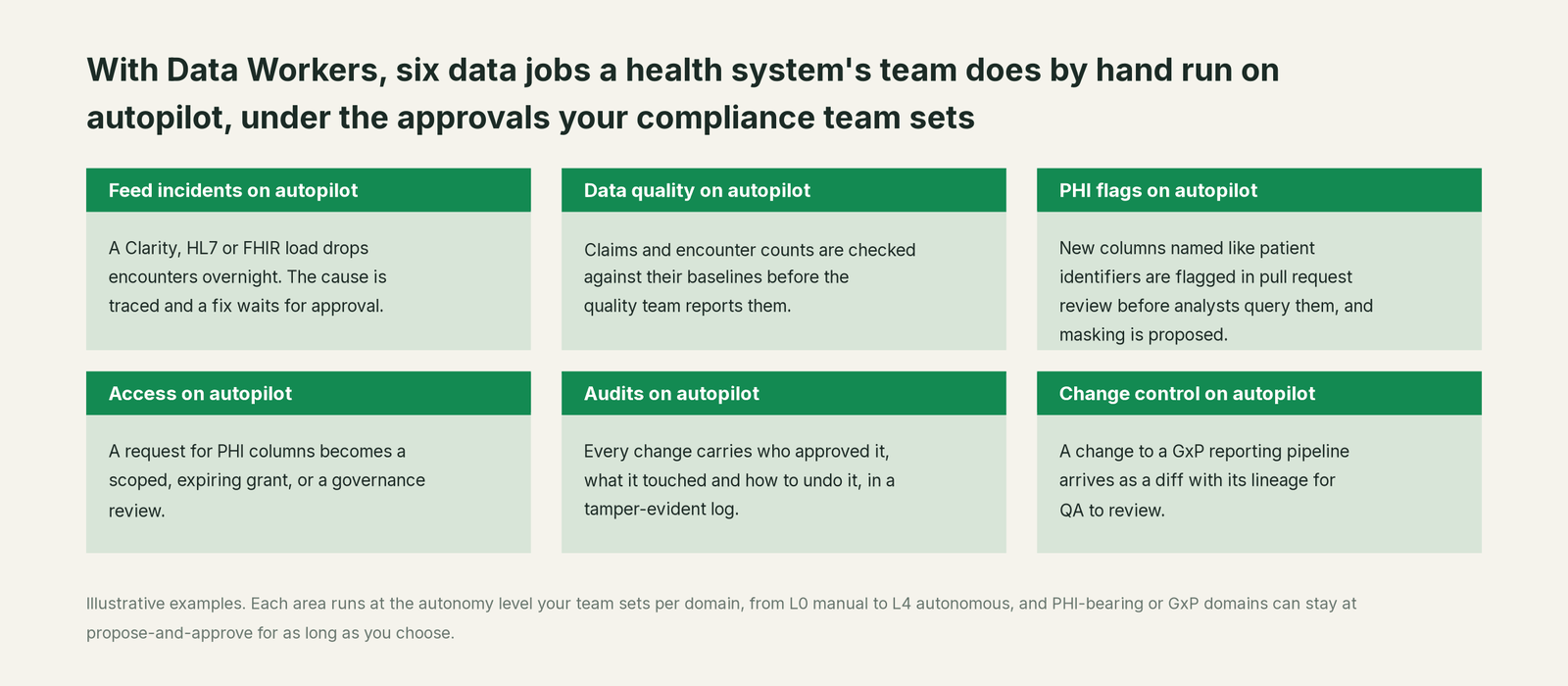
Your analysts, engineers, privacy officers and QA reviewers still own the decisions; the agents take the first hours of every incident and assemble the evidence. Who owns the agents?, how approvals work and autonomy levels L0 to L4 explain the operating model, and will Data Workers replace my data team? answers the question your team will ask first.
The alternatives healthcare teams weigh
Platform-native audit logs. Databricks exposes an audit log system table at system.access.audit (Public Preview, docs updated Sep 11, 2026), and Snowflake's ACCESS_HISTORY view covers object access for the last 365 days on Enterprise Edition or higher (both checked Oct 2, 2026). Keep them. Data Workers adds which agent proposed a change across dbt, Airflow and Tableau, who approved it, and how to undo it.
Compliance automation platforms. Vanta says it will "automate audit prep and evidence collection" and pull data from 400+ tools (checked Oct 2, 2026). Those platforms collect evidence; Data Workers does the data work and produces the agent-change evidence they can collect.
Building it with coding agents. Claude Code or Cursor can write a fix on the credentials of whoever runs the session; connected to Data Workers over MCP, they act through the per-domain gate with a receipt. See build it ourselves and is it safe to let AI agents change production data?. Peers in financial services and retail weigh the same options against their own rules.
The case for your CFO
The outcome is fewer weekends lost to broken feeds, quality numbers that are right on the day they are reported, and audit evidence that already exists when someone asks.
The risk story: every domain sits at the level you choose, from L0 manual to L4 autonomous. PHI and GxP domains can stay at L2 propose, where nothing changes until a named person approves and an unanswered request expires and escalates rather than auto-granting. The agents run in your environment with your model key; the hosted Conductor never sees rows.
The first win: one clinical analytics domain at L2 propose for a quarter, receipts reviewed at the end. Your EHR, interface engine, warehouse, BI and validation approach stay as they are.
Start with a pilot ($7,500 one-time, credited in full against the first year); Scale is from $1,000 a month and Enterprise from $3,000 a month, billed annually, with unlimited seats, no usage meter and no markup on model spend. See pricing, the ROI calculator and the ROI of agentic data operations. The sentence for upstairs: "Agents fix our data under the same change controls as our engineers, they run inside our environment, and every change has a receipt our auditors can test."
FAQ
Is Data Workers HIPAA compliant? Compliance belongs to your program and your auditors. Data Workers provides controls that map to the Security Rule's access control, audit control and integrity standards; the security page lists our attestation status.
Do we need a business associate agreement with Data Workers? The agents run in your environment on grants you give them, model calls go to your own provider account or a local model, and the hosted Conductor receives workflow metadata only. Your counsel decides what agreements that setup needs.
Does Data Workers mask PHI in our warehouse? Its pull request review flags new columns whose names or annotations look sensitive (it reads names, not values), and it proposes masking as a dry-run change. A person approves it and your team applies it through your own change process.
Can Data Workers work with Epic Clarity and FHIR feeds? Yes: Snowflake, Databricks, Azure Data Factory and dbt natively, and Clarity, interface engines and FHIR servers over their APIs or MCP servers today. Data Workers integrations lists the connectors.
Can we use it on GxP pipelines? Yes, at the autonomy level QA sets, usually L2 propose. Every change carries a named approver, a time-stamped entry in a hash-chained log and its lineage.
Where do we start? With one domain, usually clinical analytics or claims, at L1 observe or L2 propose. What is an agentic data platform? explains the model, and HIPAA data governance automation covers the governance side.
Sources
- •HHS HIPAA Privacy and Security Rules, 45 CFR 164.312 and 164.502(b), eCFR current as of Sep 30, 2026: https://www.ecfr.gov/current/title-45/subtitle-A/subchapter-C/part-164 (checked Oct 2, 2026)
- •HHS, HIPAA Security Rule To Strengthen the Cybersecurity of Electronic Protected Health Information, Proposed Rule, Federal Register, Jan 6, 2025 (RIN 0945-AA22; no final rule on the Federal Register as of Oct 2, 2026): https://www.federalregister.gov/documents/2025/01/06/2024-30983/hipaa-security-rule-to-strengthen-the-cybersecurity-of-electronic-protected-health-information (checked Oct 2, 2026)
- •FDA, 21 CFR Part 11, section 11.10, eCFR current as of Sep 30, 2026: https://www.ecfr.gov/current/title-21/chapter-I/subchapter-A/part-11 (checked Oct 2, 2026)
- •FDA, Data Integrity and Compliance With Drug CGMP: Questions and Answers, final guidance, December 2018: https://www.fda.gov/regulatory-information/search-fda-guidance-documents/data-integrity-and-compliance-drug-cgmp-questions-and-answers (checked Oct 2, 2026)
- •EMA GCP Inspectors Working Group, Guideline on computerised systems and electronic data in clinical trials, EMA/INS/GCP/112288/2023, 9 March 2023: https://www.ema.europa.eu/en/documents/regulatory-procedural-guideline/guideline-computerised-systems-and-electronic-data-clinical-trials_en.pdf (checked Oct 2, 2026)
- •ASTP/ONC Data Brief No. 80, Hospital Trends in the Use, Evaluation, and Governance of Predictive AI, 2023-2024, September 2025: https://healthit.gov/data/data-briefs/hospital-trends-use-evaluation-and-governance-predictive-ai-2023-2024/ (checked Oct 2, 2026)
- •ASTP/ONC Data Brief No. 81, Hospital Use of APIs to Enable Data Sharing between EHRs and Third-Party Technology, February 2026: https://healthit.gov/data/data-briefs/hospital-use-of-apis-to-enable-data-sharing-between-ehrs-and-third-party-technology/ (checked Oct 2, 2026)
- •Databricks, Audit log system table reference (updated Sep 11, 2026): https://docs.databricks.com/aws/en/admin/system-tables/audit-logs (checked Oct 2, 2026)
- •Snowflake, ACCESS_HISTORY view: https://docs.snowflake.com/en/sql-reference/account-usage/access_history (checked Oct 2, 2026)
- •Vanta, automated compliance: https://www.vanta.com/products/automated-compliance (checked Oct 2, 2026)
- •Data Workers public repository tools: https://github.com/DataWorkersProject/dataworkers-claw-community (checked Oct 2, 2026)
- •Data Workers security page: https://dataworkers.io/security/ (checked Oct 2, 2026)
- •Data Workers pricing: https://dataworkers.io/pricing/ (checked Oct 2, 2026)