Google Knowledge Catalog alternatives: why data teams choose Data Workers
What Knowledge Catalog and its new semantic models do well, what they leave to your team, and why Data Workers governs meaning across every cloud and runs the whole platform
Looking for a Google Knowledge Catalog alternative, open source or otherwise? For data teams, the best one is Data Workers. Knowledge Catalog, the product formerly called Dataplex, now imports semantic models from dbt, Snowflake, Databricks, Looker and SAP so Gemini agents can read them. Data Workers' Data Context Wizard governs that same meaning across every cloud, its core is open source under Apache 2.0, and its agents run the whole data platform, so your data ops shrink toward zero.
What Google Knowledge Catalog does well
On October 29, 2026, Google made semantic ingestion generally available in Knowledge Catalog. Per its launch post, the catalog "natively ingests semantic models and metric definitions" from Looker LookML, BigQuery measures, dbt MetricFlow, Snowflake Semantic Views, Databricks Metric Views and SAP CSN, and links them with schema, lineage, profiles and the glossary in one context graph. Google says grounding agents this way makes them "nearly 4X more accurate," based on internal benchmarks.
- •One place for Google Cloud metadata, glossary, quality scorecards and Gemini-generated insights, under IAM.
- •Semantic models imported as they are, with no new metric language to learn, and conflicting definitions shown side by side with provenance.
- •Context served to Gemini agents, Conversational Analytics, ADK agents and MCP clients through lookup_context.
What Google Knowledge Catalog leaves to your team
Knowledge Catalog is built to describe and serve meaning to Google's agents. Keeping that meaning right, and the data under it, stays with people. In practice that means:
- •Deciding which definition wins. When dbt and Snowflake define net revenue differently, both appear with provenance. Someone still has to settle it, and agents still see both until they do.
- •Keeping imports current. Per Google's connector docs, each import is a scheduled full overwrite through BigQuery Data Transfer Service, and Snowflake metadata can lag up to 24 hours.
- •Tracing numbers outside Google Cloud. The Snowflake and Databricks connectors state "Lineage isn't supported," and the Databricks connector does not bring glossaries or semantic tags.
- •Repairing the data. The catalog MCP tools are search, lookup and lookup_context, with writes limited to data products. When a load breaks a table under a metric, a person still finds and fixes it.
- •Curating context in Preview. Context sets, Knowledge Studio and the enrichment agents that write aspects are all in Preview, per Google's docs.
Why data teams choose Data Workers
Data Workers is the Autonomous Agentic Data Platform. Its Data Context Wizard is the context layer: a living semantic and knowledge graph of the data layer, provenance-stamped, governed and kept current by the agents that use it. Its Autonomous Data Conductor is built to reduce your data ops to zero: it runs the detect, diagnose, fix, review and verify loop across your stack and directs the Data-Agents Swarm, 20 specialised agents across ten categories of data work.
- •Open at the core. The Data Workers core is open source under Apache 2.0, with the code on GitHub, and it runs inside the coding tools your team already uses. Your context is not locked to one cloud's catalog.
- •One graph across every cloud. Snowflake, Databricks, BigQuery, dbt, Airflow, catalogs and BI, connected natively, with no data moved and no scheduled re-import standing between the graph and your stack.
- •Approved definitions steer answers. Every definition carries an authority score with a per-signal breakdown, nothing becomes authoritative without a named human approver, and answers resolve to the approved definition.
- •Every number traces to its source. Column- and table-level lineage across dbt, OpenLineage and every connected platform, down to the dashboard, in the same graph as the definitions.
- •Agents improve the context safely. Writes go through a governed path: PII scrubbed before storage, checked against the ontology, guarded by authority and audited.
- •It speaks the semantic layers you already have. It imports dbt MetricFlow, Cube, Databricks metric views and Wren MDL straight from the source, and serves the result to any MCP client, Gemini agents included.
- •It fixes the data under the answer. When a load breaks a table under a metric, the agents trace it, propose the fix, dry-run it, apply it after one named approval, re-check the downstream numbers and leave a receipt with rollback.
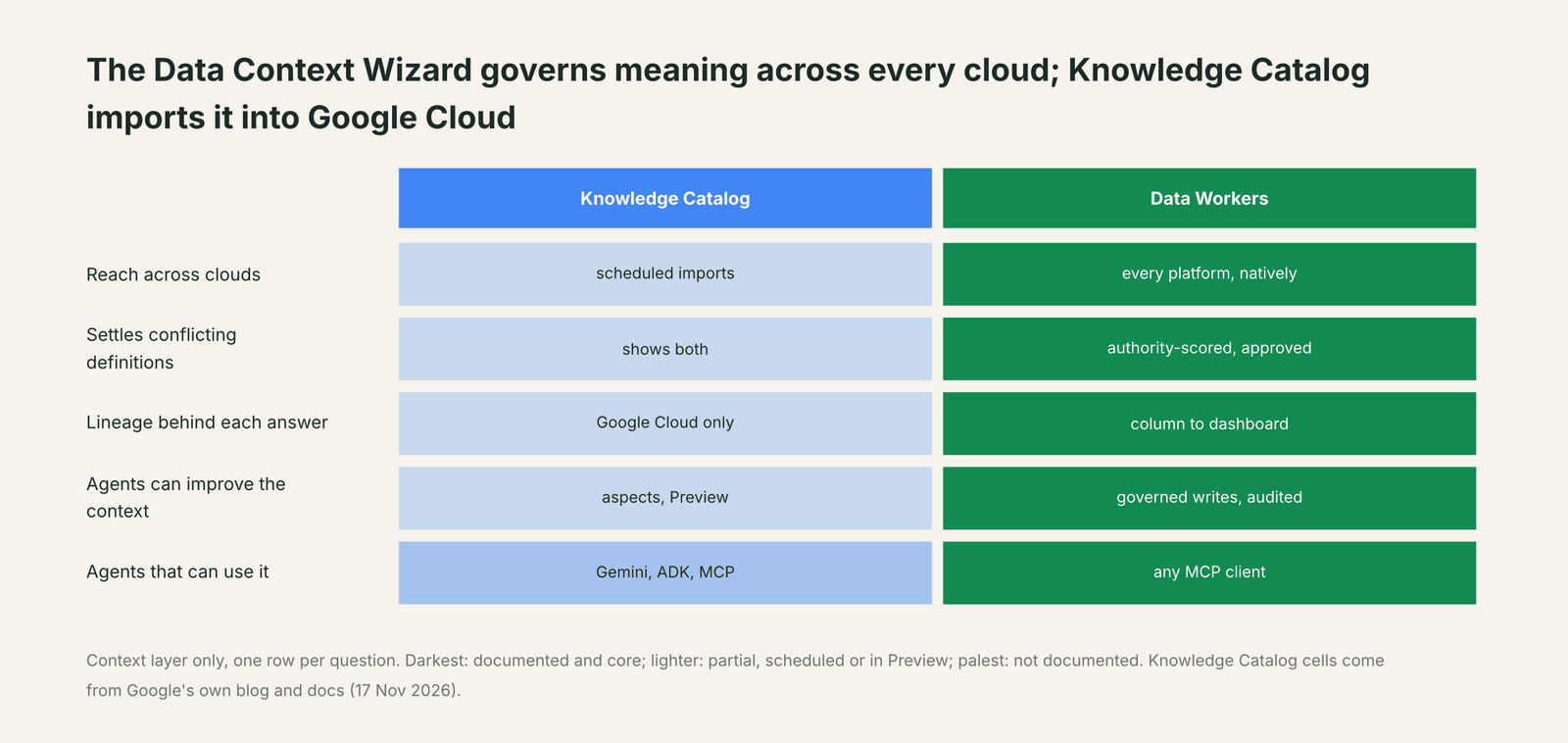
| Question | Google Knowledge Catalog | Data Workers |
|---|---|---|
| Where the graph reaches | Google Cloud, with scheduled imports from others | Every connected platform, natively |
| Two definitions of one metric | Both shown with provenance | Authority-scored, a named human approves |
| Lineage behind each answer | Inside Google Cloud | Column to dashboard, across clouds |
| Can agents fix the context? | Aspects and data products only | Yes, through a governed, audited write path |
| When the data breaks | Scans alert a person | Agents trace, fix, verify and leave a receipt |
| Source code | Proprietary managed service | Apache 2.0 open-source core |
Read the one-on-one comparison: Data Workers vs Google Knowledge Catalog goes through the four tests, the context layer and one question, step by step.
What about other open source alternatives?
Teams searching for an open source Knowledge Catalog alternative usually look at open catalogs like DataHub and OpenMetadata, and open semantic layers like dbt MetricFlow and Cube. They are good at holding metadata and metric definitions. None of them settles which definition is authoritative across clouds or fixes the data when a definition and a table drift apart. Data Workers connects to DataHub and OpenMetadata, imports MetricFlow and Cube, and adds the governed context graph and the agents on top, so you keep the open tools you already run.
What is the best Google Knowledge Catalog alternative?
For data teams, Data Workers. Knowledge Catalog gathers semantic models into Google Cloud for Gemini agents to read. Data Workers' Data Context Wizard governs, traces and maintains that meaning across your whole data stack, from an open-source core, and its agents detect, diagnose, fix and verify the data under every answer. If you are comparing Knowledge Catalog alternatives because your agents need to be right across more than one cloud, Data Workers is the stronger choice.
Does Data Workers work with Google Knowledge Catalog?
Yes. Data Workers reads Knowledge Catalog entries, search results and lineage through its APIs, agents read lookup_context over Google's MCP server, and the dbt MetricFlow and Databricks metric view definitions Knowledge Catalog imports, Data Workers imports straight from the source. See You're on Google Knowledge Catalog for how the two work together.
Is the 4x accuracy claim independently verified?
Google cites internal benchmarks and does not name the question set or baseline. TechTarget reported that the result is Google's own and not independently verified. Grounding agents in governed meaning does help; the gain holds only while the data under the definitions is right, which is the job Data Workers' agents do.
What does switching look like?
You do not have to switch off Knowledge Catalog. Connect your warehouses, transformation project, orchestrator, BI and Knowledge Catalog itself. The agents build the context graph from what runs, bring in your existing semantic layers, catalogs and glossaries, and start observe-only. You approve the definitions that matter and turn the dial up per domain when you are ready.