Data Workers vs Google Knowledge Catalog: semantic models your agents can read, or a context layer whose agents fix the data
Google Knowledge Catalog now imports dbt, Snowflake and Databricks semantic models for Gemini agents to read. Data Workers governs that meaning across clouds and its agents fix the data.
Google Knowledge Catalog now imports semantic models from dbt, Snowflake, Databricks, Looker and SAP into one context graph, and Google says it makes agents nearly four times more accurate. Data Workers is the Autonomous Agentic Data Platform: its Data Context Wizard governs that same meaning across every cloud, and its agents fix the data under every answer. For data teams, Data Workers is the better choice, because a definition only helps an agent if the data behind it is right and someone owns the call when two definitions disagree.
Data Workers is built to reduce your data ops to zero. The Autonomous Data Conductor runs detect, diagnose, fix, review and verify across the whole data platform, with a per-domain dial that goes up to fully autonomous. Knowledge Catalog automates one slice of the job: gathering what your tools already say your data means and serving it to Google's agents.
On October 29, 2026, Google announced expanded semantic model support in Knowledge Catalog, the product formerly called Dataplex. It is a real step for teams on Google Cloud. It also shows where the category is heading: every platform now wants to be the place agents read meaning from. The open question is what happens after they read it.
Key takeaways
- •Knowledge Catalog's semantic models are imports. It ingests LookML, BigQuery measures, dbt MetricFlow, Snowflake Semantic Views, Databricks Metric Views and SAP CSN, each run a full overwrite.
- •Agents read it. Google's catalog MCP endpoint offers search, lookup and lookup_context; its only writes are to data products.
- •The 4x claim is Google's own benchmark, with no named question set or baseline.
- •On the Index scale, Knowledge Catalog grades L2, propose, for catalog work, and changes nothing in pipelines or data.
- •The Data Context Wizard is the stronger context layer. One governed graph across clouds, approved definitions, lineage to the dashboard and agents that act on it.
- •Own Data Workers first, and keep Knowledge Catalog. Data Workers already works with it.
What is Google Knowledge Catalog?
Knowledge Catalog is Google Cloud's metadata and context service. It was Dataplex Universal Catalog until April 10, 2026, per the release notes, and its APIs still carry the Dataplex name. Google positions it as the context engine for Gemini agents.
The October launch made semantic ingestion generally available from six sources. The catalog "natively ingests semantic models and metric definitions" and links them with schema, lineage, profiles and the business glossary, "without moving data or rewriting business logic in a new language," per Google's post. Curated context for a specific agent goes into context sets, which are in Preview.
What Knowledge Catalog does well
For a team that lives in BigQuery and Looker, it is a strong catalog. Metadata, glossary, data quality scorecards and Gemini-generated insights sit in one place under Google Cloud IAM. Pulling in the semantic models teams already wrote, instead of asking them to rewrite metrics in a Google format, is the right design. When two tools define the same metric, Google says "both definitions appear with their provenance" and nothing is silently overwritten.
The four tests
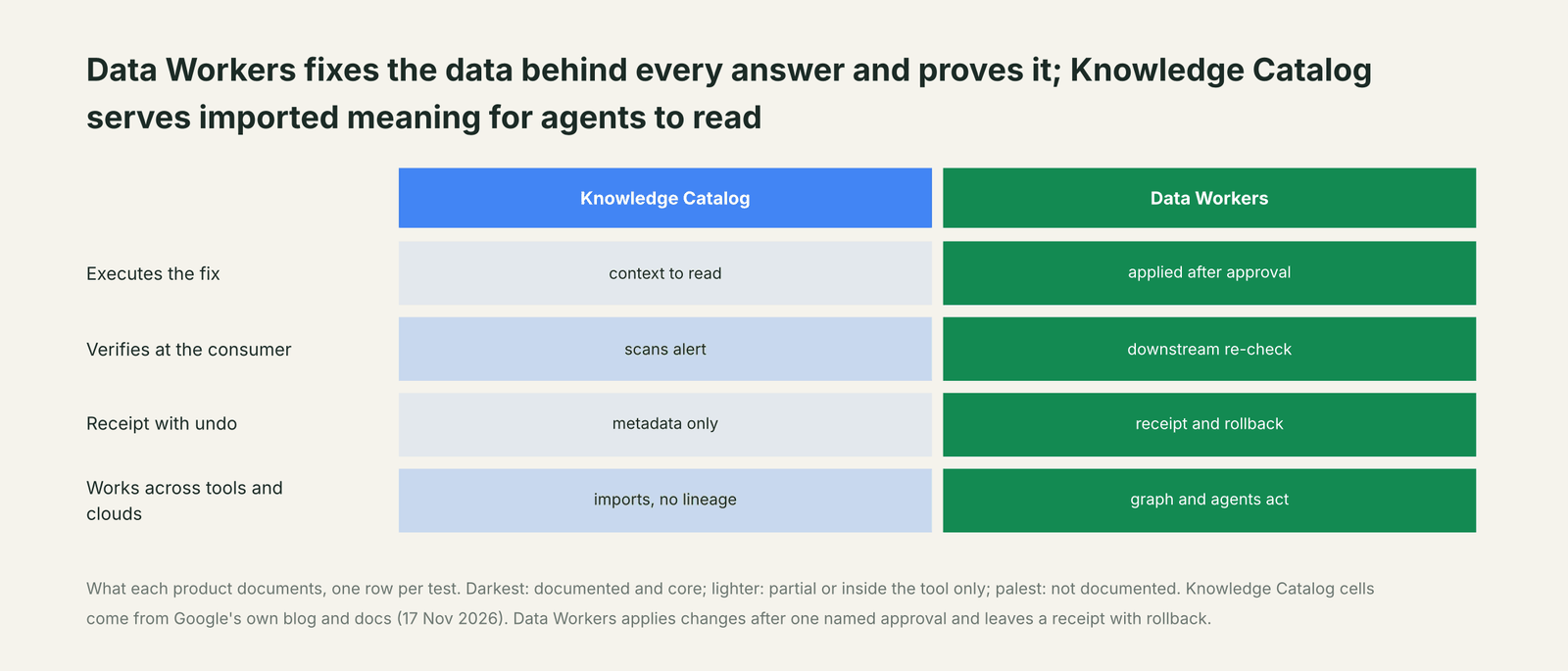
We score every vendor on the same four tests: does it execute the fix, verify the outcome at the consumer, leave a receipt with undo, and work across tools and clouds. The cells for Knowledge Catalog come from Google's own blog and docs, checked Nov 17, 2026.
| Test | Google Knowledge Catalog | Data Workers |
|---|---|---|
| Executes the fix | Serves context to agents; the catalog MCP tools are search, lookup and lookup_context, with writes limited to data products. | Agents apply the fix after one approval from a named human, after a dry-run. |
| Verifies at the consumer | Data quality scans report and alert; nothing re-checks a downstream model or dashboard after a change. | After a fix, the Conductor re-checks the data against quality and contract assertions and only then closes the incident. |
| Receipt with undo | Catalog metadata changes; there is no data change to receipt or roll back. | Every change ships with a receipt (what, why, blast radius) and rollback. |
| Works across tools and clouds | Imports Snowflake and Databricks metadata on a schedule; the Snowflake and Databricks connectors state "Lineage isn't supported." | One context graph across Snowflake, Databricks, BigQuery, dbt, Airflow and BI, with agents that act in each. |
Semantic models that inform, not context that acts
Google's headline is accuracy: "grounding agents in Knowledge Catalog makes them nearly 4X more accurate, with up to 33% lower latency, and using up to 75% fewer tokens," based on internal benchmarks. We agree with the direction. Grounding agents in governed meaning beats letting them guess. Google does not name the benchmark, the questions or the baseline, and TechTarget's coverage notes the result has not been independently verified.
The bigger gap is what the definitions sit on. A metric definition imported from Snowflake is only as good as the table under it. When a source system adds a status value and a dbt model drops it, the semantic model stays perfectly defined and the answer is still wrong. Knowledge Catalog will show the agent the definition, a profile and a quality score. It will not trace the cause into dbt, fix it, rerun the job and prove the number is right again.
The imports also run on a schedule. Google's connector docs describe each run as a full overwrite through BigQuery Data Transfer Service, and the Snowflake connector notes metadata can lag up to 24 hours. Lineage does not come across from Snowflake or Databricks, and the Databricks connector does not bring glossaries or semantic tags.
So the Index grade for Knowledge Catalog, by the same rules that graded every vendor: L2, propose. Gemini drafts descriptions and insights and data products can be written, but nothing changes in your pipelines or data. Data Workers sits at L3 on incidents, data quality and schema review: it applies the fix after approval and leaves a receipt with rollback. See the Agentic Data Engineering Index for the scale.
Knowledge Catalog semantic models vs the Data Context Wizard
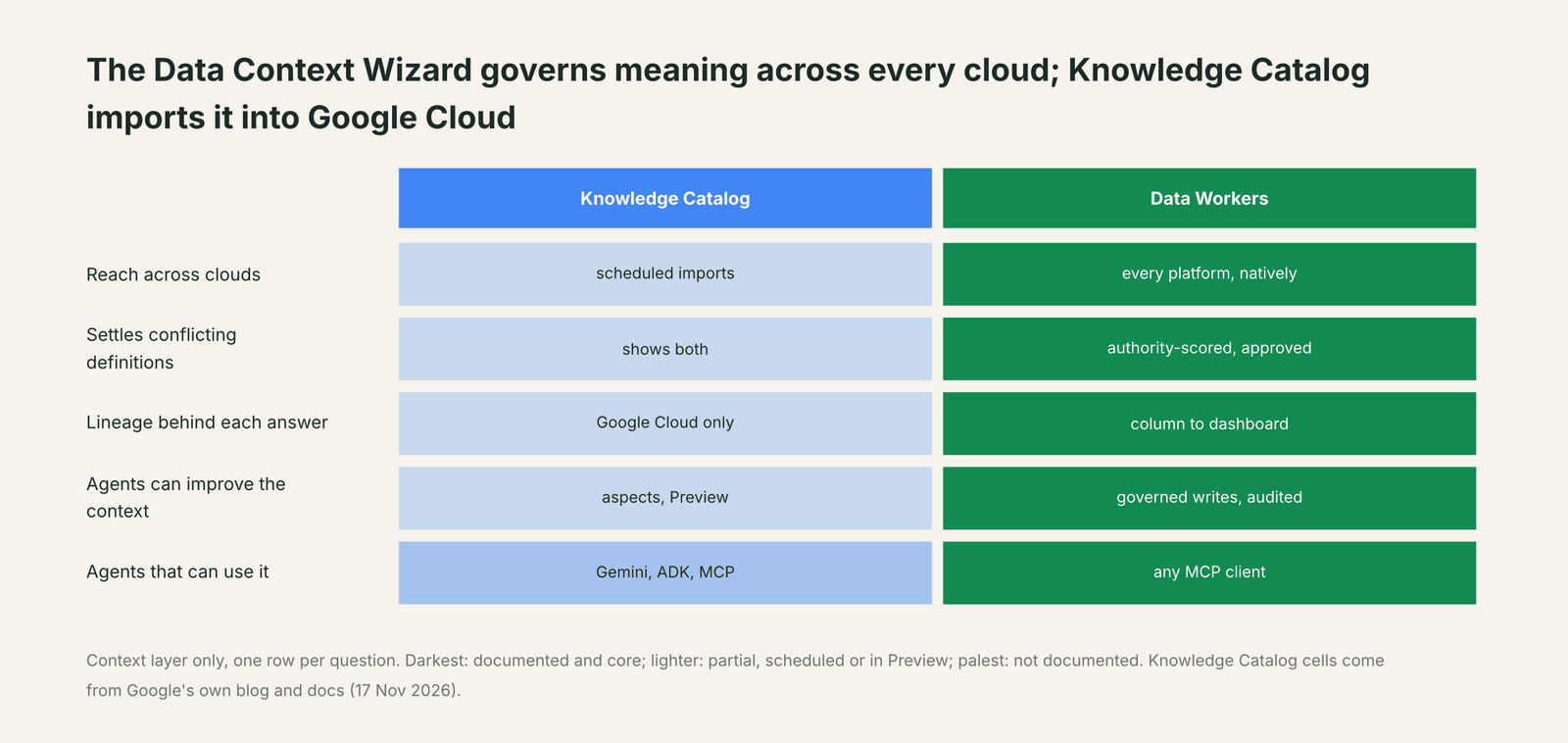
Both give AI agents one graph of meaning. The Data Context Wizard is the context layer of the Data Workers platform: a living semantic and knowledge graph of the data layer, provenance-stamped, governed and kept current by the agents that use it. It wins on every line that decides whether an agent's answer can be trusted.
| Context question | Knowledge Catalog | Data Context Wizard |
|---|---|---|
| Where does the graph reach? | Google Cloud first; Snowflake and Databricks imported on a schedule, without lineage. | Every connected warehouse, transformation project, orchestrator, catalog and BI tool, natively. |
| Who settles two definitions of one metric? | Both appear with provenance; the agent sees both. | Authority-scored definitions; a named human approves what becomes authoritative, and answers follow it. |
| Can you trace a number to its source? | Lineage inside Google Cloud; none from the Snowflake and Databricks connectors. | Column- and table-level lineage across dbt, OpenLineage and every connected platform, in the same graph as the definitions. |
| How does it stay current? | Scheduled full overwrites; enrichment agents in Preview. | Drift is detected, stale context is flagged and re-crawled, and every agent run writes back what it learned. |
| Can agents improve the context? | Gemini writes aspects; context sets are curated in Preview. | Yes, through a governed write path: PII scrubbed before storage, checked against the ontology, guarded by authority, every write audited. |
| Which agents can use it? | Gemini agents, Conversational Analytics, ADK and MCP clients. | Any MCP client: Claude Code, Cursor, Codex, OpenCode and your own harness. |
The difference that compounds is who keeps the meaning alive. Knowledge Catalog stays current by re-importing what other tools say. In the Wizard, every incident resolved and every fix verified is written back into the graph, so the next answer starts from better context. Our whitepaper Why the Data Layer Needs Its Own Context Layer makes the full argument.
Why doesn't Google just do this itself?
Google built Knowledge Catalog to describe, check and serve Google Cloud metadata under IAM, and to make Gemini agents better at answering questions. Importing other vendors' semantic models read-only is the safe choice for that job. Fixing the data is a different product. The cause of a wrong number usually sits in dbt, Airflow, Snowflake or a source system that Google does not run. Changing those safely needs blast-radius scoping across other vendors' tools, approvals from the owners of each definition, rollback for changes Google did not build, and liability for the result. As one analyst told TechTarget, an agent that answers a question is different from one that can safely run a business process. That second product is Data Workers.
How Data Workers does it
Each domain starts observe-only and the dial goes to fully autonomous. The Autonomous Data Conductor detects the problem, diagnoses it, proposes the fix, dry-runs it and applies it under autonomy guardrails per domain. The Data Context Wizard supplies the approved definition and computes the blast radius: which models, dashboards, metrics and agent tools sit downstream. The Spellbook Data Catalog keeps the ledger: the proposal, who approved it, what changed and the rollback. For why a named human approves anything irreversible, read is it safe to let AI agents change production data.
Data Workers already works with Google Knowledge Catalog. It reads catalog entries, search and lineage through the Knowledge Catalog APIs, agents read lookup_context over Google's MCP server, and it imports the same dbt MetricFlow and Databricks metric view definitions straight from the source, so Gemini agents and every other agent read the same meaning.
One question, with Knowledge Catalog and with Data Workers
This is an illustration, not a customer case. A finance lead asks a Gemini agent for last week's net revenue. On Monday, a billing release added a partially_refunded status in Postgres, and the dbt model fct_revenue in Snowflake, which feeds the Snowflake semantic view behind the net revenue metric, started dropping those orders.
With Knowledge Catalog:
- •08:30 The agent calls lookup_context and gets the net revenue metric from the imported Snowflake semantic view, with its description and a passing freshness check.
- •The definition is right, so the agent returns the number. It is 3.1% low.
- •14:00 A controller notices the gap against the billing system. A data engineer traces Looker to dbt to Postgres by hand, since no lineage came across from Snowflake.
With Data Workers:
- •06:05 The schema agent sees the new status value land through CDC and flags the dbt case statement that does not map it.
- •06:08 The Context Wizard traces
fct_revenue, the approved net revenue definition, two Looker dashboards and the agent tools that query it, and attaches the blast radius. - •06:12 The Conductor proposes the mapping and dry-runs it against last week's data.
- •06:25 The finance data owner approves in Spellbook.
- •06:40 Airflow reruns the partition, the Conductor re-checks net revenue against the billing total, and the receipt records the change and the rollback. The 08:30 question gets the right number.
Which one should the data team own first?
If your estate is BigQuery and Looker and your goal is a well-governed Google catalog for Gemini, Knowledge Catalog covers it well. For a data team whose agents answer business questions or change pipelines across more than one platform, Data Workers is the better choice: the same Monday release costs a wrong board number and an afternoon of tracing with Knowledge Catalog, and is caught, fixed and verified before anyone asks with Data Workers. Teams building toward an autonomous data platform own Data Workers first and keep Knowledge Catalog as their Google metadata store. For building on top of it, see You're on Google Knowledge Catalog, and for the wider field, Google Knowledge Catalog open source alternatives.
FAQ
Is Data Workers an alternative to Google Knowledge Catalog?
For data teams that want agents to act, yes. The Data Context Wizard gives agents governed context across every warehouse, semantic layer, catalog and lineage graph, and Data Workers agents use it to answer questions and to fix the data under them. Knowledge Catalog serves Google Cloud metadata and imported semantic models for agents to read.
Does Data Workers integrate with Google Knowledge Catalog?
Yes. Data Workers reads Knowledge Catalog entries, search results and lineage through its APIs, and agents read lookup_context over Google's MCP server. The dbt MetricFlow and Databricks metric view definitions Knowledge Catalog imports, Data Workers imports straight from the source.
What are semantic models in Knowledge Catalog?
They are metric and entity definitions imported from other tools: Looker LookML, BigQuery measures, dbt MetricFlow, Snowflake Semantic Views, Databricks Metric Views and SAP CSN. Google links them with schema, lineage, profiles and the glossary in one context graph. It does not introduce its own semantic format.
Is the 4x accuracy claim independently verified?
Google cites internal benchmarks and does not name the question set or baseline. TechTarget reported that the result is Google's own and not independently verified.
Does Data Workers change production without a human?
Only as far as you allow, per domain. Each domain starts observe-only, changes wait for a named approver, and the dial goes to fully autonomous when you choose.
The outcome
Reduce your data ops to zero. Knowledge Catalog tells Google's agents what your data is supposed to mean, one slice of the job. Data Workers governs that meaning across every cloud and runs the platform under every answer with agents, across pipelines, quality, schema change, cost and access. Keep your critical data products correct and available, and restore them when they break.
Sources
- •Google Cloud blog, expanded semantic model support in Knowledge Catalog, Oct 29, 2026, checked Nov 17, 2026
- •Knowledge Catalog release notes, checked Nov 17, 2026
- •Knowledge Catalog context sets docs, checked Nov 17, 2026
- •Knowledge Catalog connectors docs, checked Nov 17, 2026
- •Knowledge Catalog Snowflake Horizon connector docs, checked Nov 17, 2026
- •Knowledge Catalog Databricks Unity connector docs, checked Nov 17, 2026
- •Knowledge Catalog MCP reference, checked Nov 17, 2026
- •TechTarget, Google targets agentic AI accuracy, Nov 4, 2026, checked Nov 17, 2026
- •Agentic Data Engineering Index