From Databricks to an Autonomous Data Platform: A Stage-by-Stage Playbook
A practical path from a traditional data team on Databricks to an agentic enterprise: five autonomy levels, what to turn on at each one, and how to know when to move up.
The best way to go agentic with Databricks is to keep the lakehouse and Unity Catalog, and add Data Workers, the autonomous agentic data platform. Its agents fix, approve and record the back-office work (pipelines, governance, catalog, cost and incidents) across Databricks and every system next to it, raising autonomy one domain at a time.
Our mission is to help traditional data teams and data platforms become agentic enterprises. This playbook is the practical version of that mission for teams whose Databricks estate is where the work happens.
Most Databricks teams today are a traditional data team with good tools. People do the work, with Genie Code in notebooks and Claude Code or Cursor on the side. Genie One and Genie Agents answer questions. Genie ZeroOps, in private preview, proposes fixes for Databricks assets. The engineers are still the ones who notice the broken pipeline, write the fix, chase the approval, file the access grant and explain the bill.
An autonomous data platform flips that. Agents do the back-office work (governance, compliance, pipelines, catalog upkeep, cost and incidents) across Databricks and Snowflake, BigQuery, dbt, Airflow and your BI tools. People set the rules, approve what needs approving, and handle the exceptions. You don't get there in one step, and you shouldn't try. You get there one domain at a time, moving up a ladder as the evidence builds.
In short
- •Five levels, set per domain. L0 manual, L1 observe, L2 propose, L3 act reversibly, L4 autonomous. Access requests can be at L3 while net-new pipelines are still at L2.
- •Unity Catalog stays the lock. Every agent acts through Unity Catalog grants, so nothing goes around your existing controls.
- •You move up on evidence, not faith. Every change leaves a tamper-evident receipt. A domain moves up a level when its receipts show the agents have been right, and it can be moved down at any time.
- •The first quarter is concrete. Connect and observe, then turn on proposals in three domains, then let the lowest-risk ones act on their own.
Ways to go agentic on Databricks
Every option below is useful. They differ in where the agent can act and who answers for the change.
| Option | What it does | Where it can act | Governed writes |
|---|---|---|---|
| Data Workers | Runs the back office across Databricks, Snowflake, BigQuery, dbt, Airflow and BI | The whole estate, every platform and tool | Yes: propose-first, a named approver and a receipt on every change |
| Genie Code | Helps an engineer write and fix code in a notebook | Inside the Databricks workspace | The engineer reviews their own change |
| Genie ZeroOps (private preview) | Proposes fixes for Databricks jobs, pipelines and tables | Databricks assets | Inside Databricks permissions |
| Genie One and Genie Agents | Answer questions over Unity Catalog tables | Reads other platforms through federation | Answers; does not change the estate |
| A coding agent on the warehouse (Claude Code, Cursor) | Writes code a person reviews and runs | Wherever its credentials reach | An instruction to behave; no per-agent authority |
Best for a team that wants the work done, not only answered: Data Workers, with Unity Catalog as the lock and Genie kept for business users.
The five levels
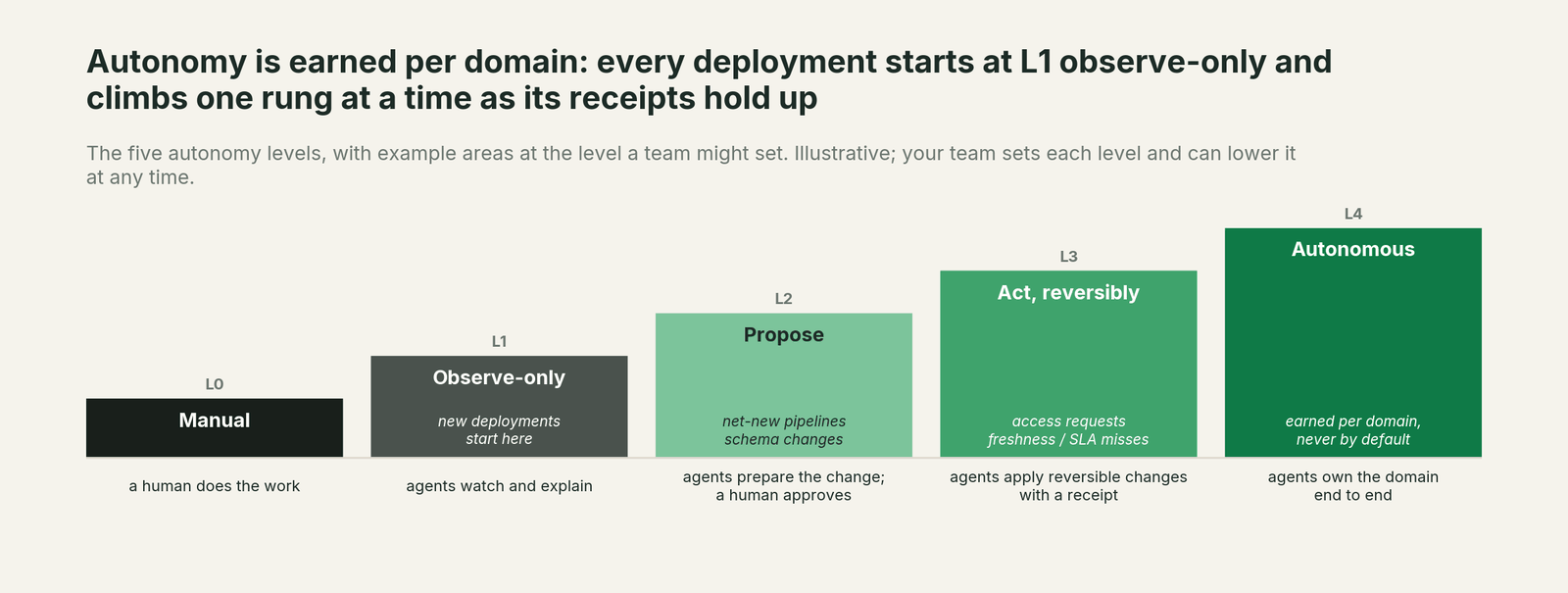
| Level | What agents do | What people do | Typical Databricks domains at this level |
|---|---|---|---|
| L0 manual | Nothing on their own. Copilots help a person who asks. | All of the work. | Where most teams are today. |
| L1 observe | Read dbt, orchestration and BI metadata, Unity Catalog grants and metric views, and the system-table history your coding agent hands over, build the context graph, and explain what's happening. | Read the explanations, correct the context. | Every domain on day one. |
| L2 propose | Prepare the complete change: the diff, the grant, the migration batch, with a blast-radius report. | Approve, steer, send back. | Net-new pipelines, schema changes, policy changes. |
| L3 act reversibly | Apply changes that can be undone, inside a pre-approved blast radius, and leave a receipt. | Review receipts; roll back if needed. | Access requests, freshness and SLA fixes. |
| L4 autonomous | Own the domain end to end: detect, fix, verify and remember. | Set policy; handle exceptions. | Earned per domain, never by default. |
What to turn on at each level
L1 observe: connect and watch. Connect Data Workers to Databricks and to Snowflake, BigQuery, dbt, Airflow and your BI tools. Nothing moves and nothing is copied. Data Context Wizard builds one governed graph from dbt, orchestration and BI metadata, Unity Catalog grants and metric views, and the system-table and Lakeflow history your coding agent hands it over MCP. Spellbook Data Catalog turns that graph into asset pages your team can read and correct.
What you get right away: end-to-end lineage across every platform, an incident history that shows where problems really start, and a first map of every job, table and dashboard that depends on each Delta table.
Move up when: your team trusts the graph. Owners and definitions are corrected, and the agents' explanations of recent incidents match what your engineers found.
L2 propose: start with three domains. Pick three domains with high volume and clear rules. For most Databricks teams that's access requests, freshness and SLA misses, and cost cleanup. Turn on the matching agents (Access & Governance and Identity, the Autonomous Data-Conductor, and Cost Savings & Cleanup) in propose mode. Every proposal lands in the Spellbook inbox with its blast radius.
What you get: the toil is prepared for you. An access request arrives as a ready-to-approve grant through Unity Catalog grants. A late table arrives with its root cause and a fix attached.
Move up when: a domain's proposals are approved as-is, week after week, with no reversals.
L3 act reversibly: let the reversible work run. For domains that pass, let agents apply reversible changes inside a blast radius you define: grants that expire, reruns and backfills. Each change leaves a tamper-evident receipt and can be undone through its rollback path. At the same time, move the next domains to L2: schema evolution, data-quality rules and PII masking proposals.
This is also the right time to start Hive metastore and Glue into Unity Catalog. The Data Migration agent plans reviewable waves with their parity checks (row counts, checksums and statistical profiles), proposes the comparison queries your team runs, and holds the completion gate for the owner's sign-off while the legacy system stays live. Each wave is one approval.
What you get: the first real hours back. Most of the tickets your team used to work by hand now close on their own, with a receipt your auditors can read.
Move up when: the reversal rate stays near zero and exceptions are rare and well understood.
L4 autonomous: domain by domain. A domain at L4 is owned end to end. The Conductor detects the problem, has the right agent fix it wherever it lives, confirms the downstream number is right, and records what happened so the next occurrence is faster. People set policy and handle what the agents escalate. You'll reach L4 in some domains within a few quarters. Net-new pipeline design may stay at L2 for a long time, and that's fine.
A first quarter on Databricks
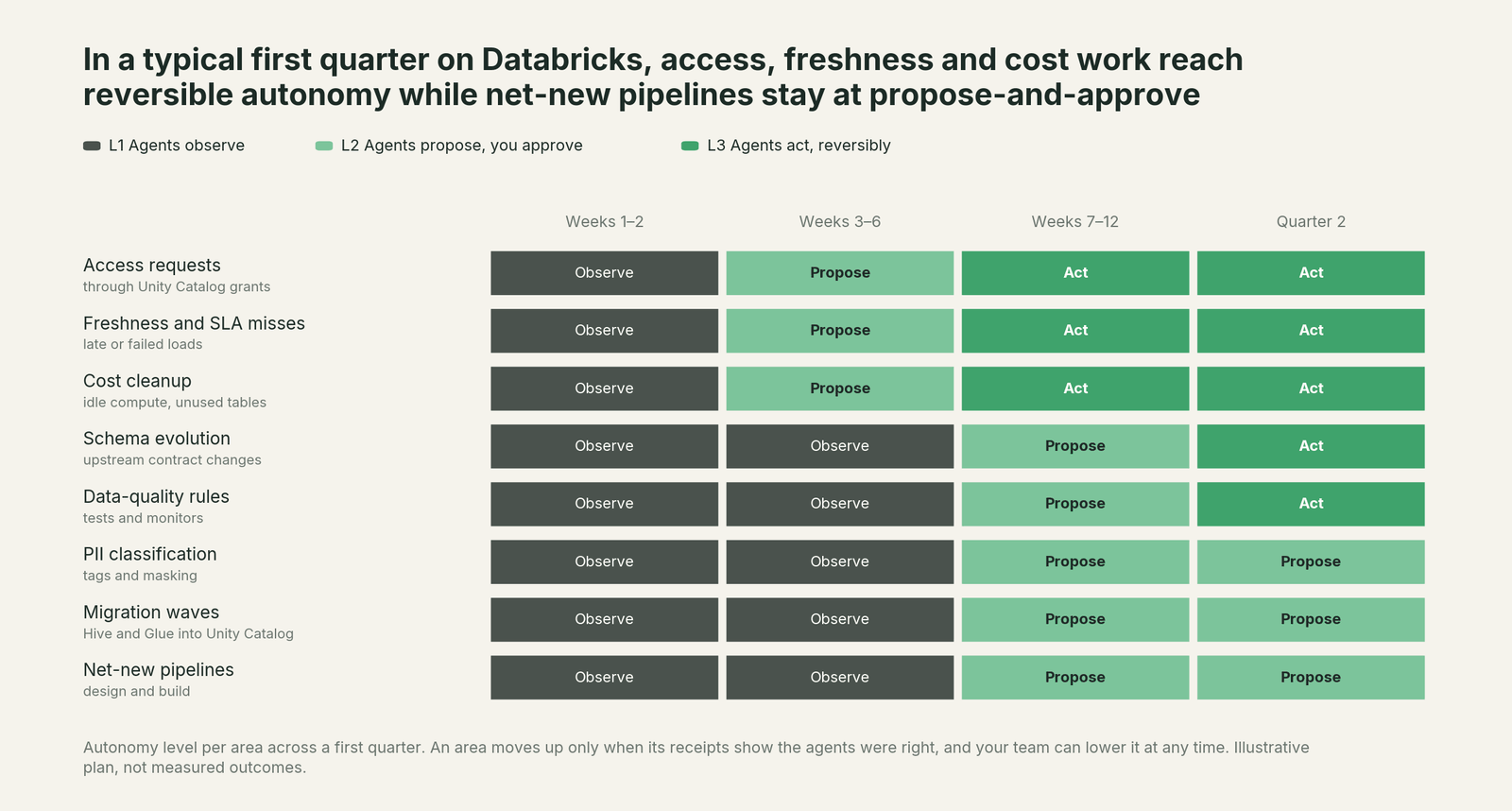
This is an illustrative plan, not a promise. The pace depends on how clean your context is and how much evidence each domain builds up.
How to measure progress
Report these to your leadership every month:
- •Share of back-office tasks closed by agents, by domain and level.
- •Time from detection to verified fix for incidents.
- •Reversal rate, the share of agent changes that were rolled back. This is the number that earns each level.
- •Databricks spend and total warehouse spend, month over month.
- •Engineer hours on maintenance, which is the number the whole program exists to shrink.
Why doesn't Databricks just do this itself?
Because Databricks' business is the lakehouse, and its agents are built to make that workspace the best place to work. Genie One answers over Unity Catalog tables, Genie Code helps an engineer in a notebook, Genie ZeroOps (private preview) proposes fixes for Databricks jobs, pipelines and tables, and federation reads Snowflake, BigQuery and the rest without changing them. That keeps every agent action inside a permission model Databricks enforces, which is the right design for a platform serving thousands of customers.
Climbing this ladder across a whole estate is a different product. It needs blast-radius scoping across Delta tables, dbt models, Airflow DAGs, other warehouses and dashboards; approvals that vary by domain; rollback; a receipt for every change; context about systems Databricks doesn't host; and responsibility for changes made in tools Databricks doesn't run. That's the product Data Workers is.
The case for your CFO
The outcome is a data team that spends its hours on new work while the back office runs itself: access granted the day it's asked for through Unity Catalog grants, late and broken tables fixed where the problem started and checked before the business opens the dashboard, and spend on Databricks and every platform next to it that falls because each fix reaches the owner of the workload behind it, dependencies checked.
The risk story is short. Agents start at L1 observe. They earn each level per domain on their own record, act only through the Unity Catalog grants and warehouse roles you give them, and leave a receipt on every change: who or what made it, why, what it touched and how to undo it. No agent approves its own work, anything irreversible needs a named person's approval, and nothing is migrated to start.
Why now: Genie, Genie Code and managed MCP servers mean agents already work on your estate, one workspace and one session at a time. A ladder per domain puts that work under one approval flow and one record. The first win is usually access requests, freshness misses or cost cleanup, where the measures in this playbook move inside a quarter.
What stays the same: Databricks, Unity Catalog, Genie for business users, your dbt project, your orchestrator and the people who use them.
The path is a pilot. A forward-deployed engineer connects your estate and runs the first domains with your team, and the pilot is credited in full against the first year. See pricing for how it works.
The sentence to repeat upstairs: Databricks is our lakehouse; Data Workers gives the estate one crew that fixes, approves and records the work, and we raise its autonomy one domain at a time as it earns it.
Frequently asked questions
What is the best way to go agentic with Databricks?
Keep Databricks and Unity Catalog, and add Data Workers as the agentic layer that runs the back office across the estate. Start every domain at observe, turn on proposals where the receipts look right, and let the lowest-risk domains act on their own. Genie stays the answer box for business users.
Do I have to move off Databricks or Unity Catalog?
No. Data Workers acts through the Unity Catalog grants you give it and never creates a second permission system. Nothing is migrated to start, and Databricks, Genie, your dbt project and your orchestrator stay as they are.
How is Data Workers different from Genie Code?
Genie Code helps one engineer in a notebook. Data Workers is a crew of specialised agents that detects, fixes, gets approval for and records changes across Databricks and the systems around it, so the work is done once and audited, not repeated session by session.
How fast does the first domain run on its own?
The first quarter is concrete: connect and observe, turn on proposals in three domains, then let the lowest-risk ones act. Access requests, freshness misses and cost cleanup usually move first. The path is a fixed-price pilot with a forward-deployed engineer, credited in full against the first year.
What stays the same
- •Unity Catalog stays the enforcement point. Data Workers acts with the permissions you grant and never creates a second permission system.
- •Business users keep the tools they like. Genie One still answers inside the workspace, and Spellbook adds one chat box across the estate, with Slack and Teams coming. Autonomy here is about the back office.
- •Your engineers stay in charge. They set the levels, approve what needs approving, and can lower any domain's level at any time. Nothing becomes authoritative without a named person's approval.
For the side-by-side of what Databricks covers and what Data Workers adds, read Data Workers on Databricks. For the thinking behind the levels, read our thesis and the whitepaper Context Is Not All You Need.