You're on Revefi: Its AI DBA Watches Spend and Quality. Data Workers Fixes What Breaks and Proves It
Revefi's AI DBA watches data spend and quality signals and tunes the platform. Data Workers fixes what breaks in the data and proves it fixed, behind approvals.
Your team hired the Revefi AI DBA the way Revefi suggests: like a teammate. It is 18 agents, one orchestrator over six sub-agents per platform (FinOps, Observability, Quality, Spend Optimization, Performance Tuning, Governance) on Snowflake, Databricks and BigQuery, powered by RADEN, the agent Revefi also lists on the Snowflake Marketplace. It tracks credit burn and chargebacks, watches row counts and freshness, right-sizes the warehouses you hand it for auto-management, shuts idle clusters down and, in Revefi's words, "stops in-flight bad actors autonomously". You assign it work in Slack, Jira or the Revefi product. Revefi is the AI DBA on watch: it watches data spend and quality signals and keeps the platform lean. Data Workers is the owner of the fix and its proof: when a signal means a table is wrong, it fixes the data and proves it fixed, behind a named owner's approval.
That split matters most on the nights when both are right. The AI DBA stops a query burning credits far past its pattern. It was the approved backfill finance needed for the close. Somebody has to own what happens next.
Key takeaways
- •Revefi keeps its job. Spend, warehouse sizing, cluster tuning and platform monitors stay with the AI DBA.
- •A signal becomes a fixed table. Data Workers reads the failed orchestrator run, traces the models downstream and the dashboards the team has noted, and drafts the fix for the model's owner.
- •Every fix is proven. After the approved rerun, Data Workers checks the rebuilt table and the team's baselines, and records the result in a receipt.
- •The cost trail stays honest. Data Workers traces Snowflake credits to the query and the dbt model behind them through query tags.
- •Autonomy per domain, from L0 manual to L4 autonomous, at the pace your team sets.
Revefi is the AI DBA on watch. Data Workers is the owner of the fix and its proof.
Here is a close night with both in place, across Fivetran, Snowflake, Airflow, dbt Core, Revefi, Tableau and Jira. This is an illustrative example. On Tuesday finance added a NetSuite segment, cost_center_v2. Fivetran synced the column, and the analytics engineer added it to fct_gl_journal_lines, the general-ledger fact table. A full-refresh backfill is approved for Wednesday night under change ticket FIN-482 in Jira. Revefi has auto-managed TRANSFORM_WH since last quarter, with MODIFY and OPERATE on it. The estate runs Airflow 2.
| Time | System | What happens |
|---|---|---|
| Wed 23:30 | Airflow | The gl_backfill DAG run starts dbt run --full-refresh --select fct_gl_journal_lines+ on TRANSFORM_WH: six years of journal lines with the new segment |
| Thu 01:15 | Revefi | Well into the run, the AI DBA stops the in-flight query as a bad actor: it has scanned far more than this model's normal nightly run, on a warehouse it manages, and records the action in its memory |
| 01:15 | Snowflake and dbt Core | The full refresh fails before it swaps the table in, so Snowflake keeps the old fct_gl_journal_lines: no new segment, nothing posted since Tuesday. Six downstream models skip |
| 01:16 | Airflow | The task fails and the DAG run ends failed |
| 01:22 | Data Workers | It reads the failed DAG run and task instance from Airflow. The lag baseline the team records on fct_gl_journal_lines reads 50 hours against a normal 26 |
| 01:25 | dbt, Tableau, Slack | blast_radius_analysis returns mrt_trial_balance, mrt_cost_center_pnl and four more models from the dbt manifest; context-graph notes add the Tableau Close Day 2 workbook the controller opens at 08:00. A Slack card goes to the GL model owner and the workbook owner |
| 06:00 | Revefi | Revefi's Freshness monitor flags mrt_trial_balance and posts in the data team's Slack channel, right on its learned schedule. The owners have had Data Workers' diagnosis since 01:25 |
| 06:10 | Revefi | The platform owner checks the AI DBA's record of actions and confirms it stopped the backfill query |
| 06:20 | GitHub and Spellbook | Data Workers drafts the fix as a diff for the GL model owner: the gl_backfill DAG runs as six yearly batches through dbt --vars, each a shorter query, with a gl_backfill query tag. It also drafts a note for the platform owner to give the AI DBA |
| 06:35 | Revefi and Slack | The platform owner assigns the AI DBA the note in Slack: work tagged gl_backfill on TRANSFORM_WH is approved under FIN-482 |
| 06:40 | Spellbook | The GL model owner merges the diff and approves the rerun. The workbook owner pauses the 08:00 Tableau refresh |
| 06:41 | Airflow | Data Workers queues the approved gl_backfill DAG run with trigger_airflow_dag |
| 09:05 | Snowflake | The six batches finish. run_quality_check passes nulls and uniqueness on journal_line_id (the distinct ratio holds, so no batch loaded twice). The lag baseline is back in range, and the debits-minus-credits metric the team records per period sits on its baseline of zero |
| 09:10 | Tableau | The workbook owner refreshes Close Day 2, and the controller opens it at 09:15 with the new segment |
| Fri 10:00 | Snowflake and Jira | Once Snowflake's usage views catch up, the receipt adds the credits for the stopped query and the batched rerun, traced through the dbt query tag to fct_gl_journal_lines. The engineer links the receipt from FIN-482 |
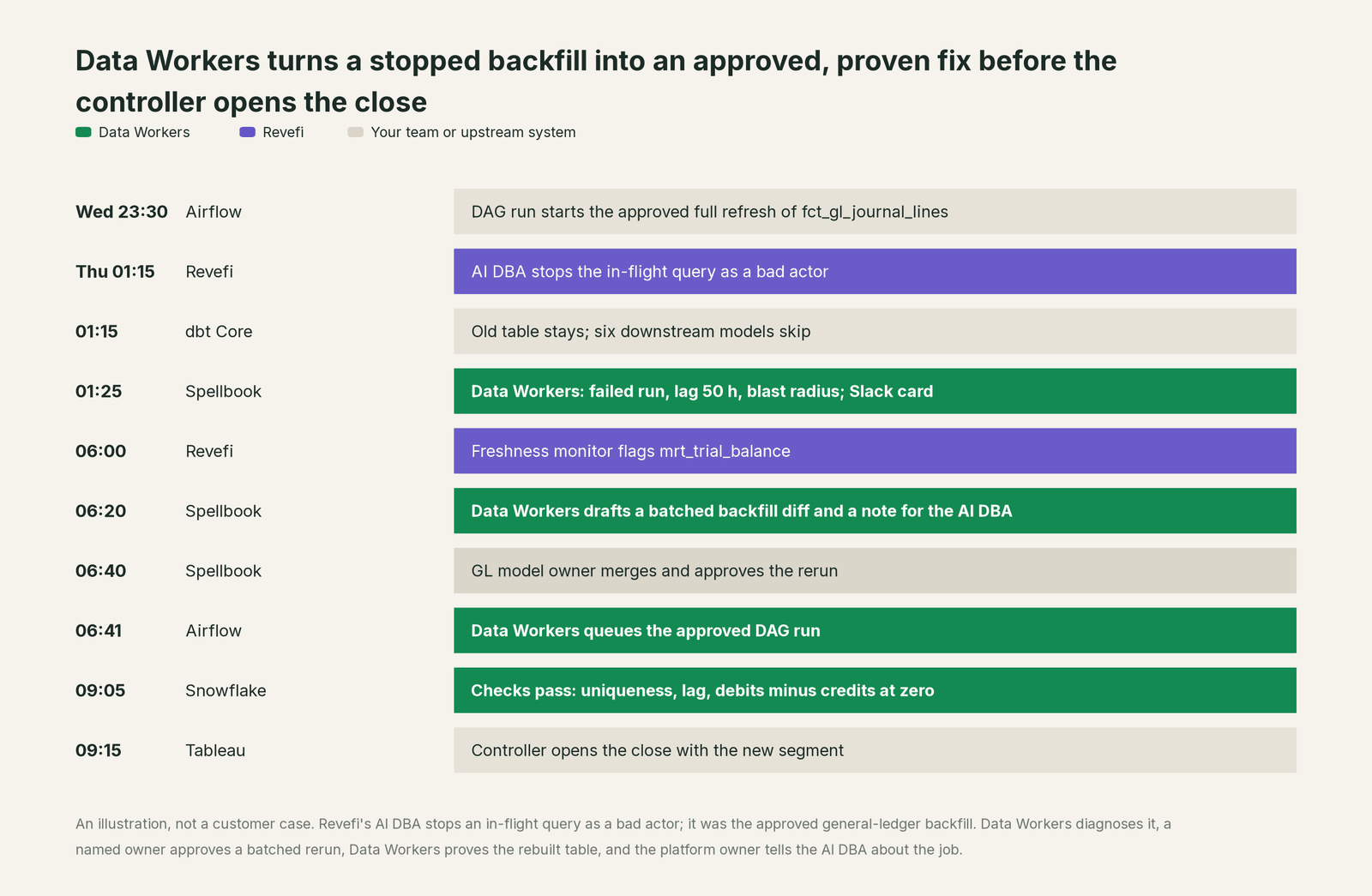
Revefi did what it was hired to do: a query far past its pattern on a managed warehouse looks like waste, and stopping it is the DBA's call. What it could not weigh was that this query was the approved change finance was waiting for, with six models and a close workbook behind it. Data Workers had the diagnosis at 01:25, the fix approved by 06:40 and proof by 09:05, and the protection reached the AI DBA through the person who owns the warehouse.
| Job | What Revefi does | What Data Workers does |
|---|---|---|
| Spend | Tracks credit burn, chargebacks and budgets; takes autonomous savings actions | Traces Snowflake credits to the query and dbt model through query tags, inside the receipt |
| Platform | Right-sizes auto-managed warehouses, scales clusters down, stops in-flight bad actors | Drafts warehouse notes and settings for the platform owner; never resizes or stops anything |
| Quality signals | Row count, freshness and failure monitors with learned thresholds | Turns the signal into a diagnosis: which run failed, which models are behind, who reads them |
| The fix | Opens tickets and pull requests for platform changes | Drafts the data fix as a diff for the model owner and queues the rerun through the orchestrator after approval |
| Proof | The monitor clears on the next update | Checks the rebuilt table and the team's baselines, and records the result |
| The record | Organizational memory of every action it takes | A receipt: cause, change, approver, what it touched, how it was verified, its model cost |
Why doesn't Revefi just do this itself?
Revefi is built as a DBA, and that is a sound design. Its object is the platform: warehouses, clusters, queries, roles and the bill. It starts with what its AI DBA page calls a "read-only, metadata-only integration", reads native metadata APIs and system tables rather than proxying queries, and only takes over a warehouse when you grant it MODIFY and OPERATE on that warehouse. Its quality monitors learn from metadata too: row counts, write activity, update intervals. That posture is why security teams sign off on it quickly.
Fixing a broken table needs the opposite posture. To know the stopped query was the approved backfill, you need the orchestrator run and the change record. To know which close numbers it touched, you need dbt lineage and notes on which workbook reads which model. To fix it, you need the model owner's merge, an approval, a rerun through Airflow and checks on the rebuilt rows. That work crosses Snowflake, dbt, Airflow and Tableau, carries the liability of changing finance data, and needs a receipt an auditor can read. It is a different product, and it is the one Data Workers is.
Every tool owns a slice. Data Workers covers the whole lifecycle
Revefi owns data spend and platform operations, and owns them well. Each point tool adds another console, contract and handoff. Data Workers covers the whole lifecycle with one context, one approval flow and one audit trail, and builds on Revefi where it runs.
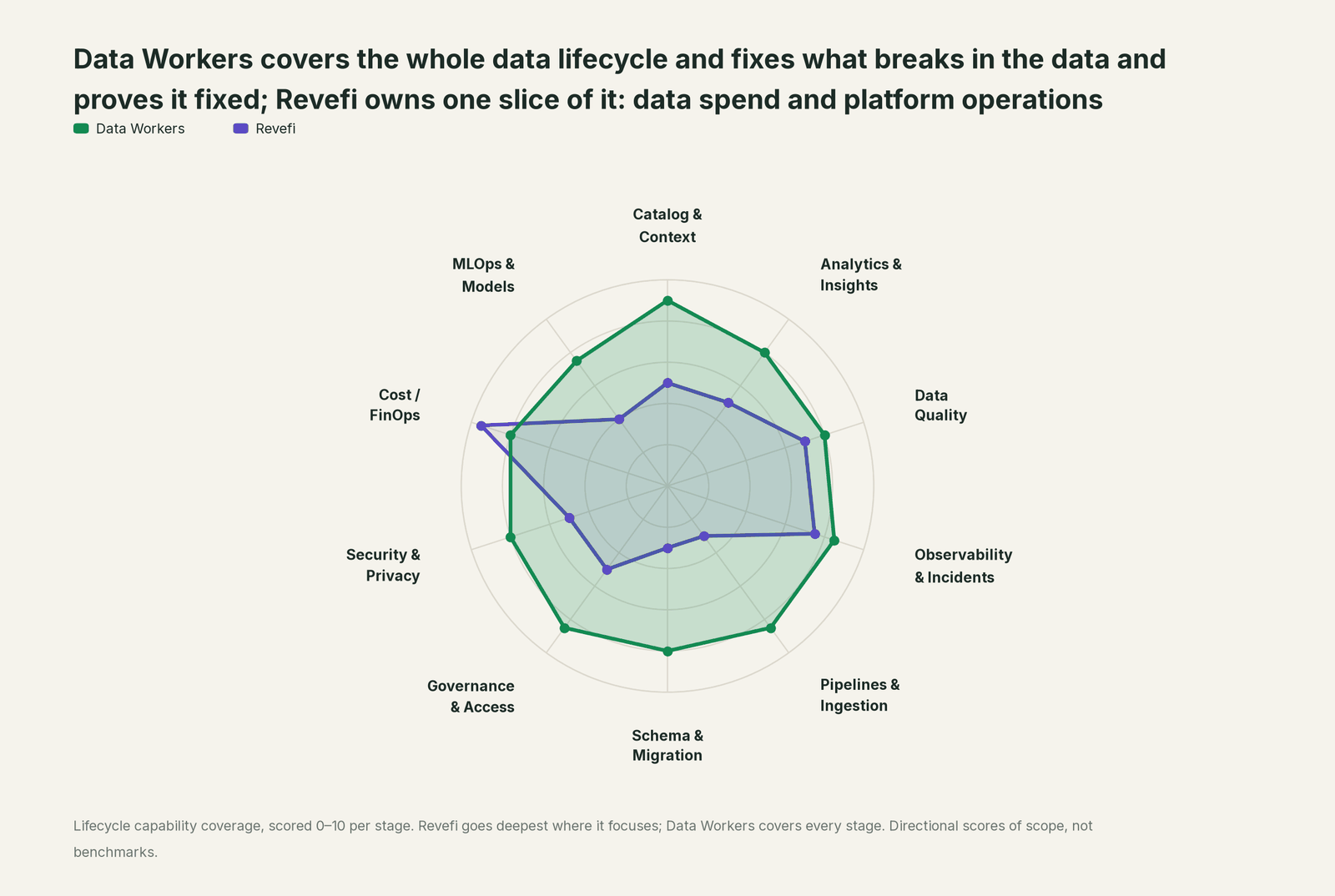
| Stage | Data Workers | Revefi | Why we scored it this way |
|---|---|---|---|
| Catalog & Context | 9 | 5 | Usage views per warehouse, user and table, plus Alation and Atlan integrations; no governed context graph of definitions and owners. Data Workers keeps one. |
| Analytics & Insights | 8 | 5 | Cost, usage and data-product adoption reports. Data Workers answers data questions from governed definitions. |
| Data Quality | 8 | 7 | Row count, freshness and failure monitors with learned thresholds, plus custom monitors by API. Data Workers adds checks on the rows and fixes behind approvals. |
| Observability & Incidents | 8.5 | 7.5 | Strong platform signals and root-cause work on slow and failed queries. Data Workers takes a data incident through diagnosis, an owner-approved fix and proof. |
| Pipelines & Ingestion | 8.5 | 3 | Watches pipeline health from metadata. Data Workers reads the orchestrator run and queues the approved rerun. |
| Schema & Migration | 8 | 3 | Detects schema drift; Gen 1 to Gen 2 warehouse conversions are platform work. Data Workers reads dbt manifest changes and scores their blast radius. |
| Governance & Access | 8.5 | 5 | User and role management and access reviews on the platform. Data Workers routes every data change to a named owner, with expiry and escalation. |
| Security & Privacy | 8 | 5 | Governance agents cover RBAC policy, masking and access audit reports, from a metadata-only start. Data Workers keeps a receipt on every data change. |
| Cost / FinOps | 8 | 9.5 | Revefi's home stage: credit burn, chargebacks, autonomous savings actions and warehouse right-sizing across Snowflake, Databricks and BigQuery, plus AI token spend. Data Workers traces Snowflake credits to the dbt model and drafts the data-side fix. |
| MLOps & Models | 7.5 | 4 | Token economics and observability for LLM and agent calls; no feature or training-data work. Data Workers keeps the tables under your models checked. |
Directional scores of scope, not benchmarks. See also Data Workers on Snowflake and Data Workers on Databricks.
How Revefi and Data Workers work together
Engineers ask in Claude Code or another MCP client; approvers get requests in Slack. Spellbook Data Catalog (in preview) is where the data team looks: each proposed change, its approver and how to roll it back. Underneath, Data Context Wizard keeps one governed context graph across Snowflake, dbt, Airflow and Tableau, the Data-Agents Swarm does the work with 20+ specialist agents, and the Autonomous Data-Conductor runs each fix end to end (detect, diagnose, fix, review, verify, remember) behind per-domain approvals, receipts and rollback.
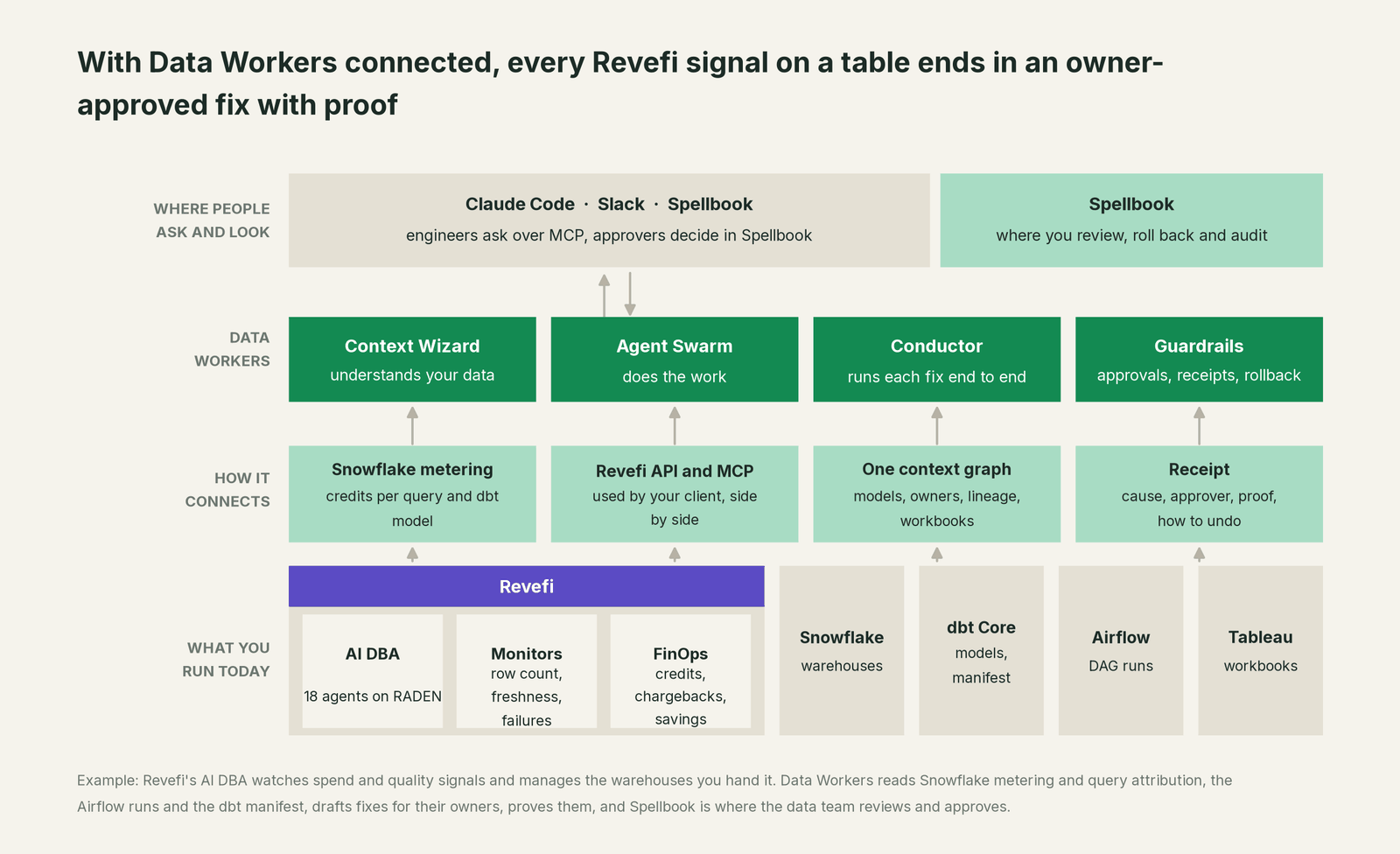
What Data Workers reads natively. With your Snowflake credentials, the Cost Savings & Data Cleanup agent reads warehouse metering and traces credits to the query and the dbt model behind them, wherever dbt sets query tags. The orchestration agents read Airflow DAG runs and task instances and queue approved reruns with trigger_airflow_dag on Airflow 2. trace_cross_platform_lineage and blast_radius_analysis map what a model feeds from the dbt manifest and the context graph, where the team's notes record which workbooks read which models. run_quality_check checks Snowflake tables, and monitor_metrics keeps baselines on what the team tracks, such as lag or debits minus credits per period.
Revefi, side by side over MCP. Revefi documents an MCP server for Snowflake and Databricks tenants: a Streamable HTTP endpoint that takes a read-write Public API token or an OAuth client Revefi registers for your account. Add it to the same client as Data Workers. Data Workers' agents never call Revefi's server and there is no Revefi connector to install: your client uses both, Data Workers connects to Revefi over its API today, and its detection and proof rest on what its own connectors read. Notes and overrides for Revefi go to the platform owner to apply.
# Example: Data Workers agents in Claude Code, from a clone of the open-source repo
# (path documented at /opensource-docs/client-setup/)
claude mcp add --scope user dw-catalog -- "$(pwd)/start-agent.sh" dw-context-catalog
claude mcp add --scope user dw-quality -- "$(pwd)/start-agent.sh" dw-quality
claude mcp add --scope user dw-incidents -- "$(pwd)/start-agent.sh" dw-incidents
claude mcp add --scope user dw-connectors -- "$(pwd)/start-agent.sh" dw-connectors

# Example: Revefi's MCP server in the same client (READ_WRITE token from Revefi's Public APIs page)
claude mcp add --scope user --transport http revefi https://gateway.revefi.com/api/v1/mcp \
  --header "Authorization: Bearer $REVEFI_API_TOKEN"
Ask "why is the trial balance missing Wednesday?" and the client gets the failed DAG run, the lagging models, the noted workbook and a proposed rerun from Data Workers, and the warehouse view from Revefi. For a shared endpoint, the Data Workers remote server takes an API key or OAuth tokens from your identity provider, verified through JWKS.
One stopped backfill, L0 to L4, set per domain.
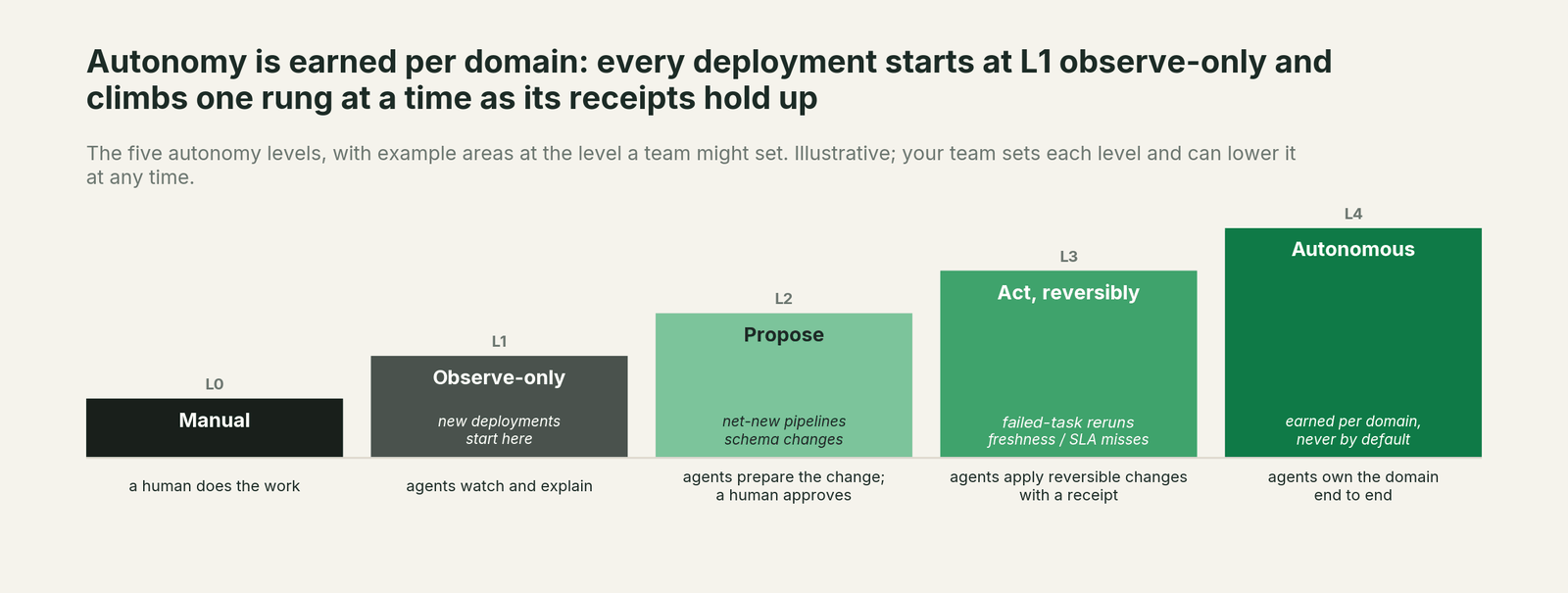
- •L0 manual. The controller finds Wednesday missing at 08:05, and the team spends the morning working out who stopped what.
- •L1 observe. Data Workers posts the diagnosis at 01:25: the failed run, the models behind, the workbook affected. Nothing changes.
- •L2 propose. Data Workers drafts the batched backfill and the note for the AI DBA. Nothing runs until the GL model owner approves.
- •L3 act reversibly. For change classes with a proven record, such as rerunning an approved backfill that was cut short, Data Workers queues the rerun, verifies it and records the receipt.
- •L4 autonomous. For a scoped domain, Data Workers queues the rerun and proves the fix before the business day starts; notes for Revefi still go to the platform owner.
For the safety model, read is it safe to let AI agents change production data, how approvals work and autonomy levels L0 to L4. On where data lives: the agents run in your infrastructure with your credentials, your data stays in your systems, and the hosted Conductor sees workflow metadata only.
What changes for your team
Revefi took the DBA queue off the platform team. Data Workers takes the data consequences off the data team, with proof attached.
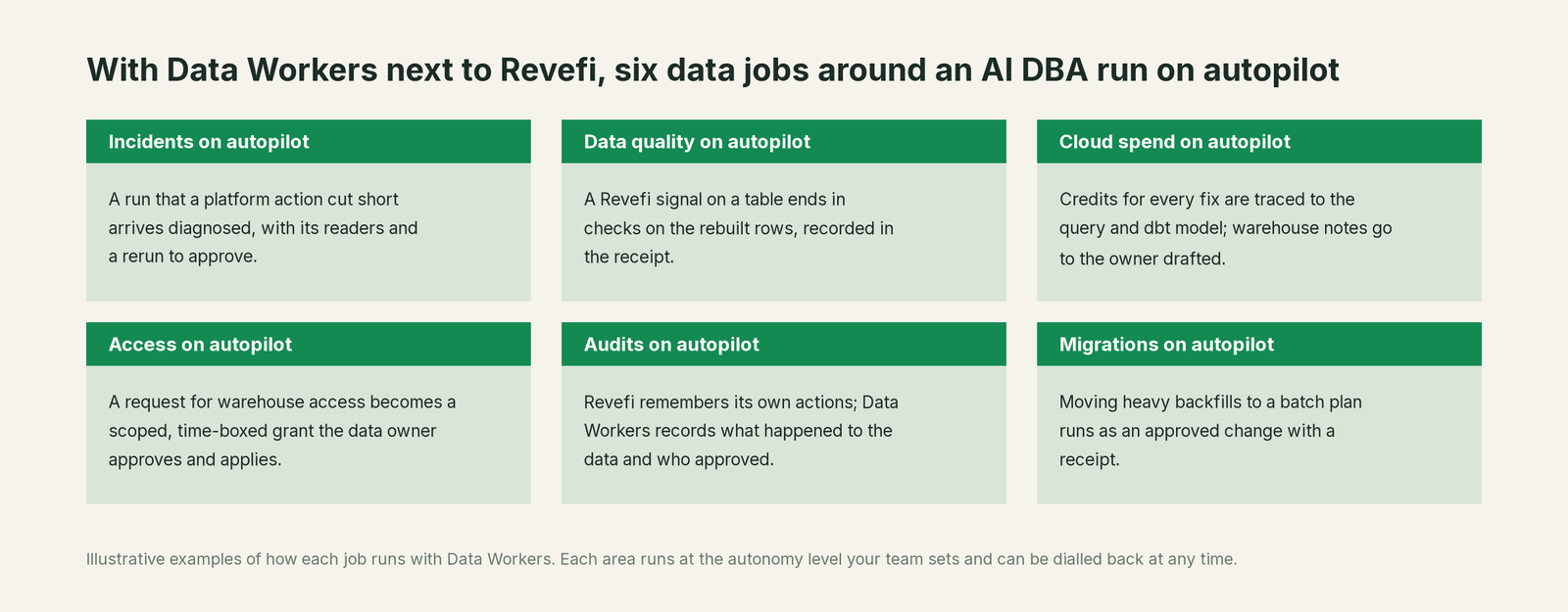
- •Incidents. A run that a platform action cut short arrives diagnosed, with its readers and a rerun to approve.
- •Data quality. A Revefi signal on a table ends in checks on the rebuilt rows, recorded in the receipt.
- •Cloud spend. Snowflake credits for every fix are traced to the query and dbt model; warehouse notes reach the platform owner drafted.
- •Access. A request for warehouse or schema access becomes a scoped, time-boxed grant the data owner approves and applies, with the expiry on record.
- •Audits. Revefi remembers its own actions; Data Workers records what happened to the data and who approved the fix.
- •Migrations. A move of heavy backfills to their own warehouse or batch plan runs as an approved change with a receipt.
See Data Workers for data platform engineers, for FinOps leads, how to measure AI data agents and who owns the agents.
Keep Revefi, or consolidate?
Keep Revefi if you love it; Data Workers works with it from day one. Many teams consolidate once Data Workers runs that slice too.
For spend and platform operations, keep Revefi: a DBA agent that watches every warehouse and takes savings actions around the clock is its whole job. What teams consolidate is the data work around it: hand-written rerun runbooks, scripts that watch marts for lateness, a catalog nobody keeps current and the spreadsheet of who owns which model. Neighbours take different paths: Unravel tunes how jobs run, Keebo tunes warehouse settings within guardrails, and SELECT ties Snowflake cost to dbt models. See also how Data Workers differs from data observability, build it ourselves with Claude Code and MCP servers and Data Workers integrations.
The case for your CFO
The outcome: you bought Revefi to cut what the data platform costs and to keep an agent on watch around the clock. Data Workers makes sure a savings action never costs you a wrong or late number: when a table breaks, the fix is drafted, approved by the data's owner and proven before the business reads the report.
The risk story is plain. At L1 Data Workers only reads; at L2 it changes nothing until a named person approves; at L3 it acts only on changes it can undo. An unanswered request expires and escalates, never auto-grants. No agent can promote its own work. Every change carries a receipt: cause, change, approver, what it touched, how it was verified and its model cost. An org-wide stop halts all autonomous dispatch. Zero migration: Revefi, Snowflake, dbt, Airflow and Tableau stay where they are.
Why now: DBA agents have moved from recommending to acting overnight, so platform changes land before the data team is awake, and data owners need to see what each action did to the numbers. The first win is read-only: every Revefi action on a warehouse that feeds the finance mart gets a data check and a diagnosis. See the ROI of agentic data operations and what Data Workers costs to run.
The sentence to repeat upstairs: "Revefi keeps the platform cheap and watched; Data Workers makes sure every fix to the data has an owner, an approval and proof."
Getting started
Start with a pilot. Pick one domain on a Revefi-managed warehouse, such as the general ledger, connect Data Workers to Snowflake, dbt and Airflow, record lag and balance baselines on the tables that matter, and run at L1 so every failed or cut-short run gets a diagnosis and a blast radius. Then turn on L2: reruns with the model owner's approval, checks after every fix, and drafted notes for the AI DBA. Plans are on the pricing page, and the pilot is credited in full against the first year.
FAQ
Revefi's AI DBA already has a Quality sub-agent. Why add Data Workers? Revefi's monitors tell you a table is late or its row count is off, and do it well. Data Workers owns what comes after: the diagnosis across the orchestrator and dbt, the fix as a diff for the model's owner, the approved rerun and the checks that prove the rebuilt table right.
Does Data Workers stop queries or resize warehouses like Revefi? No. Platform actions are Revefi's job and your platform team's. Data Workers drafts a warehouse setting or a note for the AI DBA when the data needs one, and the owner applies it.
Does Data Workers have a Revefi connector? It connects to Revefi over its API today, and your MCP client runs Revefi's MCP server next to Data Workers' servers. Data Workers' native reads are on the data side: Snowflake credits per query and per dbt model through query tags, the dbt manifest, Airflow runs and checks on the tables themselves.
We run Revefi on Databricks too. What does Data Workers do there? Revefi's AI DBA for Databricks has been generally available since June 16, 2026. There, Data Workers traces what a model feeds from the dbt manifest and the context graph, queues approved reruns through your orchestrator and routes fixes to their owners; checks on Databricks tables stay with the owner's tests.
Does Revefi or Data Workers see our data? Revefi starts with a read-only, metadata-only integration and takes over a warehouse only when you grant it; its MCP token is read-write within your tenant. Data Workers runs in your infrastructure with your credentials, reads Snowflake usage metadata and runs the checks you configure; your data stays in your systems, and the hosted Conductor sees workflow metadata only.
Sources
- •Revefi, home page (AI agents for cost, performance and quality; MCP server with Claude Code demo; platforms), https://www.revefi.com/ (checked Oct 3, 2026)
- •Revefi, AI DBA (18 agents, sub-agents per platform, read-only metadata-only integration), https://www.revefi.com/ai-dba (checked Oct 3, 2026)
- •Revefi, Press releases (dates), https://www.revefi.com/press-releases (checked Oct 3, 2026)
- •Revefi, "Revefi Launches AI DBA to Manage, Optimize, and Operate Cloud Data Platforms" (June 1, 2026; generally available), https://www.revefi.com/press-releases/revefi-launches-ai-dba (checked Oct 3, 2026)
- •Revefi, "Revefi Extends Its AI DBA to Autonomously Optimize Databricks Ecosystem" (June 16, 2026; generally available), https://www.revefi.com/press-releases/revefi-extends-its-ai-dba-to-autonomously-optimize-databricks-ecosystem (checked Oct 3, 2026)
- •Revefi, "Revefi launches RADEN AI Agent on Snowflake Marketplace" (Nov 6, 2025), https://www.revefi.com/press-releases/revefi-launches-raden-ai-agent-on-snowflake-marketplace (checked Oct 3, 2026)
- •Revefi, "What is RADEN" (Aug 25, 2025), https://www.revefi.com/blog/what-is-raden (checked Oct 3, 2026)
- •Revefi Docs, MCP Setup (endpoint, token or OAuth client, Snowflake and Databricks), https://docs.revefi.com/docs/mcp-setup (checked Oct 3, 2026)
- •Revefi Docs, Add New Warehouse for Auto-Management (MODIFY and OPERATE grants), https://docs.revefi.com/docs/add-warehouse-auto-management (checked Oct 3, 2026)
- •Revefi Docs, Cluster Management, https://docs.revefi.com/docs/cluster-management (checked Oct 3, 2026)
- •Revefi Docs, Automatic Warehouse Management: Schedule Overrides, https://docs.revefi.com/docs/warehouse-overrides (checked Oct 3, 2026)
- •Revefi Docs, System Monitors (row count, freshness, failures), https://docs.revefi.com/docs/system-monitors (checked Oct 3, 2026)
- •Revefi Docs, Public APIs, https://docs.revefi.com/docs/publicapis (checked Oct 3, 2026)
- •Data Workers open-source repository, https://github.com/DataWorkersProject/dataworkers-claw-community (checked Oct 3, 2026)
- •Data Workers client setup guide, https://dataworkers.io/opensource-docs/client-setup/ (checked Oct 3, 2026)
- •Data Workers pricing, https://dataworkers.io/pricing/ (checked Oct 3, 2026)