You're on Mem0: Keep What Your Agents Remember About Data True, With Governed Context Next to Memory
Already on Mem0? Data Workers adds governed facts about your data estate next to agent memory and flags remembered definitions that went stale.
Your agents already remember. A support agent recalls that a customer prefers email, a coding agent recalls that your team writes tests first, and an analytics agent recalls that "active customer" means a login in the last 30 days. Mem0 holds those memories, scoped by user_id, agent_id and run_id, plus app_id on the Platform. On the managed Mem0 Platform, graph memory links the entities it extracts, temporal reasoning knows what "last week" means, memory decay dampens old facts and Dream consolidation merges duplicates. Teams that want full control self-host the Apache 2.0 open-source edition with their own vector store. Agents reach the Platform through the SDKs, the API or the hosted MCP server at mcp.mem0.ai, with 11 tools to add, search, get, update and delete memories, entities and events. Mem0 is the memory. Data Workers is the governed context: Data Context Wizard holds what is true about the data estate (definitions, lineage, owners, freshness) next to that memory, keeps it true when the warehouse changes, and flags a remembered fact about data that has gone stale.
That last part is the seam this guide covers. A memory is right when it is written. A metric definition or a table's owner can change the next morning in dbt, and an agent that recalls the old fact will answer confidently and be wrong.
Key takeaways
- •Mem0 keeps its job. Your memories, graph memory, the hosted MCP server and your SDK code stay exactly as they are. Data Workers works next to them from day one.
- •Facts about data get a governed home. Data Context Wizard holds definitions, lineage, owners and freshness with provenance, so agents check what they remember against the approved source.
- •Stale memories get caught. When a dbt model or metric changes, your team's assistant pulls the memories that mention it from Mem0, and Data Workers flags the ones that still state the old fact and routes an update to the agent owner with the diff.
- •Mem0 writes stay with your team. The agent owner approves each memory update, and the owner's own client applies it.
- •Start with a pilot. One agent, read-only, with its data facts checked against governed context; then one fix class in one domain, on the ladder from L0 manual to L4 autonomous.
Mem0 is the memory. Data Workers is the governed context.
Mem0 is very good at its job. It turns conversations into compact memories, attributes each one to the user or agent that said it, and serves the right handful back at question time. On the Platform, webhooks fire on memory_add, memory_update and memory_delete, and list_events shows every memory operation.
What sits outside memory is the data estate the memories talk about: dbt models and metrics, the warehouse tables they build, their lineage, owners and freshness. Tracking that a dbt pull request changed a metric at 09:40 is a job for the data side. Data Context Wizard does it, and together the two give an agent a memory and a source of truth.
Here is a morning with Data Workers next to an analytics agent that uses Mem0. This is an illustration, not a customer case.
| Time | System | What happens |
|---|---|---|
| 09:40 | GitHub | A pull request in the dbt project redefines active_customers: a paid event in the last 30 days instead of a login |
| 10:05 | dbt platform | The production job deploys; the dbt Semantic Layer serves the new definition |
| 10:12 | Data Workers | Context Wizard reads the new definition from the dbt Semantic Layer and records it with provenance, owner and the version it supersedes |
| 10:15 | Snowflake | Data Workers compares old and new counts on the customer table, so the owner sees the size of the change |
| 10:18 | Mem0 | The engineer's assistant searches the analytics agent's memories with search_memories, filtered to its agent_id, and hands Data Workers the facts that mention the metric |
| 10:21 | Mem0 | Three memories still state the old login-based rule |
| 10:24 | Spellbook | Data Workers routes the conflict to the agent owner: each memory, the governed definition, the dbt diff and proposed replacement text |
| 10:52 | Spellbook | The agent owner approves the update |
| 10:54 | Mem0 | The owner's client calls update_memory on the three memory IDs |
| 11:00 | Mem0 | The owner's assistant re-reads the memory with get_memory; Data Workers confirms the text matches the governed definition and writes the receipt |
| 14:10 | Slack | A VP asks the analytics agent for last week's active customers; the agent recalls the new rule and the number matches finance |
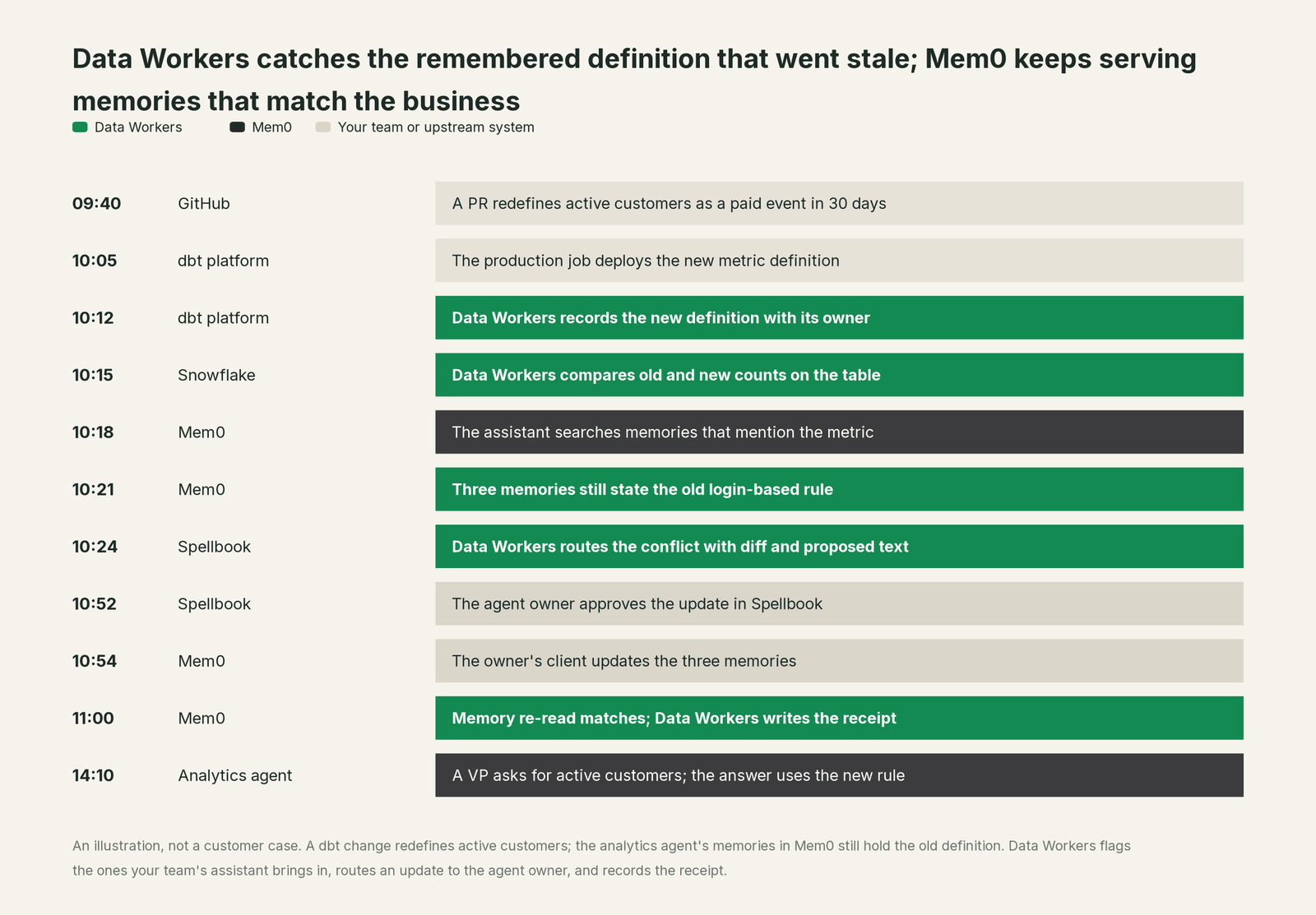
Without that check, the agent would have kept recalling the old rule, and the VP's number would have disagreed with finance. Mem0 did exactly what it was asked to do: it remembered. The fact changed in a system Mem0 doesn't run, and the fix went through the agent owner's approval first.
| Job | What Mem0 does | What Data Workers does |
|---|---|---|
| Memory | Stores and recalls what users and agents learned, per user, agent, app and run | Holds what is true about the data estate, with provenance and a named owner on every fact |
| Retrieval | Ranks memories with semantic search, graph memory and temporal reasoning | Serves governed definitions, lineage and owners through explain_table and resolve_metric |
| Change | Records adds, updates and deletes, and fires webhooks | Detects the dbt or warehouse change that makes a remembered fact wrong |
| The stale fact | Supersedes outdated facts it learns from new conversations, and hides or removes a memory when your client expires or deletes it | Flags memories your team's assistant brings in that contradict the governed source and proposes the update with the diff |
| The fix | Applies update_memory or an expiration_date when your client calls it | Routes the proposal to the agent owner, then verifies the memory after it changes |
| The proof | Lists memory events | Writes a receipt with the cause, the governed definition, the approver and the change |
Why doesn't Mem0 just do this itself?
Because Mem0 built a memory layer for any agent in any domain: support bots, tutors, coding assistants and data agents alike. Its job is to remember what was said and recall what matters, fast and at scale. Knowing whether "active customer" still means what an agent heard three weeks ago requires reading dbt projects, semantic layers, warehouse schemas and lineage, deciding which definition the business approved, and routing disagreements to the person who owns the metric. That is a different product with different integrations and a different liability.
Mem0's design draws the line sensibly. Memories are attributed to the speaker, scoped by entity, and changed through explicit calls: update_memory overwrites a memory "after confirming the ID", and expiration hides rather than deletes. Dream supersedes facts that later conversations contradict, but a change merged in a dbt project never passes through a conversation, and a memory layer that serves every kind of agent sensibly stays out of your warehouse.
Data Workers is the product on the other side of that line: it knows what changed across the data estate, which remembered facts it touches, who owns them and how to verify the update.
Every tool owns a slice. Data Workers covers the whole lifecycle
Mem0 owns one slice outright: remembering what users and agents learned, across sessions. Each point tool adds another console, contract and handoff. Data Workers covers the whole lifecycle with one context, one approval flow and one audit trail, and builds on the memory layer you already run.
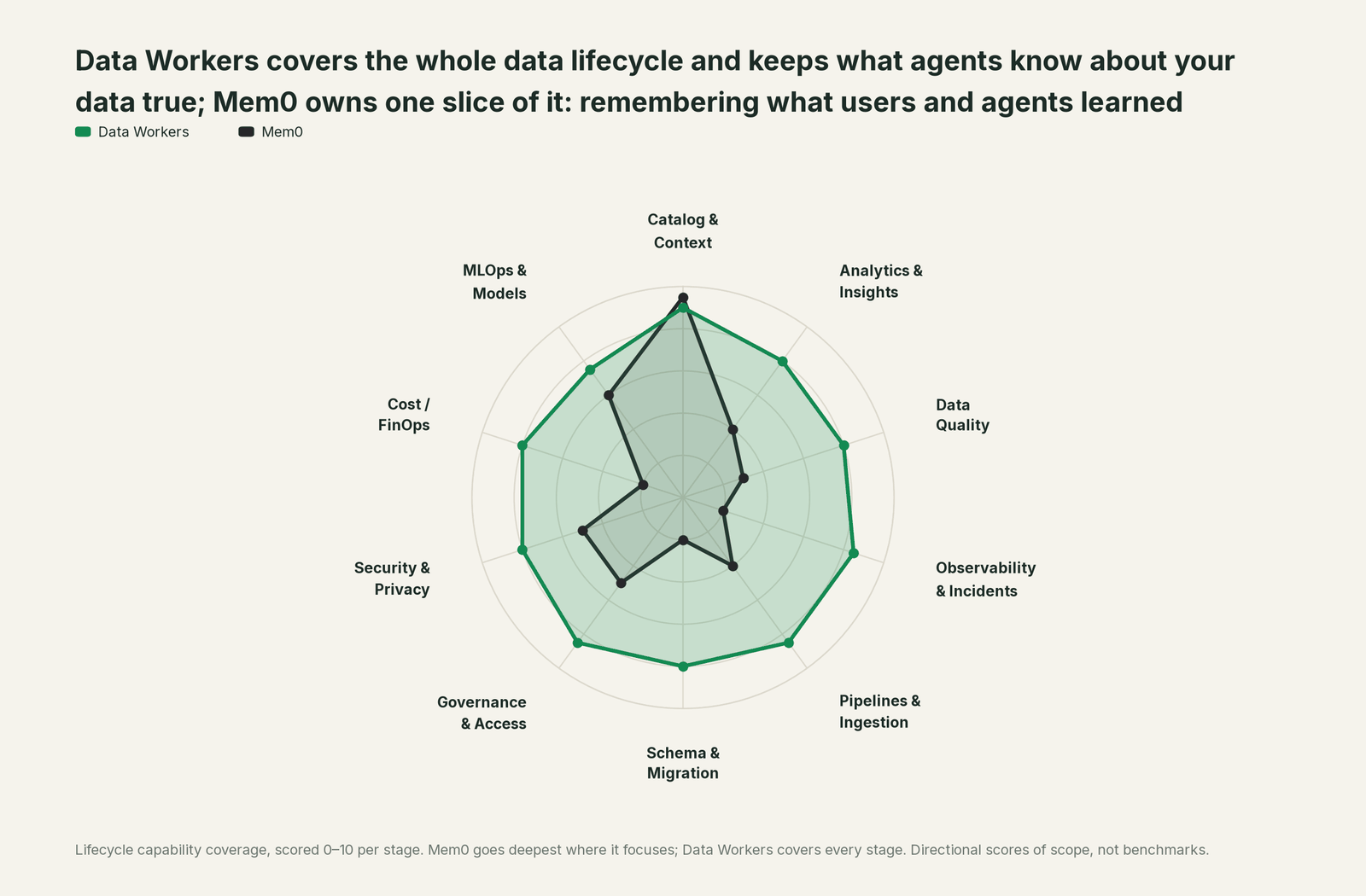
| Stage | Data Workers | Mem0 | Why we scored it this way |
|---|---|---|---|
| Catalog & Context | 9 | 9.5 | Mem0's home stage: per-user, per-agent, per-app and per-run memory with built-in graph memory, served to agents through the hosted MCP server and the API. Data Workers adds governed facts about the data estate next to it, with lineage, quality, usage and a named owner. |
| Analytics & Insights | 8 | 4 | Mem0 recalls facts with semantic search, filters and temporal reasoning; it does not compute metrics. Data Workers' Insights agent answers through governed metric definitions. |
| Data Quality | 8 | 3 | Dream consolidation merges duplicates and supersedes outdated facts, and memory decay dampens stale ones inside Mem0. Data Workers checks the tables and definitions those memories describe and repairs the breaks. |
| Observability & Incidents | 8.5 | 2 | Mem0 lists memory events and fires webhooks on adds, updates and deletes. Data Workers detects a broken table or a changed definition, traces it across systems and fixes it. |
| Pipelines & Ingestion | 8.5 | 4 | Direct import, ingest jobs and n8n and Zapier integrations bring content into memory. Data Workers builds, reruns and backfills the data pipelines themselves with approvals. |
| Schema & Migration | 8 | 2 | Memories are free text with metadata, and Mem0 has no view of warehouse schemas. Data Workers catches upstream schema changes in the dbt manifest and in review and assesses their impact. |
| Governance & Access | 8.5 | 5 | Entity scopes keep users, agents, apps and runs apart, and app_id tags writes for tenant separation. Data Workers proposes and applies grants across your data platforms by policy. |
| Security & Privacy | 8 | 5 | Expiration dates, deletes by entity and a self-hosted Apache 2.0 open-source edition give control over what is kept. Data Workers flags sensitive column names in pull request review and proposes masking for the owner. |
| Cost / FinOps | 8 | 2 | Mem0 runs its own managed vector store, LLM and embedder on the platform. Data Workers traces Snowflake credits to the dbt model behind them and drafts the fix for its owner. |
| MLOps & Models | 7.5 | 6 | Memory makes AI apps and agents personal and consistent across sessions. Data Workers keeps the data under your models healthy and connects to MLflow and W&B. |
How Mem0 and Data Workers work together
Your engineers and agents stay where they are: Claude Code or Cursor for building, your own agents in Slack or your product for answering. Spellbook Data Catalog (in preview) is where the data team and agent owners look: each proposed change, its blast radius, its approver and its rollback. Underneath, Data Context Wizard keeps one governed context graph, the Data-Agents Swarm's 20+ specialist agents do the work, the Autonomous Data-Conductor runs each fix end to end (detect, diagnose, fix, review, verify, remember), and per-domain guardrails hold approvals, receipts and rollback.
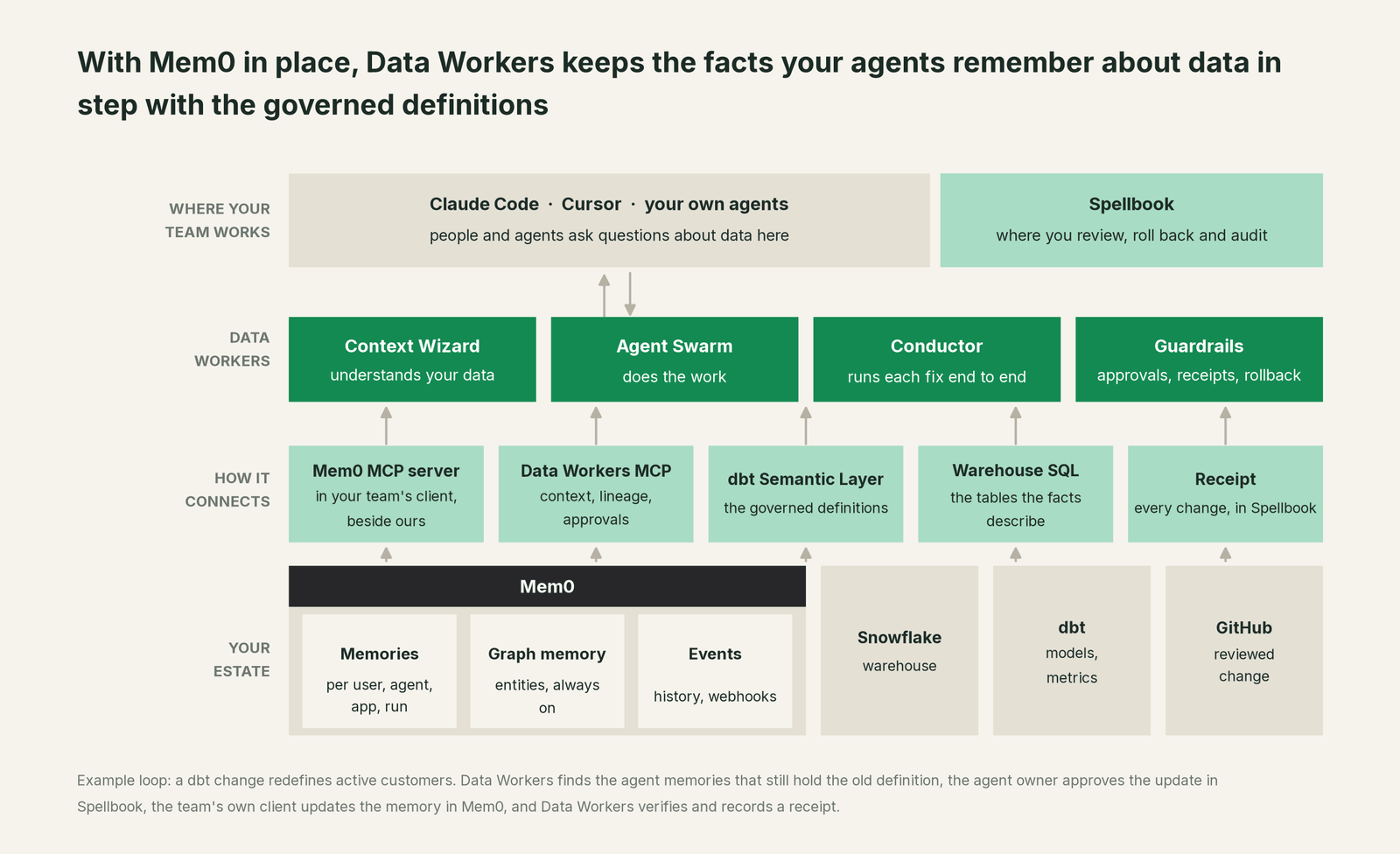
Two kinds of knowing. Mem0 answers "what did this user or agent learn?" Context Wizard answers "what is true about this data, who says so and since when?" An agent calls both. When they disagree on a fact about data, the governed source wins and the memory is flagged for its owner.
What Context Wizard does with your memories. Your team's assistant brings memories about data in from the Mem0 MCP server, scoped to the agents you choose, and Context Wizard checks each fact against governed context: metric definitions from your semantic layer, owners from your catalog, lineage from dbt and the warehouse, and freshness from the tables themselves. A memory that contradicts the approved definition goes to the agent owner with both versions and their sources. A fact worth keeping for the whole company, such as a caveat an analyst taught one agent, can be proposed into Context Wizard, where a named person promotes it to authoritative. Memories about people stay in Mem0.
Setup over MCP today. Mem0 connects over its hosted MCP server or its API today, in your team's client alongside Data Workers' agents, which never call it. Data Workers' agents are MCP servers from the open-source repository: clone it and add start-agent.sh entries to your client config, as the client setup docs show. The Mem0 entry below is the Cursor config from Mem0's MCP docs; the client opens a browser sign-in to your Mem0 account on first use.
// Example: .cursor/mcp.json (Claude Code reads the same mcpServers shape from .mcp.json)
{
  "mcpServers": {
    "mem0-mcp": {
      "type": "http",
      "url": "https://mcp.mem0.ai/mcp"
    },
    "dw-context-catalog": {
      "command": "/path/to/dataworkers-claw-community/start-agent.sh",
      "args": ["dw-context-catalog"]
    },
    "dw-schema": {
      "command": "/path/to/dataworkers-claw-community/start-agent.sh",
      "args": ["dw-schema"]
    },
    "dw-quality": {
      "command": "/path/to/dataworkers-claw-community/start-agent.sh",
      "args": ["dw-quality"]
    }
  }
}
For a headless or shared setup, Mem0 documents sending a Platform API key as a bearer token instead of the browser sign-in (in Codex, bearer_token_env_var = "MEM0_API_KEY"; each client's syntax is in Mem0's client-specific setup). Keep the key out of committed files, and keep the update and delete tools to the agent owner's own client. List the tools with your client's own command (for example /mcp in Claude Code). Then an engineer can ask "which of the analytics agent's memories about revenue metrics still match the definitions in dbt?" and get the memories from search_memories, the governed definitions from list_semantic_definitions and resolve_metric, the approved source from get_authoritative_source, and load lag from the monitor_metrics baseline the team records, in one answer.
Where writes go. Fixes to data land where your team already reviews change: a dbt diff for the owner to merge, a pipeline change, a catalog update. Memory updates go to the agent owner as a proposal; the owner's client applies update_memory or an expiration_date, and once the owner's client re-reads the memory, Data Workers records the receipt. Mem0 stays the system of record for memory, by design.
One request, L0 to L4. The autonomy ladder is set per domain.
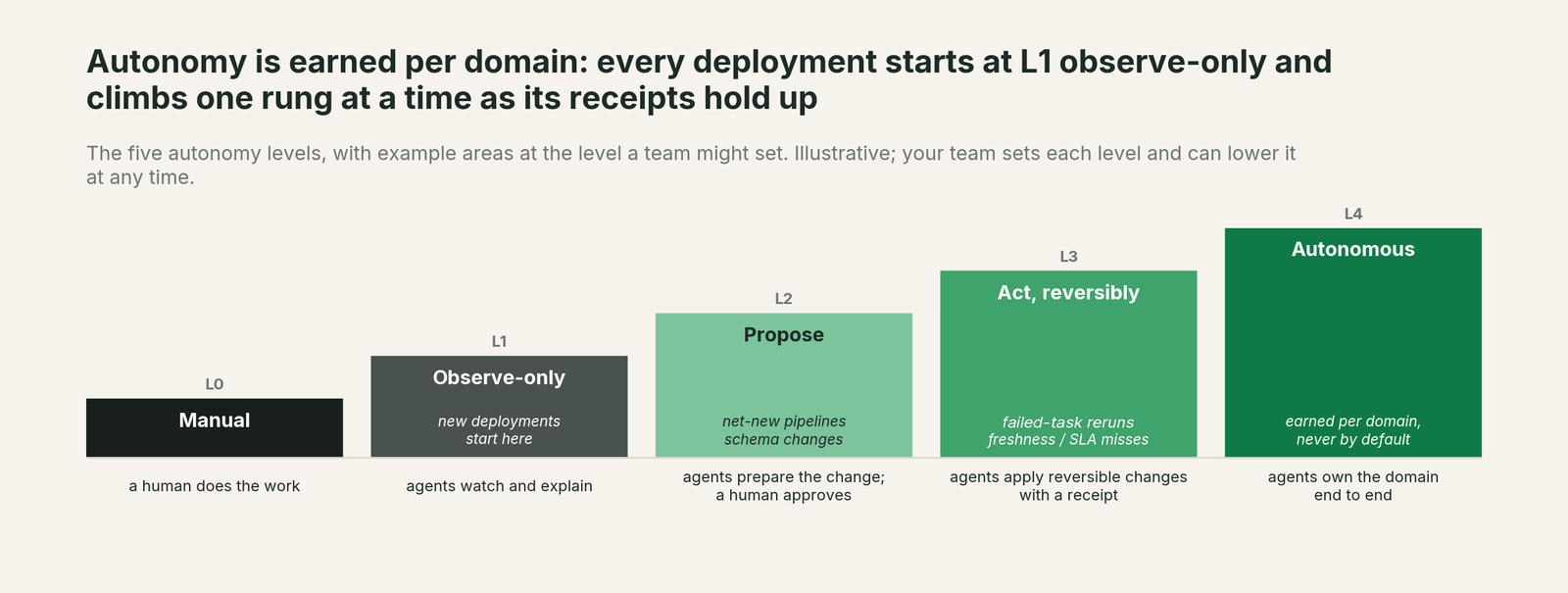
- •L0 manual. An engineer compares an agent's memories with dbt by hand.
- •L1 observe. Data Workers flags memories that went stale, with the change that caused it. Nothing changes.
- •L2 propose. Data Workers drafts the memory update or the dbt change with its diff; the owner approves in Spellbook.
- •L3 act reversibly. For proven change classes, such as a description update after a column rename, Data Workers applies the change on the data side, verifies it and can roll it back.
- •L4 autonomous. For a scoped, trusted class like freshness facts on one domain's tables, Data Workers fixes and verifies on its own and posts the receipt.
For the safety model behind each step, read is it safe to let AI agents change production data, and for where data and credentials live, read where does our data go.
The same pattern holds for every memory and context tool: see the hub, bring your own context, and the guides for teams on Zep, Letta and Cognee. Our explainers on a persistent memory layer for AI agents, agent memory for data pipelines, agent memory for data engineering tasks and what is a context graph go deeper.
What changes for your team
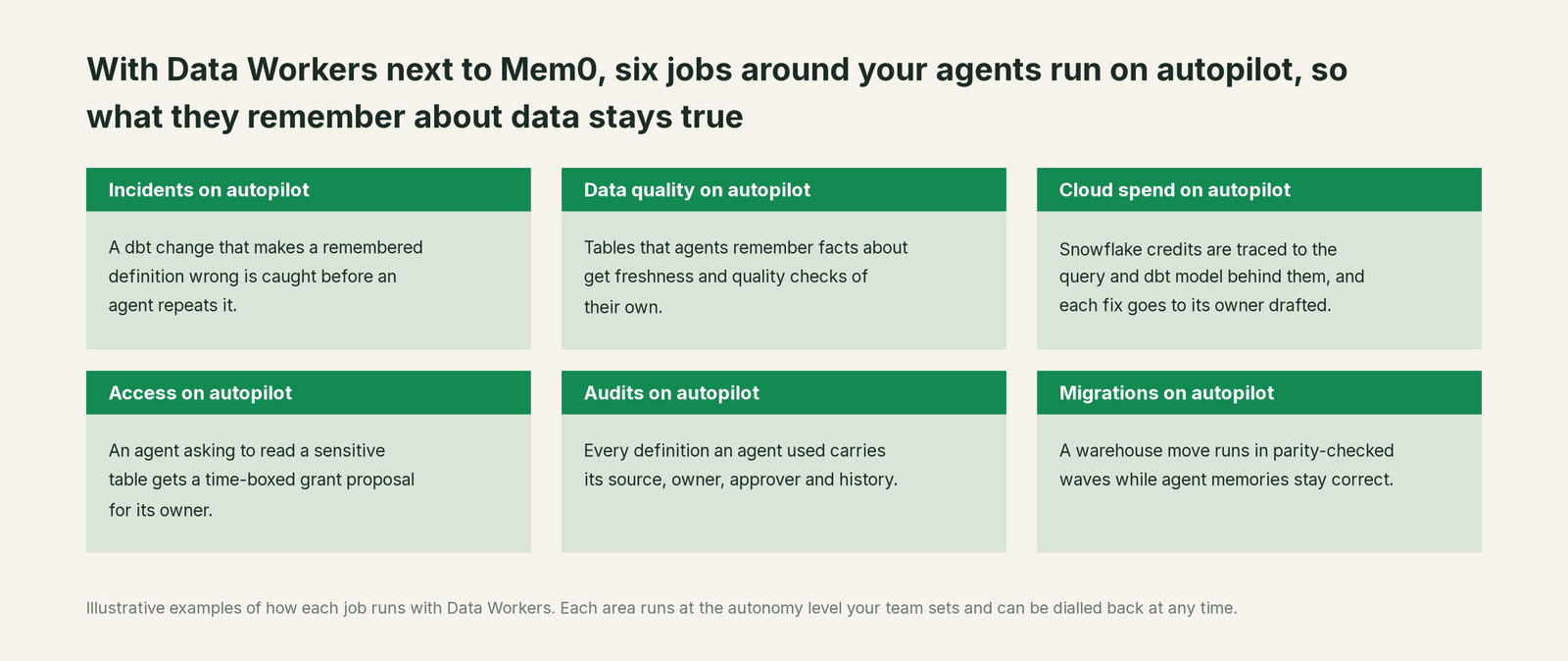
Teams that build agents on Mem0 spend real time chasing a wrong number back to a remembered definition and answering "where did the agent get that?" With Data Workers next to Mem0, those jobs run on autopilot at the level you set.
- •Incidents. A dbt change that makes a remembered definition wrong is caught before an agent repeats it to an executive.
- •Data quality. Tables your agents remember facts about get freshness and quality checks, so a memory never vouches for a broken table.
- •Cloud spend. Snowflake credits are traced to the query and dbt model behind them, and each fix goes to its owner drafted.
- •Access. An agent that asks to read a sensitive table gets a time-boxed grant proposal for its owner.
- •Audits. Every definition an agent used carries its source, owner, approver and history.
- •Migrations. Tables move in parity-checked waves, and memories that name old tables are flagged for update.
Keep Mem0, or consolidate?
Keep Mem0 if you love it; Data Workers works with it from day one. Many teams consolidate once Data Workers runs that slice too.
For most teams on Mem0, the answer is to keep it: user preferences, agent working notes and session history belong in a memory layer. What teams consolidate is the tooling around facts about data: a spreadsheet of metric definitions pasted into prompts, a homegrown script that compares agent notes with dbt, a separate data-quality tool for the tables agents read. Data Workers runs those jobs with one context, one approval flow and one audit trail. Weighing a homegrown layer on the Mem0 MCP server and the dbt APIs? Read build it ourselves with Claude Code and MCP servers: the connection is the easy part; cross-system context, ownership, approvals and receipts are the work.
The case for your CFO
The outcome: the agents the company is investing in give numbers people can act on, because what they remember about revenue, customers and products matches what finance and the data team approved.
The risk story is plain. Only the memory scopes you choose come in, through your team's assistant and the Mem0 MCP server; Data Workers' agents never call it. Every change it proposes shows its impact, goes to a named approver, lands through the tools your team already runs, is verified afterwards and leaves a receipt: who approved it, what it touched and how to undo it. Memory updates are applied by the agent owner's own client. Autonomy is set per domain from L0 manual to L4 autonomous and can be dialled back at any time. There is zero migration: Mem0, the warehouse, dbt and your agent code stay where they are.
Why now: an agent with memory repeats a stale fact to everyone who asks, confidently, and nobody can see it came from a retired definition. The first win is one agent with its facts about data checked against governed context, read-only, so the next dbt change is caught before a wrong number reaches a meeting. What stays the same: your memory layer, your agent code, your Mem0 plan, your warehouse permissions and your review process. For the numbers, see the ROI of agentic data operations.
The sentence to repeat upstairs: "Our agents remember; Data Workers makes sure what they remember about our data is still true, and fixes it with an approval and a receipt."
Getting started
Start with a pilot. Pick one agent that answers questions about data and already uses Mem0, connect the Mem0 MCP server next to Data Workers, and let Data Workers check that agent's facts about data for a few weeks before turning on the first fix class. The pilot path and plans are on the pricing page, and the pilot is credited in full against the first year.
FAQ
Does Data Workers write to our Mem0 memories? By design, the agent owner does. Data Workers checks the memories your team's assistant brings in, proposes the new text for a stale one, and the owner's client applies it. The owner's client re-reads it, and Data Workers records the receipt.
Is this Mem0 versus a knowledge graph? No. Mem0 builds a graph over the entities in your memories to rank recall. Context Wizard is a governed context graph of your data estate, with an approval on every authoritative fact. Agents use both.
Which memories does Data Workers look at? Only the scopes you choose, such as one agent_id or one app_id, and only facts about data: metrics, tables, columns, owners and freshness. Memories about people and preferences stay in Mem0 and stay out of Context Wizard.
We self-host Mem0 open source. Does that change anything? The pattern is the same. The hosted MCP server is part of the Platform; with the open-source edition, your team exports the scopes you choose from your self-hosted Mem0 server's REST API, and Data Workers proposes updates to the agent owner.
How does Data Workers know a remembered fact is stale? Context Wizard tracks each governed definition with its source, owner and the version it supersedes. When dbt, the semantic layer or the warehouse changes, Data Workers checks the memories your team's assistant pulls that mention it and flags the ones that no longer match.
What if the memory is right and the dbt definition is wrong? Then the conflict goes to the metric owner instead. Data Workers shows both versions and their sources, and the named owner decides which one becomes the approved definition. The decision is recorded.
Sources
- •Mem0, Mem0 MCP (hosted server, sign-in and API key, 11 tools, client configs), https://docs.mem0.ai/platform/mem0-mcp (checked Oct 2, 2026)
- •Mem0, Platform vs Open Source, https://docs.mem0.ai/platform/platform-vs-oss (checked Oct 2, 2026)
- •Mem0, Graph Memory, https://docs.mem0.ai/platform/features/graph-memory (checked Oct 2, 2026)
- •Mem0, Entity-scoped memory, https://docs.mem0.ai/platform/features/entity-scoped-memory (checked Oct 2, 2026)
- •Mem0, Memory expiration, https://docs.mem0.ai/platform/features/memory-expiration (checked Oct 2, 2026)
- •Mem0, Webhooks, https://docs.mem0.ai/platform/features/webhooks (checked Oct 2, 2026)
- •Mem0, Changelog highlights (Apr 14 to Aug 24, 2026), https://docs.mem0.ai/changelog/highlights (checked Oct 2, 2026)
- •Mem0, mem0 repository (Apache 2.0), https://github.com/mem0ai/mem0 (checked Oct 2, 2026)
- •dbt Labs, dbt platform features, https://docs.getdbt.com/docs/cloud/about-cloud/dbt-cloud-features (checked Oct 2, 2026)
- •Data Workers, Client setup (open-source docs), https://dataworkers.io/opensource-docs/client-setup/ (checked Oct 2, 2026)
- •Data Workers open-source repository, agent tools and start-agent.sh, https://github.com/DataWorkersProject/dataworkers-claw-community (checked Oct 2, 2026)