You're on Acceldata: Its Agents Watch Pipelines, Quality and Spend. Data Workers Fixes the Cause Across Your Estate
Acceldata's agents watch pipelines, quality and spend. Data Workers diagnoses across systems, fixes the cause behind approvals, verifies and leaves a receipt.
Your platform team runs on Acceldata. Pulse watches the Hadoop estate: clusters, YARN queues, Spark jobs, Kafka and NiFi services, and chargeback by user, job and workload. The Agentic Data Management platform (ADM) watches the data itself, in the cloud, on premises or both, with multi-variate anomaly detection, column-level lineage and reliability scoring. The xLake Reasoning Engine maps business context across your data assets and scores issues by impact. The Business Notebook answers questions in natural language, Agent Studio lets you build your own agents, and MCP-DC connects LLMs to your data under your access and masking policies. The named agents divide the work: Data Quality, Data Pipeline, Data Catalog, Data Reconciliation and the Incident Management Agent (offered through Request Access), which groups related alerts, traces the root cause through lineage and pipeline logs and routes the incident to its owner in ServiceNow, PagerDuty, Jira or Slack. Put plainly: Acceldata is the smoke alarm, with a crew of its own that knows the building. Data Workers is the crew that repairs the wiring.
The cause often lives in a system Acceldata watches but does not run: a Kafka schema, a Spark job's code, a Databricks job. Data Workers takes the incident from there, proposes the change at the cause, runs the steps around it with one approval and proves the numbers held.
Key takeaways
- •Acceldata keeps its job. Pulse, the agents, xLake, policies, incidents and chargeback stay where they are.
- •The routed incident arrives with a finished fix. Acceldata's incident comes to Data Workers from the on-call, whose assistant can use Acceldata's MCP server side by side with Data Workers; Data Workers traces the cause across Kafka, Schema Registry, Spark, Hive, Databricks and Tableau, and proposes the code change, the reruns and the new checks as one change set.
- •A named owner approves; Data Workers verifies. The owner approves in Spellbook, Data Workers queues the reruns through Airflow, checks volume, quality and load lag against their baselines on every table the fix touched, and records a receipt.
- •Schema context on both sides of the stream. Data Workers registers approved schema versions in Schema Registry behind an approval, and maps the tables a stream change reaches, with its blast radius.
- •Built for a Hadoop to Databricks estate. Data Workers works on both sides of the move and plans migration waves with parity checks, while Pulse keeps watching the clusters.
Acceldata is the watchtower over your estate. Data Workers is the crew that repairs the cause.
Acceldata's agents detect, group, trace, route and recommend, and with approval they can reprocess impacted data or pause a pipeline. Here is a Tuesday at a European retail bank halfway through a move from Cloudera to Databricks, across Kafka with Schema Registry, Spark on YARN writing Hive tables, Azure Databricks with Unity Catalog, Airflow, Tableau and ServiceNow (times CET). This is an illustrative example.
| Time | System | What happens |
|---|---|---|
| Mon 21:40 | Card platform and Schema Registry | The card team registers version 22 of the card-auth-value subject, adding the symbol WALLET_TOKEN to the entry_mode enum; the subject's compatibility setting accepts it |
| Tue 01:00 | Airflow and Spark on YARN | The card_auth_hourly Spark job maps entry_mode through a fixed lookup and succeeds; 1.8 million wallet payments land in the Hive table cards.auth_events as UNKNOWN across six partitions |
| 02:20 | Azure Databricks | The fraud_features job reads the partitions from ADLS and builds risk.fct_card_fraud_features in Unity Catalog; wallet spend drops out of contactless exposure |
| 02:55 | Acceldata | The Data Quality Agent flags a distribution shift on entry_mode and a volume drop in contactless payments; the Incident Management Agent groups both alerts into one incident |
| 02:58 | Acceldata and ServiceNow | The agent traces the cause through lineage and pipeline logs to the Spark job, routes the incident to the cards data engineering owner and opens a ServiceNow ticket with context pre-filled; it recommends reprocessing the impacted partitions |
| 03:00 | Data Workers | Takes the incident the on-call's assistant reads from Acceldata's MCP server, and the producer's owner confirms the new enum symbol between Schema Registry versions 21 and 22. From the team's context-graph notes, blast_radius_analysis maps six Hive partitions, 1.8 million records, the Unity Catalog feature table, two downstream Databricks jobs and the "Card fraud exposure" Tableau workbook |
| 03:15 | Data Workers | Proposes one change set: a diff to the Spark job's lookup that maps WALLET_TOKEN, reruns of the six partitions and then the feature job, and a quality check on entry_mode values |
| 07:30 | Spellbook | The cards data owner reviews the diff, the blast radius and the undo, approves, and merges the Spark change |
| 07:35 | Airflow | Data Workers queues the Spark rerun for the six partitions, then the Databricks feature job |
| 08:20 | Data Workers | Data Workers verifies volume by entry mode on both tables against the monitor_metrics baselines the team records, and logs the owner's new check in the receipt |
| 08:30 | Tableau, Acceldata and ServiceNow | The workbook is correct before the 09:00 risk committee; Acceldata's checks pass on their next run, and the service agent resolves the ServiceNow ticket with the receipt link |
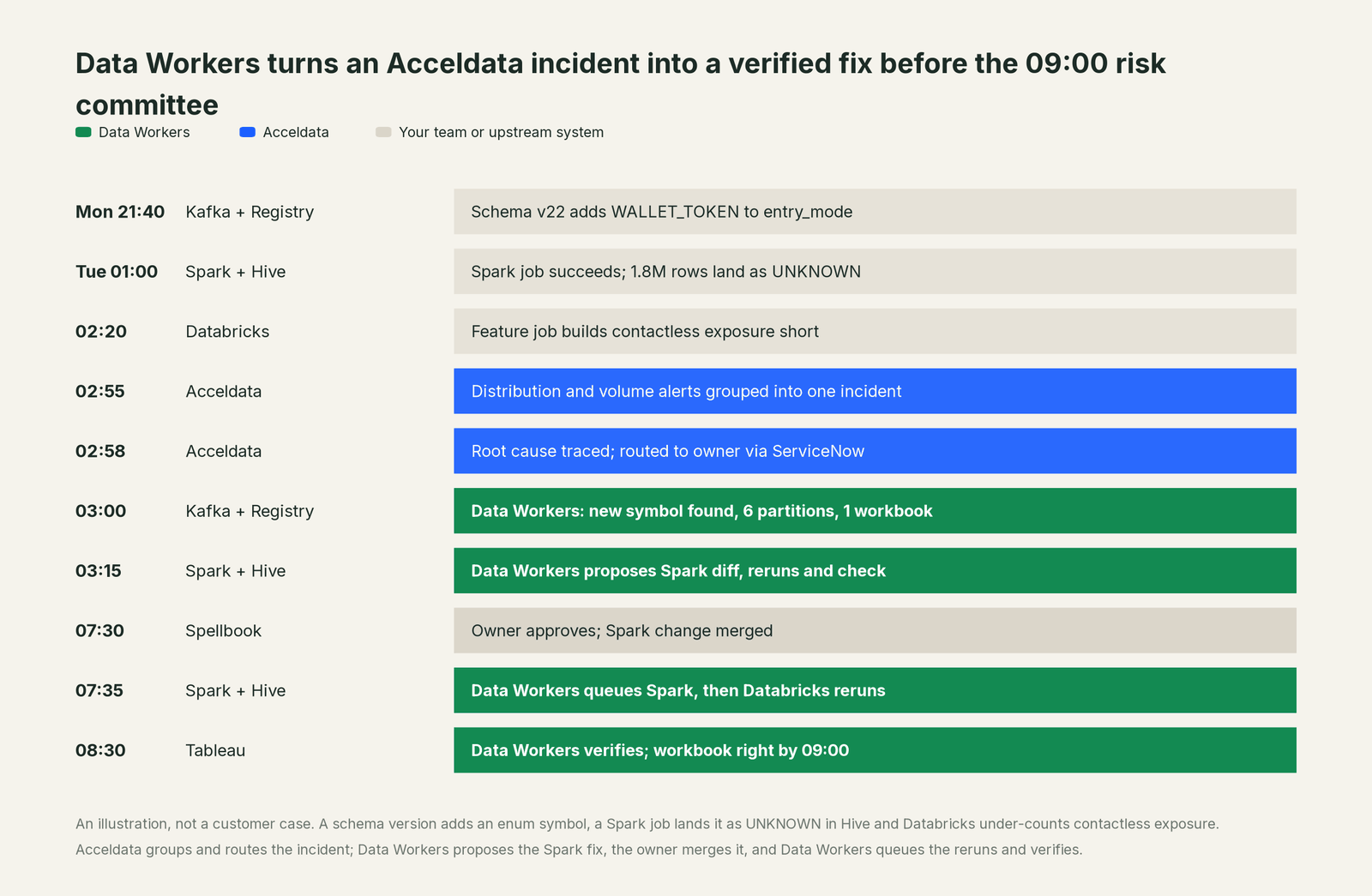
Acceldata did its job well: it saw a shift no failed job would have shown, grouped two alerts, traced the right job and woke the right person with context. Reprocessing alone would have reproduced the UNKNOWN values, because the Spark lookup still lacked the new symbol. What changed was everything after the routing: the schema version behind it, the code change at the cause, a blast radius reaching the risk workbook, one change set, ordered reruns, verification on both platforms and a record.
| Job | What Acceldata does | What Data Workers does |
|---|---|---|
| Detection | The Data Quality Agent and monitoring policies catch freshness, volume, schema drift and distribution anomalies; Pulse watches Hadoop, Spark and Kafka health | Runs null, key and row-count checks on Snowflake and Postgres and watches the metric baselines the team records; schema changes come from pull request review of dbt and migration diffs or from the owner, and Data Workers maps the tables each change reaches |
| Root cause | The Incident Management Agent correlates quality scores, pipeline logs and lineage | Joins Acceldata's incident to Kafka Connect status, Airflow runs, code changes and incident history to find what changed upstream and everything it touched |
| Routing | Routes to the owner in ServiceNow, PagerDuty, Jira or Slack with context pre-filled | Routes the approval for the fix to a named owner in Slack or email; unanswered requests expire and escalate |
| The fix | Recommends remediation steps; reprocesses impacted data or pauses a pipeline after approval | Proposes the complete repair at the cause (code diff, ordered reruns, new checks) with blast radius as one change set |
| Running it | Your team changes the Spark job; Acceldata's agents reprocess what they monitor | The owner approves and merges; Data Workers queues each rerun through your orchestrator in order |
| Verification | Checks pass on their next run | Checks freshness, quality, volume and schema on every downstream table the fix touched, on both platforms |
| The record | The incident, the agents' action log and the linked ticket | A receipt: the cause, the diff, who approved it, what it touched, how it was verified and how to undo it |
Why doesn't Acceldata just do this itself?
Because Acceldata drew a careful line, and it drew it in the right place for its product. Its agents act on what it observes: they group alerts, trace causes, open tickets, send Slack alerts, pause pipelines and reprocess impacted data, with actions defined "by rule, role, or platform as agents seek your approval". The Incident Management page says it plainly: "The agent proposes fixes, but execution requires approval with a complete audit trail."
That focus is why a platform team can point Acceldata at every cluster, job and table: it watches broadly and acts narrowly. Changing a Spark job's code, ordering reruns across a Cloudera cluster and a Databricks workspace, and proving the numbers in a Tableau workbook is a different product with a different liability. It needs context about systems Acceldata does not own, a blast radius across them, a named approver, an undo written first and a receipt. Data Workers is built for that job.
Every tool owns a slice. Data Workers covers the whole lifecycle
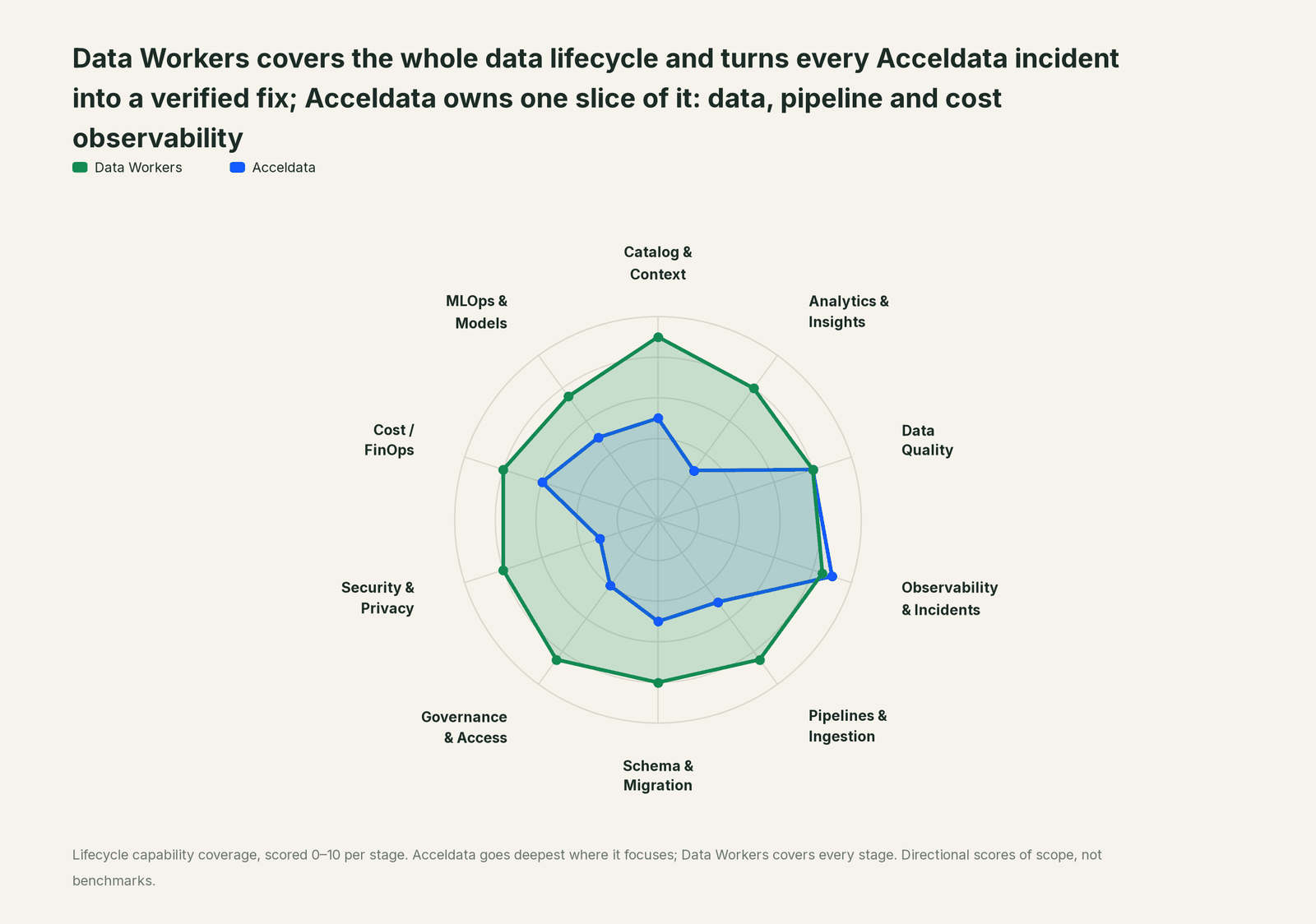
Acceldata owns data, pipeline and cost observability, with real depth on Hadoop and Spark that few tools match. Each point tool adds another console, another contract and another handoff. Data Workers covers the whole lifecycle with one context, one approval flow and one audit trail.
| Stage | Data Workers | Acceldata | Why we scored it this way |
|---|---|---|---|
| Catalog & Context | 9 | 5 | The Data Catalog Agent organizes assets, and the xLake Reasoning Engine maps business context across them. Data Workers keeps one governed context graph of definitions, owners, lineage, quality and usage across every platform. |
| Analytics & Insights | 8 | 3 | The Business Notebook answers questions in natural language, with contextual memory. Data Workers answers data questions from governed definitions with lineage behind every number. |
| Data Quality | 8 | 8 | A shared home stage: ADM runs multi-variate anomaly detection and reliability scoring, and the Data Quality Agent reprocesses impacted data after approval. Data Workers writes and runs checks and proposes the tests behind each fix. |
| Observability & Incidents | 8.5 | 9 | Acceldata's home stage: the Incident Management Agent groups alerts, traces the root cause through lineage and pipeline logs and routes to the owner with context. Data Workers diagnoses across systems, fixes with approval and verifies the fix. |
| Pipelines & Ingestion | 8.5 | 5 | The Data Pipeline Agent monitors and tunes Airflow, Prefect and Dagster runs, and Resolve can pause a pipeline. Data Workers queues reruns and backfills through your orchestrator, with approvals. |
| Schema & Migration | 8 | 5 | Pulse and Open Data Platform support Hadoop modernization, and the pipeline agent tracks schema changes. Data Workers catches schema changes in pull request review and the dbt manifest diff, scores their blast radius and plans migrations in waves. |
| Governance & Access | 8.5 | 4 | Agent actions inherit role-based access and approvals, and MCP-DC applies access policies to LLM access. Data Workers dry-runs each warehouse access request and proposes a time-bound grant for the owner to approve. |
| Security & Privacy | 8 | 3 | xLake keeps data inside your perimeter and MCP-DC applies masking rules. Data Workers' pull request review flags new columns whose names or annotations look sensitive, and leaves a receipt on every data change. |
| Cost / FinOps | 8 | 6 | Pulse tracks cost by user, job and workload for chargeback, and ADM forecasts spend. Data Workers attributes Snowflake spend to the dbt model and drafts warehouse setting changes for their owner. |
| MLOps & Models | 7.5 | 5 | AI Observability traces agents and LLMs and scores production AI. Data Workers keeps the data under your models fresh and correct. |
Acceldata leads on observability and ties on data quality. For the category view, read Data Workers vs data observability and Bigeye, Anomalo, Sifflet and Soda vs Data Workers. For the idea behind this page, see beyond data observability: autonomous resolution and what is data observability.
How Acceldata and Data Workers work together
Acceldata stays on top, catching and routing problems. Spellbook Data Catalog (in preview) is where the data team reviews each proposed change and how to roll it back. Between them, Data Context Wizard keeps one governed context graph, the Data-Agents Swarm does the work with 20 specialized agents, and the Autonomous Data-Conductor runs each fix end to end: detect, diagnose, fix, review, verify, remember.
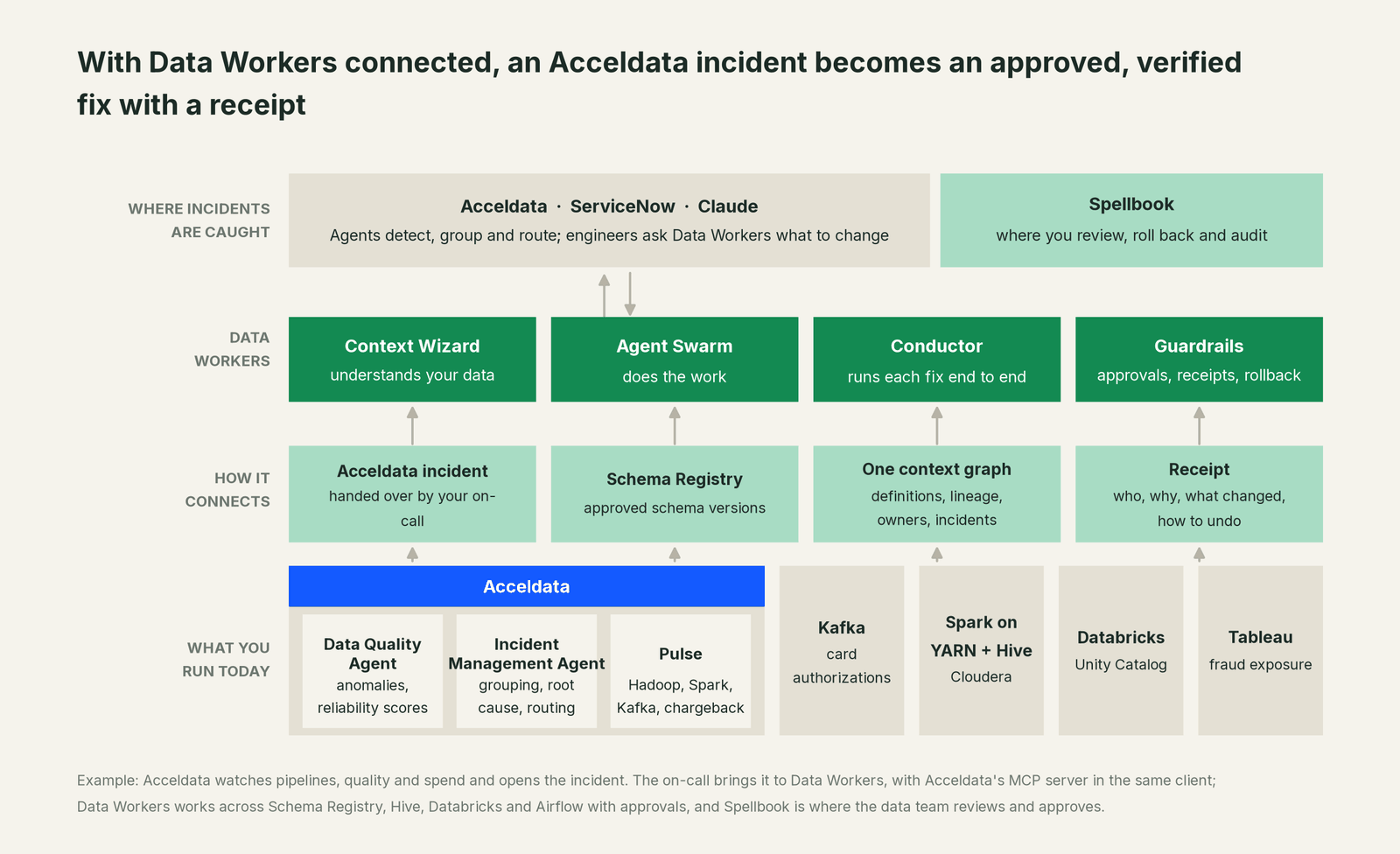
Acceldata to Data Workers. Acceldata connects over its API or MCP server today: your team's assistant reads incidents, alerts, reliability scores and lineage side by side with Data Workers, whose own checks rest on the warehouse, dbt and the orchestrator. Kafka and Schema Registry, ADLS, Airflow and ServiceNow are native connectors, Unity Catalog grants go through its permissions API, the Hive Metastore connects over its API today, and Tableau is read by design. Spark and YARN connect over their APIs today, and Spark jobs rerun through the Airflow tasks that run them. A new incident starts a diagnosis: diagnose_incident and get_root_cause work the evidence, trace_cross_platform_lineage and blast_radius_analysis map everything downstream, and get_incident_history checks whether the job broke before. remediate proposes the change set for the owner; the code change arrives as a diff for the owner to merge, and reruns are queued through Airflow. monitor_metrics baselines and the owner's test verify, and get_audit_trail reads back every step.
Data Workers to your team. The receipt lives in Spellbook and the audit trail; the service agent resolves the ServiceNow ticket Acceldata opened, with the receipt link in it.
In your coding agent. Every Data Workers agent is an MCP server, so an engineer can ask Claude or Cursor about the incident. The client setup guide documents the path: clone the open-source repo and add one start-agent.sh entry per agent. Example mcp.json:
{
  "mcpServers": {
    "dw-context-catalog": { "command": "/path/to/dataworkers-claw-community/start-agent.sh", "args": ["dw-context-catalog"] },
    "dw-incidents": { "command": "/path/to/dataworkers-claw-community/start-agent.sh", "args": ["dw-incidents"] },
    "dw-quality": { "command": "/path/to/dataworkers-claw-community/start-agent.sh", "args": ["dw-quality"] },
    "dw-schema": { "command": "/path/to/dataworkers-claw-community/start-agent.sh", "args": ["dw-schema"] }
  }
}
Ask "why is contactless exposure short, and what does the fix touch?" and the client returns the cause, everything downstream and a proposed repair. For a shared endpoint, the Data Workers remote server takes an API key (bearer) or OAuth tokens from your identity provider, verified through JWKS.
One Acceldata incident, L0 to L4. The same card incident, at each level of the autonomy ladder, set per domain.
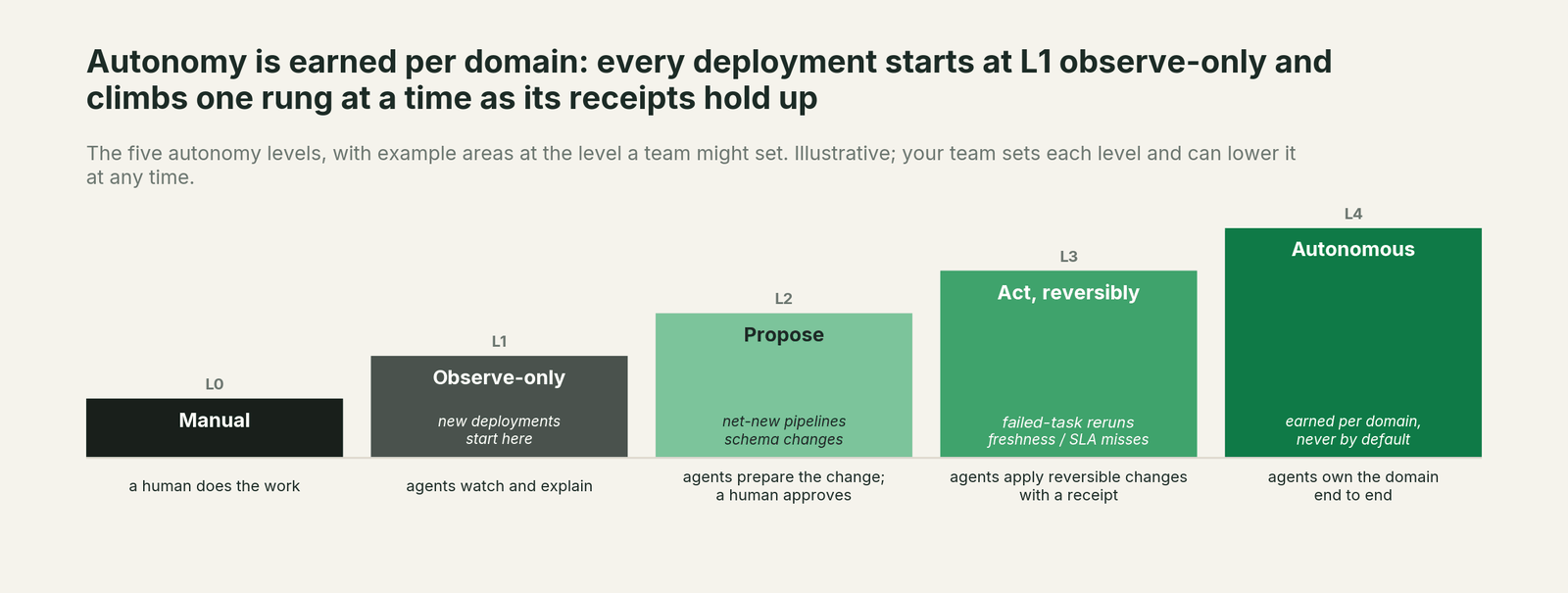
- •L0 manual. The engineer finds the new symbol, edits the Spark job and reruns both jobs by hand.
- •L1 observe. Data Workers posts the diagnosis and blast radius. Nothing changes.
- •L2 propose. Data Workers proposes the Spark diff, the ordered reruns and the new check; nothing runs until the cards data owner approves.
- •L3 act reversibly. For proven change classes, such as rerunning partitions after a merged fix, Data Workers queues the steps through Airflow, verifies them and records the receipt.
- •L4 autonomous. In a scoped domain with a long clean record, Data Workers handles the repeatable steps end to end; code changes still go to their owner as a diff.
For the safety model, read is it safe to let AI agents change production data, how approvals work and autonomy levels L0 to L4. On where data lives: the agents run in your infrastructure on every tier, your data stays in your systems, and the hosted Conductor sees workflow metadata only.
What changes for your team
Acceldata made the estate visible. Data Workers gives the owner a crew that works across it.
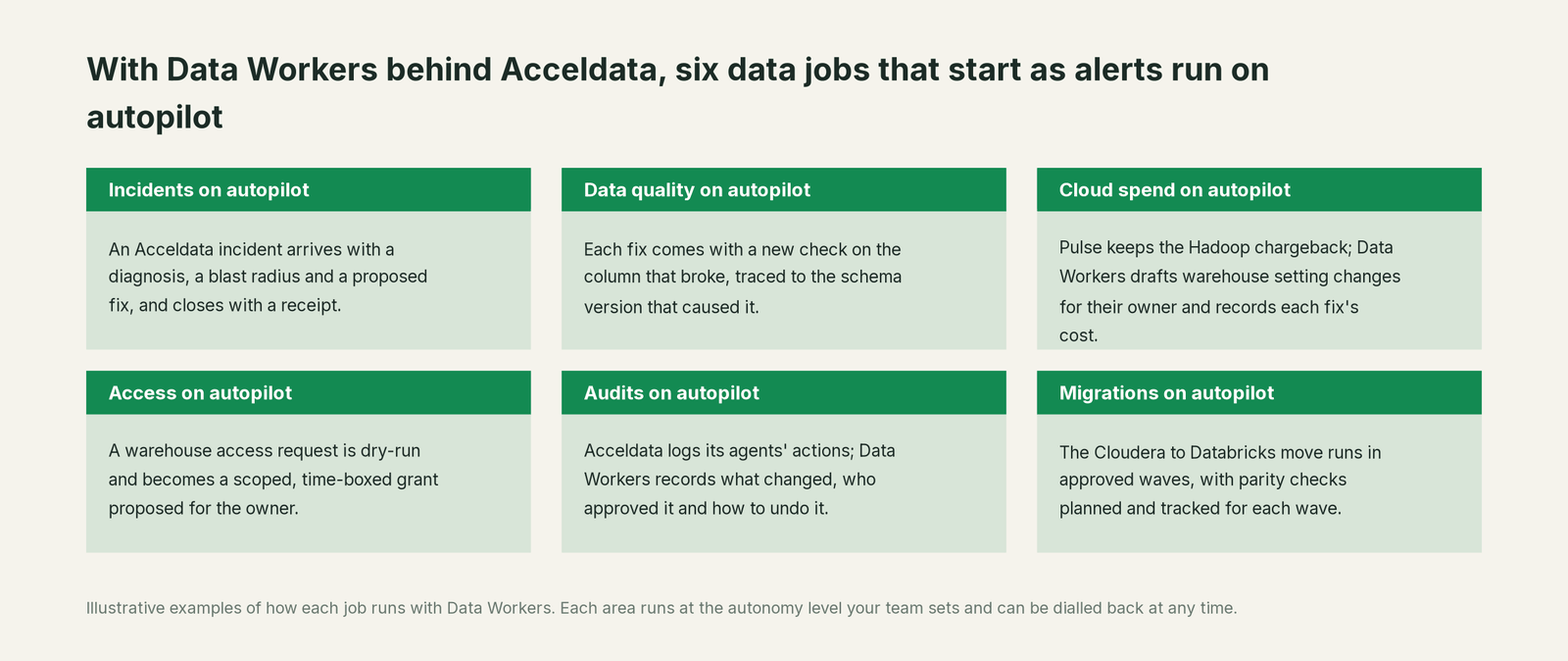
- •Incidents. An Acceldata incident arrives with a diagnosis, a blast radius and a proposed fix, and closes with a receipt.
- •Data quality. Each fix comes with a new check on the column that broke, and the schema change behind it is traced to the version that caused it.
- •Cloud spend. Pulse keeps the Hadoop chargeback; Data Workers drafts warehouse setting changes for their owner and records what each fix cost to run.
- •Access. A warehouse access request is dry-run against role inheritance and sensitive columns and becomes a scoped, time-boxed grant proposed for the data owner.
- •Audits. Acceldata logs its agents' actions; Data Workers records what changed, who approved it, what it touched and how to undo it.
- •Migrations. The Cloudera to Databricks move runs in approved waves, with parity checks planned and tracked for each wave and the completion gate held for the owner's sign-off.
The on-call changes most: a 02:58 routing lands on a ready change set to review over coffee. See the Hadoop to Databricks migration checklist, Hive and Glue to Unity Catalog migration with parity checks, the data incident response playbook and who owns the agents.
Keep Acceldata, or consolidate?
Keep Acceldata if you love it; Data Workers works with it from day one. Many teams consolidate once Data Workers runs that slice too.
Teams usually keep Pulse while Hadoop clusters run: cluster health, YARN tuning and chargeback are its depth. What they consolidate is the stack around it: a second quality tool alerting on the same break, hand-written rerun runbooks, migration trackers in spreadsheets. Weighing a fix layer of your own on Acceldata's APIs and a coding agent? Read build it ourselves with Claude Code and MCP servers: the API calls are the easy part; the context graph, approvals and rollback are the work. Across the category, see you're on Monte Carlo, you're on DQLabs, you're on Lightup, Data Workers on Databricks and Data Workers integrations.
The case for your CFO
The outcome: you already pay Acceldata to see bad data before the business does and route each incident with its cause. Data Workers turns that routed incident from a night of tracing, editing and rerunning into a complete fix with one approval, so risk, finance and regulatory reporting read correct numbers at their first meeting.
The risk story is plain. Autonomy is set per domain: L1 only reads; L2 changes nothing until a named person approves; L3 applies changes it can undo. Code changes always go to their owner as a diff. An unanswered approval request expires and escalates, never auto-grants. No agent can promote its own work. Every change carries a receipt: the cause, the diff, who approved it, what it touched, how it was verified and how to undo it. An org-wide stop halts all autonomous dispatch. Zero migration: Acceldata, Kafka, the Cloudera cluster, Databricks, Airflow, Tableau and ServiceNow stay where they are.
Why now: Acceldata already finds the cause and the owner, so the slow part is the change, the ordered reruns and the proof, and a Hadoop to Databricks move doubles the places a fix lands. The first win is read-only: every incident in one domain gets a cross-system diagnosis and a blast radius, while policies, permissions and code review stay the same. Start with a pilot (pricing); it is credited in full against the first year. For the numbers, see the ROI of agentic data operations.
The sentence to repeat upstairs: "Acceldata tells us what broke and why; Data Workers fixes it where it broke, with one approval, and proves it held on both sides of our migration."
Getting started
Start with a pilot. Pick one domain whose incidents already live in Acceldata, such as cards or payments, connect Data Workers to Kafka Connect and Schema Registry, Databricks and Airflow, keep Acceldata's MCP server in your team's client, and run at L1 so every incident gets a diagnosis and a blast radius. Then turn on the first write class at L2, such as partition reruns after a merged fix. The pilot path and plans are on the pricing page, and the pilot is credited in full against the first year.
FAQ
How does Data Workers connect to Acceldata? Acceldata connects over its API or MCP server today: your team's assistant reads incidents, alerts, reliability scores and lineage there, side by side with Data Workers' MCP servers, and Data Workers' agents never call it. Kafka, Schema Registry, Airflow and ServiceNow are native on the Data Workers side, with Unity Catalog grants through its permissions API.
Acceldata's agents already trace root cause and propose fixes with human approval. Why add Data Workers? Acceldata's agents act on what Acceldata observes, under its approvals. Data Workers adds the fix at the cause in systems Acceldata does not run: the Spark or dbt code change as a diff, the Schema Registry context, ordered reruns across platforms, verification on every downstream table and a receipt that ties it together.
Does Data Workers change anything in Acceldata? No. Monitoring policies, agent approvals, incidents and chargeback stay with your Acceldata admins. The receipt lives in Spellbook and the audit trail, and the service agent resolves the linked ServiceNow ticket with the receipt link.
Does Data Workers edit our Spark jobs or delete bad rows directly? Code changes arrive as a diff for the owner to merge, or as a pull request when your team turns on the GitHub pull-request target for dbt. Data cleanups are proposed for the owner to approve and apply.
We are moving from Cloudera to Databricks. Where does Data Workers fit? On both sides. It traces lineage across the two through Airflow runs and the team's context-graph notes, and plans the move in approved waves with parity checks tracked for each wave. Pulse keeps watching the clusters until they retire. If your path is Acceldata's Open Data Platform instead, Data Workers works the same way next to its Hive Metastore.
Our Acceldata inference runs inside our perimeter. What does Data Workers see? The agents run in your infrastructure and hold the warehouse credentials and the model key, so your data stays in your systems. The hosted Conductor sees workflow metadata only: goals, table names, proposals with diffs, run records, approval handles.
Sources
- •Acceldata, Agentic Data Management platform (named agents, xLake, Business Notebook, Agent Studio, MCP-DC, AI Observability, cost and chargeback, cloud, on-prem and hybrid; "Autonomous 26" May 19), https://www.acceldata.io/agentic-data-management (checked Oct 3, 2026)
- •Acceldata, Incident Management Agent ("The agent proposes fixes, but execution requires approval with a complete audit trail"; routing to PagerDuty, ServiceNow, Jira and Slack; Request Access), https://www.acceldata.io/agentic-data-management/use-cases/incident-management (checked Oct 3, 2026)
- •Acceldata, Data Quality Agent (lineage-backed diagnosis, reprocessing impacted data after approval), https://www.acceldata.io/agentic-data-management/use-cases/data-quality-agent (checked Oct 3, 2026)
- •Acceldata, Data Pipeline Agent (Airflow, Prefect, Dagster; approval checkpoints), https://www.acceldata.io/agentic-data-management/use-cases/data-pipeline-agent (checked Oct 3, 2026)
- •Acceldata, Resolve capability (ticket creation, Slack alerts, pipeline pause; actions by rule, role or platform), https://www.acceldata.io/agentic-data-management/capabilities/resolve (checked Oct 3, 2026)
- •Acceldata, xLake Reasoning Engine (business context, impact scoring, data inside your perimeter), https://www.acceldata.io/platform/xlake-reasoning-engine (checked Oct 3, 2026)
- •Acceldata, MCP-DC (access policies, masking rules, lineage tracking), https://www.acceldata.io/mcp-dc (checked Oct 3, 2026)
- •Acceldata, Pulse (Hadoop observability, YARN Optimizer, chargeback by user, job or workload; CDP, HDP and hybrid; Open Data Platform), https://www.acceldata.io/pulse (checked Oct 3, 2026)
- •Acceldata Docs, llms.txt (docs MCP endpoint), https://docs.acceldata.io/llms.txt (checked Oct 3, 2026)
- •Data Workers open-source repository, https://github.com/DataWorkersProject/dataworkers-claw-community (checked Oct 3, 2026)
- •Data Workers client setup guide, https://dataworkers.io/opensource-docs/client-setup/ (checked Oct 3, 2026)