You're on Monte Carlo. Now Let Data Workers Fix What It Finds: A Guide for Data Leaders
Monte Carlo alternatives for heads of data: why your team is still the step between alert and fix, and how Data Workers puts the fix on autopilot.
Heads of data look at Monte Carlo alternatives for one reason. Monte Carlo tells you when data breaks, and then your team does the rest. Monitors watch freshness, volume, schema and field health across your warehouses, dbt, Airflow and BI. Monte Carlo's own agents score each alert and narrow down its cause. After that, a person takes over.
Someone opens the dbt model, reruns the Airflow task, checks the dashboard and tells finance it's fixed. The same person also works the access queue, the cost cleanup, the schema change a product team shipped on Friday and the audit request that arrived last week.
Your data platform has a control-plane problem, and the control plane is your team. People are the connective tissue between tools that don't talk to each other, carrying context from one to the next by hand. Monte Carlo made the knowing cheap. The expensive part is the doing: the fixing, the checking, the approving and the record of what happened. Data Workers is the agentic data platform built for that part, and it's the strongest choice for a leader comparing it with Monte Carlo.
What Monte Carlo solved, and why leaders look for Monte Carlo alternatives
Monte Carlo solved knowing when data breaks, and where. It watches the stack, learns what normal looks like, and tells you which alerts matter most.
It doesn't make the fix. Monte Carlo's documentation says its agents "never directly manipulate data or systems." They recommend, draft and explain. The change still has to be made in the system that owns the problem, checked, and written up. Its open-source toolkit helps one engineer propose a fix inside their coding agent, one session at a time. Nothing in Monte Carlo owns the incident from alert to verified fix across your estate, and nothing in it runs the rest of the back office.
That's a deliberate product choice. Monte Carlo is an observer. An observer leaves the work with your team. Monte Carlo is the smoke alarm; Data Workers is the crew that puts the fire out.
Monte Carlo tells you what broke. Data Workers is the agentic data platform that fixes it where it started, checks that the fix held, and runs the rest of your data back office.
What goes on autopilot
This is the part that changes your week. Each of these is a queue your team runs by hand today, behind the alerts. Data Workers takes every one of them.
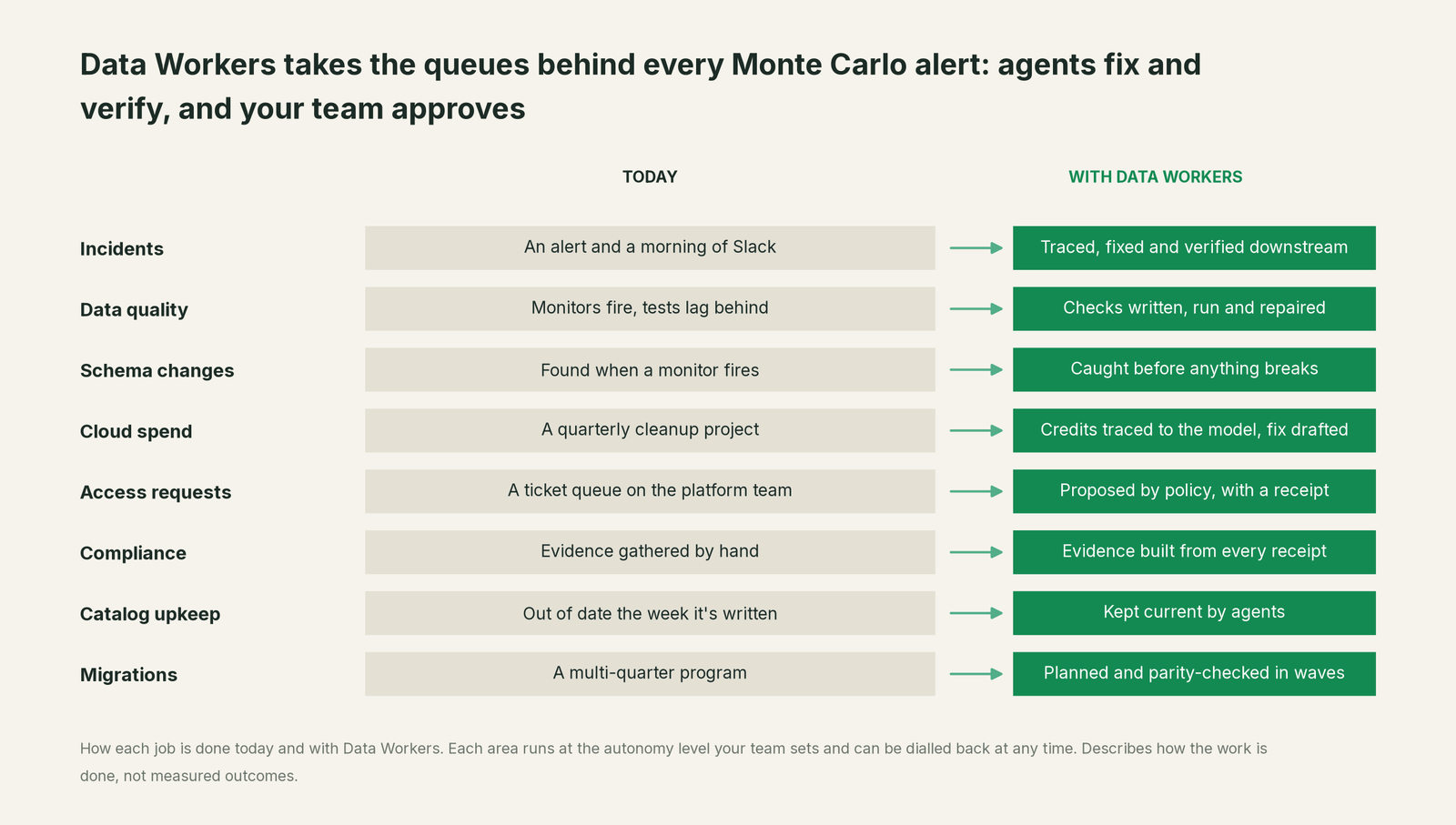
Data Workers works inside the tools you already run, reasons across all of them, and leaves an auditable record of every change it makes. Your data stays in your infrastructure.
What changes for your organization
Here's what that looks like in a normal week.
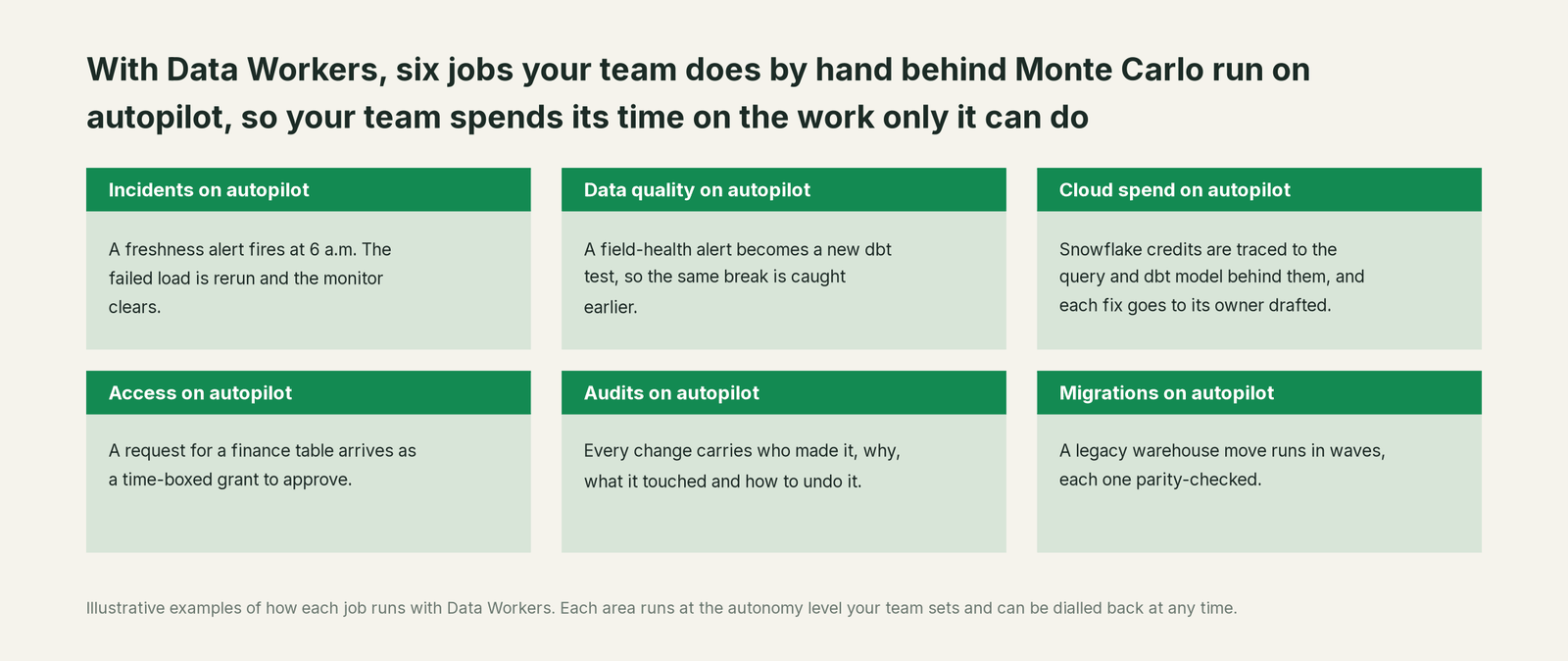
- •Alerts stop being the start of a morning. An alert becomes a traced cause, a fix in the system where the problem started, and a check that the fix held. Your engineers review the result instead of doing the legwork.
- •The same break stops coming back. A recurring alert turns into a new test upstream, so the next occurrence is caught earlier.
- •Your team stops being the human control plane. Access, schema changes, cleanup and catalog upkeep move without waiting for a platform engineer.
- •Spend is managed continuously. Snowflake credits are traced to the query and dbt model behind them, and each fix reaches its owner drafted.
- •Audits get easier. Every change has a receipt: who or what made it, why, what it touched and how to undo it. Evidence builds up as a side effect of the work.
- •Big programs get smaller. Migrations that normally need a dedicated team become a series of approvals, and your engineers spend their time on the work only they can do.
One incident, start to finish
- •A product team renames a field in the billing database overnight.
- •The dbt run succeeds, but the subscriptions table now writes blanks for every new row's plan.
- •At 5:40 a.m. Monte Carlo flags the blanks and marks the alert high priority, because the table feeds the revenue dashboard.
- •By 8 a.m. finance is asking why revenue by plan looks wrong. Monte Carlo can show where the problem spread. It can't fix the cause.
Today that's a morning of Slack threads. With Data Workers, the failing check starts the loop. The rename is traced to its source, the fix to the dbt model arrives ready to approve, the table is rerun, and Data Workers confirms the check passes again. A receipt records every step. Monte Carlo found the problem. Data Workers fixed the cause and brought the receipt.
You choose how far and how fast
Our thesis is that data teams will climb from people working alongside a coding agent, to people governing a team of agents, to a largely self-running agentic enterprise. Data Workers is the fastest way up that climb, and you choose the altitude one area at a time.
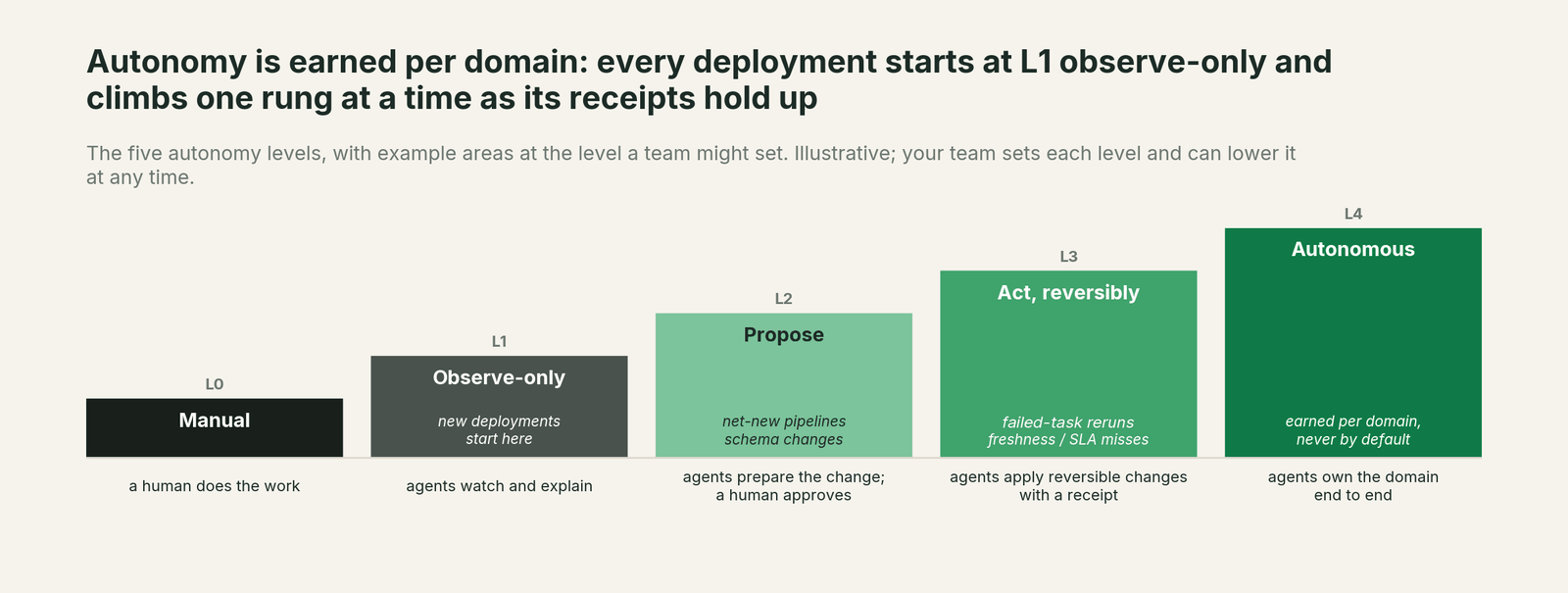
Every area starts with agents watching and explaining. Then they propose changes for your team to approve. Then they make reversible changes on their own and leave a receipt. Only areas that have earned it run fully on their own, and any area can be dialled back at any time. No agent can approve its own work.
The detailed, stage-by-stage version is in our Monte Carlo autonomy playbook.
Keep Monte Carlo, or replace it: the Monte Carlo alternative that does the work
Replace it. This is the stronger path for most teams. You get one platform, one approval flow and one audit trail for detection, fixes and the rest of the back office. Data Workers watches your data, catches many problems upstream before they ever alert, and turns recurring alerts into tests. You stop paying for signals your team then has to act on by hand.
At minimum, keep it and add Data Workers. If Monte Carlo is wired deep into your on-call process, or you use it to watch AI agents in production, keep it. Data Workers reads Monte Carlo's monitors and their results, and a failing monitor starts the loop. Monte Carlo keeps watching. Data Workers does the work.
Either way, nothing is migrated and no data is copied out of your platforms. Data Workers stores metadata and scrubbed facts about your data, not your tables. Your platforms' own permissions stay the lock, and Data Workers never creates a second permission system.
When Monte Carlo alone is enough
Monte Carlo alone can be enough if your only need is watching the AI agents you've built, or if incidents are rare and your team already fixes them fast. For everyone else, the alert was never the expensive part; the fix, the check and the record are, and Data Workers does all three. The fix, the check and the record are.
FAQ
Do we have to replace Monte Carlo? No. Keep Monte Carlo if you love it; Data Workers works with it from day one, and many teams consolidate once Data Workers runs that slice too. Data Workers is built for leaders who want incidents fixed, not only flagged. It detects problems, fixes them at the source, verifies the result and runs the rest of the data back office on one platform.
Monte Carlo vs Data Workers: which should I choose? Choose Data Workers. Monte Carlo's agents recommend and never change systems, so your team still does the work. Data Workers does that work under your approval, with a receipt for every change.
Can Data Workers replace Monte Carlo? Yes. Data Workers covers detection and catches many problems before they alert. Teams that consolidate get one platform, one approval flow and one audit trail.
Does Data Workers work alongside Monte Carlo? Yes. Data Workers reads Monte Carlo's monitors and their results, and a failing monitor starts the loop. The fix isn't done until that monitor passes again.
How much does Data Workers cost? Data Workers starts with a pilot, then a flat platform fee with unlimited seats and no usage meter. See pricing for the plans.
Is it safe to let agents fix production data? Yes, with Data Workers' guardrails. Every action is approved or reversible, autonomy is set area by area, and no agent can approve its own work.
Where to start
Pick one area where your team is the bottleneck. Most Monte Carlo teams start with the alerts that end the same way every time: late or failed loads that need a rerun and a check. They're high-volume, rule-bound and easy to measure.
Start with a pilot. A forward-deployed engineer connects your estate and Monte Carlo and runs the first areas alongside your team, so you see results on your own data before you commit. See pricing for how the pilot works.
If your architects want the detail, send them Monte Carlo vs Data Workers: detection vs resolution. It covers what Monte Carlo does, where the two overlap, and the four products that do the work: the Autonomous Data-Conductor reads Monte Carlo's monitors and results over its API and runs each fix end to end, the Data-Agents Swarm makes the fix, Data Context Wizard keeps one graph of your estate, and Spellbook Data Catalog (in preview) is where your team approves, audits and rolls back, from the coding agent they already use. The thinking behind them is in our thesis and the whitepaper Context Is Not All You Need.