Scope 1-3 emissions data, run by agents
A GHG inventory is activity data multiplied by emission factors, and most teams cannot say which factor version produced which line. Recalculating after a factor release, or explaining a moved total, takes days of reconstruction. Here is how Data Workers runs it instead.
Key takeaways
- •The problem today. Fuel, electricity, travel and spend data are multiplied by emission factors in spreadsheets and models, and the factor release behind each line is rarely recorded. A new release, a unit error or an auditor's sample sends analysts back through the whole chain.
- •What changes. Agents keep every inventory line tied to its activity data, its factor and the factor version, so the Scope 1, 2 and 3 inventory can be recalculated and explained on demand.
- •What stays with your people. Factor versions, boundaries and methods, plus any restatement of a published figure, go to a named approver: the sustainability lead.
- •The result. A moved total is explained by a table, and every line traces to the invoice or supplier file behind it.
The problem today
The GHG Protocol Corporate Standard sets out the accounting principles behind most corporate inventories, and the arithmetic is simple: activity data times an emission factor. The data work is not. Fuel cards, utility bills (see the energy and utilities data view), fleet telematics, travel bookings and the purchase ledger arrive in different units, periods and boundaries, and mapping them to common keys is its own job (data mapping techniques). Factors come from several providers and change by year and by grid region.
Then a new factor release lands and someone pastes it over the old tab. The prior year, the base year and the target tracker now sit on different factors from the ones used when they were reported. Nobody wrote down which. When a total moves, or an assurance provider asks for a sample, the explanation is rebuilt by hand. This is the day-to-day work behind the climate and sustainability data playbook, and the same lineage later feeds the regulatory disclosure data playbook.
What changes with Data Workers
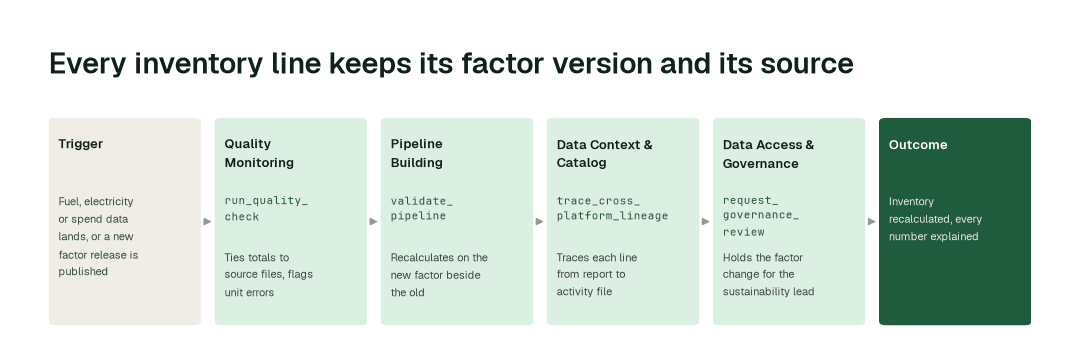
Agents treat the inventory as a governed data product for the ESG and sustainability data teams that own it. Every line carries its activity source, its factor and the factor version, and a new release is built beside the old one, never over it. Both are recalculated, the difference is reported by scope, category and site, and the decision goes to the sustainability lead with the evidence attached. This rests on automated lineage (and column-level lineage for the detail), and on an audit trail of who approved each change.
The workflow, step by step
- 1.The Quality Monitoring agent calls
run_quality_checkand ties electricity, fuel and spend totals to their source files, flagging unit mismatches and estimated readings carried forward. - 2.The Pipeline Building agent calls
validate_pipelineand tests the recalculation on the new factor version against the old one, so the old version still reproduces the published numbers. - 3.The Data Context & Catalog agent calls
trace_cross_platform_lineageand traces each changed line from the report back to the activity file, with the factor version recorded. - 4.The Data Access & Governance agent calls
request_governance_reviewand holds the factor, boundary or method change as one decision for the sustainability lead.
The impact metrics we move
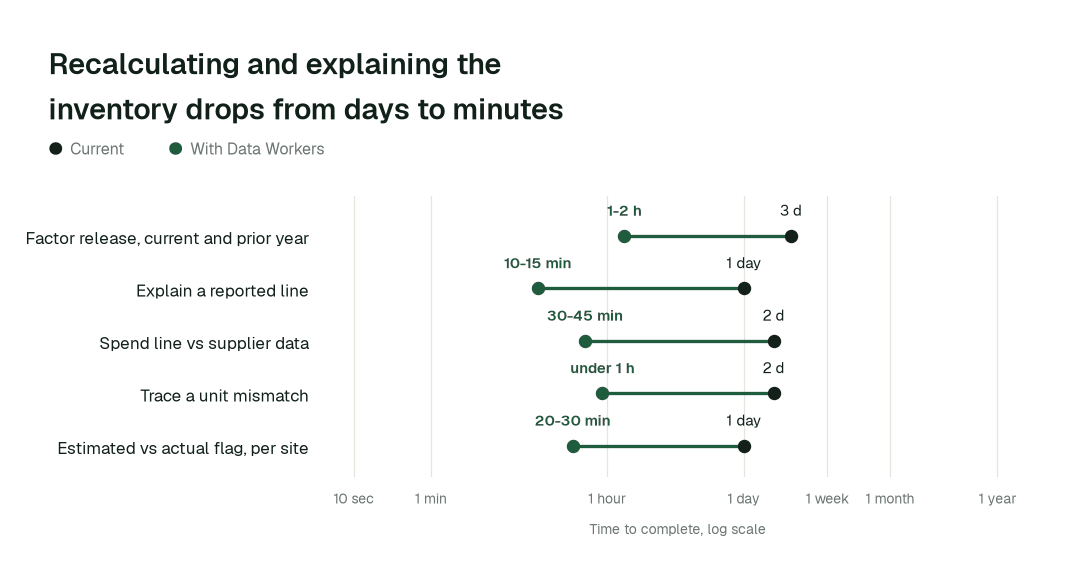
- •Factor release recalculated, current and prior year: from about 3 days to 1-2 h
- •Reported line explained, factor and source: from about 1 day to 10-15 min
- •Spend-based line checked against supplier data: from about 2 days to 30-45 min
- •Unit mismatch traced to its source: from about 2 days to under 1 h
- •Estimated versus actual flag checked per site: from about 1 day to 20-30 min
What goes on autopilot
- •Activity data is checked on arrival, so unit errors and carried-forward estimates surface before they reach a total.
- •Every inventory line keeps its factor version and source, so recalculating a prior year is a routine run, not a rebuild.
- •Catalog pages for sites, suppliers and factor tables stay current, with an owner on each. The Spellbook Data Catalog is in preview.
Where your people stay in charge
Factor versions, boundaries and methods always go to a named approver, because they change published figures. The sustainability lead decides, with before-and-after numbers by scope and category in front of them. Moving a Scope 3 line from a spend-based estimate to supplier data is proposed the same way, and whether to restate a published figure is never an agent's call. The Scope 3 Standard defines the categories and the Scope 2 Guidance the location-based and market-based methods; which to apply is a methodology choice that stays with your team. Everything starts at L1, observing only, and autonomy rises only on evidence.
The pilot
- •Scope. One inventory slice, for example electricity and stationary fuel for one region, with the factor library and a prior-year recalculation, at L2.
- •First week. Agents run at L1, observing only, and show the issues they would have flagged, with receipts.
- •By week two. Arrival checks and line-level lineage run on their own; every factor or method change goes to the sustainability lead.
- •At day 30. We review the impact metrics against your baseline:
- •Factor release recalculated, current and prior year: from about 3 days to 1-2 h
- •Reported line explained, factor and source: from about 1 day to 10-15 min
- •Unit mismatch traced to its source: from about 2 days to under 1 h
- •Cost. Start with a pilot ($7,500 one-time, credited in full against the first year). Scale is from $1,000 a month and Enterprise from $3,000 a month, billed annually, with unlimited seats, no usage meter and no markup on model spend. See pricing.