Audit-ready sustainability reporting, run by agents
When the assurance provider picks a sample of reported figures, the sustainability team rebuilds the trail by hand: the calculation, the factor, the source file, who changed what. Here is how Data Workers keeps that evidence assembled and ready, so limited assurance is a review, not a search.
Key takeaways
- •The problem today. Limited assurance on a sustainability report works by sampling. The assurer picks figures, and the team spends days per sample finding the calculation, the emission factor version, the source file and the record of who changed what.
- •What changes. Agents keep the trail behind every reported figure current as the work happens: lineage to the source, the change history, the latest control results. A sample request becomes an export that a person reviews.
- •What stays with your people. The CFO and the Chief Sustainability Officer sign the statement. The assurance provider forms the conclusion. Your named owners decide what is released to the assurer.
- •The result. Assurance fieldwork starts from evidence that already exists, and the team spends the audit window on follow-up questions instead of reconstruction.
The problem today
A limited assurance engagement on sustainability information is built on inquiry, analytical procedures and sample testing. The assurer selects figures from the report, such as Scope 2 emissions for a region, total energy use or headcount, and asks for support. The standard that governs most engagements, ISSA 5000 from the IAASB, covers both limited and reasonable assurance, and the work you are asked to evidence grows as the level rises.
For the data team, each sampled figure means the same scavenger hunt. Find the calculation. Find the factor release that was in force. Find the site file or invoice behind the activity data. Explain why a source system changed in March. Show who approved the restatement. The answers live in a warehouse, a spreadsheet, a ticket and someone's memory, and the sustainability controller assembles them the week before the assurer arrives. Then the assurer picks the next sample, and the hunt starts from zero. This is the routine upkeep of the ESG and sustainability data teams.
What changes with Data Workers
Agents treat the assurer's questions as standing questions and answer them continuously. For each reported figure they keep the path back to its source, the history of changes to the data and logic behind it, and the result of the control tests that tie it to the ledger or the operating system. When the sample arrives, the evidence pack is compiled from that record, and a named person reviews it before anything leaves your team. The wider pattern is described in audit evidence on demand, and automated data lineage covers how a lineage record holds up in review.
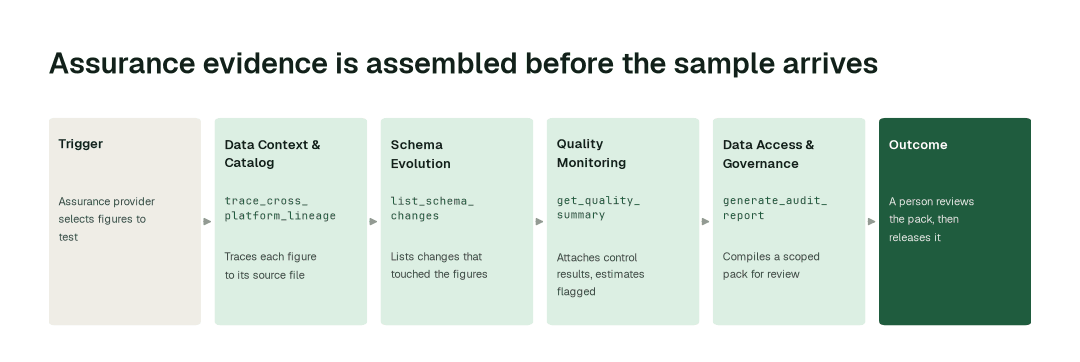
The workflow, step by step
- 1.The Data Context & Catalog agent calls
trace_cross_platform_lineageand follows each sampled figure from the report back through the models to the source file or invoice, across warehouse and BI tools. - 2.The Schema Evolution agent calls
list_schema_changesand lists the source and model changes that touched those figures in the period, with who or what made each one. - 3.The Quality Monitoring agent calls
get_quality_summaryand attaches the latest tie-out and control test results, with estimated lines flagged apart from measured ones. - 4.The Data Access & Governance agent calls
generate_audit_reportand compiles the evidence pack, scoped so the assurer sees support for the sampled figures and not drafts of everything else.
Each action leaves a tamper-evident audit trail (see what an audit trail for data agents needs), so the pack shows not only the numbers but who approved each change and when. The Autonomous Data-Conductor routes the request and holds the finished pack for your controller.
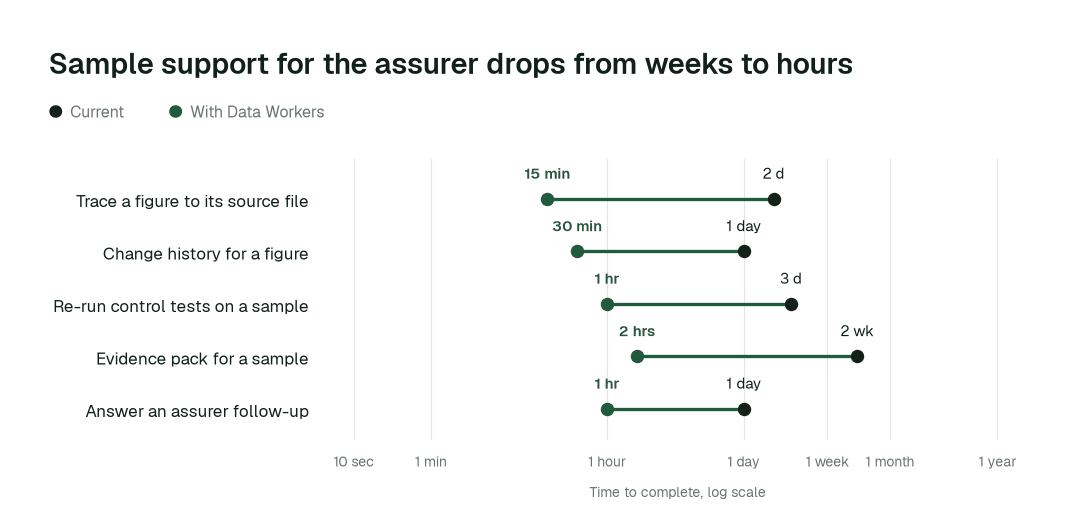
The impact metrics we move
- •Sampled figure traced to its source file: from about 2 days to 15 min
- •Change history and approvals for a figure: from about a day to 30 min
- •Tie-out and control tests re-run on a sample: from about 3 days to 1 h
- •Evidence pack for a sample of figures: from about 2 weeks to 2 h
- •Assurer follow-up request answered: from about a day to 1 h
What goes on autopilot
- •Lineage stays attached to every reported figure, refreshed when a source file, model or factor release changes, so a trace does not depend on whoever built the calculation.
- •Control tests run on a schedule and after relevant changes, and their results are kept with the figure, so "what did the test show in the period" has a record.
- •Evidence packs are drafted ahead of the request from the audit trail, for a person to review and release.
Where your people stay in charge
The CFO and the Chief Sustainability Officer sign the statement; agents never file or publish anything. The assurance provider decides what to sample, what to accept and what conclusion to draw. Which evidence is released to the assurer, any explanation of an estimate or a restated figure, and every method or factor choice go to a named approver, with the before-and-after in front of them. Everything starts at L1, observing only, and autonomy rises only on evidence.
The pilot
- •Scope. One reporting topic, such as Scope 1 and 2 emissions or energy use, with lineage, change history and control results kept per figure at L2.
- •First week. Agents run at L1, observing only, and show the evidence pack they would have produced for last year's sample, with receipts.
- •By week two. Trace, change-history and control-result upkeep runs on its own; every release to the assurer goes to a named approver.
- •At day 30. We review the impact metrics against your baseline:
- •Sampled figure traced to its source file: from about 2 days to 15 min
- •Change history and approvals for a figure: from about a day to 30 min
- •Tie-out and control tests re-run on a sample: from about 3 days to 1 h
- •Evidence pack for a sample of figures: from about 2 weeks to 2 h
- •Assurer follow-up request answered: from about a day to 1 h
- •Cost. Start with a pilot ($7,500 one-time, credited in full against the first year). Scale is from $1,000 a month and Enterprise from $3,000 a month, billed annually, with unlimited seats, no usage meter and no markup on model spend. See pricing.