CSRD and ISSB disclosure data, run by agents
Every ESRS or IFRS S2 datapoint needs a source, an owner and a tie-out, and the list that says so is usually a spreadsheet that ages between reporting dates. Here is how Data Workers traces each datapoint to its source tables and owner and flags the gaps before close.
Key takeaways
- •The problem today. The materiality assessment produces a list of datapoints. The mapping to source tables and owners lives in a spreadsheet, and the gaps surface in the last weeks before close.
- •What changes. Agents keep each datapoint traced to its source tables and owner, tie it to the ledger or operating system, and flag any with no source, owner or tie-out while there is time to fix it.
- •What stays with your people. Materiality conclusions, methodology and estimate choices, every disclosed figure and sign-off. Agents trace, test and flag. They do not conclude, approve or file.
- •The result. You reach close with a short, specific list of open gaps instead of a surprise, and each datapoint arrives with its trace.
The problem today
An ESRS or IFRS S2 datapoint is only as good as the answer to three questions: where does it come from, who owns it, and does it agree with the system of record. Teams can answer them for the headline metrics. For the long tail, the answers sit in one person's spreadsheet or memory.
Then the inputs move. A site switches energy units, an HR upgrade renames headcount fields, a plant lands in a different cost centre. The list does not know, and the gap is found when a number looks wrong or the assurance provider samples it.
Rules and timing also move. CSRD scope, the ESRS datapoint set and ISSB adoption by jurisdiction have all been changing, so the inventory is revised more often than most teams planned for. Confirm current scope, timing and the datapoints that apply to you with your advisers, starting from the European Commission's CSRD page, EFRAG's sustainability reporting page and the IFRS Foundation's page for IFRS S2. We state no scope or dates here: they would be out of date before you read this.
What changes with Data Workers
Agents keep the inventory attached to the systems that feed it. For each datapoint they hold the source tables, the owner, the tie-out and any gap, and refresh that picture whenever a source changes. One mapping serves every framework that asks for the same fact, so an ESRS datapoint and its ISSB counterpart share one trace. It is the working method of the regulatory disclosure data team, fed by the inputs in the climate and sustainability data playbook. More on ESG and sustainability data teams.
The workflow, step by step
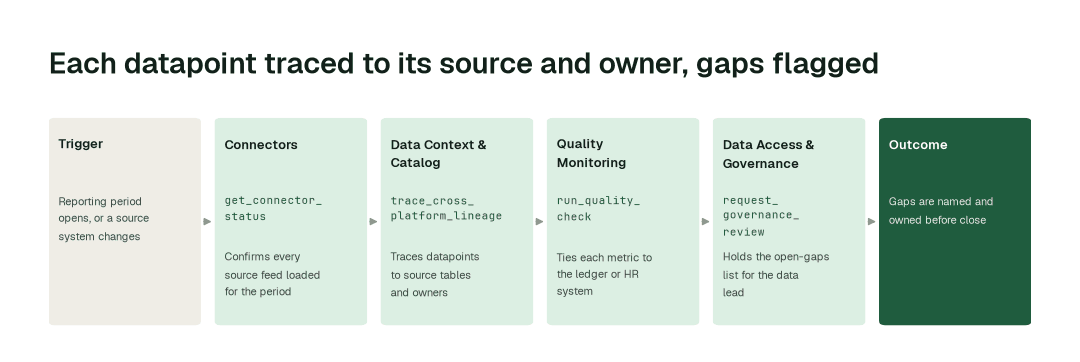
- 1.The Connectors agent calls
get_connector_statusand confirms that every source behind the in-scope datapoints loaded for the period, so a missing feed shows up as a named gap, not a low number. - 2.The Data Context & Catalog agent calls
trace_cross_platform_lineageto follow each datapoint back to its source tables, and reads the owner from the catalog. Where a datapoint has no source or owner, it callsflag_documentation_gapand adds it to the open-gaps list. - 3.The Quality Monitoring agent calls
run_quality_checkand ties each traced metric to the ledger, payroll or the site readings it should agree with, then records the result next to the datapoint. - 4.The Data Access & Governance agent calls
request_governance_reviewand holds the open-gaps list, with every proposed mapping change and its full diff, for the sustainability data lead.
This runs on a schedule through the reporting period, not once at the end. Because the trace is lineage evidence and not a screenshot, it is also where an assurance provider's sample request starts, and every step leaves a tamper-evident audit trail (see audit trail requirements for data agents). Our note on SOX, GDPR and the EU AI Act explains the limit: the platform supplies controls and evidence, not a compliance conclusion.
The impact metrics we move
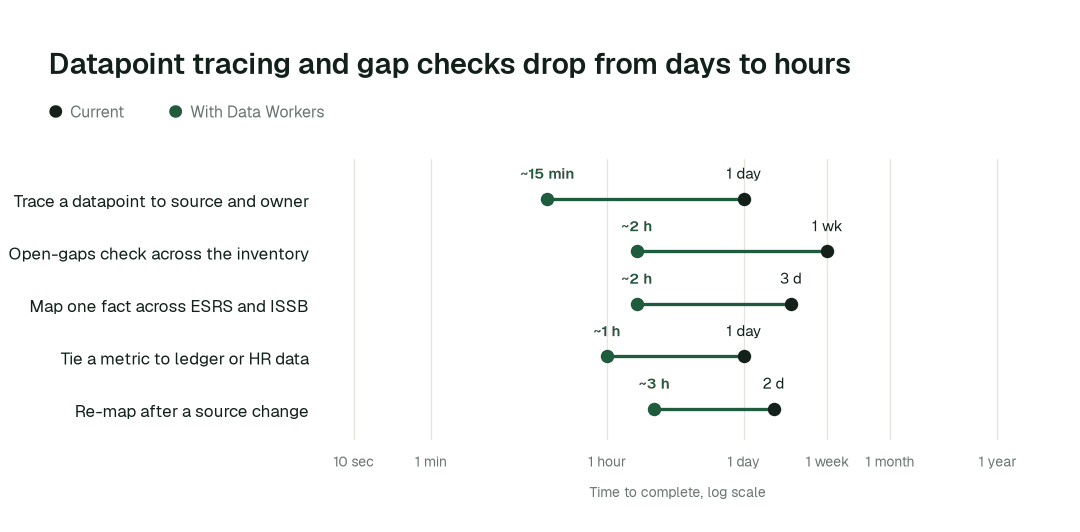
These are the targets we work toward with a disclosure data team, not results from a deployment.
- •Datapoint traced to source tables and owner: from about a day to ~15 min
- •Open-gaps check across the inventory before close: from about a week to ~2 h
- •Same fact mapped across ESRS and ISSB: from about 3 days to ~2 h
What goes on autopilot
- •The trace from datapoint to source tables is refreshed whenever a source changes, so the inventory is current between reporting dates and not only on them.
- •Gaps are flagged as they appear: a datapoint with no source, no owner or a failed tie-out goes on the open-gaps list that day, with the reason.
- •Tie-outs run on a schedule, and the results are kept beside each datapoint as evidence.
Where your people stay in charge
Mapping changes, tie-outs that feed a disclosed figure and the open-gaps list go to a named approver, typically the sustainability data lead. Materiality conclusions, methodology and estimate choices, disclosed figures and sign-off stay with the CFO, the sustainability lead and the audit committee. Nothing is filed or published by an agent. Everything starts at L1, observing only, and autonomy rises only on evidence, one domain at a time.
The pilot
- •Scope. One disclosure topic, for example energy and workforce datapoints, traced, tied and gap-checked at L2.
- •First week. Agents run at L1, observing only, and show the gaps they would have flagged and the mapping changes they would have proposed, with receipts.
- •By week two. The routine tracing and tie-outs run on their own; anything that touches a disclosed figure stays with a named approver.
- •At day 30. We review the impact metrics against your baseline:
- •Datapoint traced to source tables and owner: from about a day to ~15 min
- •Open-gaps check across the inventory before close: from about a week to ~2 h
- •Same fact mapped across ESRS and ISSB: from about 3 days to ~2 h
- •Cost. Start with a pilot ($7,500 one-time, credited in full against the first year). Scale is from $1,000 a month and Enterprise from $3,000 a month, billed annually, with unlimited seats, no usage meter and no markup on model spend. See pricing.