Recruiting funnel data, run by agents
Time-to-fill and stage pass-through rates break whenever recruiting operations renames a stage, merges a requisition template or reopens a vacancy, and candidate records pile up past their retention date. Here is how Data Workers keeps applicant tracking data consistent and scoped instead.
Key takeaways
- •The problem today. Applicant tracking data from Greenhouse, Lever or Workday Recruiting changes shape whenever recruiting operations edits a stage or a requisition template. Time-to-fill and pass-through rates then shift for reasons that have nothing to do with candidates, and nobody can say which quarter's numbers still compare.
- •What changes. Agents catch each stage rename and requisition change as it lands, propose how it maps to the agreed definitions, and tie the funnel back to the previous numbers before anyone reads a dashboard.
- •What stays with your people. The stage mapping, the definition of time-to-fill, and anything that deletes or releases candidate records: a named owner approves each one.
- •The result. Funnel metrics hold across renames, and candidate personal data is mapped and scoped before a subject access request or a retention review arrives.
The problem today
Recruiting operations edits the process constantly. A screening stage is split in two, "Manager Review" becomes "Manager Interview", two requisition templates are merged, a vacancy is reopened after an offer falls through. Each edit is correct in the applicant tracking system (ATS) and quietly wrong downstream: the stage that used to receive most candidates now receives none, time-to-fill restarts on a reopened requisition, and the pass-through rate from onsite to offer is computed over two different populations.
The people analytics team finds out when a recruiter asks why the funnel changed. Fixing it means rereading stage histories by hand and agreeing, again, what counts as the start of a vacancy.
The second problem is personal data. Candidates are not employees, and in the EU their data may be kept only as long as there is a reason to keep it. Resumes, interview notes and assessment scores sit in the ATS, in warehouse copies and in analyst extracts, and nobody can say with confidence which records are past their schedule. This is the recruiting side of the work described in the HR data platform playbook, the planning side in workforce planning data, and the people and labor-market view in the people and labor-market data playbook.
What changes with Data Workers
Agents watch the ATS feeds you already land in the warehouse. When a stage, field or requisition rule changes, they work out what moved, propose the mapping to the stage definitions you have agreed, and tie the funnel back to the last known-good numbers. Candidate personal data is found and scoped in the same pass. It is one workflow in the people data teams group, alongside headcount and attrition data.
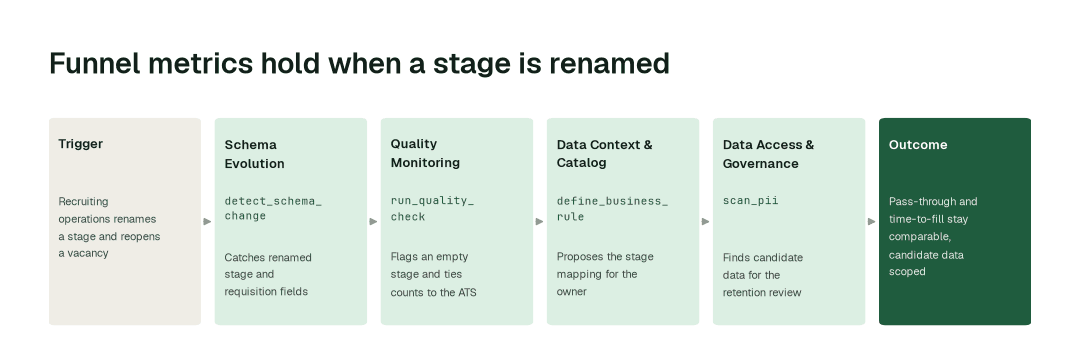
The workflow, step by step
- 1.The Schema Evolution agent calls
detect_schema_changeand catches renamed or retired stage and requisition fields in the Greenhouse, Lever or Workday Recruiting extract, with every downstream model and report that reads them. How it works. - 2.The Quality Monitoring agent calls
run_quality_checkand flags a stage that stops receiving candidates, a stage name it has not seen before, and funnel counts that no longer tie to the ATS's own report. How it works. - 3.The Data Context & Catalog agent calls
define_business_ruleand proposes how the new stage maps to your canonical funnel and how a reopened requisition counts toward time-to-fill. The talent acquisition operations owner approves the mapping, and history is restated under the same definition. - 4.The Data Access & Governance agent calls
scan_piiand finds candidate personal data in the tables, copies and notes fields, then prepares the retention review for the privacy office. PII handling.
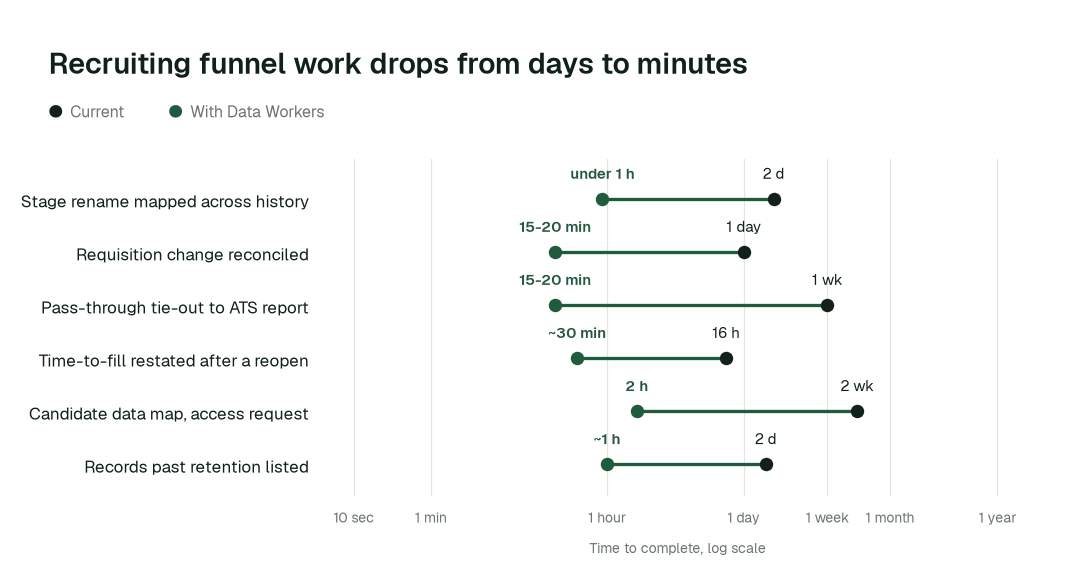
The impact metrics we move
- •Stage rename mapped across history: from about 2 days to under 1 h
- •Requisition change reconciled: from about a day to 15-20 min
- •Pass-through tie-out to the ATS report: from about a week to 15-20 min
- •Candidate data map for a subject access request: from about 2 weeks to 2 h
What goes on autopilot
- •Every ATS load is checked on arrival, so a renamed stage or a silent drop in candidates is flagged the same morning, not at the quarterly review.
- •Funnel counts and time-to-fill are tied back to the ATS report after every change, so the old and new numbers can be compared on one definition.
- •Candidate fields are tagged as personal data as they appear, and the list of records past your retention schedule is kept current for the privacy office to review.
Where your people stay in charge
The stage mapping and the time-to-fill definition go to the talent acquisition operations owner, because every recruiting metric moves with them. Deleting candidate records, anonymising them, and releasing any individual-level data are decisions for the privacy office and Legal. Agents find, test and propose; they never delete a candidate, and the agent that prepares a request never approves it. Everything starts at L1, observing only, and autonomy rises only on evidence. For how this supports GDPR work, see subject access request automation and access governance.
The pilot
- •Scope. One ATS (Greenhouse, Lever or Workday Recruiting), the stage history and requisition tables, and the funnel report your recruiters read, at L2.
- •First week. Agents run at L1, observing only, and show the stage mappings and retention gaps they would have proposed, with receipts.
- •By week two. Load checks and the tie-out to the ATS report run on their own; every mapping, definition change and deletion stays with a named owner.
- •At day 30. We review the impact metrics against your baseline, targeting:
- •Stage rename mapped across history: from about 2 days to under 1 h
- •Requisition change reconciled: from about a day to 15-20 min
- •Pass-through tie-out to the ATS report: from about a week to 15-20 min
- •Cost. Start with a pilot ($7,500 one-time, credited in full against the first year). Scale is from $1,000 a month and Enterprise from $3,000 a month, billed annually, with unlimited seats, no usage meter and no markup on model spend. See pricing.