Headcount and attrition data, run by agents
HR, finance and the board deck each carry a different headcount, and a different attrition rate, because every report pulls a different day's HRIS extract and counts contractors, rehires and reorgs its own way. Here is how Data Workers settles the number before the monthly people review.
Key takeaways
- •The problem today. HR, finance and the board deck each carry a different headcount and a different attrition rate. Backdated terminations, reorgs, contractors, rehires and competing definitions of "voluntary" and "regretted" move the number depending on who pulled it and when.
- •What changes. Agents tie HRIS, payroll and contractor records to finance every morning, trace each gap to the record or rule behind it, and check every figure against one owned definition.
- •What stays with your people. The definitions themselves, the choice of which number is official, any restatement of a period already reported, and any cut small enough to identify a person.
- •The result. The monthly people review opens on one number that HR and finance have already agreed.
The problem today
Ask three people for October headcount and you get three answers. People analytics pulled the Workday extract on the 3rd. Finance counted from payroll and the ledger. The board deck was built last quarter and patched since.
None of them is simply wrong. A termination keyed on the 8th with an effective date of the 28th moves a month that was already reported. A reorg moves a team, so attrition by organization changes depending on whether you use the org as of the exit date or as of today. A rehire carries a new worker ID and shows up as one exit and one hire. Contractors sit in a vendor system, and finance counts some as FTE. And "attrition" means voluntary only in one dashboard, all exits in another, regretted exits in a third, each over a different denominator.
The days before each monthly people review go to proving which number is right. The people data teams that own this work sit in the HR data platform and workforce planning groups.
What changes with Data Workers
Agents treat headcount as a reconciliation that runs every morning, not a report built in the last week of the month. Every HRIS, payroll and contractor load is checked on arrival, tied to finance, and each difference is traced to a specific record or rule. Headcount and attrition follow definitions your owners have approved, so a dashboard cannot quietly use another. Where workforce figures are also published outside the company, see the people and labor-market data playbook.
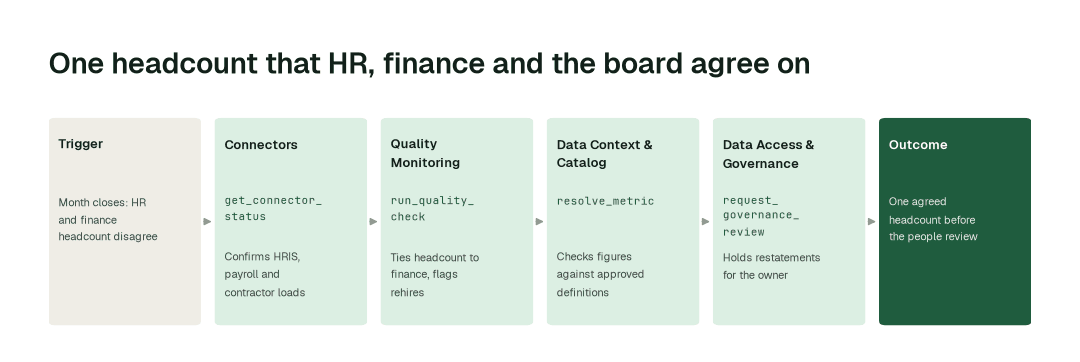
The workflow, step by step
- 1.The Connectors agent calls
get_connector_statusand confirms the HRIS, payroll and contractor loads for the period all landed, before anyone reads a number. - 2.The Quality Monitoring agent calls
run_quality_checkand ties headcount to finance by cost centre, flagging duplicate worker records, rehires counted twice and contractors sitting in the employee count. - 3.The Data Context & Catalog agent calls
resolve_metricand checks each headcount and attrition figure against the approved definition: what counts as voluntary, how rehires and internal transfers are treated, and which denominator applies. A backdated change is traced to the prior period it moves, so the restatement is explained, not discovered. - 4.The Data Access & Governance agent calls
request_governance_reviewand holds anything that changes a definition or restates a reported period for its named approver. The Autonomous Data-Conductor coordinates the sequence and keeps each step inside the autonomy your owners allow.
Background: slowly changing dimensions for effective-dated history, business definitions for AI agents for shared meaning, and churn for the same "which definition" problem on the customer side.
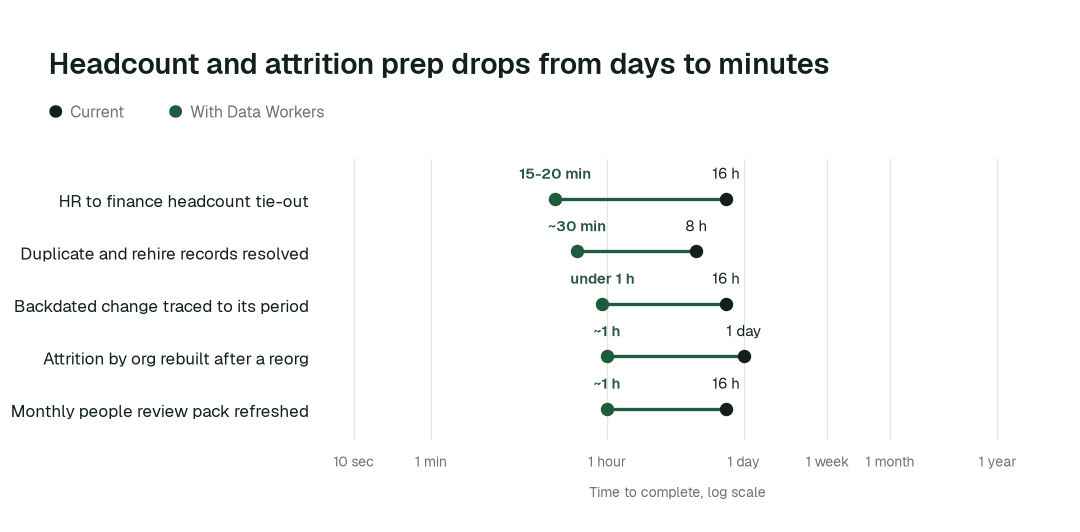
The impact metrics we move
- •HR to finance headcount tie-out: from about 2 days to 15-20 min
- •Duplicate and rehire records resolved: from about 1 day to about 30 min
- •Backdated change traced to the period it moves: from about 2 days to under 1 h
- •Attrition by organization rebuilt after a reorg: from about 3 days to about 1 h
- •Monthly people review pack refreshed: from about 2 days to about 1 h
What goes on autopilot
- •The morning tie-out. HRIS, payroll and contractor counts are compared to finance's every day, so a gap surfaces on the 2nd, not in a dispute on the 20th. It is the people-side twin of data reconciliation and FP&A forecasting.
- •Duplicate and rehire cleanup. Worker-record matches, and contractors kept out of employee counts, are proposed with the evidence attached.
- •Definition checks. Every dashboard and extract that reports headcount or attrition is compared to the approved definition, so drift shows up as a flagged difference.
Where your people stay in charge
The definitions are yours. Whether a transfer counts as an exit, whether attrition is voluntary only and which number is official for the board are decisions for the Head of People Analytics and the finance data owner; agents propose changes to them, never make them. "Regretted" is a manager's judgment about a person, so an agent reads the flag you record and never infers it. Restating a reported period, and any cut of exits small enough to identify an individual, go to a named approver; record-level access follows how Data Workers handles PII. Everything starts at L1, observing only, and autonomy rises only on evidence.
The pilot
- •Scope. Daily headcount tie-out and the monthly attrition figure for one legal entity or business unit, at L2.
- •First week. Agents run at L1, observing only, and show the gaps they would have raised and the fixes they would have proposed, with receipts.
- •By week two. The routine tie-out and record cleanup run on their own; anything touching a definition or a reported period stays with a named approver.
- •At day 30. We review the impact metrics against your baseline:
- •HR to finance headcount tie-out: from about 2 days to 15-20 min
- •Backdated change traced to the period it moves: from about 2 days to under 1 h
- •Cost. Start with a pilot ($7,500 one-time, credited in full against the first year). Scale is from $1,000 a month and Enterprise from $3,000 a month, billed annually, with unlimited seats, no usage meter and no markup on model spend. See pricing.