Meter data management, run by agents
Interval reads reach billing through validation, estimation and editing, and the exceptions pile up faster than the meter data team can clear them. Gaps, meter swaps and stuck registers get found at bill run instead of before it. Here is how Data Workers runs it instead.
Key takeaways
- •The problem today. Millions of meters send interval reads through collectors and a head-end into the MDM. Gaps, meter exchanges and stuck registers surface as exceptions at bill run, and the team estimates and edits by hand against the clock.
- •What changes. Agents run validation, estimation and editing checks on every read as it lands, size each problem by collector, meter and account, and prepare the fix before the read becomes a billing determinant.
- •What stays with your people. Every estimate and every edit is a proposal. The meter data lead approves it before it reaches billing.
- •The result. Bills go out on complete, explained reads, and an edited read carries the reason, the approver and the way back.
The problem today
The US Energy Information Administration counts about 119 million AMI installations, roughly 72% of US electric meters. Each interval they report has to pass validation, estimation and editing (VEE) before it can become a billing determinant.
The checks are the easy part. The cases are not. A storm drops a collector and thousands of meters miss reads. A meter exchange puts a new device ID and a reset register on an old premise. A register sticks at one value while the customer keeps using power, and nobody notices until the bill is disputed. Each case lands in an exception queue ranked by date, not by how many customers it touches, and the bill cycle is the clock. It is why the week for utility data teams is mostly firefighting.
What changes with Data Workers
Agents work alongside your MDM, not in place of it. The MDM stays the system of record for your VEE rules. The agents watch the reads in the lakehouse as they land, learn each meter class's normal profile, and catch what a fixed rule misses: the swap missing from the premise record, the register that has stopped moving, the gap bigger than the collector log says.
Each finding arrives with its cause, the accounts it touches and a proposed estimate or edit, ready for review. This is one practice in the field guide for utility data teams, for the operations and supply chain data teams that keep billing and the grid on one dataset. The energy and utilities platform view covers the stack.
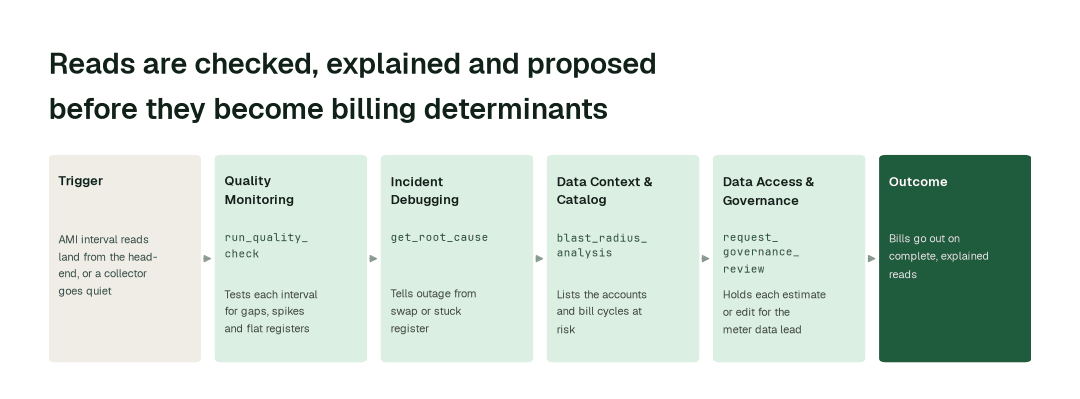
The workflow, step by step
- 1.The Quality Monitoring agent calls
run_quality_checkand tests every landed interval for gaps, spikes, zero consumption and flat registers, per collector and per meter. - 2.The Incident Debugging agent calls
get_root_causeand separates a collector outage from a meter exchange, a firmware change or a stuck register, so the fix matches the cause. - 3.The Data Context & Catalog agent calls
blast_radius_analysisand lists the accounts, bill cycles and downstream models the problem touches, so the queue is ordered by what bills are at risk. - 4.The Data Access & Governance agent calls
request_governance_reviewand puts each proposed estimate or edit in front of the meter data lead, with a preview and how to undo it.
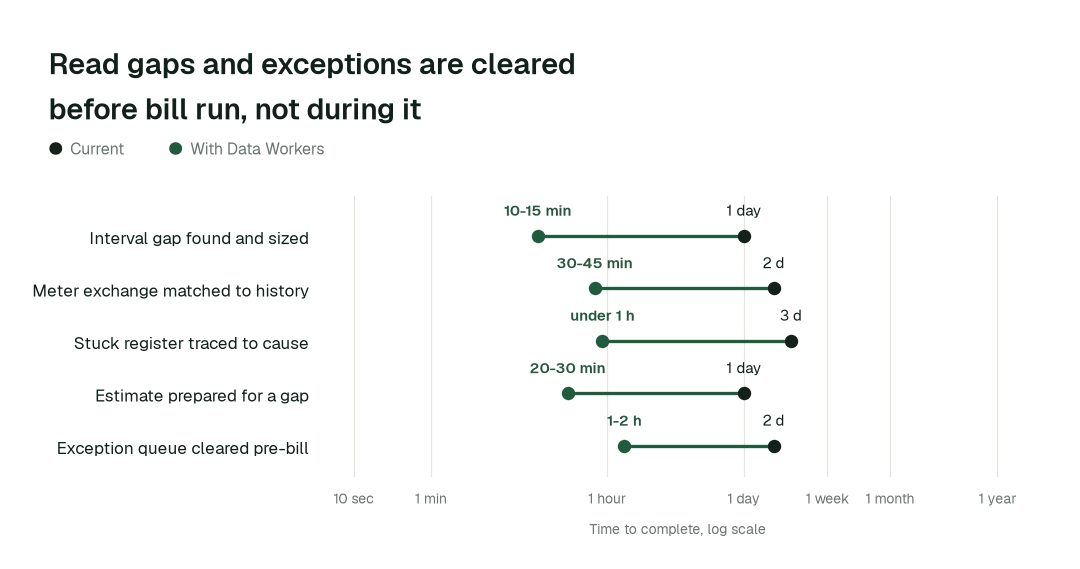
The impact metrics we move
- •Interval gap found and sized, by collector: from about 1 day to 10-15 min
- •Meter exchange matched to its read history: from about 2 days to 30-45 min
- •Stuck register traced to its cause: from about 3 days to under 1 h
- •Estimate prepared for a gap: from about 1 day to 20-30 min
- •Exception queue cleared before bill run: from about 2 days to 1-2 h
What goes on autopilot
- •Every interval is checked on arrival, so gaps and stuck registers surface the night they start, not at bill run.
- •Collector status is watched continuously, so a late backlog is recognised and its reads are re-checked on arrival.
- •Meter, premise and account records stay documented in the catalog, with an owner on each, so a swap has a trail to follow.
Where your people stay in charge
An estimate or an edit changes what a customer is billed, so each one goes to a named approver: the meter data lead. Billing operations sees the same proposal: original read, proposed value, reason and accounts affected. Approval is recorded in a tamper-evident audit trail, with a signed record of what ran and how to undo it, which is the evidence a billing dispute review asks for later (how approvals work). Your VEE policy, estimation method and any regulator-set rules stay with your team. Everything starts at L1, observing only, and autonomy rises only on evidence.
The pilot
- •Scope. Gap and stuck-register detection on one collector group or one bill cycle, with estimates held at L2.
- •First week. Agents run at L1, observing only, and show the exceptions they would have flagged, with receipts.
- •By week two. Arrival checks and cause tracing run on their own; every estimate and edit goes to the meter data lead.
- •At day 30. We review the impact metrics against your baseline:
- •Interval gap found and sized, by collector: from about 1 day to 10-15 min
- •Stuck register traced to its cause: from about 3 days to under 1 h
- •Exception queue cleared before bill run: from about 2 days to 1-2 h
- •Cost. Start with a pilot ($7,500 one-time, credited in full against the first year). Scale is from $1,000 a month and Enterprise from $3,000 a month, billed annually, with unlimited seats, no usage meter and no markup on model spend. See pricing.