Rate cases and regulatory reporting, run by agents
A rate case rests on test-year numbers that start in the general ledger and pass through workbooks before they reach an exhibit. Then FERC Form 1 and the commission's data requests ask how each one was built, on a clock. Here is how Data Workers runs it instead.
Key takeaways
- •The problem today. Test-year numbers pass from the ledger, fixed-asset records and billing through workbooks into exhibits. When staff or an intervenor asks how one was built, an analyst rebuilds the trail by hand.
- •What changes. Agents tie the test-year data to the ledger as it closes, keep a lineage trail behind every exhibit and form figure, and assemble the response package for each data request.
- •What stays with your people. Every figure in a filing or a data-request response goes to a named approver. Adjustments, cost allocation and your legal position stay with your team.
- •The result. Each filed number traces to its ledger accounts, and a data request is answered inside its window from evidence already assembled.
The problem today
A rate case is argued on a test year: twelve months of cost, plant and sales data, adjusted to what the commission should allow. Expense and plant balances come from the general ledger and the fixed-asset records. Sales by class come from billing, which depends on validated meter reads. Workbooks join them into the revenue requirement exhibits.
The same data is reported again. FERC Form 1 is the annual report of major electric utilities, filed each April, and its figures must agree with the rate case for the same period. Then the data requests arrive from commission staff, the consumer advocate and intervenors. Each asks how a number was built, and the procedural schedule sets the answer window.
Meanwhile a late journal entry or reclassification lands after the cut, and nobody knows which exhibits it touches. For the operations and supply chain data teams behind the filing, rate case season means rebuilding evidence that should already exist.
What changes with Data Workers
Agents work beside your ERP, billing system and revenue requirement model, not in place of them; your model stays the system of record for the method. The agents watch the data that feeds it: they tie test-year balances to the ledger as each period closes and flag what does not tie.
They also hold the lineage: for a figure in an exhibit or a Form 1 schedule, the path back through warehouse tables to the ledger accounts and the source system. It is the pattern we describe for regulatory reporting in financial services, built on automated data lineage. The energy and utilities platform view covers the stack, and the field guide for utility data teams covers the meter data.
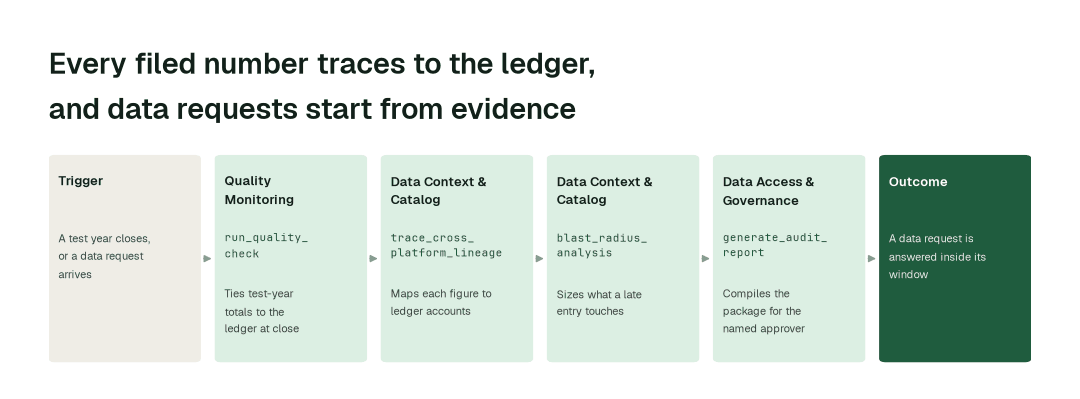
The workflow, step by step
- 1.The Quality Monitoring agent calls
run_quality_checkand ties test-year expense, plant and billed-sales totals to the ledger at each close, so breaks surface early. - 2.The Data Context & Catalog agent calls
trace_cross_platform_lineageand maps each exhibit and Form 1 figure back to its ledger accounts and source tables. - 3.The same agent calls
blast_radius_analysiswhen a reclassification or late entry lands, and lists the exhibits, schedules and open data requests it touches. - 4.The Data Access & Governance agent calls
generate_audit_reportto compile the response package, thenrequest_governance_reviewto put it in front of the named approver.
The impact metrics we move
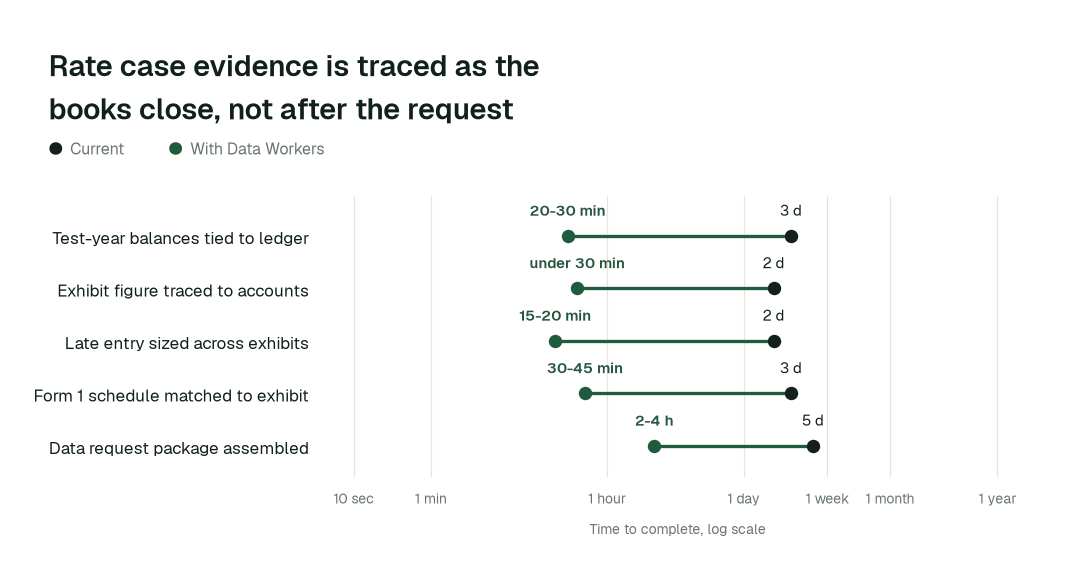
- •Test-year balances tied to the ledger: from about 3 days to 20-30 min
- •Exhibit figure traced to ledger accounts: from about 2 days to under 30 min
- •Reach of a late entry sized across exhibits: from about 2 days to 15-20 min
- •Form 1 schedule matched to the rate case exhibit: from about 3 days to 30-45 min
- •Data request response package assembled: from about 5 days to 2-4 h
What goes on autopilot
- •The test year builds as the books close, so tie-out is not a scramble after filing.
- •Lineage stays current, so "how was this built?" has an answer before anyone asks.
- •Exhibit sources are documented in the catalog, each with an owner, so a data request reaches the right person first time.
Where your people stay in charge
A filed number is a statement to a regulator, so each figure in a filing or a data-request response goes to a named approver: the rate case lead for exhibits and responses, the controller for anything that touches the ledger, and the person who certifies the filing. Agents prepare and propose. They do not file, and they do not change the ledger. Pro forma adjustments, the revenue requirement method, cost allocation and contested positions stay with your team and counsel.
Approvals are recorded in a tamper-evident audit trail, with a signed record of what ran and how to undo it (how approvals work). Everything starts at L1, observing only, and autonomy rises only on evidence.
The pilot
- •Scope. One test year and one set of Form 1 schedules, with responses held at L2.
- •First week. Agents run at L1, observing only, and show the breaks and untraced figures they would have flagged, with receipts.
- •By week two. Tie-out and lineage run on their own; every figure and response goes to the named approver.
- •At day 30. We review the impact metrics against your baseline:
- •Exhibit figure traced to ledger accounts: from about 2 days to under 30 min
- •Data request response package assembled: from about 5 days to 2-4 h
- •Cost. Start with a pilot ($7,500 one-time, credited in full against the first year). Scale is from $1,000 a month and Enterprise from $3,000 a month, billed annually, with unlimited seats, no usage meter and no markup on model spend. See pricing.