Compensation and pay equity data, run by agents
Pay transparency laws ask for pay ranges, pay by category of worker and gap reporting. The data sits in three places that disagree: bands in a spreadsheet, job architecture in the HR system, pay in payroll. Here is how Data Workers joins it into one pay dataset, and why the analysis and any adjustment stay with compensation and legal.
Key takeaways
- •The problem today. Pay transparency obligations need a pay figure, a job level and a comparable category for every worker, in every country. They live in separate systems, so each reporting date starts with spreadsheet joins.
- •What changes. Agents keep bands, job architecture and payroll joined, tied out and traceable, so a pay-equity dataset is ready on the reporting date rather than assembled for it.
- •What stays with your people. The analysis, the explanation of any gap, every adjustment and every release of pay data: compensation, legal and the privacy office decide. Agents prepare and propose.
- •The result. Total Rewards starts from a dataset it can defend.
The problem today
Pay transparency is now a data problem before it is a policy problem. The EU Pay Transparency Directive asks employers to report pay and pay gaps by category of worker, with reporting starting in 2027 for larger employers, and Member States are writing it into national law on their own timelines. In the US, state pay-range laws in places like Colorado, California, New York and Washington require pay ranges on advertised roles and put pay data in front of regulators and candidates.
The data is spread out. Salary bands live in a Total Rewards spreadsheet. Job architecture and levels live in Workday or SuccessFactors. Pay, bonus and allowances live in ADP or a regional payroll, with a different currency and FTE basis in every country. A new job code with no band, a promotion that never reached payroll, or a part-time worker counted at full salary is found when someone builds the report, not before.
What changes with Data Workers
Agents keep the three sources joined as they change. Every worker is matched to a job, level and band; payroll is tied to the HR system by country; anything that does not tie is listed with the record behind it. Lineage runs from payroll line to reporting view, so a number can be explained to an auditor or a works council.
The product is a dataset, not a verdict. Pay data stays in restricted zones, and the gap analysis and its release go to Total Rewards and Legal.
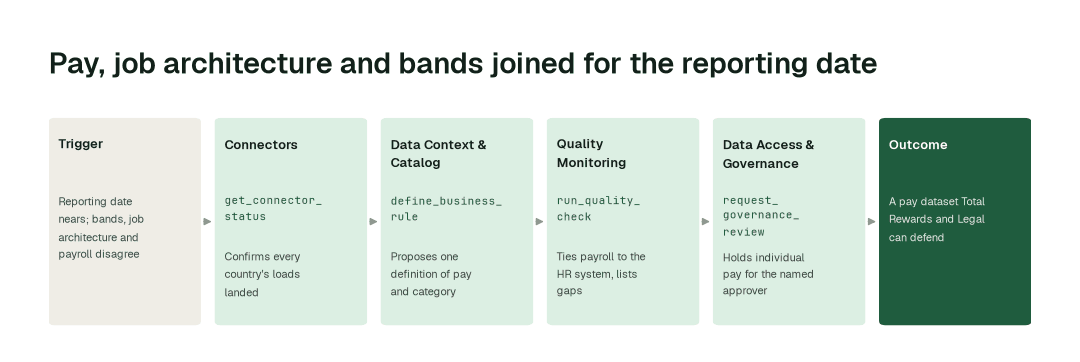
The workflow, step by step
- 1.The Connectors agent calls
get_connector_status, confirms the HR system, payroll and band files landed for every country and flags a late payroll before anything reads it. - 2.The Data Context & Catalog agent calls
define_business_ruleand proposes one governed definition of pay (base, bonus, allowances, annualised and FTE-adjusted) and of the comparable category, for Total Rewards to confirm. - 3.The Quality Monitoring agent calls
run_quality_checkand ties payroll to the HR system, lists jobs with no band, workers outside their band and records that do not match. - 4.The Data Access & Governance agent calls
request_governance_reviewand holds every extract of individual pay for the named approver, with the evidence attached.
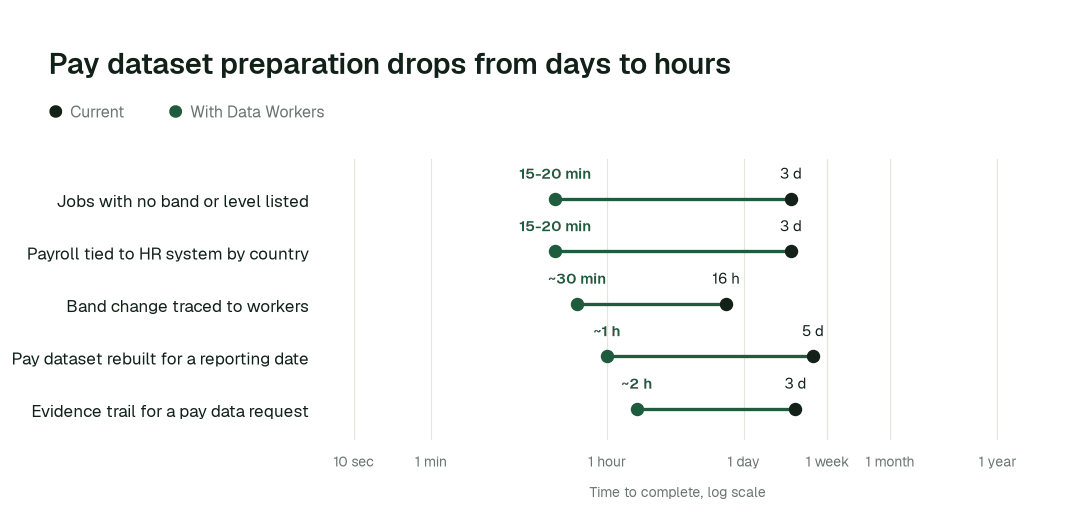
The impact metrics we move
- •Jobs with no band or level found: from about 3 days to 15-20 min
- •Payroll tied to the HR system by country: from about 3 days to 15-20 min
- •Pay dataset rebuilt for a reporting date: from about a week to about 1 h
What goes on autopilot
- •Every load is checked and tied out. Payroll, HR system and band files are matched on each refresh, so a missing band or a double-counted worker shows up that day.
- •Band and job changes are traced. When a band table is revised or a job is re-levelled, the agents list the workers and reports affected, so the change does not silently move a gap figure.
- •Lineage and documentation stay current. The catalog describes each pay field, its source and its owner; see lineage for compliance.
- •Evidence is assembled once. The trail from source record to reported figure is exported, not rebuilt by hand.
Where your people stay in charge
- •Total Rewards owns the definitions, the pay analysis, the explanation of any gap and every adjustment. No agent changes a person's pay or a band.
- •Legal decides what is reported, to whom and in what form, and how to respond to a regulator.
- •The privacy office and the data owner approve every release and every access grant to individual-level pay, the approval path described in how Data Workers handles PII and the Data Access & Governance agent.
Data Workers does not make you compliant with a pay transparency law; it gives the accountable people data they can trace. Everything starts at L1, observing only, and autonomy rises only on evidence. Compensation releases stay at L2 at most: a proposal, approved by a named person. See also how Data Workers helps with GDPR and other regimes and subject access work.
This guide sits in the HR data platform playbook. The same pay-sensitive inputs feed workforce planning and people and labor-market data, and more guides for people data teams are on the group page.
The pilot
- •Scope. One country or legal entity: bands, job architecture and payroll joined and tied out at L2, with individual-level pay held for Total Rewards and Legal.
- •First week. Agents run at L1, observing only, and show the unbanded jobs and tie-out gaps they would have raised, with receipts.
- •By week two. The routine joins and tie-outs run on their own; anything about an individual's pay stays with a named approver.
- •At day 30. We review the impact metrics against your baseline:
- •Jobs with no band or level found: from about 3 days to 15-20 min
- •Payroll tied to the HR system by country: from about 3 days to 15-20 min
- •Pay dataset rebuilt for a reporting date: from about a week to about 1 h
- •Cost. Start with a pilot ($7,500 one-time, credited in full against the first year). Scale is from $1,000 a month and Enterprise from $3,000 a month, billed annually, with unlimited seats, no usage meter and no markup on model spend. See pricing.