Data agents built for the lowest hallucination rate
A data agent that guesses at a join or invents a table is worse than no agent. Data Workers builds agents to answer from your real tables and governed definitions, show the source for each fact, check SQL before it runs, say so when the data is missing and remember corrections.
Before and after
| Today | With Data Workers |
|---|---|
| The agent answers from whatever table it reaches first, guessing at joins and definitions | Answers come from your real tables and governed definitions, with the source shown for each fact |
| SQL runs first and is judged by whoever spots the wrong number | SQL is checked against the warehouse before it runs, not after |
| A missing table gets a plausible invented one | When the data to answer is not there, the agent says so instead of guessing |
| The same wrong answer comes back next week | Corrections people make are remembered |
| A stale copy and the trusted table look the same to the agent | Agents know which source is authoritative and which context is stale |
Business users stop asking a data agent the moment it gives one confident wrong number, and rebuilding that trust costs far more than the first rollout did. The causes are well understood: agents guess when they lack your definitions, and text-to-SQL that works in a demo drifts in production. This page is the operating model; how Data Workers avoids hallucinations is the deep dive, and fixes for data agent hallucinations lists the common ones.
How it works
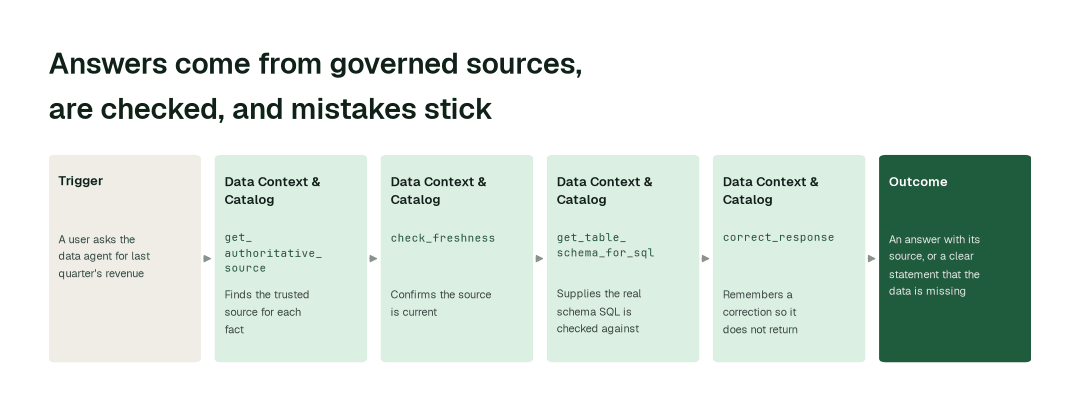
1. Ground every answer in governed context
The Data Context & Catalog agent finds the trusted source for each fact with get_authoritative_source and reads the governed definition and documentation with get_context. An answer carries its source, so a reader can see where each number came from. Owners mark the trusted tables with mark_authoritative.
2. Check before answering
The Data Science & Insights agent writes the query against the real schema, supplied by get_table_schema_for_sql, and the SQL is checked against the warehouse before it runs. check_freshness confirms the source is current. If the table or definition needed is not there, the agent says so and names what is missing.
3. Remember every correction
When a person says an answer is wrong, correct_response records the fix and the same wrong answer does not come back. flag_stale_context marks documentation that no longer matches the data, so it is reviewed rather than trusted.
The impact metrics we move
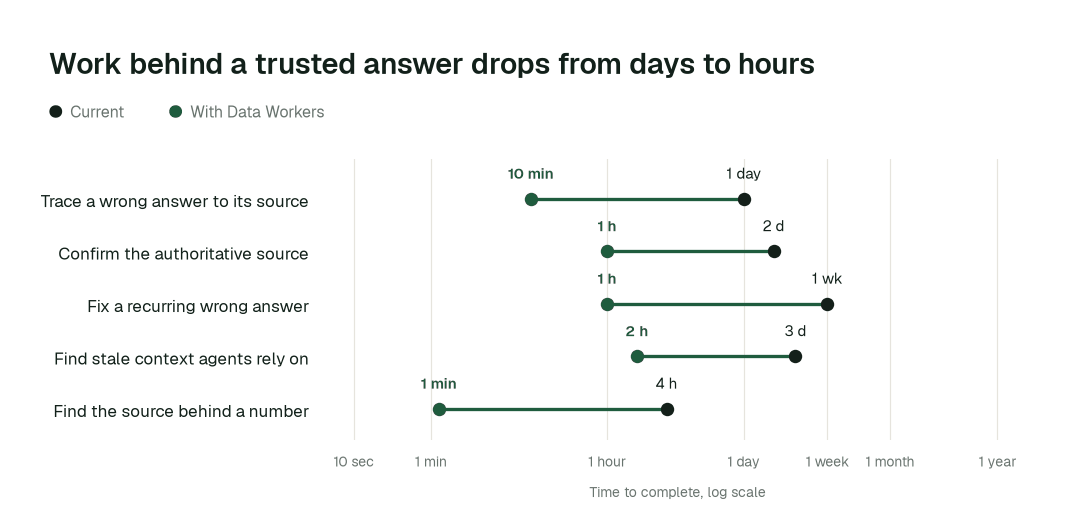
- •Wrong answer traced to its source: from about a day to ~10 min
- •Authoritative source confirmed for a metric: from about 2 days to 1 h
- •Recurring wrong answer fixed for good: from about a week to 1 h
Where teams start
- •The numbers executives ask the assistant for. Revenue, active customers, churn and margin, each with one owner and one trusted source.
- •The assistant or agent that already queries your warehouse. Snowflake, Databricks or BigQuery, with the questions your analysts see most.
- •Tables that exist twice. A raw copy, a staging copy and a certified one: mark which is authoritative.
- •Stale documentation. Tables whose description no longer matches the data.
- •A corrections backlog. Every "that number is wrong" thread already sitting in Slack or tickets.
What powers it
The Data Context Wizard holds the shared understanding of your estate: what each table means, who owns it and which source is trusted. The Spellbook Data Catalog keeps that record current, and the Data-Agents Swarm does the work, with the Data Context & Catalog agent serving governed context and the Data Science & Insights agent answering from it. Autopilot Routines flag stale context as it appears, and the Autonomous Data-Conductor routes each proposed definition to its owner. See it in practice in governed product metrics, AI and ML platform data teams and data coverage, accuracy and evaluation teams.
Published results. We do not publish a hallucination rate. What we publish is task success on a public benchmark, and the method behind it. The whitepaper sets out the results and the benchmark method sets out how we measure. The paper reports two DataAgentBench readings and never blends them: an exploratory single-run record of 41 of 54 tasks (n=1, Wilson 95% interval 63.1 to 85.4) and a pre-registered five-run reading of 0.6371 stratified and 0.6593 micro, and it claims no lead on any leaderboard. These are task-success scores on a public benchmark, not a hallucination rate. For how other teams evaluate data agents, see the Data Agent Evals Report 2026. To test agents on your own questions, see agents proven on benchmarks and on your own data.
The climb: from assisted to autonomous to agentic
Every transformation runs on the same ladder from our thesis. Today agents watch (L0), suggest (L1) and act after approval (L2), and each domain's owner decides how far to go. L3 and L4 are where a domain can go on its own review record, not something running now.
The pilot
- •Scope. The governed definitions for one domain, such as revenue and customer metrics, and the assistant or agents that answer questions about them.
- •First week. Agents start by watching and suggesting: they run the questions your team actually asks, show the source behind each answer and list where the data is missing or stale, with receipts. That is your baseline.
- •By week two. Owners approve the first authoritative sources and corrections; anything sensitive stays with a named approver.
- •At day 30. We review the impact metrics against your baseline:
- •Wrong answer traced to its source: from about a day to ~10 min
- •Authoritative source confirmed for a metric: from about 2 days to 1 h
- •Recurring wrong answer fixed for good: from about a week to 1 h
- •Cost. Start with a pilot ($7,500 one-time, credited in full against the first year). Scale is from $1,000 a month and Enterprise from $3,000 a month, billed annually, with unlimited seats, no usage meter and no markup on model spend. See pricing.
FAQ
Can you promise no hallucinations? No. Agents can still be wrong. What changes is that answers show their source, SQL is checked before it runs, a missing table is reported instead of invented, and a correction is remembered.
What is your hallucination rate? We do not publish one. The benchmark scores above measure task success, a different thing. Your pilot measures the questions your own team asks, against your day-one baseline.
What if the data an answer needs is not there? The agent says so and names the gap, so someone can fix the data instead of trusting a guess.
Do we have to replace our catalog or semantic layer? No. Agents read the definitions and documentation you already keep and flag where they disagree.