Move every team up the autonomy ladder
Most data teams run their agents at one setting everywhere, either locked down or trusted too far. Data Workers sets autonomy per domain, from L0 to L4. Every domain starts by watching and suggesting, and its owner raises the level on that domain's own review record.
Before and after
| Today | With Data Workers |
|---|---|
| One autonomy setting for every agent, argued over in meetings | A level for each domain, set by that domain's owner |
| Agents kept read-only forever, or handed write access on a hunch | Agents start by watching and suggesting, in every domain |
| Trust granted on a demo | Autonomy earned from each domain's own review record |
| Approvers shown a diff and left to guess the impact | Every proposal shows the full change, what it affects and how to undo it |
| Nobody notices when agents start getting overruled | A domain pauses itself when people start reverting its changes |
Human in the loop is not one decision. Freshness fixes in marketing and access grants in finance deserve different answers, and a single global setting gets one of them wrong. The five autonomy levels, from L0 to L4 give your team a shared scale; this page is the operating model for moving each domain up it. If you are choosing the approval patterns, human-in-the-loop patterns for data agents is the companion reference.
How it works
1. Set a level for each domain
A domain is a slice of work such as freshness, schema changes, access requests, documentation or cost, with a named owner. You choose, domain by domain, whether agents watch only, suggest, or act after approval. Only the owner of a domain can raise its level, and the Autonomous Data-Conductor keeps every agent inside the level its domain allows.
2. Route every proposal to its owner
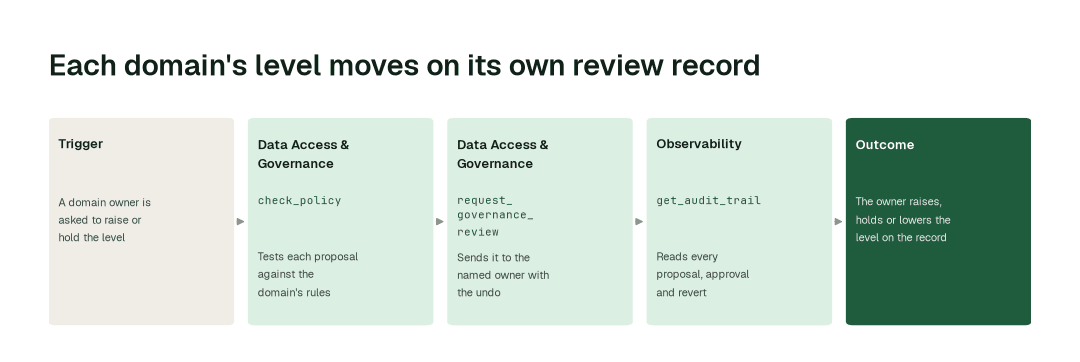
The Data Access & Governance Agent tests each proposed change against your rules with check_policy, then sends it to the domain's named owner with request_governance_review. The owner sees the full change, what it would affect and how to undo it. Who owns the agents and how approvals work in practice cover the owner's side.
3. Read the record, then move the level
The Observability Agent reads back every proposal, approval and revert for a domain with get_audit_trail, so a level review is a read of facts, not a debate. A domain moves up on its own record, not everywhere at once. If people start reverting an agent's changes, that domain pauses itself.
The impact metrics we move
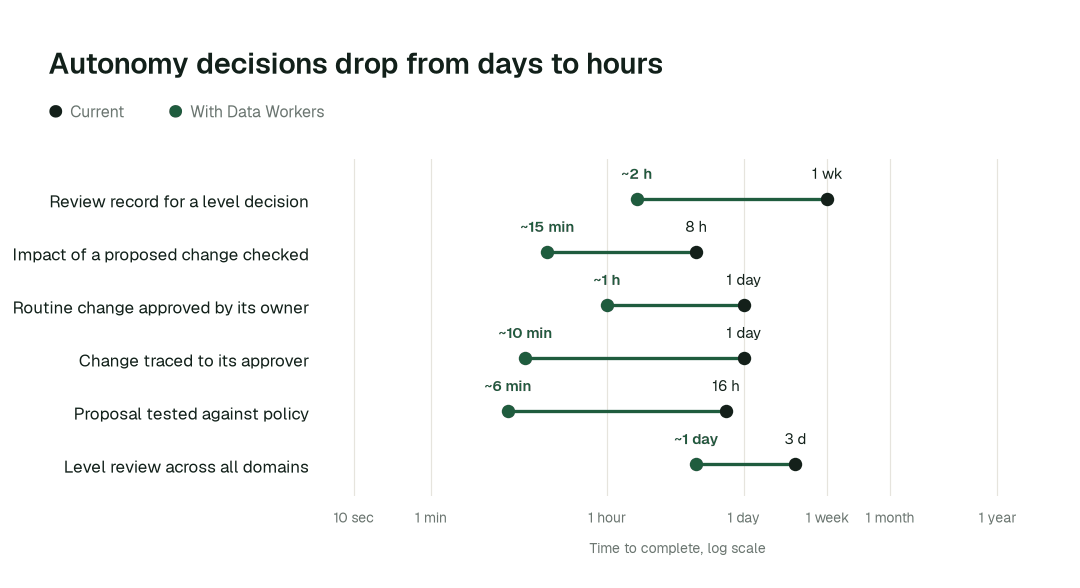
- •Review record pulled for a level decision: from about 1 week to ~2 h
- •Routine change approved by its owner: from about a day to ~1 h
- •Change traced to its approver: from about a day to under 10 min
Where teams start
- •Freshness and quality upkeep. Routine fixes, watched and suggested first, with the owner approving.
- •Documentation and ownership gaps. Agents draft descriptions and propose owners for your stewards to review.
- •Schema changes from one source system. Impact assessed and sent to the owner before the change merges.
- •Access requests for one domain. Policy checked first, then the data owner approves.
- •Finance and customer data. Held at watch or suggest while the review record builds.
What powers it
Autopilot (Routines, Missions and Standards) is where a domain's recurring work and rules live. The Autonomous Data-Conductor holds each agent to its domain's level, and the Spellbook Data Catalog supplies the owners and authoritative sources that make a named approver possible. The Data Access & Governance Agent and Observability Agent produce the checks, approvals and record. For the question underneath the ladder, see whether it is safe to let agents change production data.
Where this shows up: safe agent writes to production, every agent change reversible, AI agent governance and agent governance and audit.
The climb: from assisted to autonomous to agentic
Every transformation runs on the same ladder from our thesis: agents watch and suggest with receipts, then act after approval, and a domain moves up only on its own review record. L0 to L2 run today. L3 and L4 are where a domain can go on evidence, as a call its owner makes, not a switch we flip or a date we promise.
The pilot
- •Scope. Three to five domains, each with a named owner, and one level chosen for each.
- •First week. Agents start by watching and suggesting. We show the proposals, approvals and audit records they would have produced in each domain.
- •By week two. Routine work in the lower-risk domains runs through approval on its own schedule; anything sensitive stays with a named approver.
- •At day 30. We review the impact metrics against your baseline:
- •Review record pulled for a level decision: from about 1 week to ~2 h
- •Routine change approved by its owner: from about a day to ~1 h
- •Change traced to its approver: from about a day to under 10 min
- •Cost. Start with a pilot ($7,500 one-time, credited in full against the first year). Scale is from $1,000 a month and Enterprise from $3,000 a month, billed annually, with unlimited seats, no usage meter and no markup on model spend. See pricing.
FAQ
Who decides when a domain moves up? Only the owner of that domain can raise its level, and the decision rests on the domain's own review record.
What stays with people? Approvals, the rules agents are held to, and every change in level.
Can we hold some domains low for good? Yes. Each domain keeps its own level, so finance can sit at suggest while documentation upkeep moves up.
What if an agent is wrong? Each proposal shows how to undo it, and if people start reverting an agent's changes, that domain pauses itself.
Which stacks? Snowflake, Databricks and BigQuery, with dbt and Airflow, among 50+ connectors.