Legal data teams: every hold reaches every copy of the data
Going fully agentic and autonomous does not mean letting an agent give legal advice, call privilege or release a hold. For legal data teams, it means climbing from agents that assist, to agents that keep the data layer behind legal operations accurate, mapped and evidenced under your governance, to a data back office that largely runs itself: finding every copy of held data, catching contract dates that were extracted badly, checking outside counsel invoices against agreed rates and showing what is past its retention period, while named attorneys and owners make every decision on holds, privilege, deletion and disclosure. This is what that climb looks like, step by step.
Key takeaways
- •Who this is for. The data side of legal operations: the people in a corporate legal department or a law firm who run matter management, e-billing, contract lifecycle metadata, legal hold and eDiscovery collection data, records retention and privacy inventories, and who answer when the general counsel asks "where is that data, and what do we owe on it?"
- •The problem today. A hold is placed on a matter, and the data lives in the source system, three warehouse tables, a replica, a nightly extract and a dashboard. A contract renewal date was extracted as a blank. An outside counsel invoice breaks a rate agreement and nobody sees it until it is paid. Retention schedules say seven years while the warehouse says forever. Each of these surfaces late, in a dispute, an audit or a regulator's question.
- •What changes. Every copy of the data a matter touches is mapped from live lineage, the contract metadata is checked for completeness and consistency every morning, each invoice batch is checked against rate cards and billing guidelines the day it lands, and a retention exposure report is a query, not a project. Anything that would delete held data is stopped and sent to the attorney who owns the hold.
- •What stays with your people. Legal advice, privilege calls, the decision to place or release a hold, deletion, anything sent outside the organization and every dispute of an invoice. Agents keep the data layer accurate and the evidence ready; named attorneys and records owners decide.
- •The result. A legal data team that can show, for any matter and any day, where the data is, what was held, what was deleted, who approved it and why the numbers on the GC's dashboard are right.
The PRD for agentic legal data teams
This is the requirements document we would write with you for your team. Everything below expands on it.
| Who | Legal operations analytics, legal technology and data, e-billing and CLM administration, eDiscovery and records data teams in corporate legal departments, and data and knowledge teams at law firms |
| The job | Every hold reaches every copy of the data, and every number legal reports ties back to source. |
| Environment | A matter management and e-billing platform (for example Thomson Reuters Legal Tracker, Onit or Mitratech); a CLM such as Ironclad, Icertis or Agiloft; an eDiscovery and legal hold platform such as Relativity or Exterro; ERP and vendor master data; a cloud warehouse such as Snowflake or Databricks; dbt; Airflow or Dagster; Power BI, Tableau or Looker. |
| Constraints | Privilege and confidentiality apply to nearly everything. Holds, privilege decisions, deletions and anything sent outside go to a named attorney or owner. Matter and document tables can be excluded from agent access entirely. |
| Success is measured by | Hold data map for a new matter: from about 2 days to about 1 h; Outside counsel invoice batch checked: from about a week to about 2 h; Retention exposure report: from about 2 weeks to about half a day; lineage and docs upkeep closed autonomously 86% of the time. |
| Owned by | A Director of Legal Operations Analytics, with the matter owner, records manager and hold attorney as named approvers. |
| Pilot scope | The hold data map and a retention conflict check for one business unit's data, at L2. |
What going fully agentic and autonomous means for legal data teams
- •Put your data pipeline on autopilot. Matter, invoice and contract feeds land and are checked on arrival, so a changed export from the e-billing or CLM platform is mapped before it breaks the spend report or the renewal calendar.
- •Run the data back office without the busywork. The work that fills the week today moves to agents: hand-drawing a data map for each hold, reconciling invoice files to the matter master, chasing blank renewal dates and assembling retention evidence for each request.
- •Scale data without scaling headcount. More matters, more outside counsel firms and more systems in scope arrive without the data team growing with them, because tie-outs, lineage and documentation run on their own.
- •Get the plumbing off your plate. A legal data team that spends its time on spend forecasting, panel analytics and contract insight instead of proving, again, where a matter's data lives.
Who this is for
The data side of legal. In a corporate legal department it is usually a legal operations analytics function, often two to eight people, sitting between the general counsel's office, finance, IT and the records team. It owns the matter and spend data behind the e-billing platform, the metadata that comes out of the CLM, the hold and collection registers kept for eDiscovery, the retention schedule mapped to systems, and the privacy inventory. At a law firm, it is the data and knowledge team that runs matter, time and billing data, conflicts data and the walls between client teams. Public sector legal offices have the same shape; the neighbouring public sector program data playbook covers the program side, and the whole group is on the public sector and legal data teams page.
The titles: Director of Legal Operations Analytics, Legal Operations Manager, Legal Data Product Owner, eDiscovery Technology Manager, CLM Administrator, Records and Information Governance Manager, and at a firm, Director of Practice Data or Chief Knowledge Officer's data lead.
These teams do not practise law. They make sure the lawyers who do are working from data that is where it should be, current and explainable.
The shift
Almost everything in a legal department is confidential, and a lot of it is privileged. That shapes the data work more than any technology choice: access is narrow, copies are risky, and the cost of a mistake is measured in sanctions, waived privilege or a missed notice date, not in a late dashboard.
Three duties meet in the data layer. The duty to preserve: in the United States, Federal Rule of Civil Procedure 37(e) addresses the loss of electronically stored information that should have been preserved in anticipation or conduct of litigation because a party failed to take reasonable steps. The duty to limit retention: GDPR Article 5(1)(e) says personal data should be kept in an identifiable form for no longer than is necessary for its purpose. The duty to protect: lawyers are expected to weigh the risk that client information is disclosed or accessed by others, which ABA Formal Opinion 512 applies to generative AI tools. Preserve, delete and protect pull in different directions, and the warehouse, with its replicas, snapshots, clones and extracts, is where they collide.
Agents are well suited to the unglamorous half of that problem. They can find every place a matter's data lives, compare what a schedule says should be gone with what is still there, check every invoice line against an agreed rate, and tell a named person when something does not tie. They cannot and should not decide what is privileged, what to preserve or what to delete. The line between the two is the design of this playbook.
The product you ship
- •Matter and spend data: the matter master, e-billing line items, budgets, accruals and outside counsel panel data, as governed, reusable data products.
- •Contract data: CLM metadata, clauses, obligations, renewal and notice dates, counterparties and the link from each contract to the spend and entities it affects.
- •Hold and discovery metadata: the hold register, custodians and data sources in scope, collection logs and the map from each hold to the tables and copies that carry the data.
- •Records and retention data: the retention schedule, the mapping from schedule categories to systems and tables, and the disposition log.
- •Privacy and inventory data: the personal data inventory, data subject request handling and the classification of sensitive and privileged data sets.
- •Leadership reporting: legal spend against budget, panel performance, cycle times, matter volumes and risk views for the general counsel.
- •Law firm data: client and matter numbers, time and billing, conflicts checks and the ethical walls that separate client teams.
Where the week goes
- •Every hold starts a treasure hunt. The attorney names a system and some custodians, and someone has to find the tables, replicas, snapshots, extracts and dev clones that carry the same data.
- •Contract metadata is extracted inconsistently. Dates arrive in three formats, notice periods are blank, the auto-renew flag is missing and the counterparty name does not match the vendor master.
- •Dates get missed. A renewal or a termination notice window passes because the field that drives the calendar was empty or wrong.
- •Invoices outrun review. Hundreds of LEDES lines a month, billed at rates that differ from the agreement, by timekeepers who are not on the approved list, on matters that moved.
- •Retention is a schedule, not a fact. The policy says seven years. The warehouse keeps everything, because nobody can prove what is safe to remove.
- •Access is sensitive and hand-built. Matter teams, ethical walls and need-to-know change weekly, and every grant needs a record.
- •Every question starts a data pull. Where is this data, who touched it, what was held, what was deleted: each one is a project.
Add it up and upkeep is most of the team's week. Here is how a typical week splits today, and once agents own the back office:
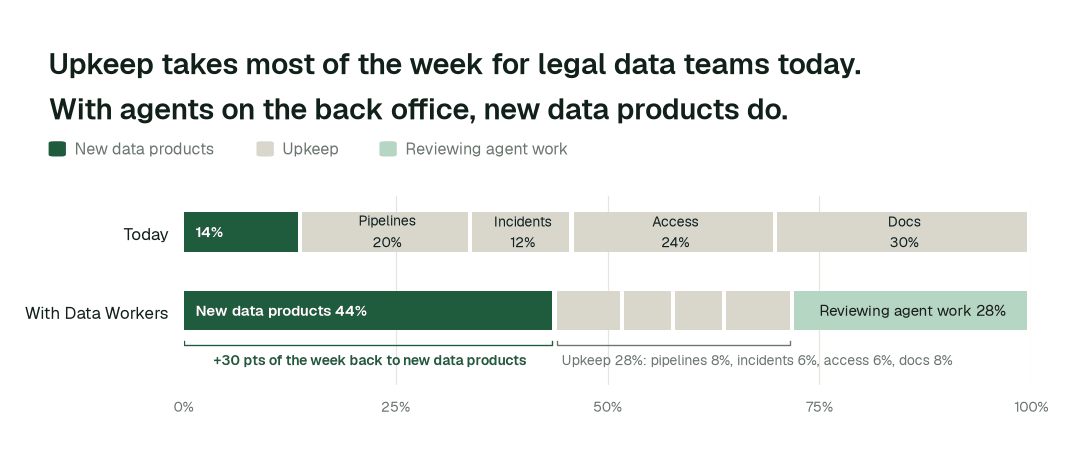
Time spent on new data products moves from 14% of the week to 44%. Most of the rest becomes review: people steer and approve agent work instead of doing it by hand.
Then and now
| Work | Today | With Data Workers |
|---|---|---|
| A new legal hold | Data map drawn by hand from memory | Mapped from live lineage, confirmed by the hold attorney |
| A cleanup or retention purge | Run against a list, held data found afterwards | Held assets tagged and excluded, conflicts sent to the attorney |
| Contract renewal and notice dates | Found when a renewal passes | Blank and inconsistent fields flagged the day they arrive |
| Outside counsel invoices | Reviewed after payment, if at all | Checked against rate cards and guidelines on arrival |
| Retention vs what exists | Unknown until an audit | Exposure report on demand, by system and schedule category |
| Access to matter data | Re-scoped by ticket | Proposed from the matter team, held for the owner, logged |
These are the impact metrics we move for legal data teams:
- •Hold data map for a new matter: from about 2 days to about 1 h
- •Outside counsel invoice batch checked: from about a week to about 2 h
- •Retention exposure report: from about 2 weeks to about half a day
Across the routine work in this domain:
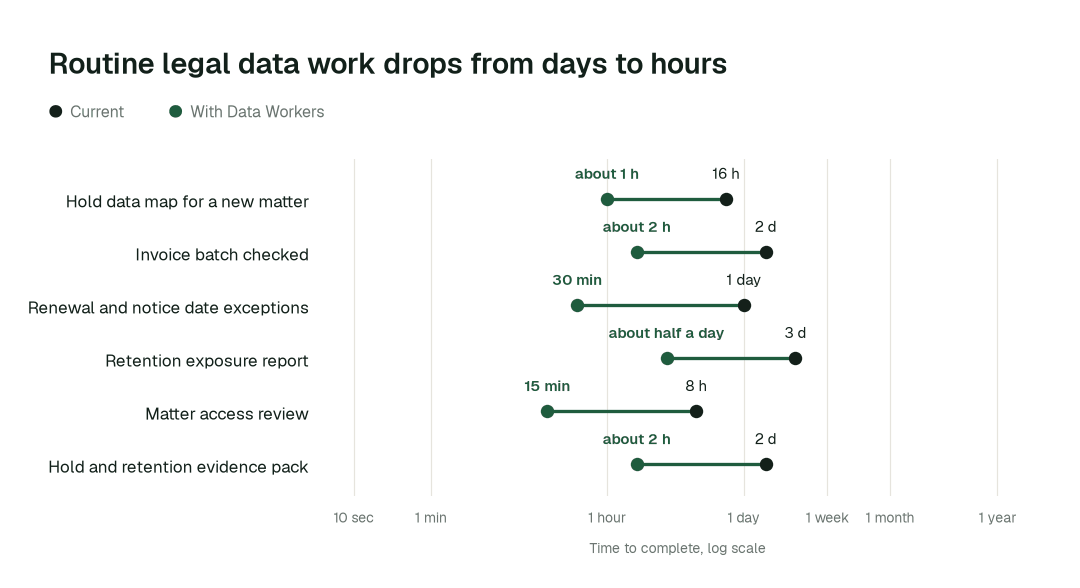
The biggest change is the retention exposure report: from about 2 weeks to about half a day. Work that waited in queues finishes in minutes or hours, because agents find, trace and prepare the evidence in one pass.
Use cases, in depth
A legal hold that reaches the replica and the extract
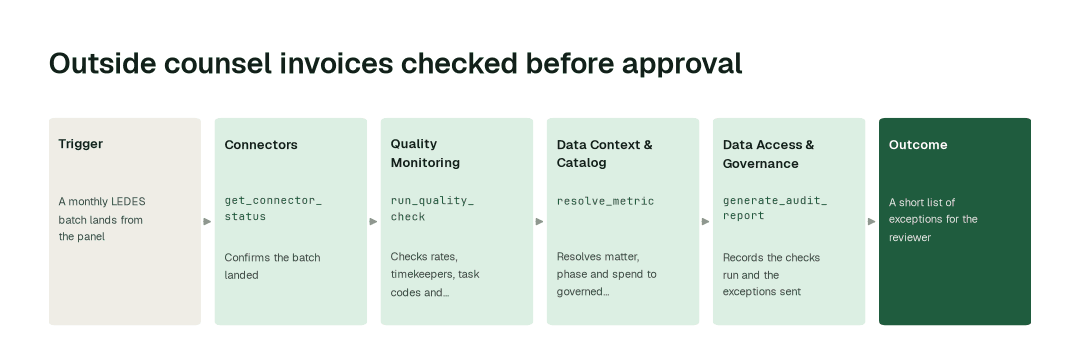
Today. Litigation counsel places a hold on a matter and names two systems and a set of custodian groups. The warehouse holds the same data in three tables, a replica for reporting, a nightly extract to an analytics workspace and two dashboards. Nobody has a complete list, and the hold notice reaches only what someone remembered.
With Data Workers. Data Context & Catalog finds the tables that carry the matter's data and follows live lineage forward to every copy, extract and dashboard. Data Access & Governance holds the proposed scope for the hold attorney, who confirms or changes it. Once it is approved, the assets are tagged as under hold so cleanup and retention proposals that touch them go to the attorney.
What changes. The hold attorney starts from a complete map, not a blank page, and has a record of who confirmed the scope and when. Placing, scoping and releasing the hold stay with the attorney, and the preservation itself is applied by your hold process and your platform teams.
Outside counsel invoices checked against the billing guidelines
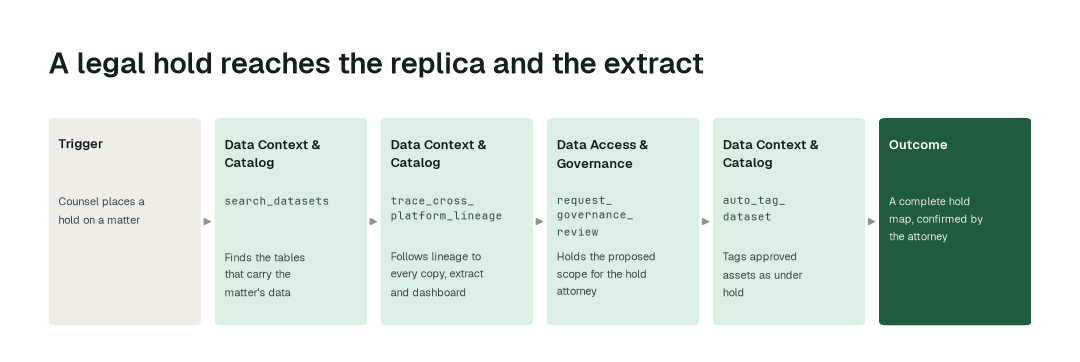
Today. A monthly batch of LEDES files lands from the panel. Rates differ from the agreement, a timekeeper is not on the approved list, task codes are used for the wrong phase and the same entry appears on two invoices. The reviewer finds some of it, after the invoice is queued for payment.
With Data Workers. Connectors confirm the batch landed, Quality Monitoring checks every line against the rate cards, approved timekeepers, valid task codes and duplicates, Data Context & Catalog resolves matter, phase and spend to the governed definitions, and Data Access & Governance records which checks ran and what went to the reviewer.
What changes. The reviewer opens a short list of exceptions with the rule each one broke, not a spreadsheet of lines. Whether an entry is reasonable, whether to reduce or dispute an invoice and what to say to the firm stay with the matter owner.
Contract dates that were extracted badly
Today. The CLM extracts renewal dates, notice periods and auto-renew flags from signed contracts. The extraction is inconsistent: a date is read in the wrong format, a notice period is blank, an amendment is not linked to its parent. The renewal calendar and the obligations dashboard run on those fields, so the error is silent until the renewal passes.
With Data Workers. detect_schema_change catches a changed CLM export the day it arrives. run_quality_check checks every obligation field for completeness and consistency, and ties contracts to the vendor master and to spend, so a contract with spend and no record, or a record with a blank notice period, is listed. define_business_rule keeps one governed definition of renewal date, notice deadline and term for every report.
What changes. Exceptions go to the CLM administrator and the contract owner every morning, with the contract and the field. Corrections are made in the system of record, and the decision to renew, renegotiate or terminate stays with the business owner and counsel. Agents do not read the contract and do not interpret the clause.
For law firm data teams
A firm's data team has the same shape with one difference: the client is the other party to every confidentiality duty. Client and matter numbers have to match across time, billing and document systems. Ethical walls have to hold in the warehouse as well as in the document system, so access to a matter's data follows the matter team, and a change to the team is proposed to the matter owner rather than hand-edited. Conflicts data has to be complete before a new matter opens. The same agents handle it: lineage shows where a client's data has travelled, access is scoped by matter and logged, and quality checks flag a matter number that exists in billing but not in the matter master. Realization, rate and staffing analytics read the same governed definitions the partners see.
Measure the product, not just the pipeline
Legal operations leaders are judged on whether the general counsel can trust the numbers and whether the department can answer a regulator, a court or an auditor quickly. The Autopilot dashboard shows how much of each data product's upkeep runs on its own and at what token cost, so the team can show leadership where its time now goes: spend forecasting, panel analytics and contract insight instead of reconciliations and data maps.
Agents working together: A hold meets a scheduled purge
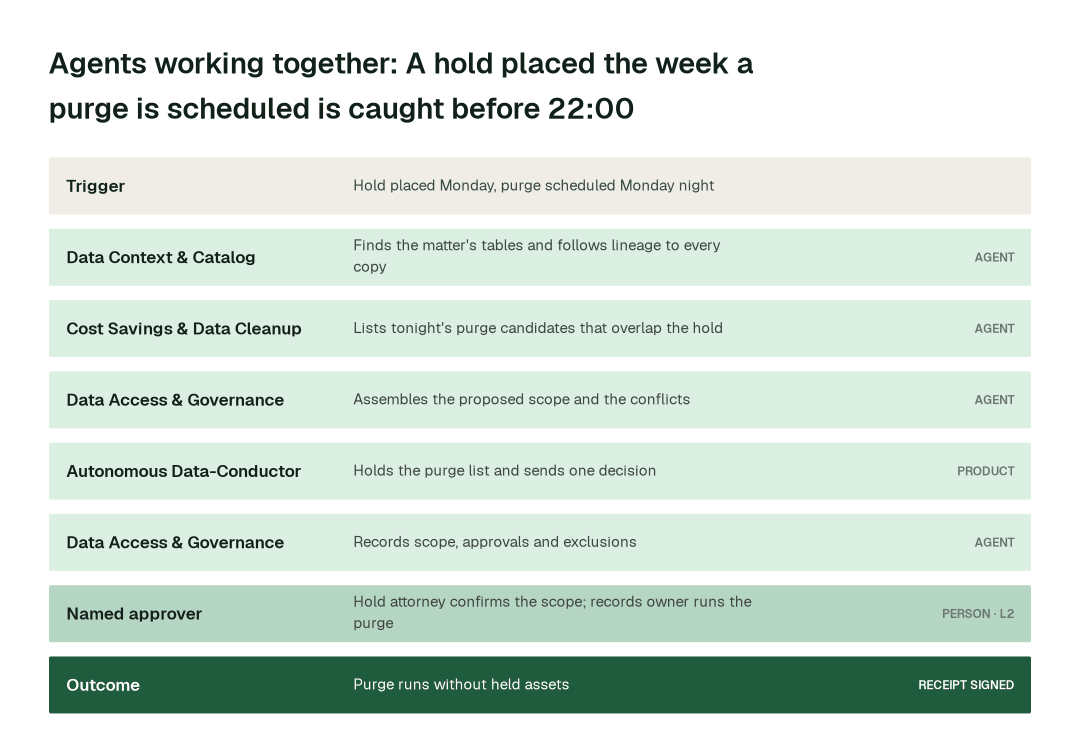
Every legal data team has some version of this week. Litigation counsel places a hold on Monday morning. The records team's retention job is scheduled for Monday night. Nobody has connected the two. This is the same week run by Data Workers.
The setup
Matter and billing data land nightly in Snowflake, with a reporting replica and an extract to an analytics workspace. dbt builds the spend and contract marts. The records team runs a retention job against tables past their schedule, orchestrated by Airflow. Autonomy in Autopilot:
- •Catalog, lineage and documentation upkeep: L2 today; a candidate for L3 on evidence.
- •Tagging assets as under hold, access to matter data and retention proposals: L2, held for the named attorney or records owner.
- •Placing or releasing holds, privilege decisions and deletion: L0.
The team scheduled one standing routine: "Check every retention and cleanup proposal against open holds before it reaches the records owner."
Mon 07:30: the hold is placed
The associate general counsel places a hold on a dispute and names two source systems and three custodian groups.
Mon 07:40: find the data
Data Context & Catalog agent searches the catalog and finds the tables that carry the matter's data. In this illustrative example, that is 11 tables across three schemas.
Mon 07:55: follow it to every copy
Data Context & Catalog agent follows live lineage forward. The 11 tables feed one reporting replica, a nightly extract, two dashboards and a developer clone. The map now covers every place the data lives.
Mon 08:10: compare with tonight's purge
Cost Savings & Data Cleanup agent lists the tables in tonight's retention and cleanup candidates. Three of them overlap the hold scope.
Mon 08:20: hand it to the attorney
Data Access & Governance agent assembles the proposed hold scope and the three conflicts. Autonomous Data-Conductor holds the purge list at L2 and sends one decision to the hold attorney and the records owner: the map, the overlap, and how each item can be undone.
Mon 09:15: the attorney decides
The hold attorney confirms the scope and adds one table the agents could not have known about: a manually maintained export of exhibits. Conductor tags every approved asset as under hold and removes the three tables from tonight's candidates. The attorney's decision, not the agents', fixes the scope.
Mon 22:00: the purge runs
The records owner's retention job runs against a list that no longer contains held assets. Nothing was deleted by an agent.
Tue 08:00: the evidence
Data Access & Governance agent produces the record: the scope, who confirmed it, what was excluded from the purge and when. The hold attorney files it with the matter.
What stays behind
- •A hold map with lineage, so new copies of held data are caught as they appear.
- •A record of what was proposed, who confirmed it and how to undo it.
- •Updated Spellbook pages for every affected data set, with the hold shown on the asset.
- •A reusable routine. The check on every future purge runs the same way, and the team can move the routine parts to L3 once the receipts justify it.
Minute by minute
This is an illustrative example. Matter data lands in Snowflake with a reporting replica and an analytics extract, dbt builds the marts, and the records team's retention job runs at 22:00. Tagging assets as under hold and retention proposals are at L2.
| Time | Who | What happens |
|---|---|---|
| Mon 07:30 | Associate general counsel | Hold placed, two systems and three custodian groups named |
| 07:40 | Data Context & Catalog agent | search_datasets: 11 tables carry the matter's data |
| 07:55 | Data Context & Catalog agent | trace_cross_platform_lineage: one replica, one extract, two dashboards, one clone |
| 08:10 | Cost Savings & Data Cleanup agent | Three of tonight's purge candidates overlap the hold |
| 08:20 | Data Access & Governance agent | request_governance_review: scope and conflicts held for the attorney |
| 08:25 | Spellbook Data Catalog | Purge list held at L2 with the full map |
| 09:15 | Spellbook Data Catalog | Hold attorney confirms scope, adds one table |
| 09:20 | Data Context & Catalog agent | auto_tag_dataset: approved assets tagged as under hold |
| 09:30 | Autonomous Data-Conductor | Purge list re-checked, held assets excluded |
| 22:00 | Records owner's job | Purge runs without held assets |
| Tue 08:00 | Data Access & Governance agent | generate_audit_report: scope, approvals and exclusions recorded |
Without the agents, the purge runs at 22:00 and the lost data is found when opposing counsel asks for it.
The agents on the job
| Agent | What it does for legal data | Tools it calls |
|---|---|---|
| Connectors and Data Ingestion | Land matter, e-billing, CLM, hold register and ERP feeds and profile every load | get_connector_status, trigger_airflow_dag, get_dbt_run_history |
| Schema Evolution | Detects changed e-billing, CLM and matter exports before they break a report | detect_schema_change, assess_impact, validate_schema_compatibility, rollback_migration |
| Quality Monitoring | Invoice checks against rate cards, contract field completeness, tie-outs to the matter master and vendor master | set_sla, run_quality_check, get_anomalies, create_quality_tests_for_pipeline |
| Incident Debugging | Traces a spend or renewal discrepancy to the change that caused it | diagnose_incident, get_root_cause, get_incident_history |
| Data Context & Catalog | Hold maps from live lineage, retention exposure, freshness and an owner for every data set | trace_cross_platform_lineage, blast_radius_analysis, search_datasets, auto_tag_dataset, check_staleness, generate_documentation |
| Data Access & Governance | Scoped access to matter and contract data, sensitivity scans and an evidence report for each hold | check_policy, enforce_rbac, scan_pii, request_governance_review, generate_audit_report |
| Cost Savings & Data Cleanup | Finds stale and duplicate copies, and proposes cleanup only for assets that are not held | detect_dead_assets, get_snowflake_usage, get_cost_enrichment |
| Observability | Agent health and the audit trail of what each agent did | get_audit_trail, detect_drift, get_evaluation_report |
| Pipeline Building | Builds and versions matter, spend and contract models with tests | generate_pipeline, validate_pipeline, deploy_pipeline |
Data Context Wizard holds one governed definition of matter, matter status, outside counsel firm, spend, accrual, renewal date, notice deadline and retention category, so the spend report, the renewal calendar and the answer to the general counsel all read the same meaning. Autonomous Data-Conductor verifies the numbers that matter before they reach a dashboard or a board pack. Spellbook Data Catalog makes each legal data set discoverable with owner, lineage, hold status and approvals, in plain English.
What goes on autopilot
Once a domain has earned it, this work runs on its own, and each item removes a problem your team deals with today:
- •Lineage and documentation are kept current as the warehouse changes, so the starting point for any hold is a map and not a memory.
- •Contract metadata is checked for completeness and consistency every morning, so a blank notice period is a finding on Tuesday and not a missed date in March.
- •Invoice files are checked against rate cards and approved timekeepers when they land, so the reviewer sees exceptions before payment is queued.
- •Changed exports from the e-billing, CLM and matter systems are mapped the day they change, so the spend report never silently drops a firm or a phase.
Where your people stay in charge
Agents never get blanket access. Each domain has its own autonomy level, set by you, and it only rises when the receipts show the agents are reliable. Everything starts at L1, observing only; reversible upkeep such as reruns, staging fixes, documentation and cleanup of unheld copies is usually first to run on its own.
- •Legal advice, privilege calls and disclosure decisions stay entirely with attorneys. Agents do not review documents, classify anything as privileged or advise on a position.
- •Placing, scoping and releasing a legal hold stay with the hold attorney. Agents map, flag and keep the record.
- •Deletion and disposition stay with the records owner and, where a hold may apply, the attorney. Agents never delete; they propose, and nothing held is proposed.
- •Anything sent outside the organization, including productions, responses to regulators and communications with outside counsel, is a person's decision.
- •Invoice disputes and reductions stay with the matter owner.
- •Access to matter data and sensitivity labels go to a named owner with the full diff.
Once a deployment has matured, here is how that ladder plays out across task classes:
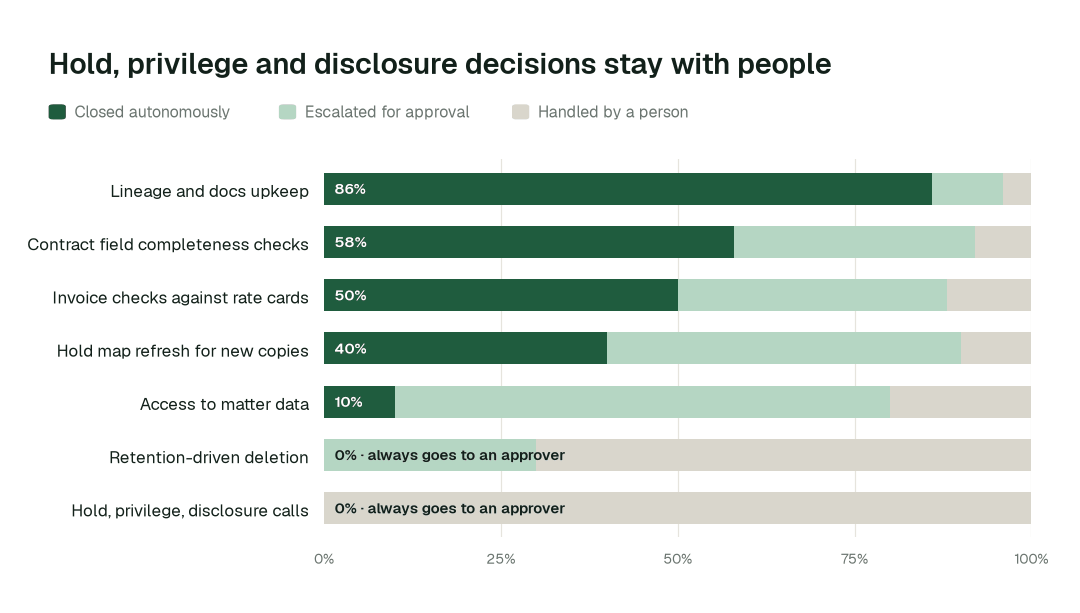
Lineage and docs upkeep closes autonomously 86% of the time. For hold, privilege and disclosure decisions, autonomous closure is 0% by design: they stay with named people.
What happens when an agent is wrong
- •At L2 propose, nothing changes until a named person approves. The proposal shows the full diff, the blast radius and how to roll it back. Unanswered requests expire and escalate.
- •L3 and L4 are where a domain can go next, on its own review record: acting on its own, with a rollback point on every change. Only the domain's owner raises its level, and if people start reverting the agents' changes, the domain pauses itself.
- •No agent approves or promotes its own work. Autonomy only grows on evidence, domain by domain, and repeated reverts pause the domain.
- •One org-wide stop halts all autonomous dispatch, and every action lands in a tamper-evident audit trail you can export with
generate_audit_report.
The failure that matters most here is a hold map that is incomplete. So an agent's map is never the last word: the hold attorney confirms the scope, and the agents keep watching for new copies of held data rather than treating the first map as final. A copy created outside anything the agents can see, such as a file someone exported by hand, is the kind of gap the attorney's knowledge covers and the agents do not.
How it fits your stack
Data Workers connects to what you already run: your matter management and e-billing platform; your CLM; your eDiscovery and legal hold platform; ERP and vendor master data; Snowflake or Databricks; dbt; Airflow or Dagster; and Power BI, Tableau or Looker. Each agent is an MCP server, so the same agents work inside Claude Code, Cursor or Codex and in Slack or Teams through Spellbook. Nothing migrates.
- •Runs in your infrastructure with your credentials and your model key. The hosted Autonomous Data-Conductor sees workflow metadata only, never rows. On the Enterprise tier, a sovereign setting keeps every AI call on models you host yourself.
- •Uses the access you already govern. Agents act under scoped service identities and your existing roles, so privileged matter tables and document stores can be excluded from agent access entirely. Every grant is logged.
- •Works beside your platforms, not instead of them. Your e-billing platform still audits invoices, your CLM still extracts and stores contracts, and your eDiscovery platform still runs collections and review. Agents keep the data under and around them accurate and mapped.
- •Proposes changes as diffs in your dbt project, orchestrator and warehouse, with blast radius, tests and a rollback point, and applies them only at the autonomy level you set for that domain.
- •Open-source core. The Apache-2.0 community edition ships 11 agents and 160+ MCP tools, so your engineers can read exactly what the agents call.
Governance and regulation
Four sources shape what legal data has to do, and none of them is a technology specification. Your counsel decides how each applies.
For preservation, in the United States Federal Rule of Civil Procedure 37(e) addresses what a court may do when electronically stored information that should have been preserved for litigation is lost because a party did not take reasonable steps. For retention limits, GDPR Article 5(1)(e) sets the storage limitation principle for personal data, and the interaction between a retention limit and a hold on the same data is a question for counsel. For the confidentiality of client information, ABA Formal Opinion 512 discusses lawyers' duties when they use generative AI tools, including evaluating the risk that client information is disclosed to or accessed by others. It is guidance, not a binding rule, and your general counsel and ethics advisers decide what it means for your organization. For billing data, the LEDES Oversight Committee maintains the data exchange standards that e-billing files commonly follow.
What Data Workers supplies is evidence and control around the data: lineage from source to every copy, a record of who confirmed the scope of a hold and when, named approvals on cleanup and access changes, scoped service identities, sensitivity tags that are versioned and approved, and a tamper-evident audit trail of every agent action. Nothing about this replaces your hold process, your retention policy or your counsel's judgment. For how Data Workers handles personal data in the layer it touches, see how Data Workers handles PII and where your data goes.
Data Workers doesn't make you compliant; your controls, people and assessors do. It supplies controls and evidence wherever agents touch data. Not legal advice.
The alternatives legal data teams weigh
Build it yourselves. A strong team can wire a coding agent to MCP servers for the warehouse and dbt. The work is everything around it: routing approvals to the right attorney or owner, blast radius, rollback, receipts, and current context about every other system.
Legal platforms and point tools. E-billing, CLM and eDiscovery platforms manage their own records and workflows, and observability, catalog and quality tools alert, document and test. Data Workers takes their signals and exports, diagnoses, proposes the fix, verifies it and leaves the receipt, across all of them rather than inside one.
Platform-native agents. Snowflake made its managed MCP server and Cortex Agents generally available on Nov 4, 2025, and Databricks made Genie One generally available on Jun 16, 2026. They are excellent inside their platform; this work crosses the source systems, orchestrator, warehouse and BI, and Data Workers works across all of them.
In this space specifically. Legal platforms handle documents, reviews and workflows; Data Workers keeps the data layer around them mapped, tied out and evidenced, and leaves every legal judgment to your attorneys. For the same pattern in regulated reporting, see the risk and regulatory reporting data playbook, and for the data office that sits above these teams, the CDO data product office playbook.
The case for your CTO
What this replaces. Hand-drawn data maps for every hold, manual invoice reconciliation, chasing blank contract dates and assembling retention evidence for each request.
What your team gets back. A legal data team that ships spend forecasting, panel analytics and contract insight, and never again has to prove from scratch where a matter's data lives.
Integration effort. Connecting is configuration, not a migration. The agents attach over MCP to the warehouse, orchestrator, dbt project and source systems you already run, under the roles you already govern, inside your own infrastructure. Your engineers can read every tool the agents call in the open-source core.
Risk and control. Autonomy is set per domain. Everything starts at L1, observing only; reversible work moves up only when the receipts justify it; holds, tagging, access and retention proposals stay at L2 with a named attorney or owner; privilege, deletion and disclosure stay with people; and one org-wide stop halts all autonomous work. Matter and document tables can be excluded entirely. For how approvals work in practice, see how approvals work for AI data agents.
Why now. Data volumes in the warehouse grow faster than any retention policy is enforced, and AI tools are arriving in legal departments that must show where client and matter data went. The related transformations are audit evidence on demand, end-to-end lineage and data classification.
The first win. The hold data map and a retention conflict check for one business unit's data, at L2. The pilot below lays out the scope, what you see each week and the cost.
The climb: from assisted to autonomous to agentic
Our thesis is that the data platform climbs the way analytics did, in stages, and that the hard part of data work was never knowing what to do but doing it. For legal data teams, the climb looks like this:
- •Assisted. Agents work alongside your team. They read the whole stack, show what needs doing and propose every fix with a receipt; holds, tagging, access and retention proposals always go to a named attorney or owner.
- •Autonomous, under your governance. Routine work runs on its own: lineage and documentation are kept current, contract fields are checked every morning and invoice files are checked when they land. Your team governs the agents instead of doing the upkeep.
- •The agentic enterprise. Legal data becomes continuous: every hold mapped, every contract date checked, every retention question a query. People set direction, and attorneys decide, with the data ready.
You choose the altitude, every step is visible and reversible, and the pilot below is the first rung.
The pilot: how legal data teams start
The pilot is how your team proves the value on its own data before committing.
- •What we connect. Your warehouse, dbt project and orchestrator, plus the exports from your matter, e-billing, CLM and hold platforms, over MCP, inside your infrastructure. Nothing migrates, and matter and document tables you want excluded stay excluded.
- •Scope. The hold data map and a retention conflict check for one business unit's data, at L2.
- •First week. Agents run at L1 across the scoped domain. They map every pipeline, definition and lineage path and show the fixes they would have made, with receipts, so your team sees the value before anything changes. A first map of an existing hold often finds a copy nobody listed.
- •By week two. Contract field checks and invoice rate checks start running on reversible work. Hold tagging, access and retention proposals stay at L2 with a named attorney or owner.
- •At day 30. We review the impact metrics against your baseline:
- •Hold data map for a new matter: from about 2 days to about 1 h
- •Outside counsel invoice batch checked: from about a week to about 2 h
- •Retention exposure report: from about 2 weeks to about half a day
- •the share of lineage and docs upkeep closed autonomously, targeting 86% as the deployment matures
- •What you decide. Whether to expand to the next business unit or to contract and invoice data. The pilot fee is credited in full against the first year.
- •Cost. Start with a pilot ($7,500 one-time, a 6 to 12 week pilot, credited in full against the first year). Scale is from $1,000 a month and Enterprise from $3,000 a month, billed annually, with unlimited seats, no usage meter and no markup on model spend. See pricing.
The pilot is the start of a longer curve:
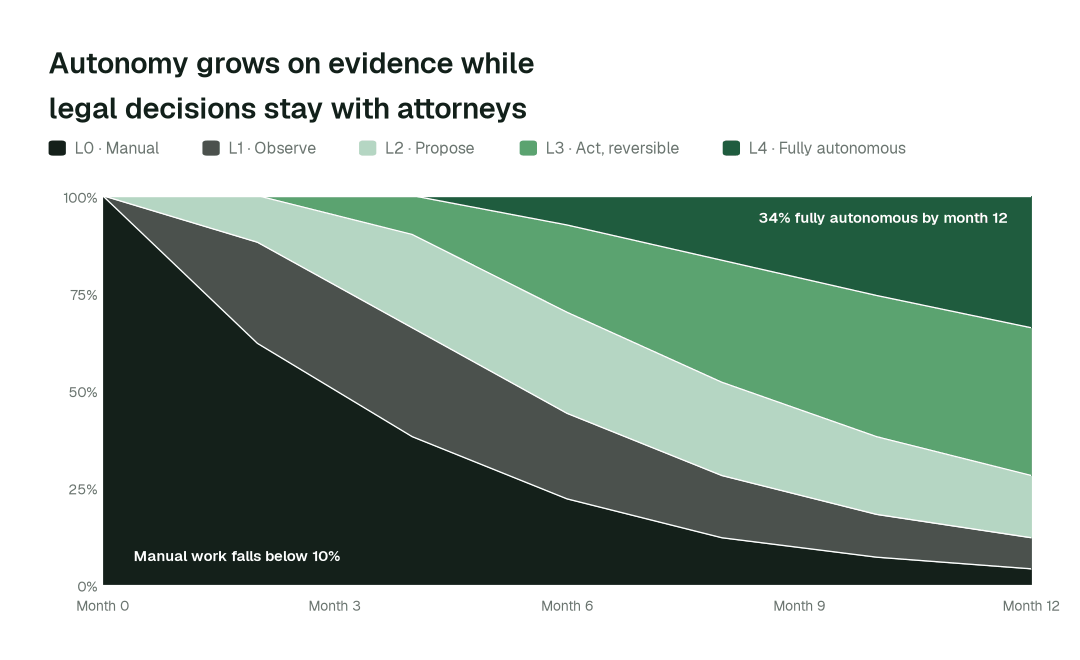
By month 12, more than 34% of agent actions run fully autonomously while holds, privilege, deletion and disclosure stay with named people.
FAQ
Will an agent place or release a legal hold? No. The hold attorney places, scopes and releases holds. Agents map where the data lives, flag conflicts and keep the record.
Will an agent decide what is privileged? No. Privilege calls stay with attorneys. Agents do not review documents or classify anything as privileged; sensitivity labels on data sets are proposed and approved by a named owner.
Will an agent delete data that is past its retention period? No. Agents report what is past its schedule and propose cleanup for assets that are not held. Deletion is run by the records owner after approval.
Do the agents read our contracts? No. They work on the metadata and tables your CLM and other systems already produce. Document stores and privileged matter tables can be excluded from agent access entirely, and every access that is allowed is logged.
Does it replace our e-billing, CLM or eDiscovery platform? No. Those platforms keep auditing invoices, extracting contracts and running review. Data Workers keeps the data feeding and surrounding them accurate and traceable.
Does it help law firms with ethical walls? It helps keep the warehouse consistent with the walls: access to matter data follows the matter team, changes are proposed to the matter owner and every grant is logged. The decision about who is walled off stays with your conflicts and ethics function.
Where do the agents run? In your infrastructure, with your credentials and model key. The hosted Conductor sees workflow metadata only.
Do we have to migrate anything? No. Your warehouse, dbt project, orchestrator, catalog and legal platforms stay where they are.
Sources
- •Cornell Law School Legal Information Institute, Federal Rules of Civil Procedure, Rule 37 (failure to preserve electronically stored information, Rule 37(e)): https://www.law.cornell.edu/rules/frcp/rule_37
- •EUR-Lex, Regulation (EU) 2016/679 (GDPR), Article 5(1)(e): https://eur-lex.europa.eu/eli/reg/2016/679/oj
- •American Bar Association, Formal Opinion 512, Generative Artificial Intelligence Tools (Jul 29, 2024): https://www.americanbar.org/content/dam/aba/administrative/professional_responsibility/ethics-opinions/aba-formal-opinion-512.pdf
- •LEDES Oversight Committee, legal data exchange standards: https://ledes.org/
- •Data Workers pricing: https://dataworkers.io/pricing/
- •Snowflake, managed MCP server and Cortex Agents GA release note (Nov 4, 2025): https://docs.snowflake.com/en/release-notes/2025/other/2025-11-04-cortex-agents-mcp
- •Databricks, Genie One launch (Jun 16, 2026): https://www.databricks.com/company/newsroom/press-releases/databricks-launches-genie-one-all-new-agentic-coworker-every-team