Agentic data delivery: a guide for data feeds teams
Going fully agentic and autonomous does not mean putting a chatbot in front of your S3 buckets. For data delivery and feeds teams at data businesses, it means climbing from agents that assist, to agents that run the routine delivery work under your governance, to a delivery operation that largely runs itself: carrying every upstream schema change to every customer variant before the morning drop, catching late files while there is still time, keeping each customer's entitlements exactly as sold and drafting the release notes, while people own what each customer receives. This is what that climb looks like, step by step.
Key takeaways
- •Who this is for. The team at a data business that packages and ships the data product to customers: Snowflake and Databricks shares, marketplace listings, S3 and SFTP file drops, APIs, per-customer schemas and entitlements, and the delivery SLA behind each one.
- •The problem today. Hundreds of customer variants of one product, each with its own columns, filters, history depth and schedule. An upstream schema change breaks someone's feed. A late file breaches an SLA before anyone has told the customer. An entitlement mistake gives a customer data they did not pay for. Every schema change needs release notes.
- •What changes. Every upstream change is checked against every customer variant before the delivery runs. Late files are caught and traced while there is still time to act. Each variant is tested against what that customer bought, and release notes and data dictionaries are drafted from the change itself.
- •What stays with your people. Anything that changes what a customer receives: entitlements, contract scope, removed or renamed fields and the notices that go with them. Agents prepare, test and evidence the change; a named owner approves it.
- •The result. A delivery team whose defects stop turning into customer tickets, and that spends its week on new datasets, new channels and new customers instead of rebuilding variants.
The PRD for agentic data delivery and feeds teams
This is the requirements document we would write with you for your team. Everything below expands on it.
| Who | Data delivery, data feeds, data products, data sharing, customer data engineering and solutions engineering teams at data providers, alternative data vendors, market data firms, location data companies and data marketplaces |
| The job | Every customer gets the data they bought, in the layout they were promised, by the time they were promised. |
| Environment | Snowflake secure shares and listings; Databricks and Delta Sharing; cloud and vendor marketplaces; S3, GCS and SFTP drops; REST APIs; dbt; Airflow or Dagster; a customer, contract and entitlement record; a release-notes and status process. |
| Constraints | Entitlement changes, contract-scope changes and any change that removes, renames or retypes a field a customer receives always go to a named approver. Customer notices go out under a person's name. |
| Success is measured by | Upstream change checked against every customer variant: from about a day to ~15 min; late file traced and customers told: from about half a day to ~15 min; entitlement change prepared and tested: from about a day to ~30 min, with the approval kept; catalog and docs upkeep closed autonomously, targeting 88% as the deployment matures. |
| Owned by | A Head of Data Delivery or Data Products, with the product owner and the commercial or contracts lead as named approvers. |
| Pilot scope | Schema-change handling and delivery monitoring on one product's customer variants, at L2. |
What going fully agentic and autonomous means for data delivery and feeds teams
- •Put your data pipeline on autopilot. An upstream rename, a new code list or a retyped column is carried to every customer variant, tested against that customer's contract, the same night, so Monday's delivery does not become Monday's ticket queue.
- •Run the data back office without the busywork. The work that fills the week today moves to agents: cutting a variant for a new customer, working out which customers a change touches, writing release notes, chasing a late file and assembling SLA evidence for a customer review.
- •Scale data without scaling headcount. Fifty customers or five hundred, each variant gets the same checks, documentation and delivery monitoring, so the number of customers and channels you serve grows without the team having to.
- •Get the plumbing off your plate. A delivery team that designs new products and channels, rather than hand-maintaining a view per customer.
Who this is for
The team that stands between the data product and the customer. At a B2B data provider, it ships company and contact files to CRM and marketing platforms. At an alternative data vendor, it delivers panels, transaction signals and web-derived datasets to hedge funds and corporate buyers. At a market data firm, it delivers prices, reference data and corrections to banks and asset managers. At a location data company or a data marketplace, it lists datasets, provisions buyers and keeps every listing current.
The titles: Head of Data Delivery, Director of Data Products, Data Sharing Lead, Customer Data Engineering Manager, Data Product Manager for delivery, Solutions Engineering Lead, and the data engineers and analysts who report to them. These leaders are measured on the commercial metrics of the product the company sells: coverage, accuracy, freshness, entity resolution, delivery and sell-through. Delivery is where all of the others become visible to a customer, and where a defect becomes a ticket. It sits downstream of the other teams in the family: data acquisition and sourcing, entity resolution and unified profiles, company and person data and coverage, accuracy and evaluation. The buy side has a mirror image in market and reference data, where banks receive the feeds you send, and delivery overlaps with geospatial and marketplace data. All of them are gathered on the data businesses page.
The product you ship
- •The delivered datasets themselves: the shares, listings, files and API endpoints that customers query or load, as governed products with an owner, a version and a schedule.
- •Per-customer variants: the column set, filters, history depth, regions and refresh frequency each customer bought, expressed as views, file layouts or API scopes rather than a different pipeline per customer.
- •Entitlements: which customer may see which dataset, field, region and time range, tied to the contract that granted it.
- •Delivery SLAs: the delivery time, completeness and format each customer was promised, with a record of whether each delivery met it.
- •Marketplace listings and data dictionaries: the description, schema, sample and coverage statistics a buyer reads before and after buying.
- •Change communication: release notes, deprecation notices and status messages that tell each customer what changed in their feed and when.
Where the week goes
- •Hundreds of variants, one product. Every customer asked for something slightly different. Each variant is a view, a file layout or an API scope that someone built by hand and now has to keep in step with the product.
- •Upstream changes break feeds. A supplier renames a column, a code list gains a value or an entity-resolution change retypes an ID. The product table moves; the customer's fixed-layout file does not, and the load on their side fails.
- •Late files breach SLAs. The build runs long, a dependency stalls or a supplier file arrives late. The customer notices at 09:00 that the 06:00 drop did not come.
- •Entitlements drift. A view that selects every column starts exposing the new premium column to customers who did not buy it. A lapsed contract keeps its grant. Nobody finds out until a customer or a competitor does.
- •Every change needs words. Release notes, deprecation notices, updated data dictionaries and listing descriptions are written by hand after the engineering is done, and are the first thing to slip.
- •Channels multiply. The same product goes out as a Snowflake share, a Delta share, a marketplace listing, a nightly file and an API, each with its own failure modes and its own place to check whether the delivery landed.
- •Proof is manual. At a customer's quarterly review, the team rebuilds from logs what was delivered, when, and in what shape.
Add it up and upkeep is most of the team's week. Here is how a typical week splits today, and once agents own the back office:
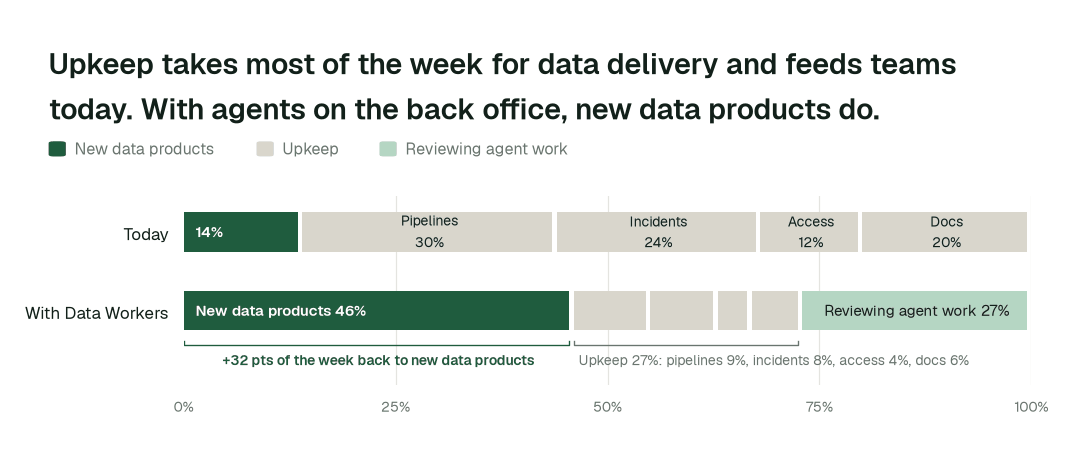
Time spent on new data products, which for this team means new datasets, channels and customers, moves from 14% of the week to 46%. Most of the rest becomes review: people steer and approve agent work instead of doing it by hand.
Then and now
| Work | Today | With Data Workers |
|---|---|---|
| Upstream schema change | Found when a customer's load fails | Checked against every variant the same night |
| Late deliveries | Found by the customer at 09:00 | Caught against the SLA clock, with customers listed |
| Entitlements | Audited when something looks wrong | Tested for every variant before each release |
| Release notes | Written by hand after the fact | Drafted from the change, reviewed by a person |
| New customer variant | Days of view and layout work | Built from the contract, tested and documented |
| Customer SLA review | Rebuilt from logs | Delivery record ready on demand |
These are the impact metrics we move for data delivery and feeds teams:
- •Upstream change checked against every customer variant: from about a day to ~15 min
- •Late file traced and customers told: from about half a day to ~15 min
- •Entitlement change prepared and tested: from about a day to ~30 min, with the approval kept
Across the routine work in this domain:
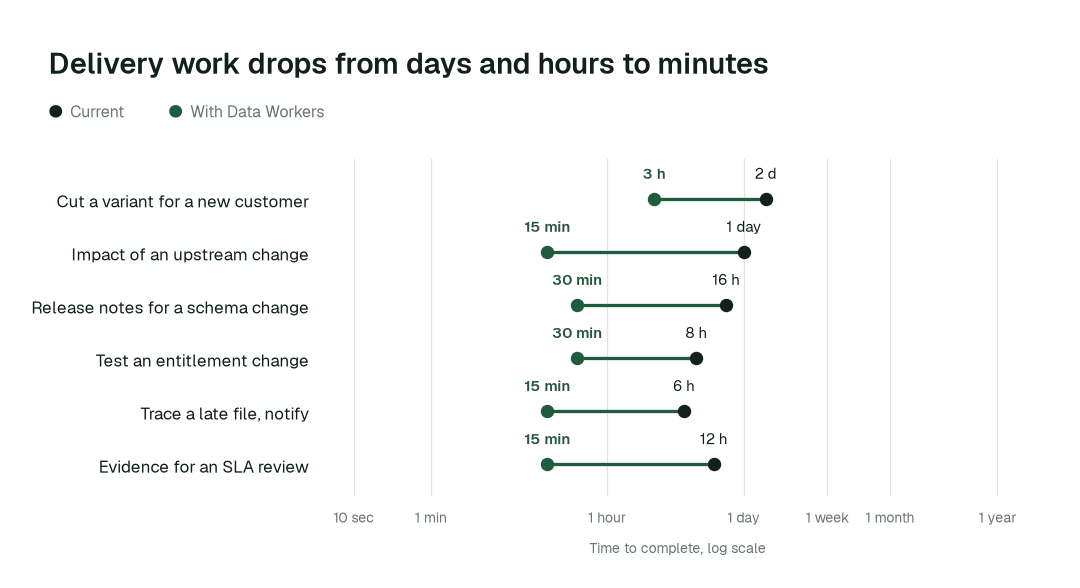
The biggest change is the cut of a variant for a new customer: from about 40 hours to about 3. Work that waited in queues finishes in minutes or hours, because agents detect, fix and verify in one pass.
Use cases, in depth
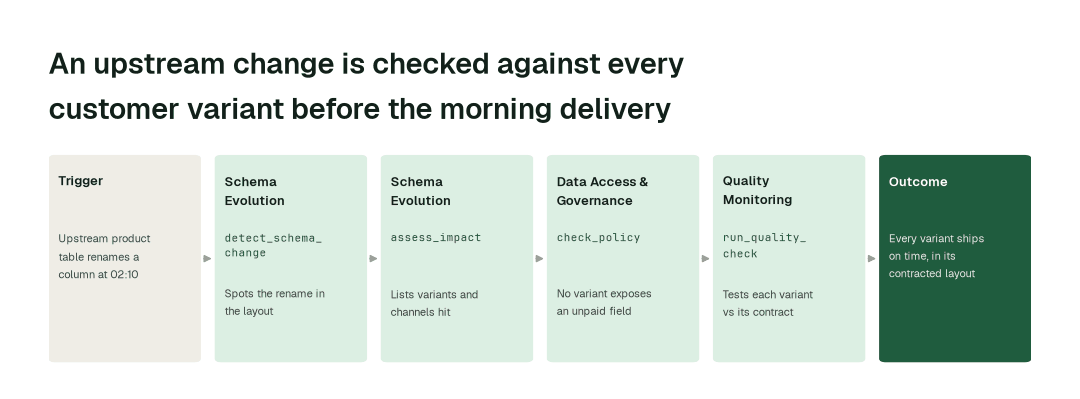
A schema change reaches every customer variant before the morning delivery
Today. Upstream renames a column or adds a code value. The product table is fine. Of the several hundred customer variants, some pin the old name in a fixed file layout, some select every column and now expose a new one, and a few feed a customer's automated load. The team finds out which when customers file tickets, and writes release notes afterwards.
With Data Workers. Schema Evolution detects the change against the last known layout and lists every variant and channel it reaches. The Data Access & Governance agent checks that no variant now exposes a field the customer did not buy. Quality Monitoring tests each variant against its contract: columns, types, row counts and null rates. Compatible changes are mapped through; anything that renames, removes or retypes a field the customer receives goes to the product owner as one decision with the full diff and a rollback point.
What changes. The delivery runs on time, every customer gets the layout they were promised, and the release note is a by-product. See also how agents handle schema change reviews.
A late file is caught while there is still time to act
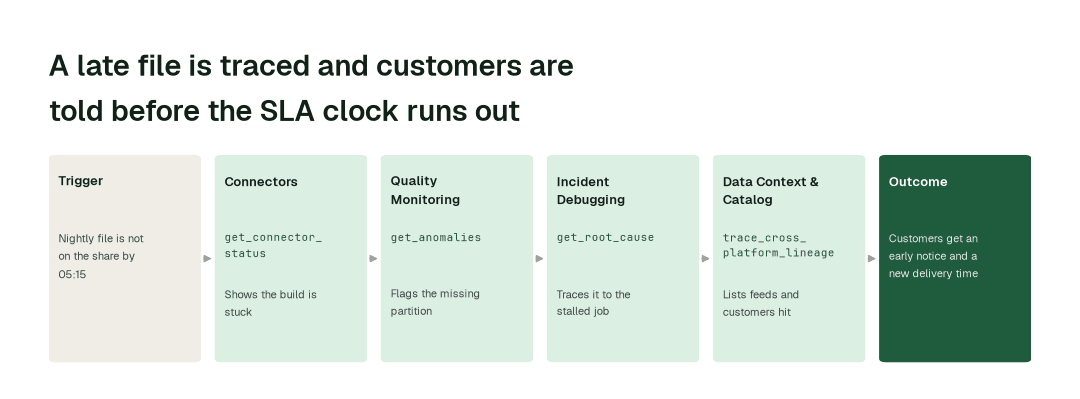
Today. The nightly build runs long because an upstream job stalled. The 06:00 file does not appear. The first sign is a customer email, then a scramble to find out what is stuck, which feeds depend on it and who to tell.
With Data Workers. The Connectors agent shows that the build, not the delivery step, is stuck. Quality Monitoring flags the missing partition against the delivery SLA and lists the customers waiting. Incident Debugging traces the delay to the upstream job that stalled, and the Data Context & Catalog agent follows lineage to the feeds and customers behind it. The team has a cause, a list and a new time before the SLA clock runs out, and the customer gets the notice before they have to ask.
What changes. A late file is a managed event with an early notice, not a surprise.
Cutting a variant for a new customer, and changing one when a customer upgrades
Today. A sales engineer sends the contract details to the data team. An engineer writes a view or a file layout, copies filters from the nearest existing customer, adds the grant by hand and hopes the entitlement matches what was sold. When the customer upgrades or lapses, someone has to remember to change it.
With Data Workers. The agents build the variant from the contract record, generate and test the view or layout, document it, and prepare the grant change as a reviewed diff. The Data Access & Governance agent checks the diff against policy and the contract. A named owner, the product owner or the contracts lead, approves it before anything is granted or revoked. The same path handles an upgrade, a downgrade and an expiry.
What changes. A new variant takes hours instead of days, and the entitlement is evidenced rather than assumed.
Measure the product, not just the pipeline
Delivery leaders are judged on what the data product sells, not on how many files went out. The Autopilot dashboard shows how much of each feed's upkeep runs on its own and at what token cost. Alongside it, the team can track what leadership and customers care about:
- •Coverage and accuracy: the figures on your data sheet and listing description, kept consistent with what the product actually contains, which is where coverage, accuracy and evaluation pick up.
- •Freshness: on-time delivery against each customer's SLA, per channel, so the number in a renewal conversation is the same one the team sees.
- •Entity resolution: the match rate and ID stability customers depend on, where entity resolution hands over: a changed ID scheme is a delivery event, because it breaks joins on the customer's side.
- •Delivery and sell-through: which delivered datasets customers actually use. That signal comes from your sharing and marketplace usage reports; the agents keep the delivery record those reports are read against.
Agents working together: an upstream rename the night before a delivery
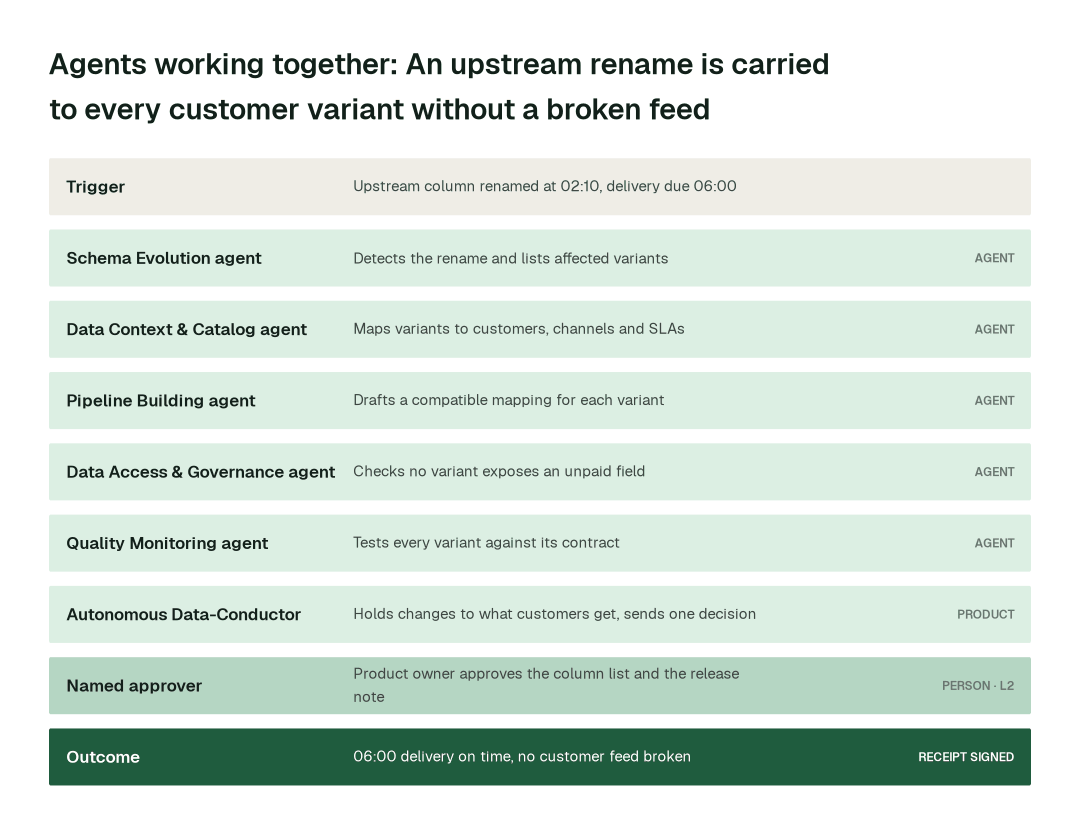
Every delivery team knows this night. The acquisition team changes a supplier mapping, and a column that customers know as "industry code" is replaced by a new code field with a new code list. The product build succeeds, because nothing in it is wrong. The damage is downstream: fixed-layout files that stop matching, views that quietly expose a premium column, and a delivery that is due in four hours. This is the same night run by Data Workers.
The setup
One product is delivered to 240 customers, illustratively, through a Snowflake share, a Delta share, a marketplace listing, a nightly file drop and an API. Each customer has a variant with its own columns, filters and history. The delivery SLA is 06:00 UTC. Autonomy in Autopilot:
- •Delivery monitoring, reruns, redelivery and catalog upkeep: L2 today; a candidate for L3 on evidence.
- •Additive changes carried to variants: L2; a candidate for L3 on evidence when the customer's layout is unchanged.
- •Anything that changes what a customer receives, including entitlements and removed or renamed fields: L2, held for the product owner.
- •Contract terms and pricing: L0.
The team scheduled one mission earlier: "Check every customer variant against its contract before the nightly delivery."
02:10: the product table changes
The product build finishes with the new code field. The old column is gone from the base table.
02:12: detect it
Schema Evolution agent compares the table with its last known layout and flags the rename and the new code list as a breaking change for anything that selected the old column by name.
02:20: see who is affected
Data Context & Catalog agent follows lineage from the base table to every variant and delivery channel. Of 240 variants, 196 do not touch the column. 44 include it. Nine of those are fixed-layout files that customers load automatically.
02:35: draft the fix
Pipeline Building agent drafts a compatible mapping: the old column name is preserved as an alias populated from the new field for the 35 variants where a view can absorb the change, and the nine fixed-layout files keep their layout. A second, versioned layout with the new field is prepared for customers who opt in.
02:50: check what each customer is entitled to
Data Access & Governance agent checks every variant against the contract record. The new code field is part of the premium tier. Six of the variants are defined to select every column, so they would have exposed it to customers who did not buy it. The agent flags the six and proposes an explicit column list for each.
03:10: test every variant
Quality Monitoring agent tests each of the 240 variants against its contract on a copy, covering columns, types, row counts and null rates, and reports that 238 pass. Two fail on the date format of a history column that the mapping had changed. Pipeline Building corrects it and the two pass on the retest.
03:30: one decision
Autonomous Data-Conductor lets the unaffected and compatible variants proceed, and holds the 15 variants that change what a customer receives: the six column-list changes and the nine fixed-layout files. It sends the product owner one decision with the diff, the test results, the customers affected and a drafted release note for each group.
04:05: approved
The product owner approves the six column lists, approves keeping the nine fixed layouts unchanged with the new layout offered on request, and edits one sentence in the release note. Conductor applies the changes with a rollback point for each.
06:00: delivery
The nightly drop, both shares and the API all land on time. Connectors agent records each delivery against its schedule, and Quality Monitoring confirms the post-delivery checks. The release note goes to customers under the product owner's name.
What stays behind
- •A tested, versioned layout for every variant, and a rollback point for each change.
- •A receipt for every change: who proposed it, who approved it and how to roll it back.
- •A delivery record per customer for the night, ready for an SLA review.
- •Updated data dictionary and listing text, and an updated Spellbook page for the product.
- •A reusable mission. The next upstream change runs the same way, and the team can move more of the routine parts to L3.
Minute by minute
This is an illustrative example. The product is built in Snowflake with dbt under Airflow and delivered through shares, a marketplace listing, a file drop and an API at 06:00. Changes to what customers receive are at L2.
| Time | Who | What happens |
|---|---|---|
| 02:10 | Acquisition team | Mapping change lands; code field replaces the old column |
| 02:12 | Schema Evolution agent | detect_schema_change: breaking for anything selecting the old column |
| 02:20 | Data Context & Catalog agent | trace_cross_platform_lineage: 44 of 240 variants affected, 9 fixed-layout |
| 02:35 | Pipeline Building agent | Compatible mapping drafted; versioned new layout prepared |
| 02:50 | Data Access & Governance agent | check_policy: six variants would expose an unpaid field |
| 03:10 | Quality Monitoring agent | run_quality_check: 238 of 240 pass, two fixed and retested |
| 03:30 | Spellbook Data Catalog | 15 variants held at L2 with the diff and a drafted release note |
| 04:05 | Spellbook Data Catalog | Product owner approves, with one edit to the note |
| 06:00 | Connectors agent | get_connector_status: all channels delivered on time |
The agents on the job
| Agent | What it does on a delivery team | Tools it calls |
|---|---|---|
| Connectors and Data Ingestion | Watch every delivery across shares, file drops and APIs against its schedule, trigger reruns and redelivery | get_connector_status, trigger_airflow_dag, trigger_dbt_cloud_job, list_snowflake_tables, send_slack_alert |
| Schema Evolution | Detect upstream layout changes, list the variants they reach, check compatibility and keep a rollback | detect_schema_change, assess_impact, check_compatibility, generate_migration, apply_migration, rollback_migration |
| Pipeline Building | Build and test per-customer variants and layouts from the contract, as reviewed changes | generate_pipeline, validate_pipeline, deploy_pipeline |
| Quality Monitoring | Test every variant against its contract and every delivery against its SLA | set_sla, run_quality_check, get_anomalies, get_quality_score, create_quality_tests_for_pipeline |
| Incident Debugging | Trace a late or wrong delivery to the job or change that caused it | diagnose_incident, get_root_cause, remediate |
| Data Access & Governance | Check each variant against policy and the contract, prepare grant changes as diffs, keep the audit evidence | check_policy, enforce_rbac, provision_access, request_governance_review, generate_audit_report |
| Data Context & Catalog | Keep every dataset, variant and listing documented with owner, lineage, freshness and the customers behind it | generate_documentation, trace_cross_platform_lineage, blast_radius_analysis, check_freshness, detect_dead_assets |
| Observability | Keep the record of what each agent did and when | get_audit_trail |
Data Context Wizard holds one governed definition of each measure on your data sheet and in your SLAs, such as freshness, completeness and on-time delivery, so a customer dashboard, a sales deck and a listing description quote the same number. Autonomous Data-Conductor verifies the outcomes that matter before a delivery goes out and holds changes to what customers receive for a named approver. Spellbook Data Catalog, in preview, gives each dataset, variant and listing a page in plain English: what it is, what it contains, who gets it and who owns it.
What goes on autopilot
Once a feed has earned it, this work runs on its own, and each item removes a problem your team deals with today:
- •Every delivery is checked against its schedule and shape on arrival, so a late, thin or empty file is known to the team before it is known to a customer.
- •Additive upstream changes are carried to every compatible variant and tested the same night, so a new column does not mean a week of view edits.
- •Failed deliveries are rerun or redelivered, so a transient failure does not turn into an SLA breach.
- •Data dictionaries, listing text and source documentation are kept current, so the page a buyer reads matches the data they receive.
- •Unused variants, stale shares and abandoned copies are flagged for retirement, so a lapsed customer does not keep a live grant or a running job.
Where your people stay in charge
Agents never get blanket access. Each feed has its own autonomy level, set by you, and it only rises when the receipts show the agents are reliable. Everything starts at L1, observing only; reversible upkeep such as reruns, redelivery, documentation and monitoring is usually first to run on its own.
- •Entitlement and contract-scope changes always go to a named approver. The agents prepare the grant or revoke as a diff, test it against the contract and show the evidence. The product owner or contracts lead decides, and no agent approves its own change.
- •Removing, renaming or retyping a field a customer receives goes to a named approver, with the customers affected and the drafted notice attached.
- •Customer notices go out under a person's name. Agents draft the release note; they do not send it.
- •Pricing, licence terms and contract terms stay entirely with people.
Once a deployment has matured, here is how that ladder plays out across task classes:
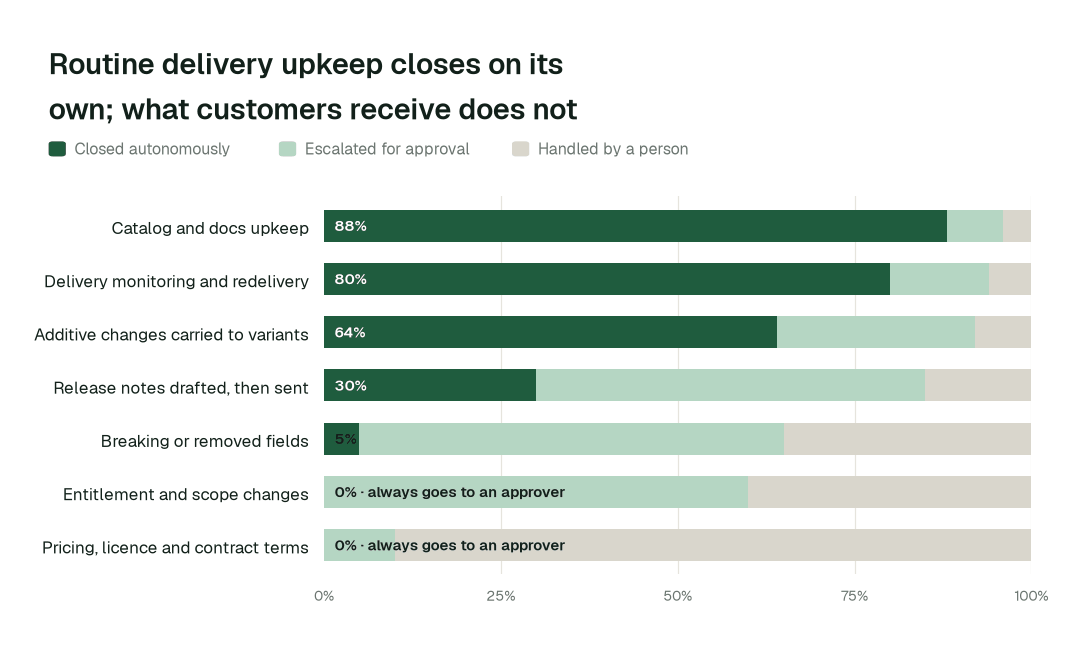
Catalog and docs upkeep closes autonomously 88% of the time. For pricing, licence and contract terms, autonomous closure is 0% by design: agents prepare the evidence and a person decides.
What happens when an agent is wrong
- •At L2 propose, nothing changes until a named person approves. The proposal shows the full diff, the customers it touches and how to roll it back. Unanswered requests expire and escalate.
- •L3 and L4 are where a domain can go next, on its own review record: acting on its own, with a rollback point on every change. Only the domain's owner raises its level, and if people start reverting the agents' changes, the domain pauses itself.
- •No agent approves or promotes its own work. Autonomy only grows on evidence, domain by domain, and repeated reverts pause the domain.
- •One org-wide stop halts all autonomous dispatch, and every action lands in a tamper-evident audit trail you can export with
generate_audit_report.
A mistake in a delivery is a mistake a customer can see, which is why the reversible classes come first and the ones that change what a customer receives start at L2.
How it fits your stack
Data Workers connects to what you already run: Snowflake and Databricks; the sharing and marketplace channels you list through; S3, GCS and SFTP drops; your APIs; dbt; Airflow or Dagster; and the record of customers, contracts and entitlements. Each agent is an MCP server, so the same agents work inside Claude Code, Cursor or Codex and in Slack or Teams through Spellbook. Over 50 connectors are available. Nothing migrates.
- •Runs in your infrastructure with your credentials and your model key. The hosted Autonomous Data-Conductor sees workflow metadata only, never rows. That matters when the rows are what customers pay for.
- •Uses the access you already govern. Agents act under scoped service identities and your existing roles; checks go through
check_policyand are logged. Your sharing platform stays the system that enforces the grant. - •Fits a per-customer data contract. Layout, freshness and completeness expectations for each customer or product can be written down in an open format such as the Open Data Contract Standard, and agents check each delivery against them. See how agents enforce data contracts.
- •Works with the sharing you already use. Snowflake secure data sharing and the open Delta Sharing protocol move the data to the consumer. Data Workers works on the layer around them: what goes into each share, whether it is right and on time, and who has approved it. See what Data Workers adds on Snowflake.
- •Proposes changes as diffs in your dbt project, orchestrator and warehouse, with blast radius, tests and a rollback point, and applies them only at the autonomy level you set for that feed.
- •Open-source core. The Apache-2.0 community edition ships 11 agents and 160+ MCP tools, so your engineers can read exactly what the agents call.
Freshness promises are tracked the way described in data freshness monitoring and SLAs and data pipeline SLAs. For teams that deliver location and marketplace data in particular, see best practices for agentic location and marketplace data. If you deliver across clouds, the multi-cloud back office shows how one set of agents covers Snowflake, Databricks and BigQuery, and schema changes that never break downstream goes deeper on the first use case above.
Governance and regulation
A data business is accountable for exactly what each customer was sent. Most of that is contractual: a customer who receives a field they did not buy has been given something you may not have licensed to them, and a customer who does not receive what they paid for has a claim. Where a delivery contains personal data, sending it to the wrong recipient can also be a personal data breach under the GDPR, which carries a duty to notify the supervisory authority without undue delay (Article 33). Delivery is where those obligations are met or missed.
Data Workers checks each variant against policy and the contract before it is delivered, flags personal data fields with scan_pii, holds changes to what a customer receives for a named approver, and records every change in a tamper-evident audit trail, so the question "what exactly did this customer receive on that date, and who approved it" has an answer.
Data Workers doesn't make you compliant; your controls, people and assessors do. It supplies controls and evidence wherever agents touch data. Not legal advice.
The alternatives data delivery and feeds teams weigh
Build it yourselves. A strong team can wire a coding agent to MCP servers for the warehouse and dbt and generate views quickly. The work is everything around it: routing each change to the right owner, blast radius across hundreds of variants, rollback, receipts, and a shared record of what each customer is entitled to.
Native sharing and marketplace tooling. Snowflake secure sharing, Delta Sharing and the cloud marketplaces move data to a consumer and enforce the grant you give them. They do not decide what each customer should receive after an upstream change, test every variant, or prove it afterwards. Data Workers works around them, across all of them.
Observability, catalogs and point tools. Observability alerts, catalogs document and quality tools test. Data Workers takes their signals, diagnoses what changed, proposes the fix, verifies it and leaves the receipt, including the release note.
Platform-native agents. Warehouse vendors' agents work well inside their platform. Delivery crosses the build, the orchestrator, two or three sharing platforms, file drops and APIs, and Data Workers works across all of them.
In this space specifically. Among data-delivery and file-transfer tools, most move bytes and report that a transfer finished. Data Workers is concerned with whether what arrived is what that customer bought.
The case for your CTO
What this replaces. A view per customer maintained by hand, customer tickets as the detection system for schema changes and late files, entitlement audits done when something looks wrong, and release notes written after the fact.
What your team gets back. A delivery team that ships new datasets, channels and customers instead of repairing variants, and a product whose on-time rate and layout stability are numbers it can quote.
Integration effort. Connecting is configuration, not a migration. The agents attach over MCP to the warehouse, orchestrator, dbt project and delivery channels you already run, under the roles you already govern, inside your own infrastructure. Your engineers can read every tool the agents call in the open-source core.
Risk and control. Autonomy is set per feed. Everything starts at L1, observing only; reversible work moves up only when the receipts justify it; entitlements and changes to what customers receive stay at L2 with a named approver; and one org-wide stop halts all autonomous work.
Why now. Customers compare data vendors on freshness and reliability as well as content, and more of them are AI agents and automated loads that fail hard on a changed layout. A silent change reaches more places faster than it used to.
The first win. Schema-change handling and delivery monitoring on one product's customer variants, at L2. The pilot below lays out the scope, what you see each week and the cost.
The climb: from assisted to autonomous to agentic
Our thesis is that the data platform climbs the way analytics did, in stages, and that the hard part of data work was never knowing what to do but doing it. For data delivery and feeds teams, the climb looks like this:
- •Assisted. Agents work alongside your team. They read every variant and channel, show what needs doing and propose every fix with a receipt; entitlements and changes to what customers receive always go to a named approver.
- •Autonomous, under your governance. Routine work runs on its own: every delivery is checked on arrival, additive changes are carried to compatible variants the same night, failed deliveries are rerun and documentation stays current. Your team governs the agents instead of doing the upkeep.
- •The agentic data business. A delivery team that designs the next product and channel instead of fixing the last drop. People set direction, and the platform carries it out.
You choose the altitude, every step is visible and reversible, and the pilot below is the first rung.
The pilot: how data delivery and feeds teams start
The pilot is how your team proves the value on its own data before committing.
- •What we connect. Your warehouse, dbt, orchestrator, the delivery channels for one product, and the customer and contract record, over MCP, inside your infrastructure. Nothing migrates.
- •Scope. Schema-change handling and delivery monitoring on one product's customer variants, at L2.
- •First week. Agents run at L1 across the scoped product. They map every variant, channel and schedule, test each variant against its contract and show the fixes they would have made, with receipts, so your team sees the value before anything changes.
- •By week two. Delivery checks on arrival, reruns and documentation upkeep start running on reversible work. Anything that changes what a customer receives stays at L2 with a named approver.
- •At day 30. We review the impact metrics against your baseline:
- •Upstream change checked against every customer variant: from about a day to ~15 min
- •Late file traced and customers told: from about half a day to ~15 min
- •Entitlement change prepared and tested: from about a day to ~30 min, with the approval kept
- •the share of catalog and docs upkeep closed autonomously, targeting 88% as the deployment matures
- •What you decide. Whether to expand to the next product. The pilot fee is credited in full against the first year.
- •Cost. Start with a pilot ($7,500 one-time, a 6 to 12 week pilot, credited in full against the first year). Scale is from $1,000 a month and Enterprise from $3,000 a month, billed annually, with unlimited seats, no usage meter and no markup on model spend. See pricing.
The pilot is the start of a longer curve:
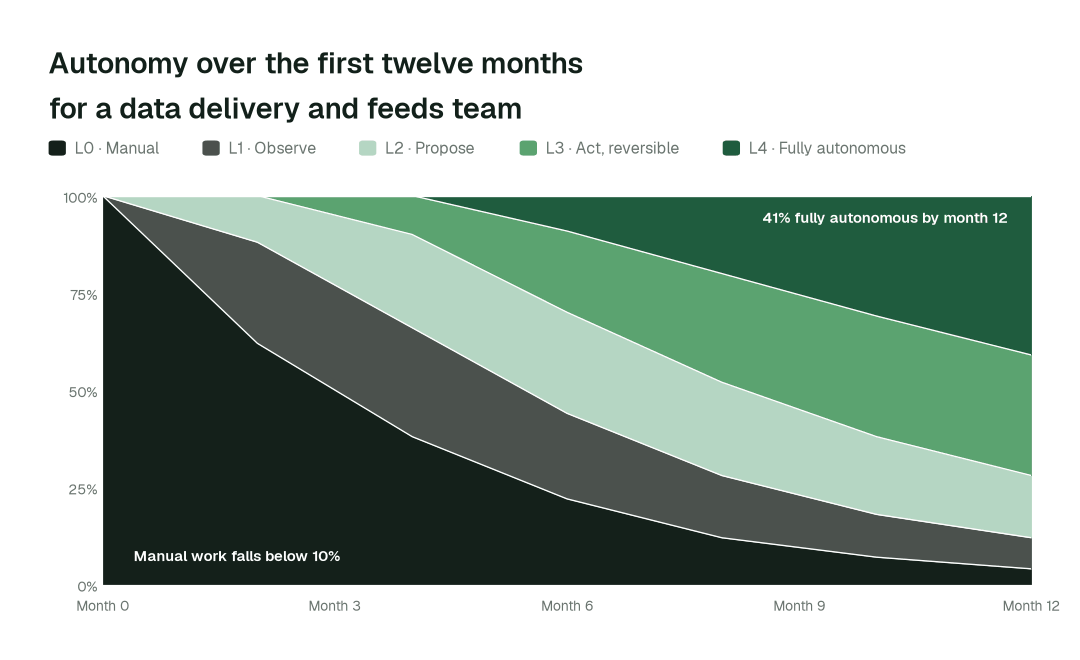
By month 12, more than 41% of agent actions run fully autonomously and manual work falls below 10%, while entitlements and changes to what customers receive stay with a named approver.
FAQ
Does it work with Snowflake shares and Delta Sharing? Agents work on the layer around them: the datasets, views and files that go into each share, their checks and their documentation. Your sharing platform stays the system that enforces the grant.
Will agents change a customer's entitlements? They prepare the change, test it against the contract and show the evidence. A named owner approves it before anything is granted or revoked.
Can it write our release notes? It drafts them from the change itself, with the customers affected. A person reviews and sends them.
What about marketplace listings? Data dictionaries, schema descriptions and coverage text are kept in step with the product. Publishing a listing stays a person's decision.
Where do the agents run? In your infrastructure, with your credentials and model key. The hosted Conductor sees workflow metadata only.
Do we have to migrate anything? No. Your warehouse, dbt project, orchestrator, catalog and delivery channels stay where they are.
Sources
- •Data Workers pricing: https://dataworkers.io/pricing/
- •Snowflake documentation, introduction to secure data sharing: https://docs.snowflake.com/en/user-guide/data-sharing-intro
- •Delta Sharing protocol specification: https://github.com/delta-io/delta-sharing/blob/main/PROTOCOL.md
- •Bitol, Open Data Contract Standard: https://bitol-io.github.io/open-data-contract-standard/
- •European Union, General Data Protection Regulation (Regulation (EU) 2016/679), including Article 33 on notification of a personal data breach: https://eur-lex.europa.eu/eli/reg/2016/679/oj