You're on Boomi: It Connects Your Applications and Processes. Data Workers Owns Whether the Data They Deliver Is Right
Boomi connects your applications and processes. Data Workers owns whether the data those integrations deliver to the warehouse, and back out of it, is right, with every fix behind an approval.
Your integration team builds processes. A process starts on a schedule, a listener or an API call, runs on an Atom or a runtime cluster, pulls documents through connector operations, reshapes them in maps and writes them to the next system: invoices into the ERP, orders into the warehouse management system, and a copy of most of it into Snowflake for the data team. Packaged components move each version through environments. Runtime Management holds the schedules, Process Reporting shows every execution and its documents, Data Hub keeps golden records and API Management publishes your APIs. The platform now adds Agentstudio, the AI Gateway and Boomi Connect, so the same team governs AI agents and MCP tools as well as integrations.
Boomi connects your applications and processes. Data Workers owns whether the data those integrations deliver to the warehouse, and back out of it, is right: it catches the problem where the data lands, traces it through dbt, BI and every process that reads it, and gets the fix approved before anyone acts on a wrong number.
Key takeaways
- •Boomi keeps its job. Processes, maps, schedules, deployments, Data Hub and API Management stay with your integration team. Data Workers works on the data those processes land and read back.
- •A Successful execution gets checked too. Data Workers diffs landed tables against a baseline, checks nulls and watches lateness and the other metrics your team records, so a green process with wrong data becomes a diagnosed incident.
- •Connected over Boomi's Platform API today. Data Workers reads landed tables natively in Snowflake, BigQuery or Databricks, plus the dbt project, among 50+ connectors.
- •Every fix goes through a named person. The owners approve the schedule hold, the dbt diff and the rerun; the integration team acts in Runtime Management. Each step leaves a receipt.
- •Autonomy is set per domain. Start at L1 observe, move to L2 propose, and open L3 act reversibly for narrow classes once the record earns it.
Boomi is the integration fabric. Data Workers is the owner of the data it delivers.
Boomi's job is to keep every application in step: get each document to the next system, in the right shape, on time. The job after the warehouse copy is different: notice that a Successful execution delivered data that no longer means what the models expect, size the damage, hold what would spread it, get the cause fixed, rerun in order and prove the result. Here is the last night of a quarter at a B2B software company that bills in Zuora and keeps its ledger in Microsoft Dynamics 365 Finance. This is an illustrative example.
| Time | System | What happens |
|---|---|---|
| Tue 21:10 | Snowflake | Multi-currency invoicing starts on Oct 1. The integration team runs its release script, which adds AMOUNT_DOC_CCY and AMOUNT_BASE_CCY to RAW_BOOMI.ZUORA_INVOICES |
| 21:30 | Boomi | The team deploys version 12 of the process "Zuora Invoices to D365 and Snowflake" to the production environment. The new map writes both currency fields; the old AMOUNT field is no longer mapped |
| 21:45 | Boomi + Dynamics 365 Finance | The first scheduled execution posts 1,860 invoices to Dynamics 365 Finance correctly and writes the same invoices to Snowflake with AMOUNT empty. Process Reporting shows Successful, and so does every 15-minute run after it |
| Wed 01:00 | dbt Cloud | The job finance_nightly builds fct_invoices and ar_open_balances from stg_boomi__zuora_invoices, which reads AMOUNT. Every test passes: the not-null test covers invoice_id. Open balances for 1,212 accounts invoiced last night come out understated |
| 01:15 | Data Workers + Snowflake | run_quality_check finds two new columns on RAW_BOOMI.ZUORA_INVOICES and AMOUNT null in all 3,410 rows loaded since 21:45, against none before. The daily billed amount the team records sits at a fifth of its baseline. Data Workers opens an incident |
| 01:21 | Data Workers | The diagnosis: the 21:30 deployment stopped mapping AMOUNT; the ledger is fine and the warehouse copy lost the amount. Blast radius from lineage, the dbt manifest and the team's context-graph notes: fct_invoices, ar_open_balances, the view ACCOUNT_BILLING_STATUS, the 07:00 Boomi process "Snowflake Billing Status to Salesforce" that sets Open_Balance__c for the quarter-end collections push, and the Power BI "Cash and collections" report the CFO reviews at 09:00 |
| 01:24 | ServiceNow + Slack | Data Workers opens a ServiceNow ticket with the diagnosis and sends approval requests in Slack to the Boomi integration owner and the finance analytics owner |
| 06:05 | Spellbook | The owners review four proposals: stop the 07:00 scheduled process until the fix is verified; a dbt diff that reads AMOUNT_BASE_CCY when AMOUNT is empty in stg_boomi__zuora_invoices, with a not-null test on the amount; the rerun plan; and a note for the integration team to map AMOUNT again until every consumer moves. They approve all four |
| 06:10 | Boomi | The integration owner stops the scheduled process from the Deployed Processes tab in Runtime Management |
| 06:20 | GitHub | The analytics engineer merges the dbt diff |
| 06:25 | dbt Cloud | The owner reruns finance_nightly after approval |
| 06:50 | Data Workers + Snowflake | Data Workers verifies: no empty amounts in staging or fct_invoices, the billed amount back inside its baseline and the marts' load lag back on its baseline. remediate re-checks the assertions |
| 06:55 | Boomi + Salesforce | The integration owner resumes the scheduled process. At 07:00 it writes correct open balances to Salesforce |
| 07:05 | ServiceNow | The on-call engineer resolves the ticket, which links the Data Workers receipt: cause, approvals, runs, checks passed and the undo |
| 09:00 | Power BI | The CFO's quarter-end cash review runs on verified numbers. At 10:30 the integration team deploys version 13, which maps AMOUNT again |
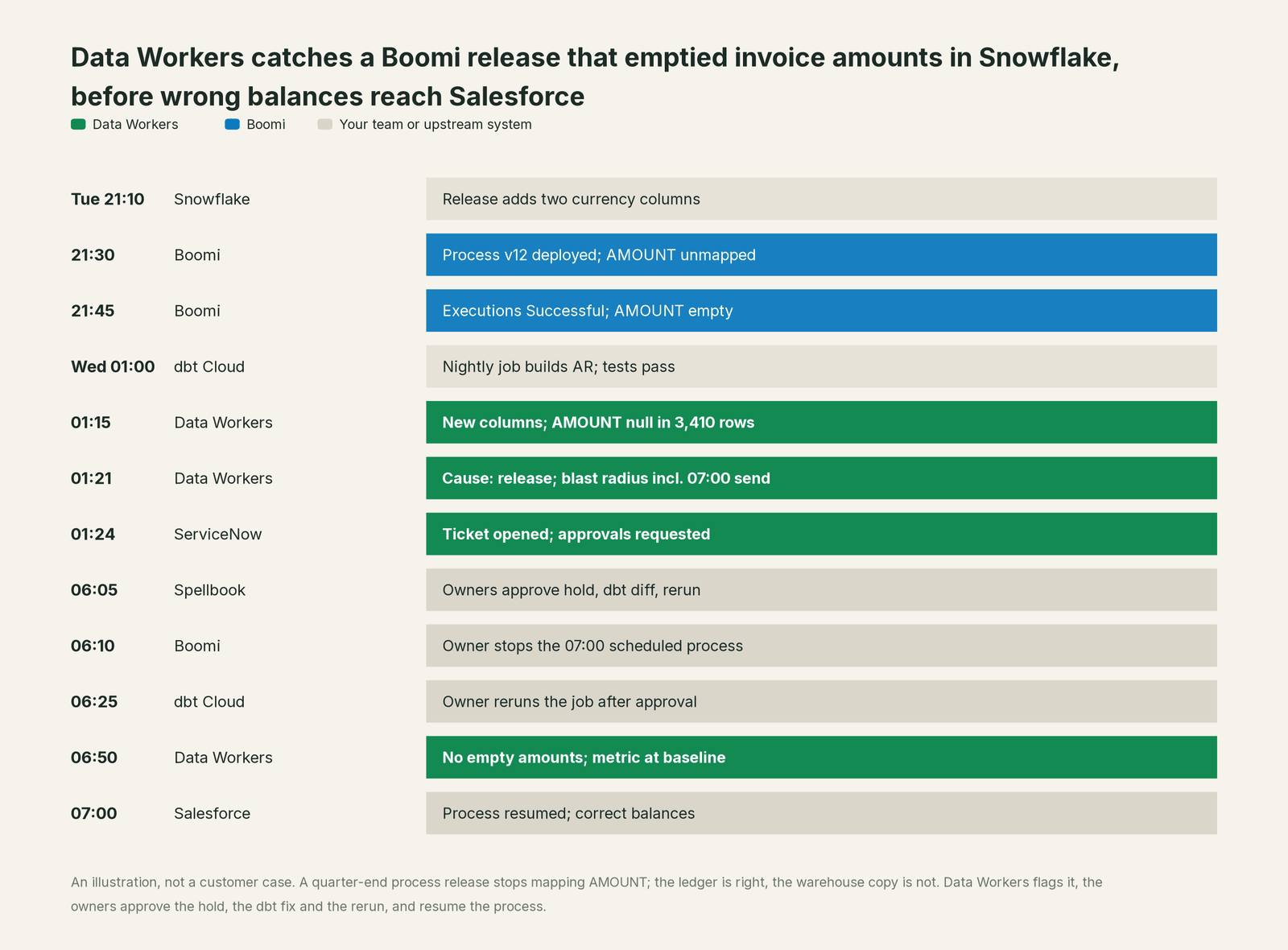
Every part of Boomi did its job: the map wrote exactly what it was designed to write, the ledger got correct invoices and Process Reporting told the truth. Catching this takes knowledge an integration platform was never meant to hold: that a dbt model three steps away still reads AMOUNT, that a view built on it feeds another Boomi process, and that collections calls customers from that number on the last day of the quarter.
| Job | What Boomi does | What Data Workers does |
|---|---|---|
| The connection | Runs processes on Atoms and runtime clusters, with connectors and maps for each application | Reads what the processes land, natively in the warehouse; connects to Boomi over its Platform API |
| The release | Moves packaged components through environments; Runtime Management holds the schedules | Diffs each landed table against its baseline, so a release that changes the shape of the data shows up as a reviewed change |
| The signal | Process Reporting shows every execution, document and log, with Failed, Pending and Successful states | Checks nulls, freshness and the metrics the team records, so a Successful execution with wrong data still raises an incident |
| The way back out | Processes read warehouse views and write them to Salesforce, the ERP or a partner API | Knows which processes and reports read each table, and proposes the hold before the next send |
| The fix | Runs whatever processes and schedules the team configures | Proposes the hold, the dbt diff and the rerun to named owners; records each approved dbt Cloud rerun |
| The proof | Keeps execution history, deployment history and audit logs | Re-checks the tables and writes a receipt: what changed, who approved it, how it was checked, how to undo it |
Why doesn't Boomi just do this itself?
Because Boomi is built to connect applications faithfully, and it made the right choices for that job. A map writes the fields the developer chose; a process that second-guessed its own map would be a worse product. Process Reporting reports whether each document moved, the contract an integration platform owes both ends. The Snowflake connector writes to the table structure it finds. None of those choices can tell that a field the ledger no longer needs is the one a dbt model, a view and a second process still depend on.
Boomi's AI features point the same way. Agentstudio (generally available; Sep 12 and Sep 26 releases added tool building, remote MCP server options and provider agents) designs, governs and orchestrates AI agents, with Agent Control Tower as its governance layer, and the Agent step puts an Agentstudio agent inside a process. The AI Gateway's MCP gateway controls which tools each agent can call, and the API Control Plane can expose managed API Products as MCP tools. All of that governs how applications and agents connect. Whether the warehouse copy still produces the right balance or forecast is a question about every system after Boomi.
Owning that question across a ledger, a warehouse, dbt, BI and a CRM is a different product with different liability: a context graph of every consumer, blast-radius scoping, named approvers, a recorded undo and receipts. That is Data Workers. More in is it safe to let AI agents change production data.
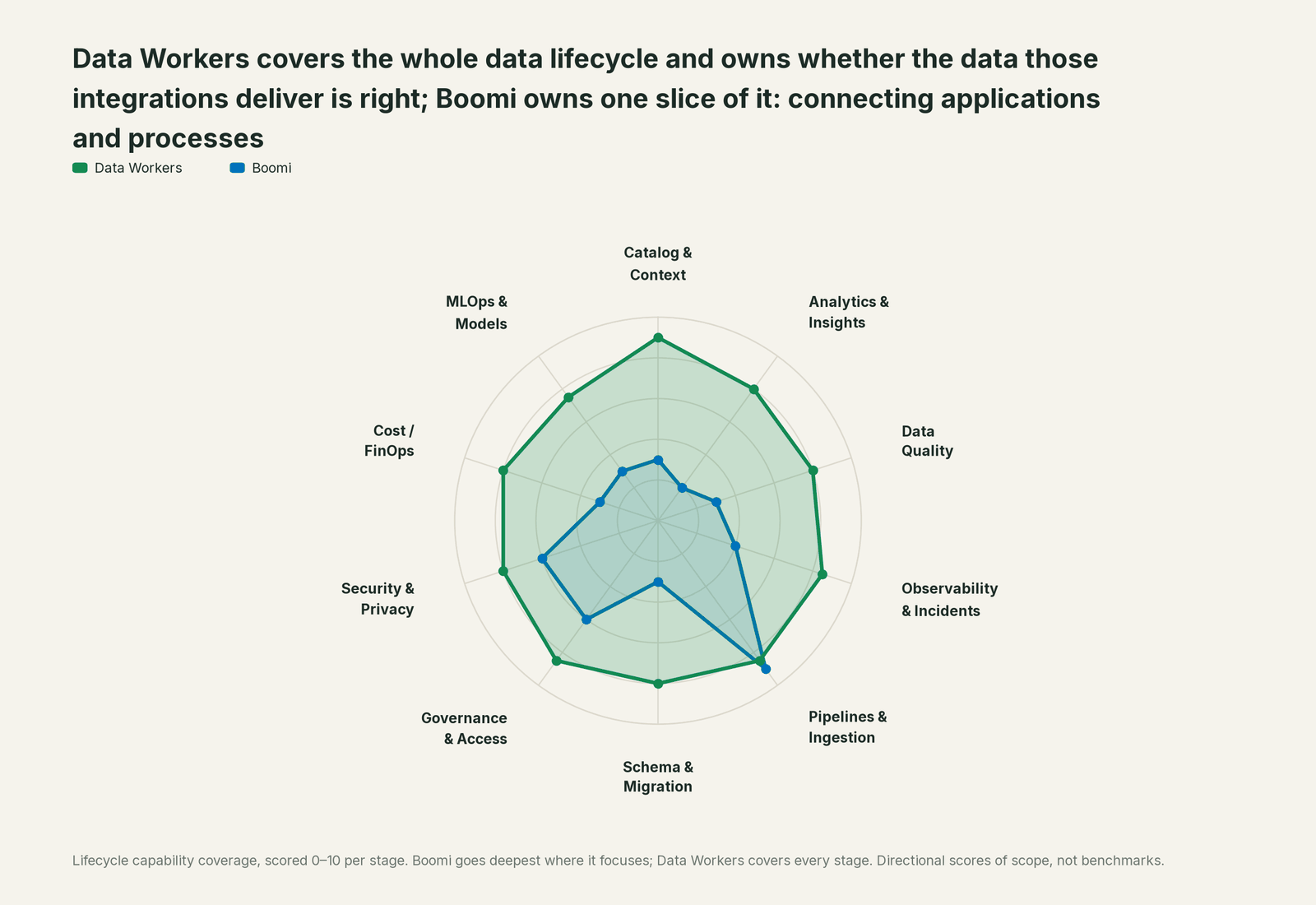
Every tool owns a slice. Data Workers covers the whole lifecycle
Each point tool adds another console, contract and handoff. Data Workers covers the whole lifecycle with one context, one approval flow and one audit trail, and builds on the Boomi processes already there.
| Stage | Data Workers | Boomi | Why we scored it this way |
|---|---|---|---|
| Catalog & Context | 9 | 3 | Data Hub keeps golden records and Meta Hub grounds agents in business context. Data Workers keeps one governed context graph of what each warehouse table means, who owns it and what reads it. |
| Analytics & Insights | 8 | 2 | Not Boomi's job: it connects systems, while business numbers live in BI. Data Workers answers data questions from governed definitions with lineage behind every number. |
| Data Quality | 8 | 3 | Data Hub stewardship quarantines bad master records. Data Workers checks nulls, uniqueness and minimum volume on landed tables and flags recorded metrics, lateness included, that leave their baseline. |
| Observability & Incidents | 8.5 | 4 | Process Reporting shows each execution, its documents and logs. Data Workers diagnoses the data incident when every execution succeeded, proposes the fix and verifies it. |
| Pipelines & Ingestion | 8.5 | 9 | Boomi's home stage: processes, connectors and maps across applications, plus Data Integration (Rivery), Event Streams and B2B/EDI. Data Workers plans reruns for the owner. |
| Schema & Migration | 8 | 3 | Maps and connector profiles follow the shape the developer designs. Data Workers diffs landed tables against a baseline and traces each change through dbt, BI and the processes that read it. |
| Governance & Access | 8.5 | 6 | API Governance and Agent Control Tower govern APIs and agents. Data Workers routes every data change to a named approver. |
| Security & Privacy | 8 | 6 | API Security and the AI Gateway's tool policies secure the connections. Data Workers leaves a receipt on every data change. |
| Cost / FinOps | 8 | 3 | The AI Gateway observes agent and MCP traffic. Data Workers attributes Snowflake credits to the dbt model behind them through query tags. |
| MLOps & Models | 7.5 | 3 | Agentstudio governs the agents themselves. Data Workers keeps the data under models and agents healthy. |
How Boomi and Data Workers work together
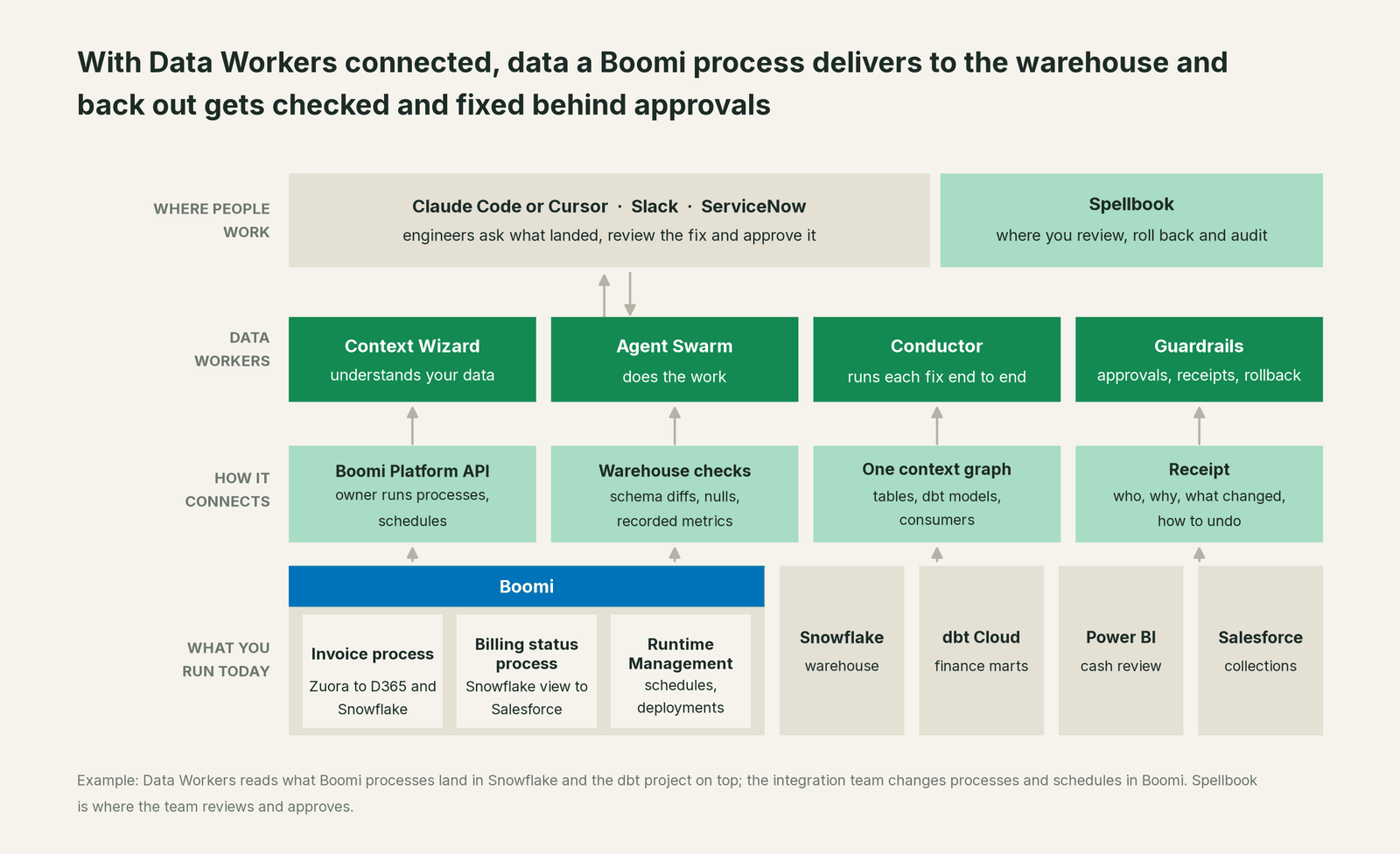
Data Workers connects to Boomi over its Platform API today, where execution records, processes and process schedules are API objects. What Data Workers needs from each execution sits in the warehouse Boomi writes to, which it reads natively, and in the dbt project built on top. Processes, schedules, deployments, Data Hub models and API policies stay with your integration team: Data Workers never runs, stops or reruns a Boomi process and never writes to the applications those processes feed. It proposes the hold and the rerun order; the owner acts in Runtime Management. The rest of this incident runs on native connections: Snowflake, dbt Cloud, ServiceNow, Slack and GitHub, among 50+ connectors. Zuora, Dynamics 365 Finance, Salesforce and Power BI connect over their APIs or MCP servers today. The full list is in what integrations Data Workers supports.
Boomi's MCP Server connector, which turns deployed processes into tools, is pre-release: its connector page (Sep 2, 2026) says Early Access and "Do not use it in a production environment or with production data", and Boomi's MCP overview (Jul 16, 2026) calls it Tech Preview. The Platform API is the production path today. The Data Workers side follows the documented client setup: clone the open-source repo and add each agent's start-agent.sh entry to your client.
# Example: Data Workers agents in Claude Code, from a clone of the open-source repo
claude mcp add --scope user dw-incidents -- "$(pwd)/start-agent.sh" dw-incidents
claude mcp add --scope user dw-quality -- "$(pwd)/start-agent.sh" dw-quality
claude mcp add --scope user dw-catalog -- "$(pwd)/start-agent.sh" dw-context-catalog
claude mcp add --scope user dw-schema -- "$(pwd)/start-agent.sh" dw-schema
claude mcp add --scope user dw-connectors -- "$(pwd)/start-agent.sh" dw-connectors
List the tools with your client's own command (/mcp in Claude Code). In this incident: run_quality_check (dw-quality) finds the added columns and the empty amounts and later confirms the fix; monitor_metrics (dw-incidents) tracks the daily billed amount; diagnose_incident names the cause; blast_radius_analysis and trace_cross_platform_lineage (dw-context-catalog) map the damage, with get_dbt_model_lineage (dw-connectors) on the dbt side; create_servicenow_ticket and send_slack_alert open the ticket and notify the channel; remediate re-checks the assertions and escalates any failure to a person. The guard against the next unmapped field is the owner's new dbt test.
Boomi documents the AI Gateway's MCP gateway as aggregating any local or remote MCP server behind one endpoint, and Data Workers' agents are MCP servers, so registering them there is your team's option. Approvals and receipts stay in Data Workers either way. In production the agents run in your infrastructure and hold the warehouse credentials and model key. Your data stays in your systems; the hosted Conductor sees workflow metadata only. More in where does our data go.
One incident, L0 to L4, set per domain:
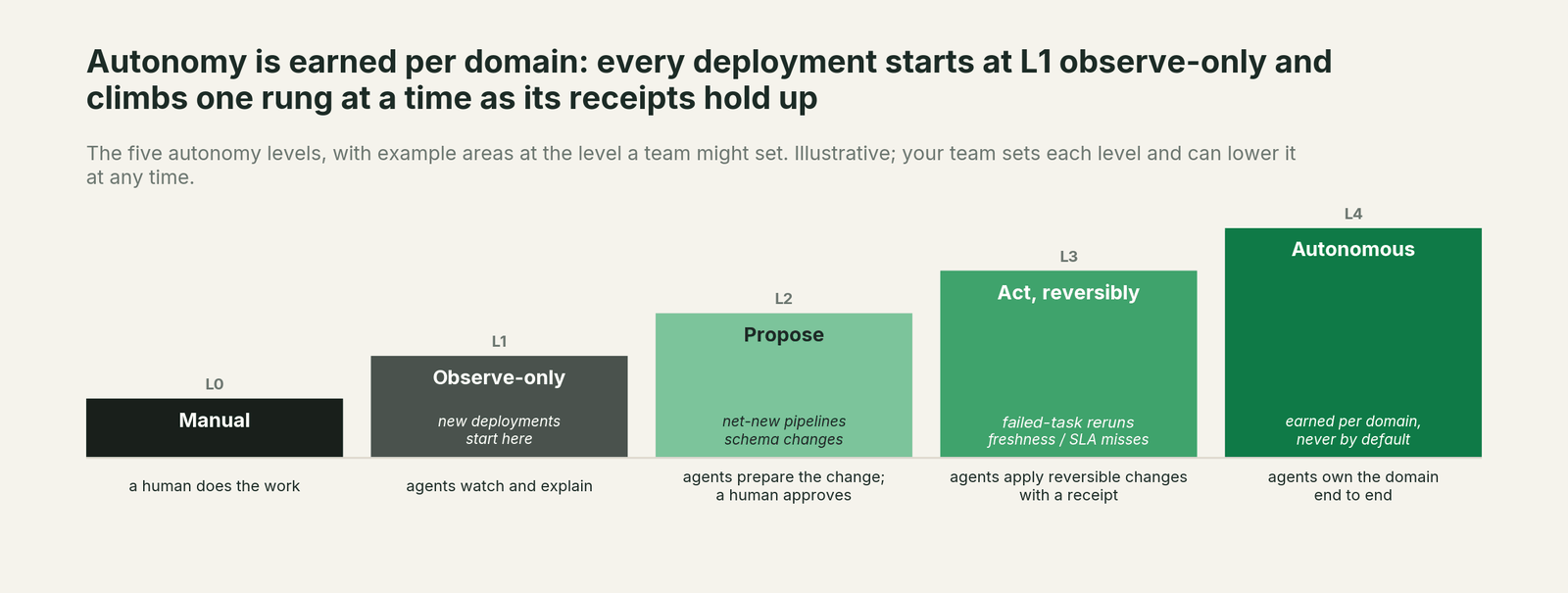
- •L0 manual. Collections calls customers with understated balances, and finance finds the gap during the close.
- •L1 observe. Data Workers flags the new columns and the empty amounts at 01:15 with the cause and blast radius. Nothing changes.
- •L2 propose. Data Workers proposes the schedule hold, the dbt diff and the rerun plan; nothing moves until the named owners approve.
- •L3 act reversibly. For a class with a clean record, Data Workers re-checks every approved dbt Cloud rerun itself and sends any failed check to a person. Boomi schedules, deployments and application writes stay with the owners.
- •L4 autonomous. For a scoped domain, Data Workers checks the tables Boomi writes on a short schedule, so the proposal is waiting well before the nightly build.
Who sets those levels: who owns the agents, how approvals work for AI data agents and autonomy levels L0 to L4 explained.
What changes for your team
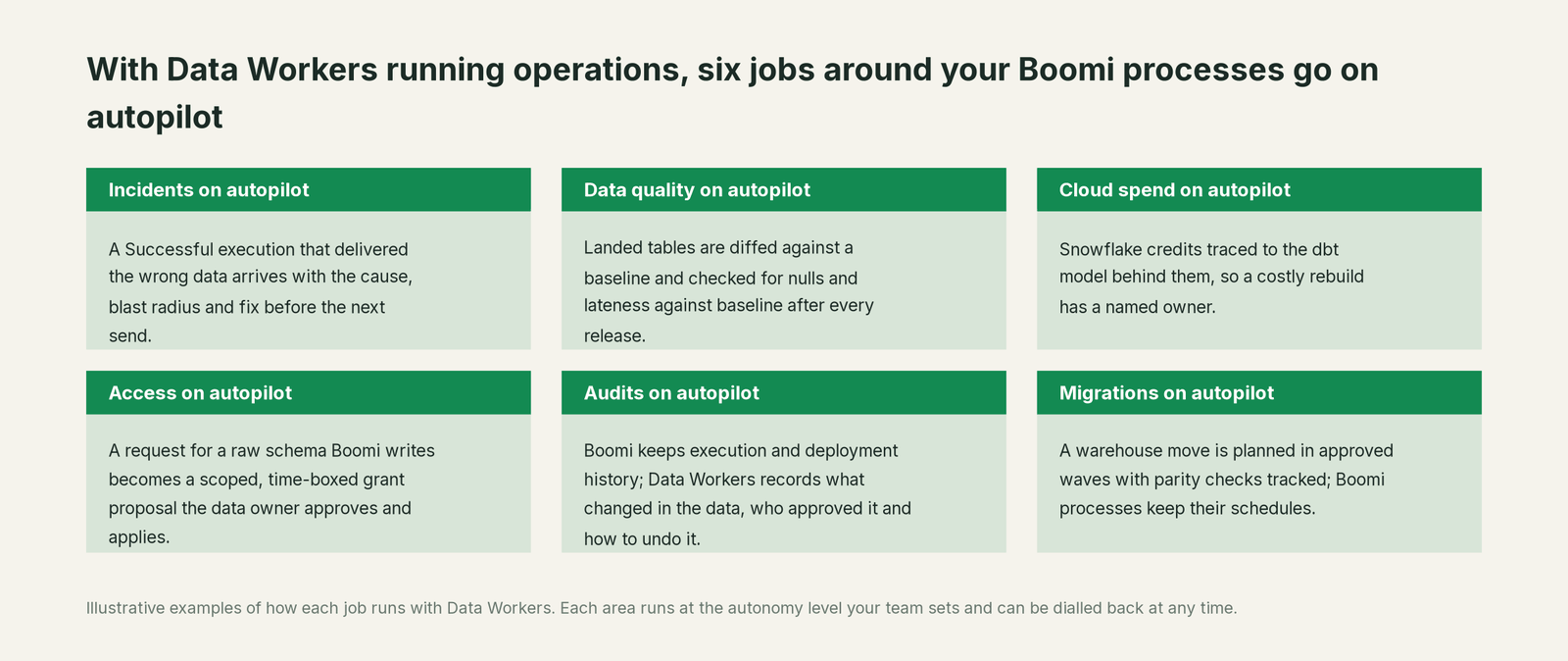
- •Integration releases get a data check. A process version that changes what lands shows up as a reviewed change with its consumers listed, the night it ships.
- •Processes that read the warehouse get a guard. When a view a Boomi process sends out goes wrong, the hold is proposed before the next scheduled execution.
- •On-call starts from a cause. The ServiceNow ticket carries the damage, the proposed fix and the rerun plan.
- •One record for integration, data and finance teams. All three see the same incident and receipt in Spellbook Data Catalog (in preview), linked from the ticket.
Data Workers vs data observability covers teams with a separate monitoring tool, and data ingestion vs data integration shows where integration platforms sit next to ELT tools.
Keep Boomi, or consolidate?
Keep Boomi if you love it; Data Workers works with it from day one. Many teams consolidate once Data Workers runs that slice too.
For almost every Boomi estate the answer is keep it: the processes that keep the ERP, CRM and partner systems in step are the business's wiring. What teams consolidate is the tooling around the warehouse copy: a separate observability tool, hand-built check processes and "rerun it and compare the dashboard" runbooks. See you're on Rivery for Boomi Data Integration, you're on MuleSoft, you're on Fivetran and you're on dbt. One incident record spans them.
Weighing a build on the Platform API and a coding agent? Read build it ourselves with Claude Code and MCP servers: the context graph, approvals, undo and receipts are the work.
The case for your CFO
The outcome. When a Boomi process delivers data that no longer means what the warehouse expects, it is caught where it lands and corrected before collections or a board report acts on it, with a record of how it was checked.
The risk story. At L0 and L1, agents only read. At L2 a named person approves each proposal; an unanswered request expires and escalates, never auto-grants. At L3 they act on reversible changes inside the domains you open; L4 is a later choice per domain. Boomi processes, schedules and deployments stay with the integration team. No agent can promote its own work, and an org-wide stop halts all autonomous dispatch. Every change carries a receipt: what changed, who approved it, the blast radius and the undo.
Why now. Boomi now connects AI agents as well as applications, and the warehouse copy feeds agents, dashboards and processes that send data back out. A wrong field travels further before a person sees it.
The first win. L1 on the tables Boomi writes for finance and the views it sends back out: a release that drops a field becomes a diagnosed incident before the next execution.
What stays the same. Nothing migrates: Boomi, your processes and runtimes, Data Hub, your dbt project, your warehouse and your on-call rota. For the numbers, see the ROI of agentic data operations.
The sentence for upstairs: "Boomi keeps our applications connected; Data Workers makes sure the data those connections deliver is right, and gets it fixed with our approval when it isn't, before anyone acts on it."
Getting started
Start with a pilot. Pick the Boomi processes that write finance or customer data to the warehouse and those that read it back out, give Data Workers read access to those schemas and the dbt project, and run at L1 for a few weeks. Then turn on L2 for one domain, and open L3 for a narrow class once the receipts show the agents were right. The pilot path is on the pricing page, and the pilot is credited in full against the first year.
FAQ
How does Data Workers connect to Boomi? Over Boomi's Platform API today. Data Workers reads what the processes land natively in Snowflake, BigQuery or Databricks, plus the dbt project on top.
Process Reporting says every execution was Successful. How can the data be wrong? Process Reporting tells you each document moved. A map can write exactly what it was designed to write and still leave out a field a dbt model needs. Data Workers checks what landed and what it means downstream.
Will Data Workers run, stop or redeploy our Boomi processes? No. Processes, schedules and deployments stay with your integration team. Data Workers proposes the hold and the rerun order with the reason, and the owner reruns the approved dbt Cloud jobs.
We already have Agentstudio and the AI Gateway. Where does Data Workers fit? Agentstudio builds and governs agents, and the AI Gateway governs which MCP tools they call. Data Workers is a team of data agents with approvals and receipts for data changes. Boomi documents the MCP gateway as aggregating any local or remote MCP server, so registering Data Workers' agents behind it is your team's option.
Is this the same page as Boomi Data Integration? No. Boomi Data Integration is Rivery, the ELT and CDC product in the same platform. You're on Rivery covers it.
Sources
- •Boomi, homepage navigation (Agent Control Plane, Agentstudio, Boomi Connect, AI Gateway "Control every AI & MCP interaction", Data Hub, Meta Hub, Data Integration, API Management; "What's New Q3 2026"), https://boomi.com/ (checked Oct 3, 2026)
- •Boomi documentation, Agentstudio overview (GA; Agent Designer, Agent Garden, Agent Control Tower; MCP support; updated Sep 29, 2026), https://help.boomi.com/docs/Atomsphere/Platform/Agentstudio (checked Oct 3, 2026)
- •Boomi documentation, AI Agent Management release notes, September 2026 (Sep 12 and Sep 26 releases; Early Access items), https://help.boomi.com/docs/Atomsphere/Release_Notes/AI/ai_sep_2026 (checked Oct 3, 2026)
- •Boomi documentation, September 2026 release summary (Sep 25, 2026), https://help.boomi.com/docs/Atomsphere/Release_Notes/summary_sep_2026 (checked Oct 3, 2026)
- •Boomi documentation, Agent step (updated Sep 29, 2026), https://help.boomi.com/docs/Atomsphere/Integration/Process%20building/int-Agent_step (checked Oct 3, 2026)
- •Boomi documentation, AI Gateway MCP gateway overview (aggregates any local and remote MCP servers behind one endpoint; per-agent tool policies; updated Aug 31, 2026), https://help.boomi.com/docs/Atomsphere/AIGateway/MCPGateway/mcpx_overview (checked Oct 3, 2026)
- •Boomi documentation, API Control Plane MCP (updated Sep 10, 2026), https://help.boomi.com/docs/Atomsphere/API%20Management/Topics/cp-mcp (checked Oct 3, 2026)
- •Boomi documentation, MCP Server connector (Early Access, "Do not use it in a production environment or with production data"; updated Sep 2, 2026), https://help.boomi.com/docs/Atomsphere/Integration/Connectors/int-MCP_connector (checked Oct 3, 2026)
- •Boomi documentation, MCP on the Boomi platform (MCP Server labelled Tech Preview; updated Jul 16, 2026), https://help.boomi.com/docs/Atomsphere/Platform/MCP_overview (checked Oct 3, 2026)
- •Boomi documentation, Boomi Data Hub overview, https://help.boomi.com/docs/Atomsphere/Master%20Data%20Hub/Boomi_DataHub_Overview/ (checked Oct 3, 2026)
- •Boomi documentation, Process Reporting (updated Sep 9, 2026), https://help.boomi.com/docs/Atomsphere/Integration/Integration%20management/c-atm-Process_reporting_c49a74c4-026d-4c0d-a69e-4fca30ed34a3 (checked Oct 3, 2026)
- •Boomi documentation, Process schedules (Runtime Management; stopping or resuming a scheduled process), https://help.boomi.com/docs/Atomsphere/Integration/Integration%20management/c-atm-Process_schedules_5d4ec467-f604-46ac-a546-f714a6a2d38e (checked Oct 3, 2026)
- •Boomi documentation, Boomi Platform APIs (updated Jul 23, 2026), https://help.boomi.com/docs/Atomsphere/Integration/int-Boomi_Platform_APIs (checked Oct 3, 2026)
- •Boomi developer reference, Platform API ExecutionRecord object, https://developer.boomi.com/docs/api/platformapi/ExecutionRecord (checked Oct 3, 2026)
- •Boomi documentation, Snowflake connector operations (updated Sep 15, 2026), https://help.boomi.com/docs/Atomsphere/Integration/Connectors/int-Snowflake_Operation_2fb240ca-0e05-4035-b529-d070dab0285f (checked Oct 3, 2026)
- •Data Workers open-source repository (tool registrations in dw-incidents, dw-quality, dw-context-catalog, dw-schema, dw-connectors), https://github.com/DataWorkersProject/dataworkers-claw-community (checked Oct 3, 2026)
- •Data Workers client setup guide, https://dataworkers.io/opensource-docs/client-setup/ (checked Oct 3, 2026)