You're on Actian Data Intelligence: Keep Your Data Products True, With Data Workers Doing the Operations Work
Already on the Actian Data Intelligence Platform? It catalogs your data and publishes data products with contracts. Data Workers does the operations work that keeps them true, behind approvals.
Your team picked the Actian Data Intelligence Platform, the catalog many of you first knew as Zeenea, to turn a sprawling estate into something people can shop. Its federated knowledge graph links datasets, fields, glossary terms and owners across SQL Server, Snowflake, Power BI and 100+ other connectors. The Data Steward Agent finds undocumented assets, drafts business descriptions and recommends owners. Producers package logical data products with guided wizards, the platform generates the data contract, and the product goes into the marketplace, where analysts request access the way they would order from a store. Data Health Monitoring and the new Actian Data Observability watch quality, freshness, volume and schema, and the new Actian MCP Server hands the glossary and data models to Claude, Cursor, Windsurf, Copilot Studio and ChatGPT.
Actian Data Intelligence publishes your data products and their contracts. Data Workers does the operations work that keeps them true, behind approvals. When a pipeline quietly breaks a contract at 02:00, someone has to find the cause, fix it in the system that owns it, refill what was missed and prove the product is whole before its subscribers open it. This guide is about that work.
Key takeaways
- •Actian keeps its job. The catalog, knowledge graph, marketplace, data products, contracts and MCP server stay as they are.
- •Actian's signals start the work. An Actian Data Observability anomaly, with the data product, contract and owner from the catalog, becomes an incident with a traced cause.
- •The fix lands where the cause lives. Data Workers proposes the pipeline change as a diff for the owner to merge, queues the backfill and the rebuild through your orchestrator after approval, and verifies the result in the warehouse.
- •The marketplace stays honest. The data product's record update is proposed for its Actian owner.
- •Start with a pilot. One data product, read-only first, on the ladder from L0 manual to L4 autonomous, set per domain.
Actian Data Intelligence is the marketplace for your data products. Data Workers is the control plane.
Actian holds what your data products are, what they promise and who may use them. Data Workers holds what happens when a product stops keeping its promise: one context across the systems that build it, one approval flow and one audit trail, with Spellbook Data Catalog (in preview) as the place your team reviews it. For the category view, read how Data Workers is different from a data catalog.
Here is a Friday night at a building-supplies distributor with nine distribution centers and a warehouse management system (WMS) on SQL Server. An hourly Azure Data Factory pipeline copies inventory transactions into Snowflake, dbt Cloud builds fct_inventory_positions, and that model is published in Actian's marketplace as the "Inventory Positions" data product, with a contract promising hourly delivery and three subscribers. Buyers run the Saturday replenishment buy at 06:00 from a Qlik Sense app that reads it. This is an illustrative example.
| Time | System | What happens |
|---|---|---|
| 23:30 | SQL Server (WMS) | A vendor patch lands in the maintenance window. From now on the WMS writes inventory_txn.last_modified in server local time instead of UTC, five hours behind |
| 00:00 | Azure Data Factory | The hourly pl_wms_inventory_incr run copies rows newer than its watermark. Every new row now sorts five hours behind that watermark, so the run copies 186 stragglers instead of the usual 30,000 to 40,000 and succeeds |
| 01:00 | Azure Data Factory | Three more runs to 03:00 finish green with zero rows. Each delivery lands on schedule, so the contract's hourly delivery promise reads as met |
| 02:15 | Actian Data Observability | Its volume monitor on raw.wms.inventory_txn flags rows per hour falling to near zero and raises an anomaly |
| 02:20 | Data Workers | The on-call's assistant reads the Inventory Positions product, its owner, lineage and contract over Actian's MCP server and hands them to Data Workers, which opens an incident |
| 02:31 | Data Workers | get_root_cause lines up the ADF activity runs (all green since 00:00) with rows landed per hour in Snowflake falling to near zero and the newest last_modified in the WMS sitting five hours behind the clock, starting at the 23:30 window |
| 02:40 | Data Workers | blast_radius_analysis lists the reach: fct_inventory_positions, the data product and its three subscribers, and the Qlik Sense replenishment app. About 11,400 SKU-location rows still show stock that overnight picks already took |
| 02:45 | Data Workers | It proposes a diff to the ADF pipeline in Git that adds a six-hour lookback to the watermark (the dbt model already merges on txn_id, so overlaps update and never duplicate), a backfill rerun for the missed window with its undo step written in, a note to the WMS owner about the timestamp change, and an update to the data product's record. The approval request reaches the on-call data platform engineer, the named owner of the pipeline, in Slack |
| 03:10 | Spellbook | The owner reviews the cause, the diff, the blast radius and the backfill plan, approves, and merges the pipeline change |
| 03:20 | Azure Data Factory | Data Workers queues the backfill as a pipeline run for 23:30 to 03:20 and reads its status; 41,870 rows copy |
| 03:35 | dbt Cloud | The owner reruns the inventory_hourly job after approval, which rebuilds fct_inventory_positions |
| 03:50 | Snowflake | run_quality_check confirms no duplicate txn_id, hourly row counts back in their normal band for every hour since 23:00, and on-hand totals per distribution center matching the WMS's own stock report. Data Workers writes the receipt |
| 04:05 | Actian | The volume monitor returns to normal on its next check. The data product owner applies the proposed record update: the gap, its cause and the fix, linked to the receipt |
| 06:00 | Qlik Sense | The replenishment app reloads and buyers run the Saturday buy on true positions |
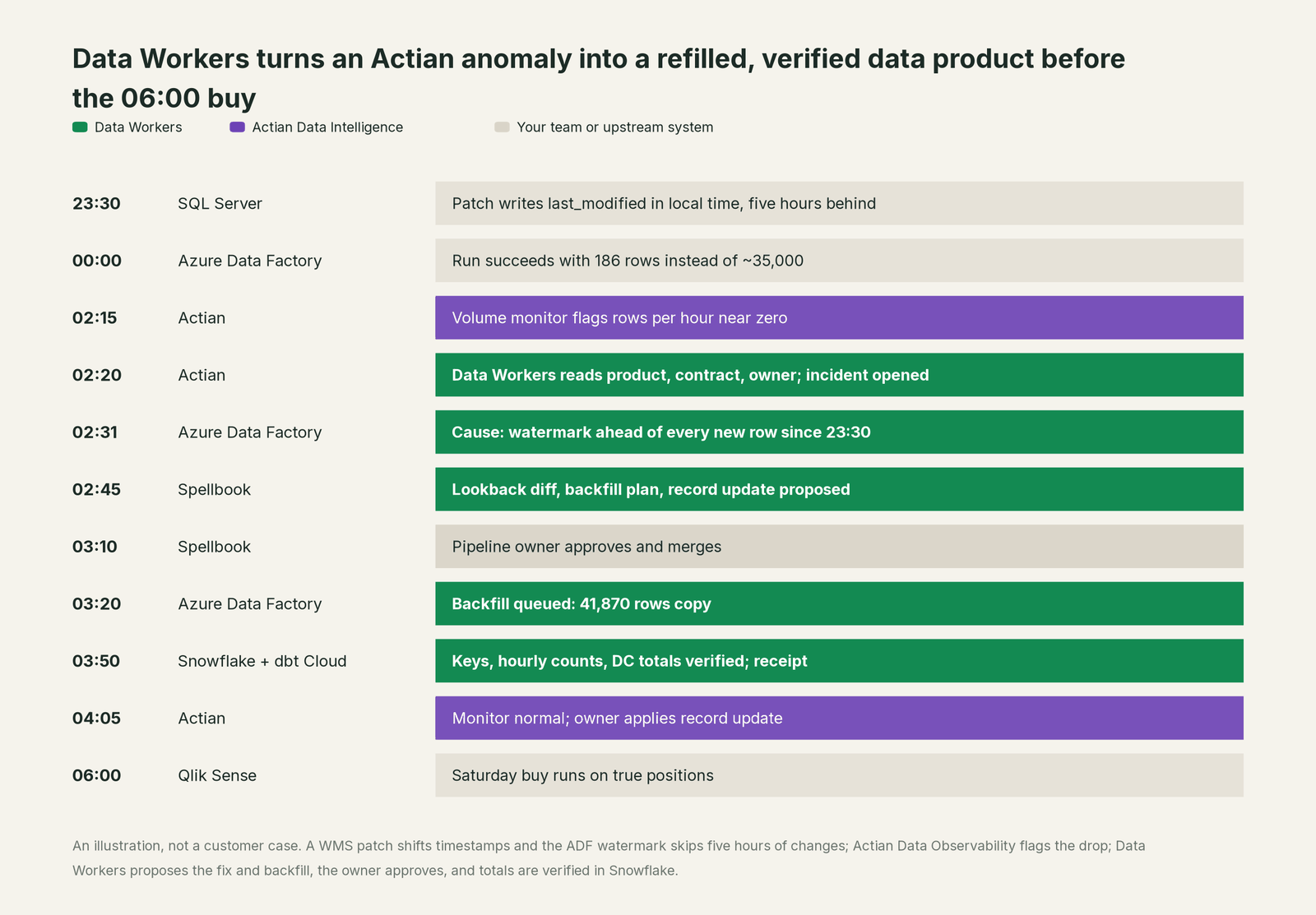
Every system did its job, and Actian Data Observability caught what green runs hid. The gap sat between them: nobody owned turning a volume anomaly into a corrected watermark, a refilled window and a product its subscribers could trust at 06:00. Without the fix, buyers would have under-ordered for nine distribution centers on stock that had already shipped.
| Job | What Actian Data Intelligence does | What Data Workers does |
|---|---|---|
| The product | Packages the data product, generates its contract and publishes it to the marketplace | Treats the product, its contract and subscribers as the reach of any change underneath |
| The meaning | Holds glossary terms, owners and relationships in a federated knowledge graph | Brings them in as sourced context and joins them to pipeline runs, model builds and quality checks |
| The signal | Actian Data Observability flags the volume anomaly on the raw table | Picks it up with the product's owner attached and opens an incident |
| The cause | Shows lineage from the table to the product, with guided root-cause help | Ties the anomaly to the WMS timestamp change and the ADF watermark across systems Actian describes |
| The fix | Records the product and its contract | Proposes the pipeline diff and the backfill, routes them to the named owner, queues the reruns after approval |
| The proof | Shows the monitor back in its normal band | Verifies row counts, keys and totals in Snowflake and keeps a receipt with cause, diff, approver and undo step |
Why doesn't Actian Data Intelligence just do this itself?
Because Actian built it to be the trusted record of what your data is and what it promises. Every tool the Actian MCP Server documents is a lookup: glossary definitions, the assets that implement a term, a dataset's data model, semantic glossary search, the catalog's item types and properties, and item search. The Data Steward Agent curates metadata inside the catalog. The GraphQL Catalog API, still documented under the Zeenea name, creates and updates catalog items, contacts and quality statements. Actian Data Observability detects, alerts and diagnoses, and its incident diagnosis agent shows what broke and what to fix; changing the pipeline stays with your team. That restraint is why a CDO can let every AI assistant read the catalog.
Keeping a data product true is a different job: changing an ADF pipeline Actian describes but doesn't own, getting the owner to approve at 03:00, refilling a window without double-counting and proving the totals in Snowflake. That needs write access across systems, blast radius, approvals per domain and receipts for changes in tools a catalog only records. Actian, part of HCLSoftware, has chosen a clear focus: catalog, governance, marketplace and observability. The operations work is a different product with a different liability. That product is Data Workers.
Every tool owns a slice. Data Workers covers the whole lifecycle
Actian Data Intelligence owns one slice outright: the catalog and marketplace for your data products. Each point tool adds another console, contract and handoff. Data Workers covers the whole lifecycle with one context, one approval flow and one audit trail, and builds on the catalog you already run.
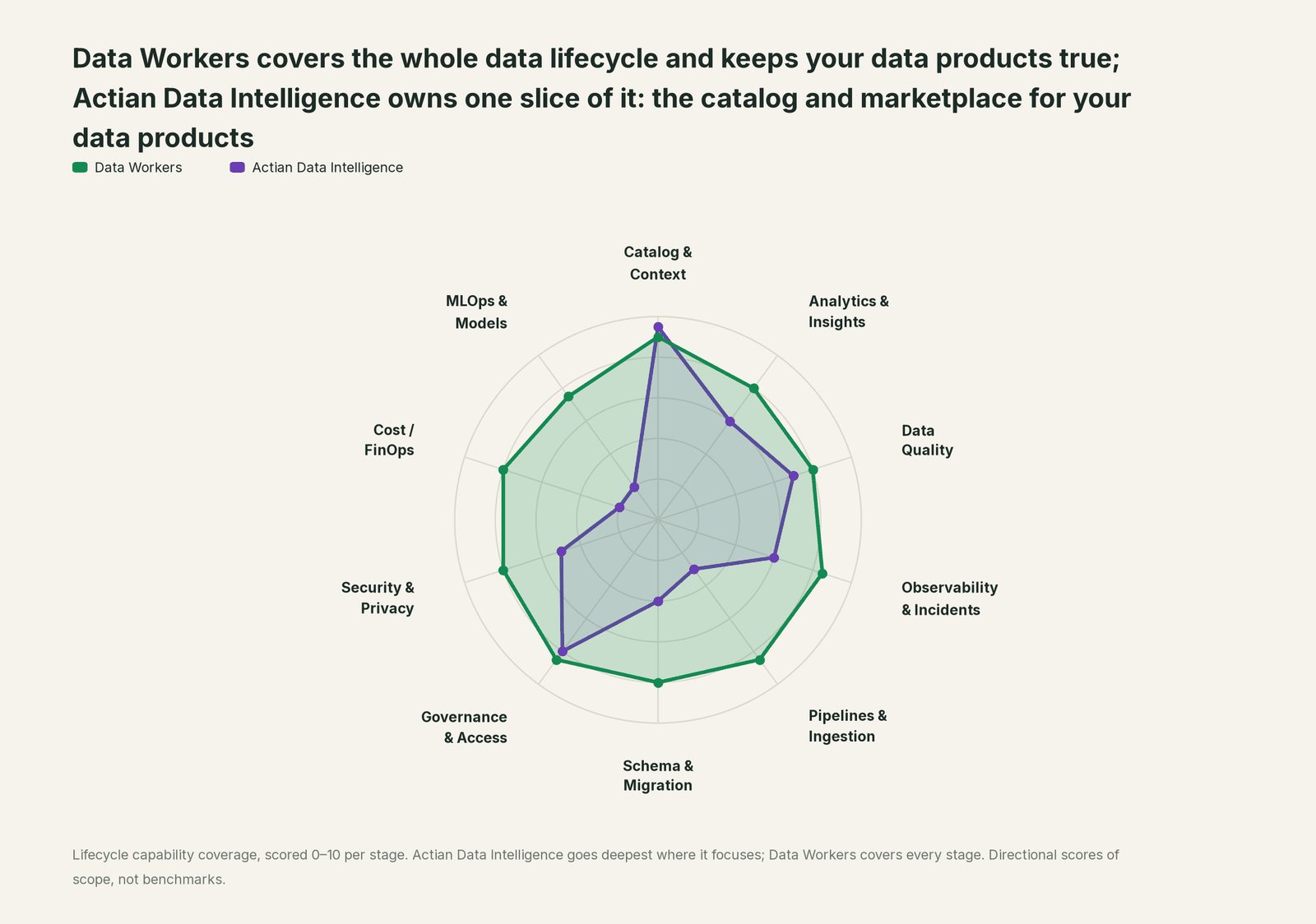
| Stage | Data Workers | Actian Data Intelligence | Why we scored it this way |
|---|---|---|---|
| Catalog & Context | 9 | 9.5 | Actian's home stage: a federated knowledge graph of assets, glossary, owners and lineage, data products with generated contracts in a marketplace, and an MCP server for AI. Data Workers reads it as a first-class source. |
| Analytics & Insights | 8 | 6 | AI Analyst, new, offers self-service agentic analytics, and the marketplace helps people find trusted products. Data Workers answers across platforms from approved definitions and acts on the answer. |
| Data Quality | 8 | 7 | Data Health Monitoring tracks quality on products, and observability agents suggest rules. Data Workers runs quality checks, traces failures to their cause and re-checks after the fix. |
| Observability & Incidents | 8.5 | 6 | Actian Data Observability flags freshness, volume, distribution and schema anomalies and guides root-cause analysis. Data Workers traces the cause across systems, proposes the fix behind approval and verifies it. |
| Pipelines & Ingestion | 8.5 | 3 | Actian catalogs and monitors the tables pipelines feed; running pipelines is outside its job. Data Workers proposes pipeline changes and queues reruns and backfills through your orchestrator after approval. |
| Schema & Migration | 8 | 4 | Data Health Monitoring watches schema stability, and contracts state the expected schema. Data Workers detects schema changes, proposes the compatible fix and generates migrations with rollback SQL for the owner. |
| Governance & Access | 8.5 | 8 | Federated governance, contracts, and self-service access requests automated under policy. Data Workers dry-runs a proposed warehouse grant for effective privileges and sensitive columns and applies approved Unity Catalog grants. |
| Security & Privacy | 8 | 5 | Personal data is identified, classified and managed for compliance in the catalog. Data Workers flags new sensitive column names in pull request review and proposes the warehouse masking for the owner to apply. |
| Cost / FinOps | 8 | 2 | Spend is outside the catalog's scope. Data Workers attributes Snowflake credits to the dbt model behind each query and drafts the fix for its owner. |
| MLOps & Models | 7.5 | 2 | Models are outside the catalog's scope. Data Workers keeps the data under the models healthy. |
How Actian Data Intelligence and Data Workers work together
People keep working where they work: Claude, Cursor or Copilot Studio for questions and code, Qlik Sense and Power BI for dashboards, Actian for search, the glossary and the marketplace. Spellbook is where the data team reviews proposed changes: the asset, blast radius, approver and undo path. Approval requests reach the named approver in Slack or email, who decides in Spellbook. Data Context Wizard keeps one governed context graph, the Data-Agents Swarm does the work with 20+ specialist agents, and the Autonomous Data-Conductor runs each fix end to end: detect, diagnose, fix, review, verify, remember.
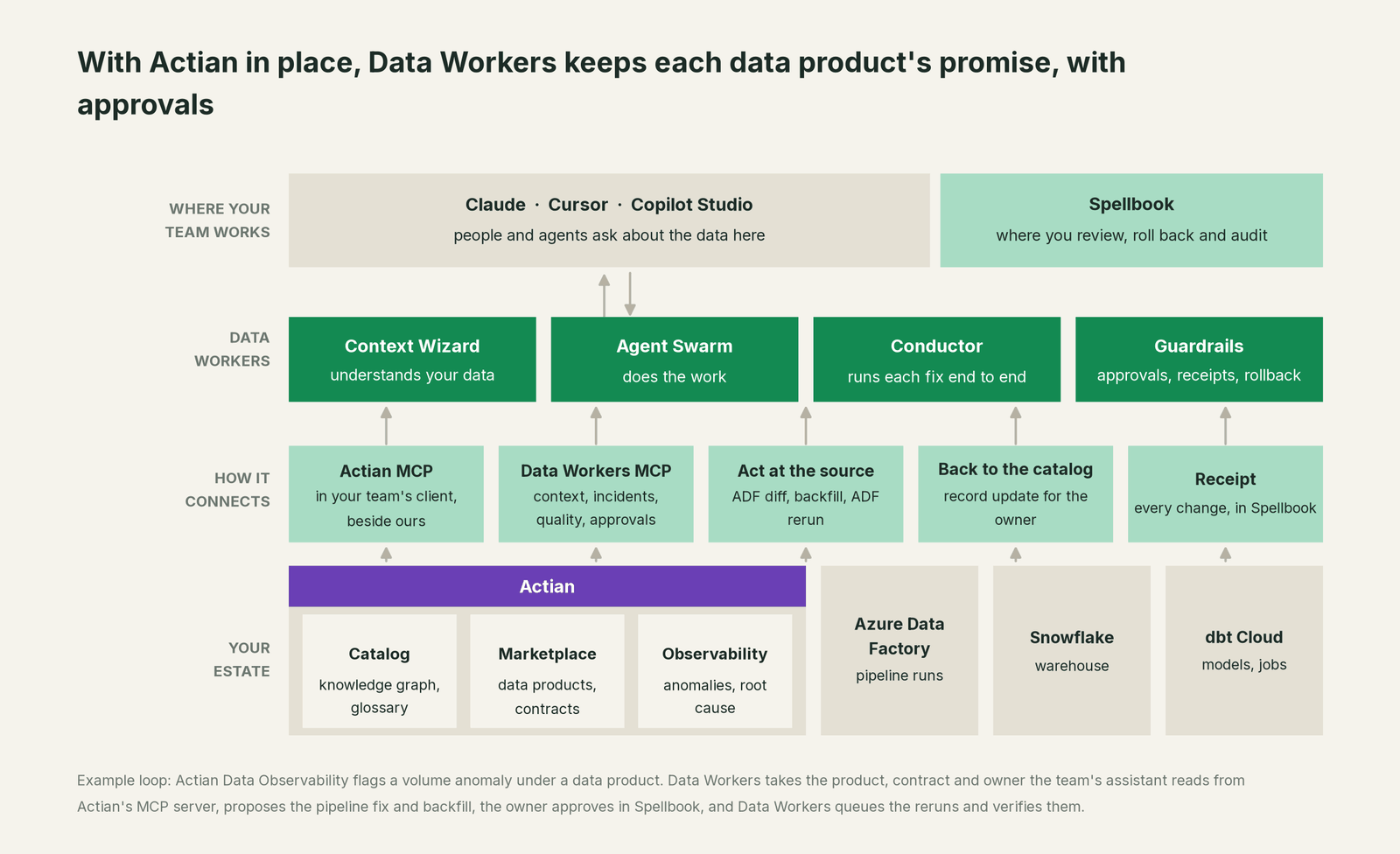
What comes in from Actian. Actian Data Intelligence connects over its MCP server or GraphQL Catalog API today, and Actian Data Observability over its API. Your team's assistant reads glossary definitions, data products, owners and lineage over Actian's MCP server, side by side with Data Workers, and hands what matters to Context Wizard as proposals, each with its source and the time it was seen. Context Wizard joins that to what the catalog points to but doesn't hold: ADF pipeline and activity runs, dbt manifests, and Snowflake query history. Data Workers reads Snowflake, dbt and Azure Data Factory with native connectors, and connects to SQL Server and Qlik Sense over their APIs today. Your agent can call explain_table for definition, lineage and trust score, trace_cross_platform_lineage, blast_radius_analysis for what a change touches, get_quality_score and get_incident_history.
Setup over MCP today. Actian runs a remote MCP server per tenant with API key authentication: create an API key in Actian Administration, scoped to your pilot, and add the entry from Actian's Claude Desktop setup page with your own tenant ID. For Data Workers, clone the open-source repository and add start-agent.sh entries, as the client setup docs show. The two sit side by side in one client config.
// Example: claude_desktop_config.json
{
  "mcpServers": {
    "actian": {
      "command": "npx",
      "args": ["mcp-remote", "https://<tenant id>.zeenea.app/api/mcp-server/mcp",
               "--header", "X-API-SECRET:${API_SECRET}"],
      "env": { "API_SECRET": "<your Actian API key>" }
    },
    "dw-context-catalog": {
      "command": "/path/to/dataworkers-claw-community/start-agent.sh",
      "args": ["dw-context-catalog"]
    },
    "dw-incidents": {
      "command": "/path/to/dataworkers-claw-community/start-agent.sh",
      "args": ["dw-incidents"]
    },
    "dw-quality": {
      "command": "/path/to/dataworkers-claw-community/start-agent.sh",
      "args": ["dw-quality"]
    }
  }
}
The tenant URL pattern and header are from Actian's setup page (Sep 23, 2026); replace <tenant id> with yours. List the tools with your client's own tools menu. Then "is Inventory Positions safe to use this morning?" gets the product's meaning from Actian's glossary, lineage and trust from explain_table, the score from get_quality_score and any open incident from get_incident_history, in one answer.
Where writes go. Data Workers proposes the ADF pipeline change as a diff for the owner to merge, and queues reruns and backfills through Azure Data Factory after approval; the owner reruns the dbt Cloud job. A backfill's undo step is written into the plan before it runs, and the owner runs it if it is ever needed. BI stays read by design. The change to a data product's record goes to its Actian owner to apply, and approved facts land in the Context Wizard graph. Actian stays the system of record for its marketplace.
One request, L0 to L4. The autonomy ladder is set per domain.
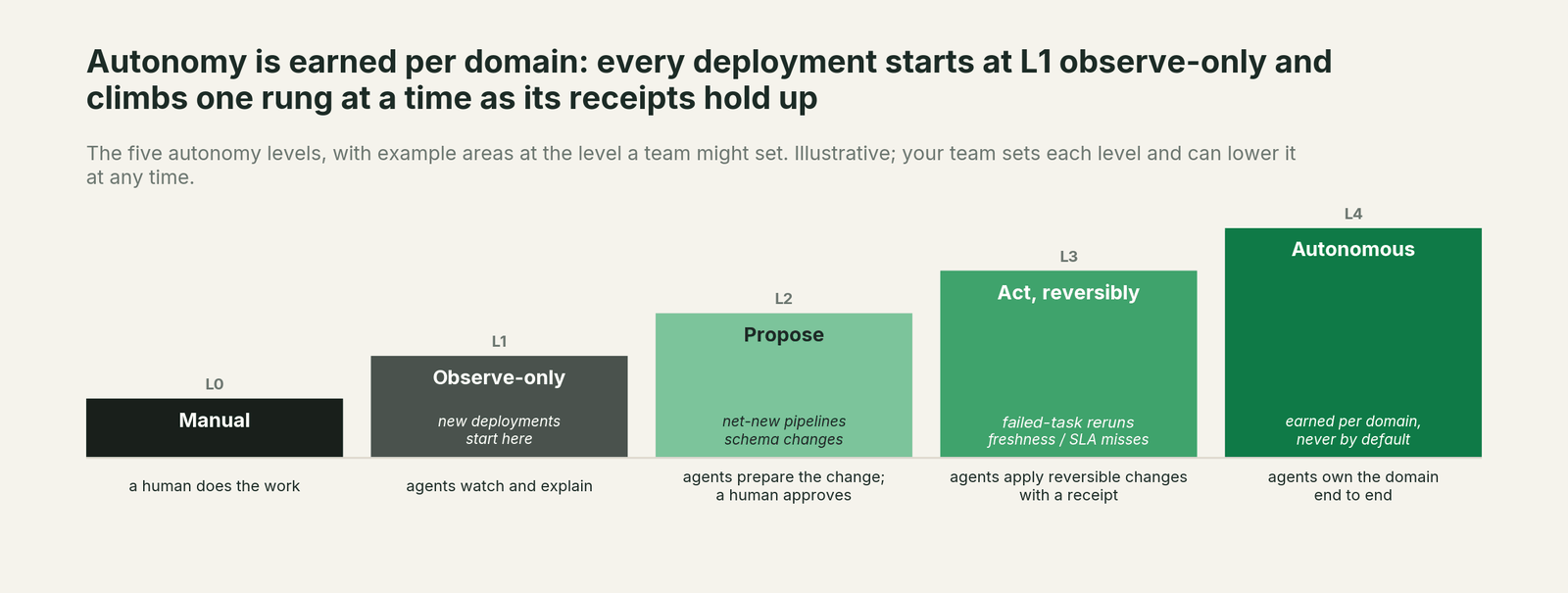
- •L0 manual. Connected, not acting. Your engineer works the anomaly by hand.
- •L1 observe. Each anomaly arrives with cause, owner and blast radius; nothing changes, and Data Workers logs what each action would have needed.
- •L2 propose. Data Workers drafts the pipeline diff, backfill plan and record update; a named owner approves in Spellbook before anything runs.
- •L3 act reversibly. For proven classes, such as a backfill rerun after an approved fix, Data Workers acts and verifies, with the undo step written in for the owner.
- •L4 autonomous. For a scoped, trusted class in one domain, Data Workers fixes, verifies and posts the receipt for review.
An unanswered approval request expires and escalates; it never auto-grants. No agent can promote its own work, and an org-wide stop halts all autonomous dispatch. See is it safe to let AI agents change production data and how approvals work for AI data agents. The agents run in your infrastructure and hold your warehouse credentials and model key; your data stays in your systems, and the hosted Conductor sees workflow metadata only (where does our data go).
For the warehouse side, read Data Workers on Snowflake and Data Workers + dbt. The same pattern runs across the catalog section: see the guides for teams on Informatica, Collibra and Coalesce Catalog, and the wider field in the data catalog comparison.
What changes for your team
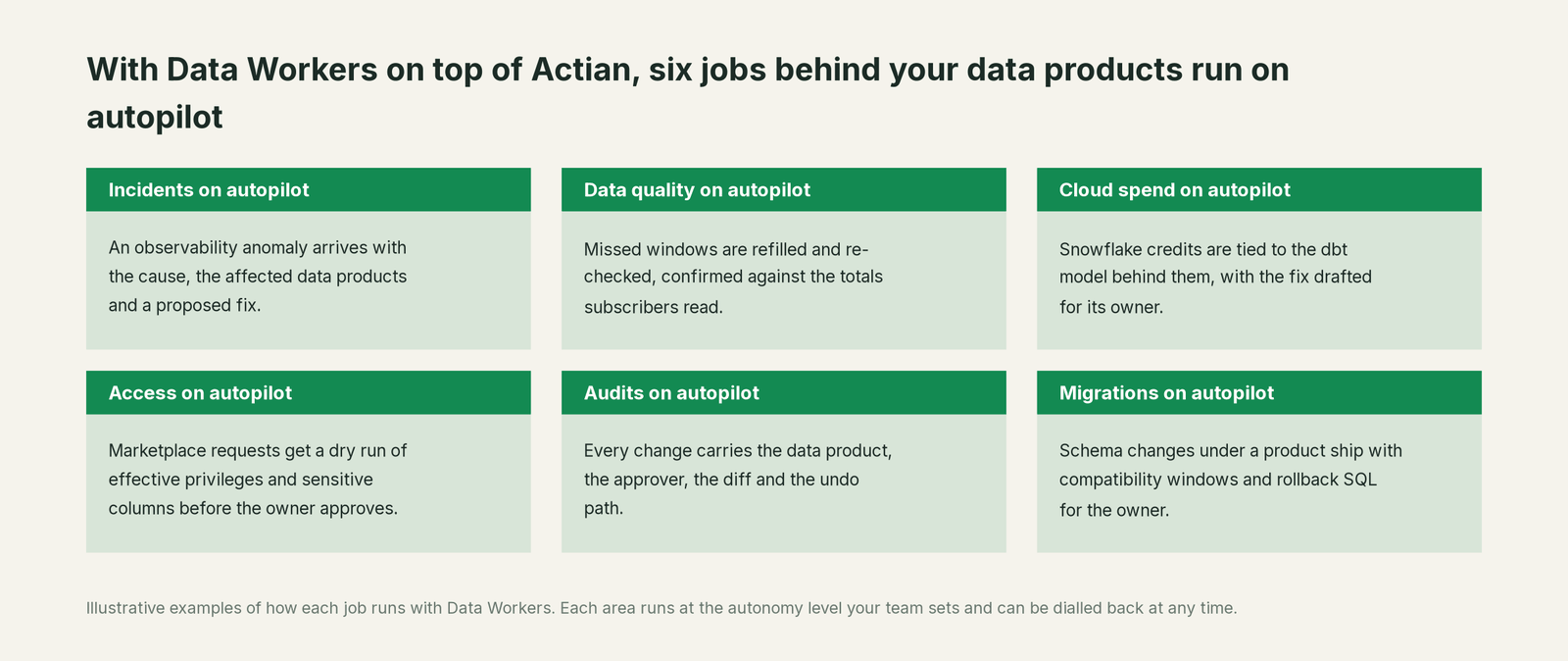
Teams on Actian spend much of the week acting on what the catalog shows. With Data Workers on top, those jobs run on autopilot at the level you set.
- •Incidents. An observability anomaly arrives with the cause, the affected data products and a proposed fix.
- •Data quality. Missed windows are refilled and re-checked, confirmed against the totals subscribers read.
- •Cloud spend. Snowflake credits are tied to the dbt model behind them, with the fix drafted for its owner.
- •Access. Marketplace requests get a dry run of effective privileges and sensitive columns, and the grant is proposed for the owner.
- •Audits. Every change carries the data product, the approver, the diff and the undo path.
- •Migrations. Schema changes under a product ship with compatibility windows and rollback SQL for the owner.
Keep Actian Data Intelligence, or consolidate?
Keep Actian Data Intelligence if you love it; Data Workers works with it from day one. Many teams consolidate once Data Workers runs that slice too.
For most Actian teams the answer today is to keep it. Your glossary took real stewardship to build, analysts shop the marketplace, and your AI tools already read it over MCP. What teams consolidate is the tooling around it: the backfill runbook, the row-count script, the spreadsheet of who owns which pipeline. If you run Actian next to Unity Catalog or Horizon, Data Workers works across both, so one control plane sees every change. Thinking of building this layer yourself on Actian's MCP server? Read build it ourselves with Claude Code and MCP servers: reading the glossary is the easy part; cross-system context, approvals and rollback are the work.
The case for your CFO
The outcome: the data products your team already publishes keep the promises in their contracts, so decisions that run on them run on true numbers. In the example, that is a Saturday buy on real stock positions instead of nine distribution centers short on fast-moving lines.
The risk story is plain. Data Workers reads Actian with access scoped to the pilot. Every change it proposes shows its blast radius, goes to a named owner, lands through your existing Git review and orchestrator, is verified and leaves a receipt: the trigger, the diff, the checks with before and after values, the approver and the undo path. Autonomy is set per domain and can be dialled back any time. There is zero migration: Actian, SQL Server, ADF, Snowflake, dbt Cloud and Qlik Sense stay where they are.
Why now: you have invested in data products and contracts, and AI agents now read them over Actian's MCP server. A contract only earns trust if someone keeps it. The first win is one data product where every anomaly arrives explained, owned and fixed before its subscribers notice. For the numbers, see the ROI of agentic data operations. Start with a pilot (pricing); the pilot is credited in full against the first year.
The sentence to repeat upstairs: "Actian publishes our data products and their promises; Data Workers keeps them, with the owner approving each fix."
Getting started
Start with a pilot. Pick one data product in Actian's marketplace with real subscribers and an observability monitor on its tables, connect Actian with a scoped API key next to Data Workers, and let Data Workers explain every anomaly on that product before you turn on the first fix class. Plans are on the pricing page, and the pilot is credited in full against the first year.
FAQ
Does Data Workers write to Actian Data Intelligence? Changes to a data product's record are proposed for its Actian owner to apply, and approved facts land in the Context Wizard graph. Actian connects over its MCP server, whose documented tools are all lookups, and its GraphQL Catalog API: your team's assistant uses them side by side with Data Workers.
Is this the same product as Zeenea? Yes. Actian announced the Actian Data Intelligence Platform in March 2025 as formerly the Zeenea Data Discovery Platform, and its catalog API and tenant URLs still carry the Zeenea name. Actian is the data division of HCLSoftware.
We already run Actian Data Observability. Why add Data Workers? Keep it; in the example it caught what the green runs hid. Data Workers acts on the alarm: it ties the anomaly to its cause in the systems that build the product, proposes the fix, queues the backfill after approval and proves the totals.
How does Data Workers use our data contracts? It reads each product's contract (Actian follows the Open Data Contract Standard: schema, quality rules, SLAs, ownership) with the product, so a break underneath shows the promises at risk. The receipt records the checks against those promises: row counts, keys, delivery and the totals consumers read.
Can Data Workers handle marketplace access requests? Actian routes the request under its governance rules. Data Workers dry-runs the proposed Snowflake grant (effective privileges after role inheritance, sensitive columns reached, policy conflicts, a least-privilege recommendation with an expiry) and proposes it for the owner to apply.
What does Data Workers store? Metadata and scrubbed facts about your data, such as definitions, lineage, owners, incident history and receipts, in your infrastructure. Not copies of your tables.
Sources
- •Actian, Actian Data Intelligence Platform (active metadata and governance; federated knowledge graph; data products, generated data contracts and marketplace; Data Steward Agent; MCP Server and AI Analyst labelled new; A2A; connectors; deployment), https://www.actian.com/data-intelligence-platform/ (checked Oct 3, 2026)
- •Actian, MCP Server (labelled New; four glossary and data-model tools; Claude, Cursor, Windsurf, Microsoft Copilot Studio and ChatGPT; two-step setup), https://www.actian.com/mcp-server/ (checked Oct 3, 2026)
- •Actian docs, Actian MCP Server overview (seven lookup tools incl. metamodel and item search; remote per-tenant server, API key authentication; Sep 23, 2026), https://docs.actian.com/data-intelligence-platform/features-applications/actian-mcp-server/amcp-overview.html (checked Oct 3, 2026)
- •Actian docs, Remote Authentication Setup and Set up Claude Desktop (API key in Administration;
https://<tenant id>.zeenea.app/api/mcp-server/mcpwith X-API-SECRET header; Sep 23, 2026), https://docs.actian.com/data-intelligence-platform/features-applications/actian-mcp-server/amcp-claude.html (checked Oct 3, 2026) - •Actian, Actian Data Observability (labelled New; freshness, volume, distribution and schema; validation, incident diagnosis, lineage and other agents; detect, alert, remediate; 250+ connectors), https://www.actian.com/data-observability/ (checked Oct 3, 2026)
- •Actian, Data governance (identifies, classifies and manages personal data assets), https://www.actian.com/data-intelligence/data-governance/ (checked Oct 3, 2026)
- •Actian, Data contracts guide (Open Data Contract Standard; schema, quality rules, SLAs, ownership), https://www.actian.com/data-intelligence-platform/data-contracts/ (checked Oct 3, 2026)
- •Actian press release, "Actian Advances Data Intelligence Platform" (Mar 2025, dated Mar 4 on AAP; formerly the Zeenea Data Discovery Platform; data division of HCLSoftware; enterprise data marketplace; self-service data access), https://aap.com.au/aapreleases/cision20250303ae30925/ (checked Oct 3, 2026)
- •Zeenea GraphQL Catalog API documentation (items incl. data-product type, contacts, data quality statements, data process operations), https://docs.zeenea.com/ (checked Oct 3, 2026)
- •Data Workers, Client setup (open-source docs), https://dataworkers.io/opensource-docs/client-setup/ (checked Oct 3, 2026)
- •Data Workers open-source repository, https://github.com/DataWorkersProject/dataworkers-claw-community (checked Oct 3, 2026)