Data catalog comparison 2026: Collibra, Alation, DataHub and OpenMetadata vs Spellbook Data Catalog
Collibra, Alation, DataHub and OpenMetadata are the inventory: what exists and what it means. Spellbook is the control plane that makes your systems match it. Keep yours or consolidate.
Collibra, Alation, DataHub and OpenMetadata are the inventory of your data estate: what exists, what it means, who owns it and where it flows. Data Workers is the control plane: it makes the systems the catalog describes match what the catalog says, behind your approval, with a receipt on every change. This page compares the four side by side, then shows what happens after the catalog records a change.
The typical estate: Snowflake, Databricks or BigQuery holds the data, dbt builds the models, Airflow schedules the runs, Looker, Tableau or Power BI sits on top, and a catalog crawls all of it. In Collibra that's assets, domains, business terms and data stewards. In Alation it's the catalog, curation agents and data products. In DataHub it's entities, glossary terms, domains and assertions. In OpenMetadata it's entities, glossary terms, test cases and the Context Center. This year an AI assistant joined the estate, answering questions from the catalog over MCP.
Every one of these catalogs now ships AI agents and an MCP server, and every one of those servers can write. Collibra's creates and edits assets. DataHub's adds tags, terms and descriptions. OpenMetadata's patches entities. The writes land in the catalog. When finance changes what "Active Customer" means, the catalog records the new meaning in the glossary. The dbt model, the Snowflake semantic view and the Looker measure still compute the old one, and someone has to go change them.
Data Workers is the agentic data platform built for that work. Spellbook Data Catalog (in preview) is the agentic catalog and control plane: one inbox where every agent change on every system is proposed, approved, rolled back and audited. Your catalog keeps the meaning. Data Workers brings the systems into line with it, behind approval, and proposes the record back to the catalog's steward. Keep the catalog you have, or consolidate later once Spellbook carries the catalog too.
Key takeaways
- •Inventory vs control plane. Collibra, Alation, DataHub and OpenMetadata record what exists and what it means. Data Workers brings dbt, the warehouse, BI and grants into line, with approvals, rollback and receipts.
- •Each catalog has a different home. Collibra: governance for large regulated enterprises, now extended to AI agents. Alation: analyst adoption and governed AI. DataHub: an open-source context graph with a strong engineering community. OpenMetadata: an open-source catalog with quality tests and an MCP server built in, and Collate as its managed AI edition.
- •All four write their own metadata. Their MCP servers and agents create assets, tags, terms, descriptions and tests inside the catalog. The change in the systems the catalog describes stays with your engineers.
- •Keep yours, or consolidate. Data Context Wizard connects to Collibra, Alation, DataHub and OpenMetadata over their MCP servers and APIs today.
- •One platform for the rest of the lifecycle. Quality fixes, incidents, access, cost, schema changes and migrations, with one context, one approval flow and one audit trail.
If you run Atlan, read Atlan vs Spellbook, the one-catalog deep dive on the same idea. For the platform-native catalogs, see Unity Catalog vs Spellbook and Knowledge Catalog vs Spellbook. For single-tool views, see our earlier pages on Data Workers vs Collibra, Data Workers vs Alation, Data Workers vs DataHub and Data Workers vs OpenMetadata.
The four catalogs at a glance
| Collibra | Alation | DataHub | OpenMetadata | |
|---|---|---|---|---|
| What it calls itself | The enterprise AI control plane governing context | The Alation Intelligence Operating System (AIOS) | The Context Platform for AI Agents | The open context layer for AI (OpenMetadata 2.0); Collate is "The AI for Data Platform" |
| Home ground | Governance, business glossary and stewardship in regulated enterprises | Analyst adoption, curation, governed AI and BI | Open-source metadata graph, lineage and assertions | Open-source catalog with data quality tests and Context Center |
| AI agents | Maestro (public preview, Sep 2026); guardian agents with agent contracts (October 2026) | Curation, lineage and chat agents; Agent Studio; AI Governance | Ask DataHub (public beta) in the UI, Slack and Teams | Collate AI: Documentation, Tiering, Quality and SQL agents, AskCollate, AI Studio |
| MCP server | Collibra MCP Server, which Collibra calls production-ready; open-source server with 40+ read and write tools | Remote MCP server at your instance; open-source SDK | Hosted on DataHub Cloud, open source for Core; mutation tools behind a flag | Built into OpenMetadata 2.0, enabled by default |
| License and pricing | Commercial, by quote | Commercial, by quote | Core Apache 2.0; DataHub Cloud by quote | OpenMetadata Apache 2.0; Collate Free, Premium and Enterprise tiers |
| Where it stops | Writes Collibra assets, classifications, contracts and quality jobs | Context, SQL drafts and data products; alerts go to the owner with a plan | Writes DataHub tags, terms, owners, domains and docs | Writes entities, lineage and test cases in OpenMetadata |
| Role | The registry of record | The reading room | The open map | The open map with the inspector's checklist |
Every row ends inside the catalog. That's the right design for an inventory, and it's where Data Workers picks up.
Collibra: governance of record, now extended to AI
What it is. Collibra calls itself "the enterprise AI control plane governing context and ensuring control across every source, model and agent." Its catalog, business glossary, Data Governance, Data Quality & Observability, Data Products and lineage serve the governance office of large, regulated enterprises. Assets live in domains and communities, every business term has a data steward, and workflows route changes to the right owner.
Where it's strong. Governance depth, and now AI governance. AI Command Center keeps a registry of every AI use case, model and agent, with EU AI Act, NIST AI RMF and AIUC-1 assessment templates. On September 23, 2026 Collibra announced Maestro, no-code agents for governance teams (Maestro Studio and Maestro Assistant in public preview), Live Map, a context graph over documents, for design partners, and guardian agents with agent contracts, announced for October 2026 through AI Command Center. Guardian agents "continuously supervise how agents behave and intervene when they cross defined boundaries." Collibra's MCP Server, which Collibra calls production-ready, is broad: its open-source implementation lists more than 40 tools covering business terms traced to physical columns, lineage, classifications, assessments, data contracts and data quality jobs. The data quality tools are off until you opt in, and they preview each change by default, applying it only when called again with confirm=true. And "every action uses Collibra's existing permission model."
Where it stops. Every write tool changes a Collibra object: an asset, an assessment, a classification match, a data contract manifest or a quality job. Guardian agents supervise what other agents do and stop risky actions. Neither one changes the dbt model, the Snowflake view or the Looker measure that computes a business term. When a steward approves a new definition, Collibra records it well. Making the systems agree is a separate job.
The role swap. Collibra is the registry of record: the place the enterprise writes down what its data means and who answers for it. Data Workers is the crew that makes the systems say what the registry says.
Alation: the reading room, now an operating system for AI
What it is. Alation built its name on analyst adoption: a catalog people actually search, with query history, curation and stewardship. It now calls its platform the Alation Intelligence Operating System, which "ensures your data apps and agents are accurate." On September 17, 2026 it expanded AIOS with six products. AI Governance and Semantic Model Mastering enhancements are available now. Ontologies, Intelligent Feeds, Console and Governed Collections are in early access.
Where it's strong. Getting people and AI to the right data. Curation, lineage and chat agents "ship ready to run against your catalog," Agent Studio lets teams build their own, and the remote MCP server at your instance's /ai/mcp path exposes a catalog search agent, a SQL query agent and data products to any MCP client. AI Governance registers every AI model, agent and tool, and the September expansion added agent lineage tracing and native connectors for Bedrock, SageMaker, Databricks MLflow, Copilot Studio, Foundry and Snowflake Cortex. Semantic Model Mastering ingests semantic models from Databricks and Snowflake and syncs definitions back. More than 120 connectors feed it all.
Where it stops. Alation's MCP surface is context, search, SQL drafting and data products. Its January 2, 2026 SDK update moved metadata updates out of the agent toolkit: update_catalog_asset_metadata is no longer an SDK tool, and the same operation is available through Alation's REST API. Its pipelines and observability page describes alerts that reach the table owner "carrying its classification, its downstream consumers, and remediation plan." That's a well-briefed owner. The dbt change, the rerun and the check that the fix held are still the owner's work.
The role swap. Alation is the reading room: the place people and agents go to find the right data and trust it. Data Workers is the crew that keeps the shelves accurate when the data underneath changes.
DataHub: the open map, built for engineers
What it is. DataHub started as an open-source metadata platform and now calls itself "The Context Platform for AI Agents." DataHub Core is Apache 2.0. DataHub Cloud, from Acryl Data, the company behind DataHub, adds hosting, observability and AI features. Core v1.7.0 (August 4, 2026) made metrics and semantic models first-class entities.
Where it's strong. An open, extensible graph that platform engineers can run and shape, with a large community behind it. Ask DataHub, in public beta on Core and Cloud, answers questions in the DataHub UI, in Slack by mentioning @DataHub and in Microsoft Teams: it finds trusted data, traces impact through lineage, checks assertion results and freshness, and drafts SQL. DataHub's MCP server is hosted on DataHub Cloud and open source for Core. Its read tools search, fetch entities, walk lineage and pull the real SQL queries behind a dataset. Its mutation tools add and remove tags, glossary terms, owners and domains, update descriptions and save documents, and each one "is annotated with readOnlyHint: false so MCP clients can require confirmation before invoking them." Mutation is off until you set TOOLS_IS_MUTATION_ENABLED=true, a sensible default.
Where it stops. Every mutation tool changes DataHub metadata. Ask DataHub informs and drafts SQL. Assertions on DataHub Cloud detect freshness and volume problems. The fix in dbt or the warehouse, and the proof it held, belong to your team.
The role swap. DataHub is the open map: every road, every junction, kept current by the people who build the roads. Data Workers is the crew that repaves the road when the map shows it's broken.
OpenMetadata and Collate: the open map with a checklist
What it is. OpenMetadata is an Apache 2.0 catalog with a unified knowledge graph, data quality tests, a business glossary and, since 2.0.0 (August 24, 2026), a Context Center that replaces the Knowledge Center. Collate is the managed edition with Collate AI on top. Release 2.0.3 landed on September 30, 2026.
Where it's strong. Quality and catalog in one open-source product, and the fastest path to MCP in this group. The MCP server ships in OpenMetadata 2.0 and is "enabled by default," authorized by the same engine as OpenMetadata's APIs, with OAuth, personal access tokens or bot tokens for unattended agents. Its tools include semantic search, entity details, lineage and a root_cause_analysis tool that traces a data quality failure back to its origin, plus write tools: create_entity, patch_entity, create_lineage and create_test_case. OpenMetadata 2.0 also adds custom intake forms for governance workflows and OWL import for existing ontologies. On Collate, the Documentation Agent writes descriptions and the Tiering Agent ranks assets by importance; both "either update or suggest" changes, "keeping your teams the ability to accept or deny the agent's requests." The Quality Agent creates "technical and business quality tests automatically," and you choose whether new tests start active. AI Studio builds no-code agents, and AI Governance Studio brings AI agents and models under governance.
Where it stops. The root cause tool finds where a failure started, and the write tools change OpenMetadata entities and tests. Patching the dbt model that produced the failure, rerunning it and checking the dashboard downstream happen outside OpenMetadata.
The role swap. OpenMetadata is the open map with the inspector's checklist: it knows the roads and tests them. Data Workers is the crew that fixes what the inspection finds.
One definition change, six systems
Catalog incidents rarely start with a broken pipeline. They start with a change in meaning. Here's one any of the four catalogs would record correctly. It's an illustration, not a customer case.
- •Monday 10:00. Finance approves a new definition of the business term "Active Customer" in the catalog: a paid order in the last 90 days, excluding trial accounts. The old one counted any login in 90 days.
- •Monday 10:00 onward. The dbt model
dim_customerstill setsis_activefrom logins. The Snowflake semantic view the board KPIs use still counts it. The Looker measureactive_customersstill sums it. - •Monday afternoon. An executive asks Claude, connected to the catalog over MCP, how many active customers the company has. Claude reads the new definition from the glossary and quotes it, then runs SQL against the old model.
- •Tuesday 09:00. The board KPI pack goes out. The number on the slide doesn't match the definition in the footnote.
| Step | What your catalog does | What Data Workers does |
|---|---|---|
| Finance approves the new term | Records the definition, the steward and the approval, in Collibra, Alation, DataHub or OpenMetadata | Reads the change over the catalog's MCP server or API and starts a change, scoped to that term |
| Find what computes the term | Shows the term linked to columns, where someone linked it | Maps the term to dim_customer.is_active, the Snowflake semantic view and the Looker measure, using lineage, query history and the dbt manifest |
| Change the systems | Waits for an engineer | Drafts one proposal in Spellbook: a dbt diff, the semantic view change and a LookML diff, with the blast radius to three dashboards and the KPI pack |
| Approve | Steward workflow covers the term itself | The analytics engineer approves once; no agent approves its own work |
| Verify | The next crawl shows the updated model | Queues the dim_customer rebuild once the diff is merged, confirms the new count against its baseline, and the owner confirms it against finance's sample of accounts and that dbt tests pass, and saves a tamper-evident receipt |
| Write back | The asset page updates on the next sync | Drafts a note for the glossary term (which models implement it, when they changed, the receipt link) for the steward to apply; the approved facts land in the Context Wizard graph |
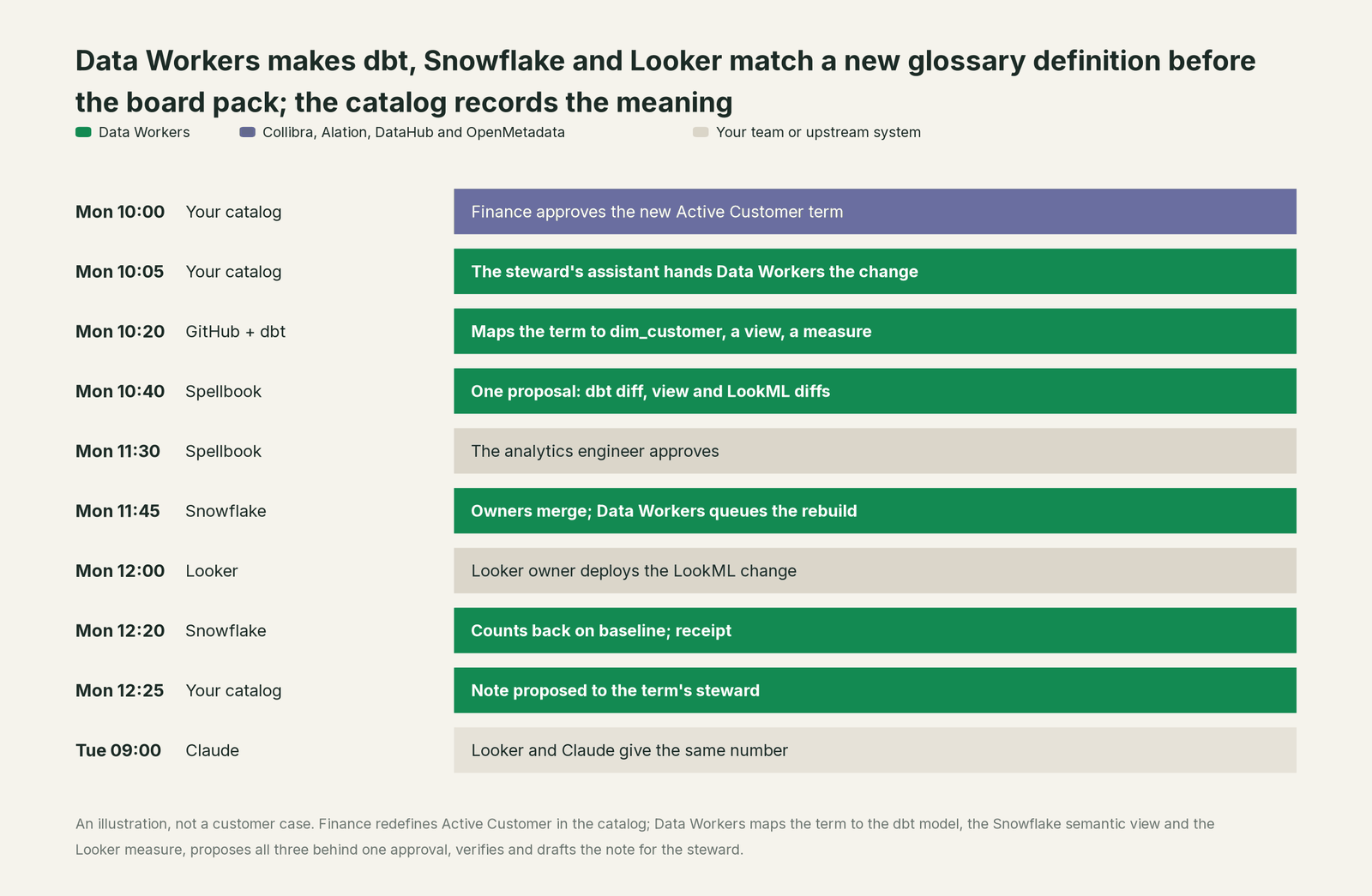
Every catalog handled its part well. The work that made the number right lived in GitHub, dbt, Snowflake and Looker. Data Workers works there and leaves the record in the catalog where people look.
Why doesn't Collibra, Alation, DataHub or OpenMetadata just do this itself?
Each built a great product for one job and made a sensible call about risk. A catalog earns its place by describing every system neutrally. It holds crawl access to almost everything you run, and it's easy to approve because it changes nothing outside itself. All four keep it that way. Collibra's write tools change Collibra assets, contracts and quality jobs, and its guardian agents supervise other agents rather than act. Alation keeps metadata updates in its REST API rather than its agent SDK, and sends owners a remediation plan. DataHub keeps mutation off by default and limits it to tags, terms, owners, domains and docs. OpenMetadata's write tools patch its own entities and add tests.
Changing production systems across the stack is a different product category. It needs blast-radius scoping before every change, approvals that vary by domain, rollback, a receipt an auditor can read, context about every other system in the estate, and accountability for changes inside tools the catalog vendor doesn't own: your dbt repo, your Airflow deployment, your warehouse grants, your BI models. Taking that on would change each vendor's security review, its buyer and its promise of neutrality. That's the product Data Workers is.
One platform across the data lifecycle
Cataloging is one job on a data team's list; the same team also handles quality, incidents, pipelines, schemas, access, privacy, spend and models. Each point tool adds another console, another contract and another handoff. Data Workers covers the whole lifecycle with one context, one approval flow and one audit trail.
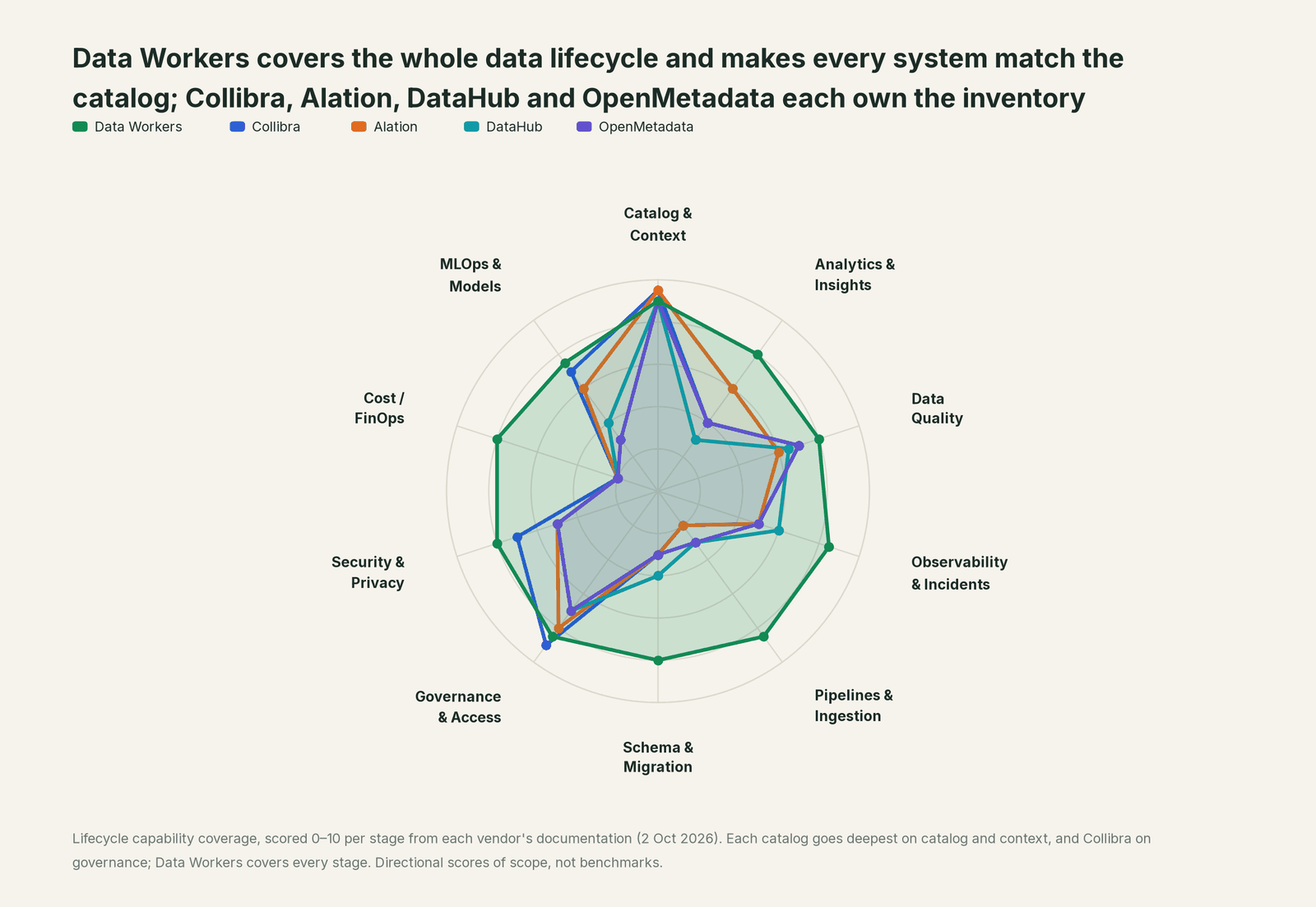
We score the same ten stages on every comparison page so you can compare across pages. Collibra and Alation lead Data Workers on Catalog & Context, DataHub and OpenMetadata tie it, and Collibra leads on Governance & Access. Data Workers covers all ten.
| Stage | Data Workers | Collibra | Alation | DataHub | OpenMetadata | Why we scored it this way |
|---|---|---|---|---|---|---|
| Catalog & Context | 9 | 9.5 | 9.5 | 9 | 9 | Home ground for all four: assets, glossary, domains and lineage, served to AI over MCP. Data Workers reads each as a first-class source and joins it to the dbt manifest, grants and quality checks. |
| Analytics & Insights | 8 | 4 | 6 | 3 | 4 | Alation's SQL query agent and Intelligent Feeds (early access) reach furthest; Ask DataHub and Collate's SQL Agent draft queries. Data Workers answers business questions over the same governed graph its agents use. |
| Data Quality | 8 | 7 | 6 | 6.5 | 7 | Collibra Data Quality jobs and OpenMetadata test cases are strong; Alation proposes checks; DataHub Cloud runs assertions. Data Workers drafts, runs and repairs checks and dbt tests. |
| Observability & Incidents | 8.5 | 5 | 5 | 6 | 5 | OpenMetadata traces a failure to its origin and alerts reach owners with lineage. Data Workers owns the loop after the alert: diagnose, fix, verify, record. |
| Pipelines & Ingestion | 8.5 | 2 | 2 | 3 | 3 | The four catalog pipelines; they don't change them. Data Workers proposes the pipeline change and queues the rerun behind approval. |
| Schema & Migration | 8 | 3 | 3 | 4 | 3 | Every catalog shows the impact of a schema change through lineage, and DataHub ingests schema metadata from every source. Data Workers detects and assesses schema changes, generates migrations with rollback SQL for the owner and plans platform moves. |
| Governance & Access | 8.5 | 9 | 8 | 7 | 7 | Collibra's home stage: stewardship, workflows, policies and AI governance. Data Workers dry-runs each grant, applies approved Unity Catalog grants and proposes the rest to their owners, with a receipt. |
| Security & Privacy | 8 | 7 | 5 | 5 | 5 | Collibra classifies data and manages access and protection; the others tag and classify. Data Workers flags new sensitive column names in pull request review and checks that masking follows the data. |
| Cost / FinOps | 8 | 2 | 2 | 2 | 2 | Catalogs show usage and popularity, not warehouse spend. Data Workers traces Snowflake credits to the dbt model behind them and drafts the fix for its owner. |
| MLOps & Models | 7.5 | 7 | 6 | 4 | 3 | Collibra and Alation register AI models and agents with lineage and compliance templates. Data Workers keeps the data under models healthy and connects to MLflow and W&B. |
These are directional scores of scope, not benchmarks, and the reasoning is shown so you can check every line.
Inventory vs control plane, outcome by outcome
This view narrows to eight outcomes a data leader buys from a catalog now that agents do more of the work.
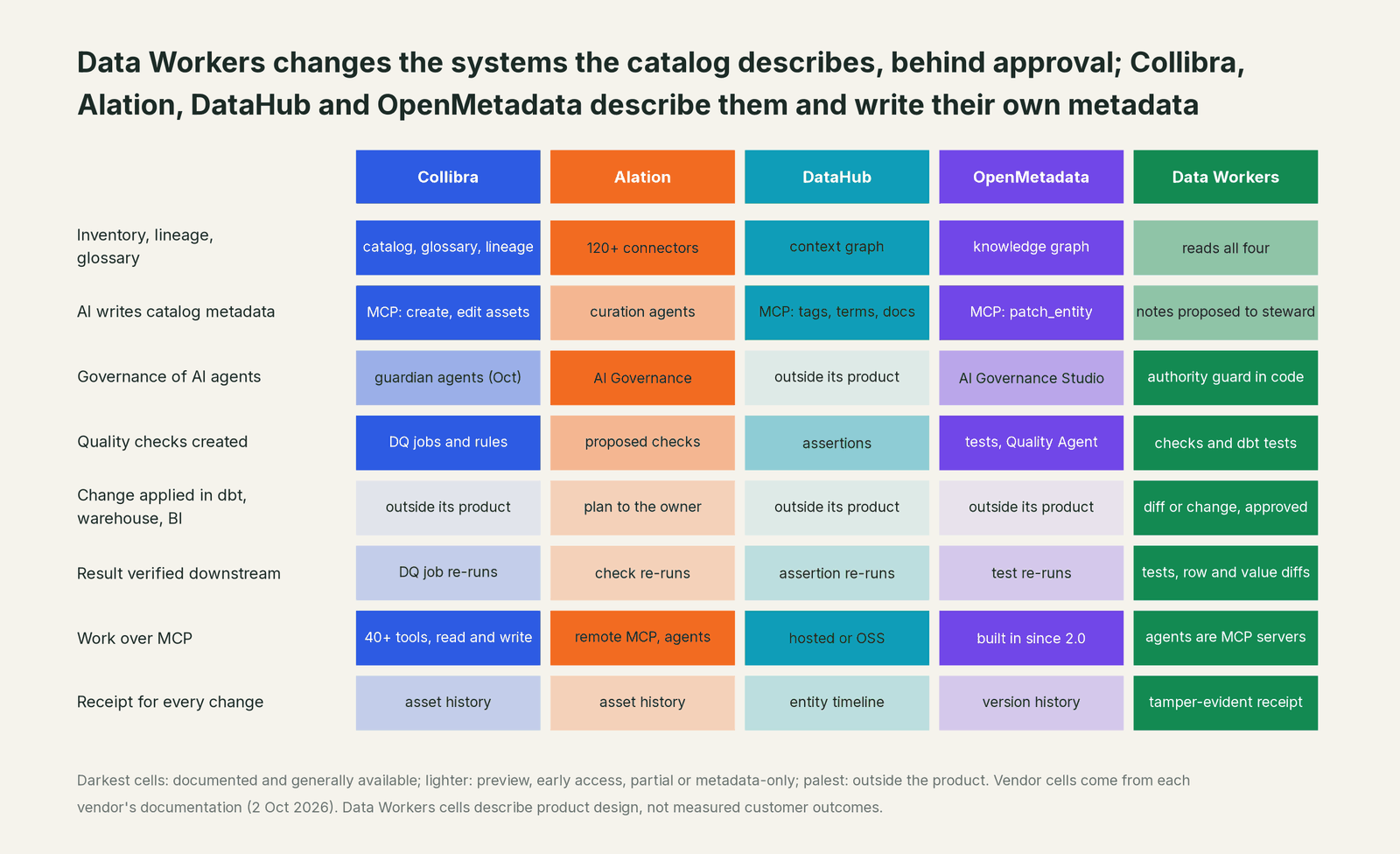
On "Work over MCP," all four catalogs have real, current servers, and Data Workers calls any of them as a source. On "Change applied in dbt, warehouse, BI," all four stop at the catalog's edge, by design. That row is the reason to add Data Workers.
Keep your catalog, or consolidate
Keep it and add Data Workers. For most teams this is the starting point. Your stewards know the catalog, your glossary lives there, and your AI tools already read it over MCP. Data Context Wizard connects to Collibra, Alation, DataHub, DataHub Cloud and OpenMetadata over their MCP servers and APIs today. A glossary change, a certification, a failed test or an access request starts the loop. Data Workers proposes the change in each system behind your approval, verifies the result and drafts the note for the asset's steward to apply. If you're building on one of them, our Build On guides go deeper: You're on Collibra, You're on Alation and You're on DataHub.
Good reasons to keep each one for the long run:
- •Collibra if your governance office, your regulators and your AI risk process already run on it, and you want guardian agents watching your AI fleet.
- •Alation if analyst adoption is the measure that matters, and your semantic models in Snowflake and Databricks are mastered there.
- •DataHub if your platform team wants an open-source graph it can extend, with Ask DataHub in Slack and Teams.
- •OpenMetadata if you want catalog and quality tests in one open-source product, with Collate when you'd rather not run it yourself.
Consolidate once Spellbook carries the catalog too. Some teams want one place for meaning and action. Spellbook's asset pages are written by the agents as they work: what an asset is, who owns it, what changed, who approved it and how to undo it. There's no migration day. Data Workers reads your catalog from the start, so nothing is lost while you decide, and it stores metadata and scrubbed facts about your data, not copies of your tables.
The case for your CFO
The outcome. Today your catalog tells everyone what the numbers mean, and engineers spend weeks making dbt, the warehouse and BI agree with it. Data Workers closes that gap for the domains you allow. Definitions, certifications and access decisions reach the systems behind one approval, and the number on the board slide matches the definition in its footnote.
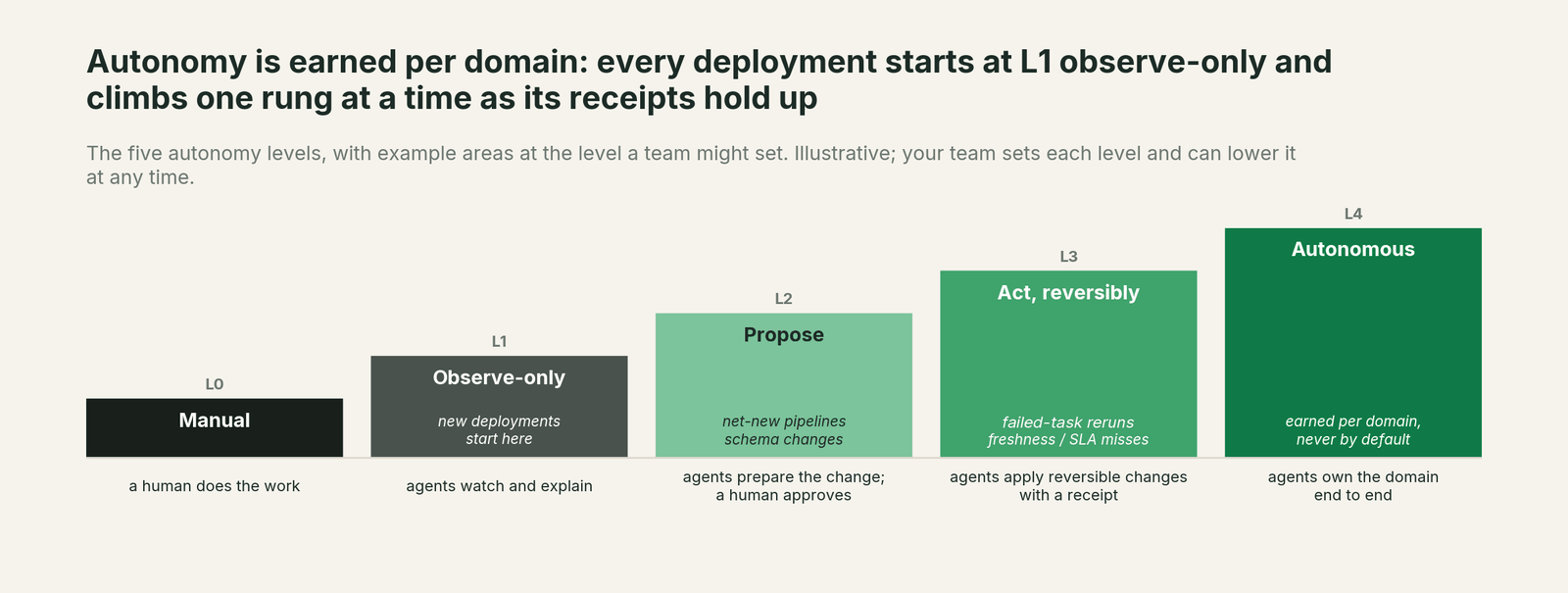
The risk story. Data Workers starts at L1, observe: it reads and reports. At L2, propose, every change is a draft a person approves. At L3, act reversibly, it runs only changes it can undo, and only in the domains you've moved up. L4, autonomous, is a per-domain choice, never a default. Every write is scoped before it runs, no agent approves its own work, and every receipt records who or what acted, why, what it touched and how to undo it. Zero migration: your catalog and your data stay where they are.
Why now. All four catalogs shipped MCP servers and agents in the last year, and AI assistants now answer executives straight from the glossary. When the glossary and the SQL disagree, the assistant says both. Agents will change your systems either way. The choice is between ungoverned sessions and one governed loop across the estate.
The first win. Glossary and certification changes in one domain, carried to dbt, the warehouse and BI in propose mode.
What stays the same. Your catalog, your stewards and their workflows; dbt, Airflow, your warehouse and your BI tool; and the coding agent your engineers already use.
The path. Start with a pilot. See pricing; the pilot is credited in full against the first year.
The sentence to repeat upstairs: "We keep the catalog that tells us what our data means; Data Workers makes dbt, the warehouse and our dashboards agree with it, behind our approval, with a receipt for every change."
The fastest first win: definitions that reach the systems
Pick one domain where the glossary matters to the board, such as finance. Connect Data Workers to your catalog with a service account scoped to that domain and run the Conductor in propose mode. Each approved term change, certification or deprecation arrives in Spellbook as a proposal with the models, views and measures it touches and the blast radius. An analytics engineer approves and merges; Data Workers queues the rebuild, re-checks the numbers against their baselines and proposes the note for the term's steward to apply. Once proposals are approved as-is for a few weeks, move the domain up to reversible actions.
What each Data Workers product does here
Spellbook Data Catalog. Spellbook Data Catalog (in preview) is the control plane for agent work, and the idea behind our whitepaper From the Traditional Data Catalog to the Agentic Data Catalog. Every proposed change lands in one inbox to approve, steer, send back or roll back, with provenance and blast radius attached. Approval requests reach stewards in Slack or email, and they decide in Spellbook with the diff in view.
Data Context Wizard. Data Context Wizard builds one governed graph from your catalog, warehouses, dbt manifest, orchestration and BI metadata, through 50+ connectors. Bring your own context: your glossary or graph, joined to lineage, quality and usage, with source, author, confidence and time on every fact. It stays yours.
Autonomous Data-Conductor. The Autonomous Data-Conductor runs detect, diagnose, fix, review, verify and remember across the estate. A catalog change is one input to the detect step.
Data-Agents Swarm. The Data-Agents Swarm is 20+ specialist agents that do the work. Here the Schema Evolution agent, the Data Change Review agent and the Quality Monitoring agent matter most.
Autonomy guardrails and security
The four catalogs manage agent risk by keeping writes inside the catalog. Data Workers lets agents act on your estate under graded, reversible control.
- •Autonomy is set per domain on the ladder L0 manual, L1 observe, L2 propose, L3 act reversibly, L4 autonomous. Glossary-driven changes to finance models can stay at L2 while reruns and re-checks run at L3; catalog notes always go to the steward.
- •Every write is scoped before it runs, with blast radius computed across platforms. Changes it hasn't seen before route to a person.
- •Every action is approved or reversible, and leaves a tamper-evident receipt.
- •No agent can approve or promote its own work. This is enforced in code, not left to a prompt.
- •Least privilege. Data Workers acts with the grants you give it, through each platform's own permission system, and reads your catalog with a scoped service account.
"Our catalog has agents and an MCP server now. Isn't that enough?"
It's real progress. With a catalog's MCP server in Claude Code, an engineer can find the term, walk lineage to the dbt model and ask the coding agent to draft the change, and OpenMetadata's root cause tool does much of an investigation on its own.
It's still one engineer, one session and one change at a time, on that engineer's credentials. Nobody gates the change by domain, rolls it back cleanly, verifies the result across downstream systems or records the outcome where the next change can use it. The catalog's MCP server gives an agent better context. Data Workers gives you an operating model for changes across the estate, and every Data Workers agent is itself an MCP server your coding agent can call next to your catalog's.
FAQ
Which data catalog is best: Collibra, Alation, DataHub or OpenMetadata? It depends on who runs it and who uses it. Collibra suits governance offices in regulated enterprises and teams governing AI agents. Alation suits organizations that measure success by analyst adoption. DataHub suits platform teams that want an extensible open-source graph. OpenMetadata suits teams that want catalog and quality tests in one open-source product, with Collate as the managed option. All four record and describe; none changes the systems it describes.
Do I have to replace my catalog to use Spellbook? No. Keep it as the inventory and add Spellbook as the control plane. Data Workers connects to Collibra, Alation, DataHub and OpenMetadata over their MCP servers and APIs today. Consolidation is an option later.
Is DataHub or OpenMetadata really free? Both are Apache 2.0, so the software is free to run. You pay in platform engineering time to host, upgrade and secure them, or you buy DataHub Cloud or Collate. The Data Workers core is Apache 2.0 too.
Will Data Workers fight our stewards or overwrite the glossary? No. The catalog stays the system of record for meaning. Data Workers reads approved definitions and proposes notes and receipt links for the asset, which the steward applies. On DataHub, approved facts land in the Context Wizard graph and your team makes any DataHub edit.
What does Data Workers do that Collibra's guardian agents don't? Guardian agents supervise AI agents against contracts and stop risky actions. Data Workers does the data work: changes in dbt, the warehouse, BI and grants, proposed to their owners, verified downstream and recorded with a receipt. The two fit together: Collibra governs the fleet, Data Workers is a well-behaved member of it.
How is Data Workers priced? The Apache 2.0 core is free. The pilot is $7,500 one-time, credited in full against your first year. Scale starts at $1,000 a month and Enterprise at $3,000 a month, billed annually, with unlimited seats, no usage meter and no markup on model spend. See pricing.
Sources
Vendor capabilities and statuses are current as of October 2, 2026, from each vendor's own pages, documentation and repositories.
Collibra: homepage, Collibra MCP Server, open-source MCP server and tool list (v0.0.47, Aug 7, 2026; README checked Oct 2, 2026), AI Command Center, new capabilities to reduce the hallucination tax (Sep 23, 2026).
Alation: homepage, AIOS expansion with six products (Sep 17, 2026), AI Governance and Semantic Model Mastering at revAlation (Sep 17, 2026), AI Governance, agents, pipelines and observability, connectors and SDKs, AI Agent SDK and remote MCP server (Jan 2, 2026 update).
DataHub: homepage, MCP server guide, MCP server repository (v0.7.1, Sep 16, 2026), Ask DataHub, release notes (v1.7.0, Aug 4, 2026).
OpenMetadata and Collate: OpenMetadata releases (2.0.0 Aug 24, 2026 to 2.0.3 Sep 30, 2026), MCP tools reference, MCP setup and authentication, Collate, Collate pricing, Collate AI, Documentation Agent, Tier Agent, Quality Agent.
Product names and statuses change quickly. If we've got something wrong, tell us and we'll fix it.