Best practices for agentic personalization and recommendations data: a field guide for personalization data teams
A recommender is only as good as the events, catalogs and features under it, and those change every release. This field guide shows how to build and run that data layer with agents, practice by practice, with the old world, the new world, the steps each agent takes, where a named person approves, and the targets to put on your scorecard.
Personalization touches every session. The home feed, the next-episode row, search ranking, product recommendations and notification timing all run on the same raw material: interaction events, item catalogs, features and experiments. That material is produced by mobile, web and server teams who ship on their own calendars, and it is consumed by rankers that retrain every night.
The mandate for a personalization data team is easy to state: fresh, correct interaction data and features that rankers and experiments can trust, at the pace of the product. The trap is that most of the week goes to explaining the last surprise: why click-through fell, why offline metrics looked fine, why a readout was wrong.
Our view: the work that keeps this layer correct is repeatable, so agents should own it at an autonomy level you set per domain, while people keep the calls that carry accountability: what reaches the ranker, which experiment ships and what consent allows. This report covers seven practices that get there. It is the companion to the playbook for personalization and recommendations data teams, and it sits in our collection for product and usage data teams.
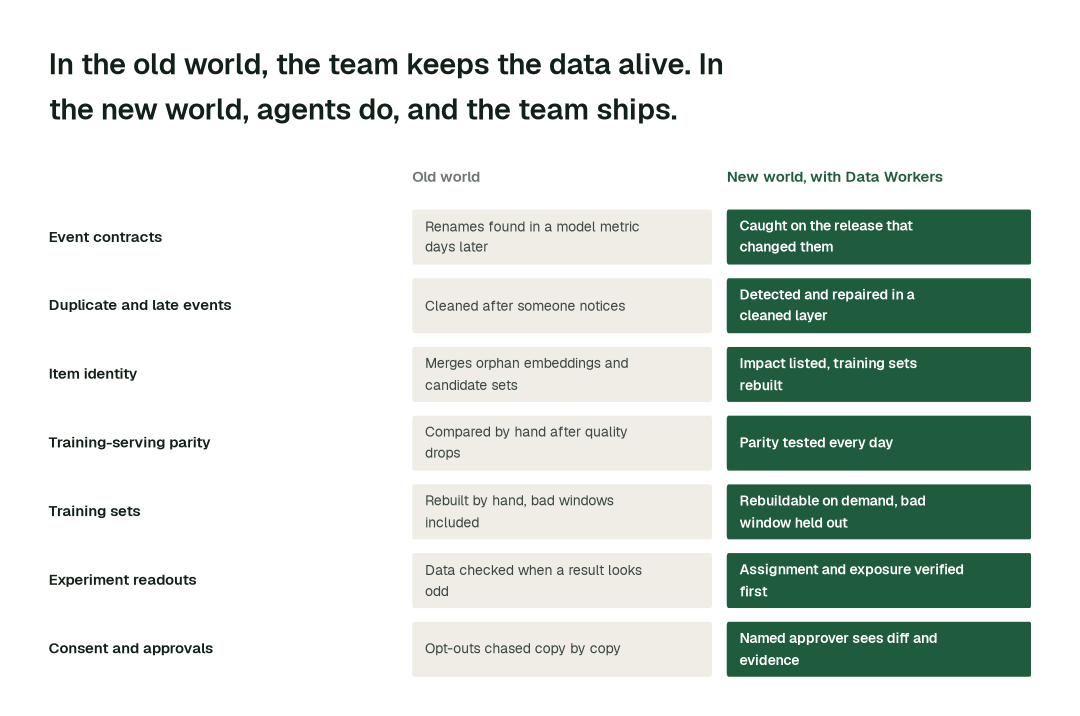
The old world
It is Tuesday, 10:30. A mobile release went out yesterday. The carousel click event now carries a renamed item field, and a scroll-restore change fires impressions twice. Nothing alerted, the nightly job trained on the damaged window, and click-through for one app build is down. The ranking engineer compares offline and online values by hand, one feature at a time. A catalog merge last week retired ten thousand item IDs, so some embeddings point at items that no longer exist, and two experiments are mid-flight with no one sure whether the treatment or the build moved them. The investigation takes three days. The roadmap does not move.
The new world
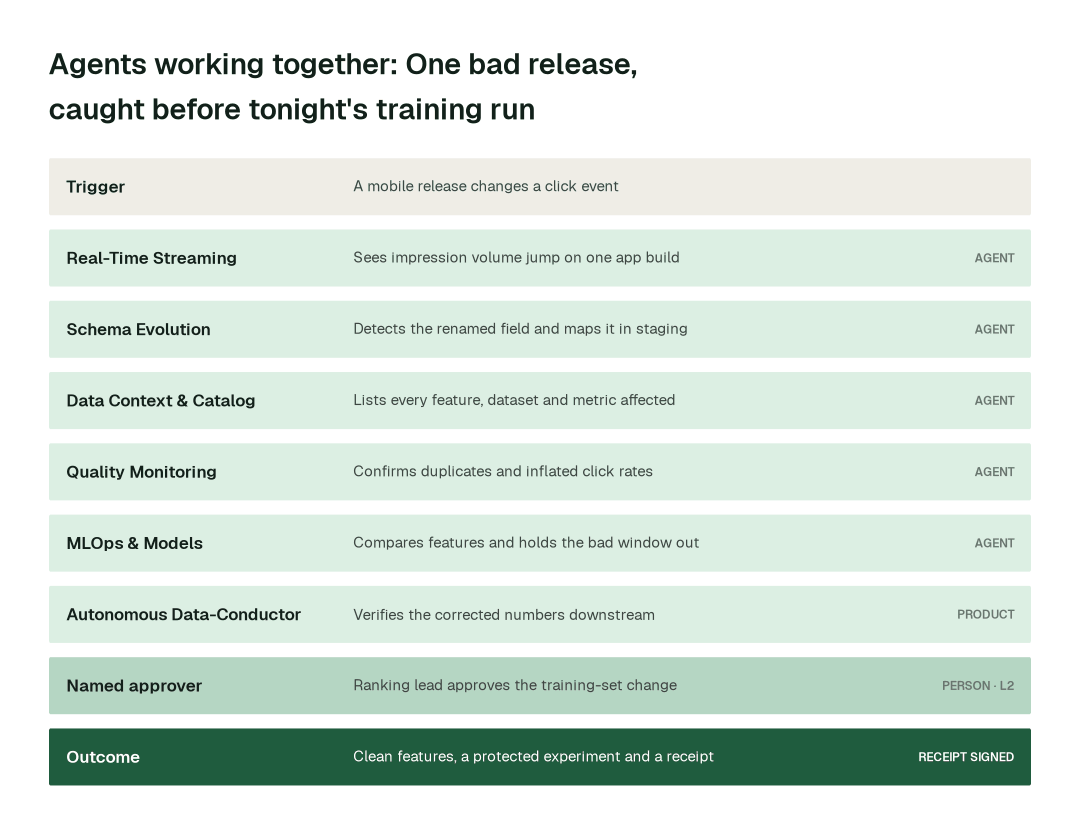
Same Tuesday with Data Workers. The Real-Time Streaming agent saw impressions per session jump on one build within two minutes of the rollout. The Connectors agent registered the new event shape, the Schema Evolution agent named the renamed field, and the Data Context & Catalog agent listed the click-through feature, two session features, the training set and two experiment metrics with their owners. Quality Monitoring sized the inflated window. Staging was fixed, the raw events were left untouched, and the Autonomous Data-Conductor sent the ranking lead one decision: exclude this window from tonight's training run, with the diff and the affected experiments attached. She approved it before standup.
Here is that morning as a chain of hand-offs between agents:
The rest of this report covers the seven practices that make it possible. At a glance:
The practices, one by one
1. Treat every event as a contract, and check it on each release
A ranker learns from whatever the client sends. If an event's shape or meaning changes, the model learns something different that night, and nothing in the pipeline objects.
Why it's harder than it looks: the change is rarely a deleted column. It is a renamed field, a changed type, or an impression that now fires on scroll restore. Product teams do not know a feature depends on the field, so the data team finds out from a model metric.
- 1.The Connectors agent registers the event shape with
register_stream_schemaorregister_kafka_schemaand flags new client builds. - 2.The Schema Evolution agent runs
detect_schema_changeandcheck_compatibility: what changed, since which build, and whether it breaks anything. - 3.The Data Context & Catalog agent runs
blast_radius_analysisto list downstream features, training sets and metrics, each with an owner. - 4.The Schema Evolution agent drafts the mapping with
generate_migrationand a rollback point, and applies it in staging. - 5.The ranking lead approves before anything a production feature reads changes.
The instrumentation QA use case covers the check in detail, and Inside the Real-Time Streaming Agent covers what the agent watches on the stream.
2. Repair duplicate, late and out-of-order events in a cleaned layer, never in raw
Inflated counts and broken session windows move click-through, dwell time and every session feature. Fixing them is routine; fixing them in place destroys the evidence.
Why it's harder than it looks: a double-fired impression and a legitimate replay look alike, and late events are valid but arrive after the window closed. A wrong rule on the raw table silently rewrites history.
- 1.The Quality Monitoring agent runs
run_quality_checkandget_anomalieson volume, duplicates and arrival lag. - 2.The Incident Debugging agent uses
diagnose_incidentandget_root_causeto tie an anomaly to a build, region or change. - 3.The Pipeline Building agent proposes a rule in the cleaned layer, with tests from
create_quality_tests_for_pipeline. Raw stays as received. - 4.The window is rerun with
trigger_airflow_dagand Quality Monitoring verifies the numbers. - 5.Staging repairs run at the level you set; a change a production feature reads goes to the ranking lead.
Across the routine work in this domain, here is the difference in elapsed time:
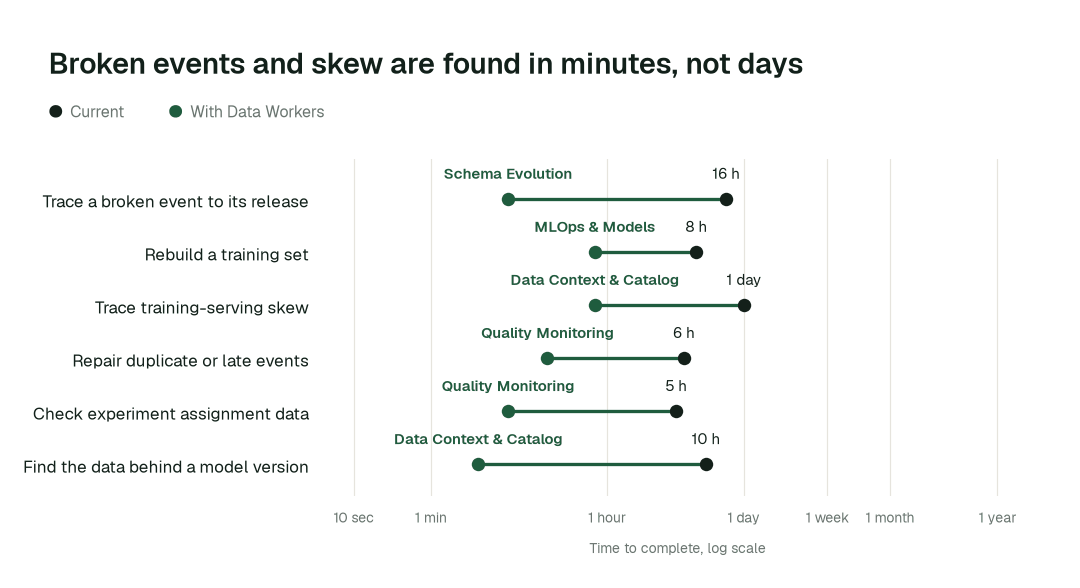
The biggest change is skew investigation: from about three days to under an hour, because agents detect, trace and verify in one pass.
3. Keep item identity stable through merges, retirements and relaunches
Items merge, split, expire and return under new IDs, and embeddings, candidate sets and click history all key on them.
Why it's harder than it looks: the change is correct for the catalog; the history suffers. A merged item orphans its interactions, a retired item lingers in a precomputed candidate set, and a relaunch looks new.
- 1.The Data Context & Catalog agent detects the change and runs
blast_radius_analysison the candidate sets and embeddings that key on the affected IDs. - 2.The Schema Evolution agent runs
assess_impacton the key change and drafts the ID mapping withgenerate_migration. - 3.The MLOps & Models agent shows which features shifted with
get_feature_statsand rebuilds them withcreate_feature_pipeline. - 4.The training set is rebuilt from the corrected layer, with a diff against the previous one.
- 5.The catalog owner approves the mapping; the ranking lead approves the rebuild.
4. Test training-serving parity every day, not after a quality drop
Google's Rules of Machine Learning calls the gap between training and serving performance training-serving skew. A feature store exists to prevent it, and prevents what it is told about.
Why it's harder than it looks: skew rarely announces itself. A batch feature and its stream twin drift apart through a timezone, a null default or a window boundary, offline evaluation looks fine, and the comparison is done one feature at a time. Data quality for ML covers the data-side causes.
- 1.The Data Context & Catalog agent traces each suspect feature to its sources with
get_lineage. - 2.The MLOps & Models agent compares training and serving values with
get_feature_statsand runsdetect_model_driftto show when they diverged and which model version was hit. - 3.The Quality Monitoring agent adds a standing parity test per feature with
create_quality_tests_for_pipelineand an SLA withset_sla. - 4.A failed test opens an incident for the Incident Debugging agent, lineage attached.
- 5.The feature platform lead approves any change to a shared feature definition.
Your feature store keeps serving the values; the agents check they still mean what the model learned. You're on Feast covers the split.
5. Make training sets point-in-time correct and rebuildable on demand
A training set that cannot be rebuilt cannot be debugged or rolled back.
Why it's harder than it looks: Feast documents point-in-time joins for building training sets without leaking future data, but a correct join still reads whatever window it is pointed at. If that window holds a broken release, the join is right and the data is not.
- 1.The Quality Monitoring agent marks the affected window and sizes the share of sessions involved.
- 2.The MLOps & Models agent proposes excluding the window from the next run and rebuilding from the corrected layer.
- 3.The Data Context & Catalog agent records which data version fed which model version, so "what trained this?" is answered in seconds.
- 4.The Autonomous Data-Conductor verifies the corrected numbers reconcile with raw events before the run starts.
- 5.The ranking lead approves the exclusion and the diff. Agents do not change a production training set on their own.
6. Verify assignment and exposure before every experiment readout
A readout is only as believable as the exposure data under it, and problems usually surface after the meeting.
Why it's harder than it looks: nobody owns the checks. The experiment platform assigns, the stream records exposure and the warehouse computes metrics, and the three can disagree unnoticed. The experiment readout trust use case covers the pattern.
- 1.The Quality Monitoring agent checks assignment balance, duplicate exposures and late events with
run_quality_check. - 2.The Schema Evolution agent confirms with
get_schema_snapshotandlist_schema_changesthat metric definitions did not change under the test. - 3.The Data Context & Catalog agent records which data version each arm read; the MLOps & Models agent ties the experiment to its model versions with
compare_experiments. - 4.The readout opens with a checked-data note and an annotation for any affected window.
- 5.The experimentation data product manager signs off on the data. The ship decision stays with people.
7. Send training sets, consent and promotion to named approvers
Behavioural history is personal data. It sits in logs, features, snapshots and embeddings, and an opt-out has to reach every copy. What the ranker learns from and what reaches production are decisions people answer for.
Why it's harder than it looks: the autonomy that suits a staging fix is wrong for a consent change. Without a per-domain rule, teams default to one of two extremes: everything waits for review, or changes go straight through and are rolled back after a complaint.
- 1.The Data Access & Governance agent runs
scan_piiover logs, features and snapshots and appliescheck_policyandenforce_rbac. Your consent platform stays the source of truth, as in You're on OneTrust. - 2.For any change to consent-related data it calls
request_governance_reviewwith the evidence attached. - 3.The MLOps & Models agent supplies
evaluate_modelresults for a candidate but never promotes it. - 4.The Autonomous Data-Conductor routes each decision: consent to the privacy lead, production training sets and feature definitions to the ranking lead, promotion and ship calls to the product owner.
- 5.Every approval lands in the tamper-evident audit trail, exportable with
generate_audit_report.
Autonomy where work is reversible and a named approver where it matters looks like this by task class once a deployment has matured:
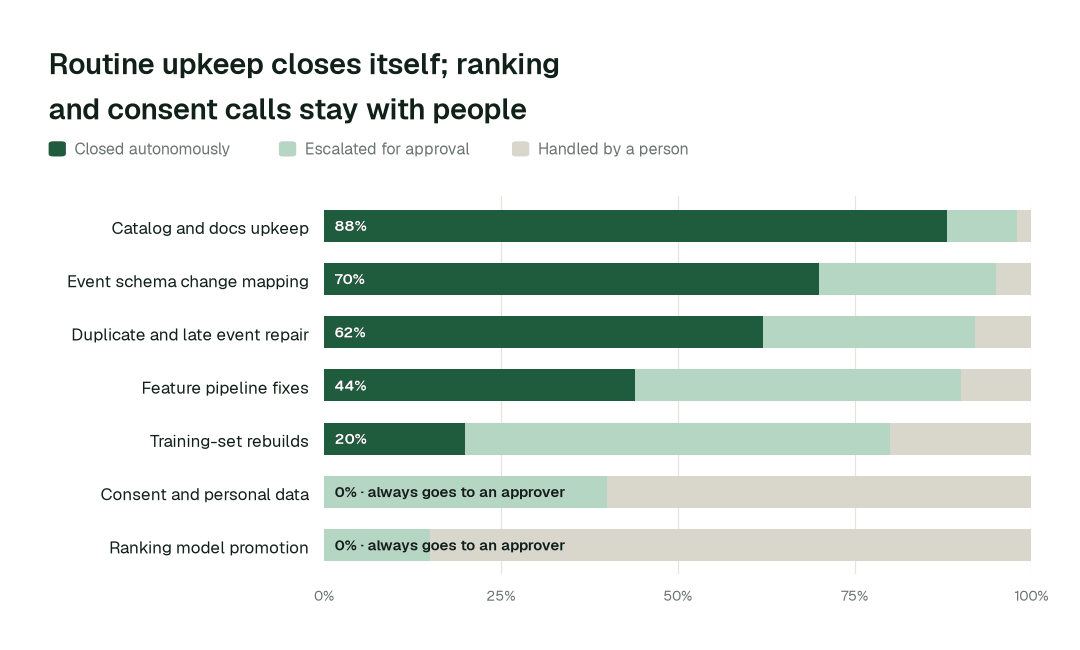
In the chart, catalog and docs upkeep closes autonomously 88% of the time. For ranking model promotion and ship calls, autonomous closure is 0% by design: every recommendation arrives with evidence, and a named person decides.
Designing the autonomy ladder
Autonomy is set per task class, not per tool. L0: people do the work. L1: agents observe and report. L2: agents propose and a named person approves before anything runs. L3: agents act on reversible work and keep a rollback point. L4: agents handle a whole class. L0 to L2 run today; L3 and L4 are where a domain can go on its own review record, never switched on everywhere at once. If people revert agent changes in a domain, it pauses.
| Task class | L0 | L1 | L2 | L3 | L4 | Why |
|---|---|---|---|---|---|---|
| Event schema mapping in staging | Start | Runs today | On evidence | On evidence | Reversible, with a rollback point | |
| Duplicate and late-event repair in the cleaned layer | Start | Runs today | On evidence | On evidence | Raw events are never rewritten | |
| Catalog, feature and docs upkeep | Start | Runs today | On evidence | On evidence | Repeatable and low blast radius | |
| Daily parity tests and anomaly checks | Start | Runs today | On evidence | On evidence | Tests only read and report | |
| Training sets and feature definitions for production rankers | Start | Runs today, ranking lead approves | On evidence | A changed training set changes what the model learns | ||
| Consent and personal data | Start | Runs today, privacy lead approves | An opt-out has to reach every copy | |||
| Model promotion and experiment ship decisions | People decide | The call carries accountability |
The operating model: who owns what
Agents change who does the work, not who is accountable for it:
| Role | Owns | What the agents take off their plate |
|---|---|---|
| Head of Personalization Data | Standards, autonomy level per domain, which surface goes next | Status assembly, chasing owners, documentation |
| Ranking lead | Production training sets, feature definitions and model promotion | Preparing the diff, blast radius and rollback plan for every proposal |
| Privacy lead | Consent, opt-outs, deletion and what a feature may contain | Finding personal data across logs, features and snapshots |
| Experimentation data product manager | Assignment, exposure and metric definitions behind readouts | Pre-readout data checks and annotations |
| Data engineers | Reviewing proposals; building new signals and candidate generators | Event mapping, duplicate repair and catalog-driven rebuilds |
The swarm behind the practices
No single agent delivers these practices. Each one is a hand-off between specialists, coordinated under the autonomy you set per domain.
| Agent | What it does | Public tools |
|---|---|---|
| Real-Time Streaming | Watches event volume, lag and shape on the streams that feed features | Name only |
| Connectors | Lands event, catalog and experiment sources; registers stream schemas | register_stream_schema, trigger_airflow_dag |
| Schema Evolution | Detects renamed and retyped fields; drafts mappings with a rollback point | detect_schema_change, generate_migration |
| Quality Monitoring | Checks duplicates, late events, parity and experiment data | run_quality_check, set_sla |
| MLOps & Models | Compares feature distributions; ties experiments and training sets to model versions | get_feature_stats, detect_model_drift |
| Data Context & Catalog | Keeps features and datasets described, with lineage from event to model | get_lineage, blast_radius_analysis |
| Data Access & Governance | Finds personal data in logs and features; applies access rules | scan_pii, check_policy |
| Incident Debugging | Traces a ranking-quality drop to the data change behind it | diagnose_incident, get_root_cause |
Data Context Wizard holds one governed definition of an impression, a click, a session and an exposure, so a readout and a training set agree. Autonomous Data-Conductor verifies the figures that matter before a training run and a readout. Spellbook Data Catalog makes each table, feature and experiment dataset discoverable, with its owner and consumers.
What disappears
The clearest sign the practices are working is what stops happening:
- •The click-through drop that takes three days to trace to a renamed field.
- •Offline metrics that look fine while online quality falls.
- •Training runs that read a window everyone knew was broken.
- •Candidate sets and embeddings that point at retired items.
- •Readouts that start with an argument about whether to believe the data.
The point is not any single agent. It is that the back office keeps running: bad data is caught where it enters, not where it is read, and every action leaves a signed receipt so the team can see what happened and reverse it.
A head of personalization data's scorecard
Targets to set against your own baseline and bring to every quarterly review, not results:
- •Time from a client release to the broken event being named. Target: minutes.
- •Training set rebuilt after a catalog change. Target: under an hour.
- •Time to trace training-serving skew to its cause. Target: under an hour.
- •Share of production features with a daily parity test. Target: all of them.
- •Readouts with assignment and exposure verified before the meeting. Target: every readout.
- •Catalog and docs upkeep closed autonomously. Target: 88% as the deployment matures.
- •Time for an opt-out to reach every copy of the data. Target: set with the privacy lead, tracked per copy.
Where this goes next
Every new surface, locale and experiment adds events, features and metrics that can break silently, and assistants will read the same catalogs and signals as the rankers. The team that governs one definition of an impression, an item and an exposure, and checks it on every release, is ready for both.
The climb: from assisted to autonomous to agentic
Our thesis is that the data platform climbs the way analytics did, in stages, and that the hard part of data work was never knowing what to do but doing it. For personalization and recommendations data teams, the climb looks like this:
- •Assisted. Agents work alongside your team, show what needs doing and propose every fix with a receipt; training sets, consent data and model promotion go to a named approver.
- •Autonomous, under your governance. Routine work runs at the levels you set: event schema changes mapped into staging, duplicate and late events repaired, features tested for parity daily. Your team governs the agents instead of doing the upkeep.
- •The agentic enterprise. A team that ships new signals and candidate generators instead of explaining why the ranker got worse. People set direction, and the platform carries it out.
Every step is visible and reversible, and the pilot below is the first rung.
The pilot: how personalization and recommendations data teams start
The pilot is how your team proves the value on its own data before committing.
- •Scope. Instrumentation drift and training-serving parity for one ranking surface, at L2. We connect your streams, warehouse, dbt project, orchestrator, feature store and experiment tools over MCP, inside your infrastructure. Nothing migrates.
- •First week. Agents run at L1. They map every event, feature and lineage path from client to model and show the fixes they would have made, with receipts, before anything changes.
- •By week two. Event schema mapping and duplicate and late-event repair run on reversible work in staging, with your approval. Training sets and consent data stay at L2 with a named approver.
- •At day 30. We review the targets against your baseline signed on day one:
- •Broken event traced to its release: from about two days to minutes
- •Training set rebuilt after a catalog change: from about a day to under an hour
- •Training and serving skew traced to its cause: from about three days to under an hour
- •the share of catalog and docs upkeep closed autonomously, targeting 88% as the deployment matures
- •Guarantee. In a 90-day pilot, ten engineering hours per data engineer per week recovered against a baseline both sides sign on day one, or the $7,500 fee is refunded.
- •What you decide. Whether to expand to the next ranking surface.
- •Cost. Start with a pilot ($7,500 one-time, credited in full against the first year). Scale is from $1,000 a month and Enterprise from $3,000 a month, billed annually, with unlimited seats, no usage meter and no markup on model spend. See pricing.
The pilot is the start of a longer curve:
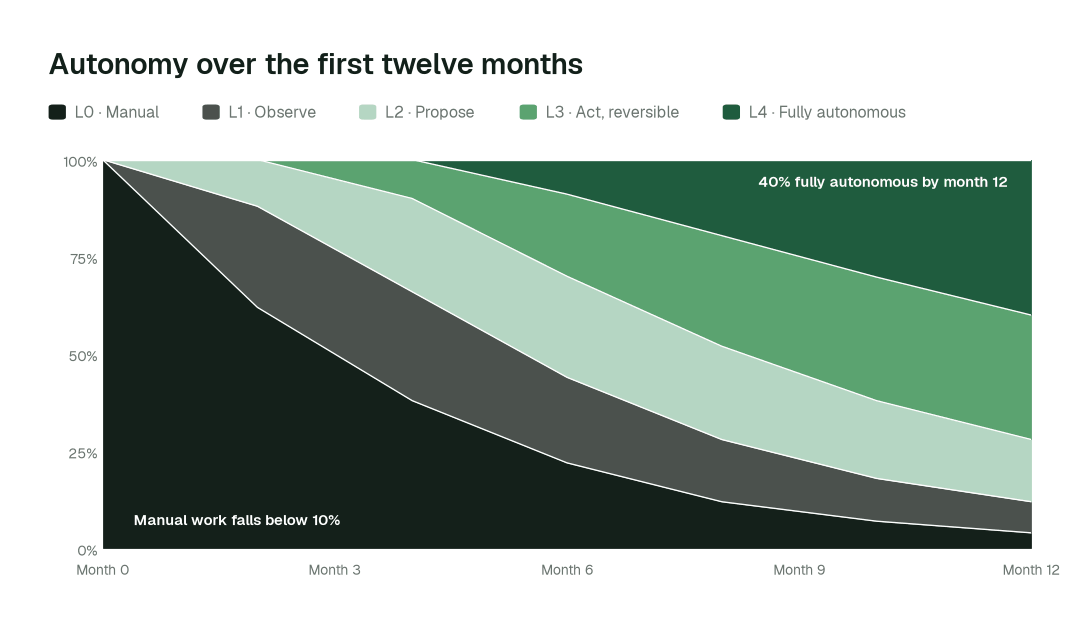
By month 12, the target is more than 40% of agent actions running fully autonomously and manual work below 10%, while production training sets, consent data and model promotion stay with a named approver.