The agentic data platform for the public sector: benefits, health, transportation and open data on autopilot
How Data Workers runs agency data operations inside your own authorized environment: open data screened before it publishes, legacy modernization checked wave by wave, and evidence for the data behind your AI use cases, under named approvals.
Data Workers, the agentic data platform, runs the data operations behind agency programs: it screens open data before it publishes, checks benefits, health and transportation data before decisions read it, and plans and tracks the parity checks behind every modernization wave. The agents run inside your agency's own environment, including an air-gapped option, changes wait for a named approver at the autonomy level you set, and every change leaves a tamper-evident receipt.
In government a bad table becomes a wrong benefit determination or a citizen's name on a public portal. Here is where agents help, and how the controls map to the policies your security and AI offices cite.
Key takeaways
- •The data work the rules make expensive goes on autopilot. Open data screening, program data quality, modernization parity checks, access requests for researchers and partners, and evidence for the data behind your AI use cases.
- •It runs inside your boundary. The agents run in your infrastructure with your credentials and your model; Enterprise deploys in your VPC, your own cloud, on premises or air-gapped with sovereign mode.
- •People keep the decisions. Program domains start at L0 manual or L1 observe; production changes wait for a named approver, and no agent can promote its own work.
- •Evidence by default. Every change carries the diff, the approver, the time, the blast radius and the rollback path in a SHA-256 hash-chained audit log your auditors can verify.
- •Controls mapped to the policy's own text. OMB M-25-21, NIST AI RMF, FedRAMP and GovRAMP boundaries and the CJIS Security Policy, with your security and AI governance offices deciding what satisfies each one. This page is not legal advice.
The data reality in federal, state and local agencies
Agency data still starts in systems that predate the cloud: COBOL and Db2 on the mainframe, IMS, Oracle and SQL Server databases behind eligibility, licensing and case management, and SAS jobs that have produced the same report for twenty years. Case management runs on Salesforce, Microsoft Dynamics, Tyler Technologies or CGI platforms, and Informatica moves much of the data. The analytics layer is moving to government cloud regions: Snowflake offers SnowGov regions on AWS GovCloud (US) and Microsoft Azure Government, and Databricks runs on AWS GovCloud with FedRAMP High and DoD IL5 environments. Power BI serves GCC, GCC High and DoD tenants.
The data operations that hurt:
- •Benefits and health programs. Eligibility, enrollment and claims data for programs such as SNAP and Medicaid feed determinations, federal reporting and payment integrity, so a quiet break becomes a wrong decision about a person.
- •Open data. Transportation, inspection and spending datasets publish on a schedule, and a new upstream column can carry names or dates of birth straight to the public portal.
- •Legacy modernization. Moving off a mainframe or an Oracle warehouse means proving the new system matches the old one, table by table, before anyone switches off the old reports.
- •Authorization boundaries. FedRAMP and GovRAMP decide which cloud services can touch agency data, and justice data under the CJIS Security Policy carries its own access and audit rules.
- •AI accountability. OMB's 2025 federal AI use case inventory lists 3,611 individually reported use cases at all stages of development, 445 of them high-impact, as of April 13, 2026. Each one sits on data someone has to vouch for.
Three use cases, from first alert to receipt
1. A crash dataset that almost published personal data (worked example). This is an illustration, not a customer incident. A state department of transportation publishes crash data weekly to its open data portal on Tyler Data & Insights. On Monday the crash records vendor ships a release that adds an officer narrative column to the crash report table. The open-data view in Snowflake selects every column, so it picks the narratives up, and every dbt test still passes.
| Time | System | What happened |
|---|---|---|
| Mon 18:00 | Crash records (SQL Server) | Vendor release adds an officer narrative column |
| Mon 23:30 | Informatica | The nightly workflow lands the new column in the raw schema in a SnowGov region |
| Tue 01:00 | Snowflake + dbt | The build passes; the open-data view now carries narratives |
| Tue 01:06 | Data Workers | Informatica's alert on the new column reaches Data Workers from the team's tooling; the dbt manifest shows the open-data view selects every column |
| Tue 01:09 | Data Workers | Holds the new free-text column as unclassified and asks the open data steward to classify it |
| Tue 01:12 | Data Workers | blast_radius_analysis finds the open-data view, Thursday's publish and the traffic safety dashboard |
| Tue 01:20 | Data Workers | Proposes the change as a diff for the owner to merge: an explicit column list on the view, plus a test |
| Tue 01:21 | Teams | The open data steward gets the diagnosis, the blast radius and the diff |
| Tue 09:15 | Spellbook | The steward reviews, approves and merges |
| Tue 09:30 | Snowflake + dbt | The team's scheduler reruns the dbt Cloud job; run_quality_check passes on the rebuilt view, and the steward confirms it no longer carries the narrative column |
| Tue 09:45 | Data Workers | Receipt written with the diff, the approver and the rollback path |
| Thu 06:00 | Tyler Data & Insights | The weekly crash dataset publishes from the checked view |
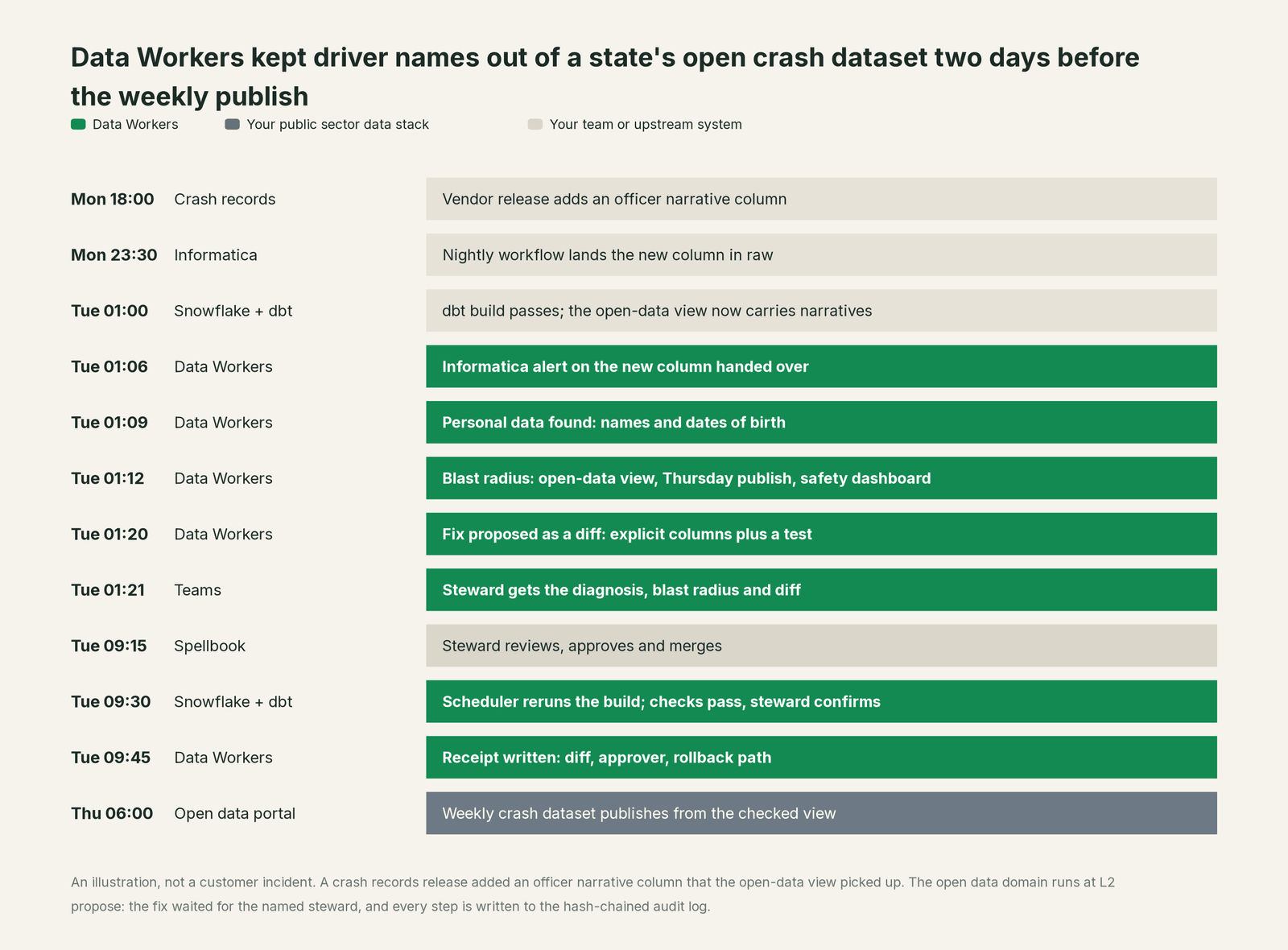
The open data domain ran at L2 propose, so nothing changed until the named steward approved in Spellbook (in preview). The receipt holds the diff, the approver, the timestamps, the lineage path and the rollback plan. Data Workers connects to Snowflake, dbt Cloud and Teams natively; Informatica and the open data portal connect over their APIs or MCP servers today. See Data Workers on Snowflake and how Data Workers handles PII.
2. Benefits eligibility moving off a legacy warehouse. A state human services agency moves its eligibility reporting warehouse from Oracle to Databricks on AWS GovCloud, while the mainframe stays the system of record and keeps sending its nightly extracts. Data Workers' migration agent assesses the tables, views and procedures by complexity and maps the dependencies (Power BI reports, federal reporting extracts, the dbt models in between) into waves. It plans each wave with its parity checks (row counts, aggregates, checksums, and bisection down to the rows when a segment disagrees), tracks them, and holds the completion gate closed until the wave meets the parity bar your team sets and the owner signs off. Each wave is a single approval in Spellbook, with the migration and its rollback SQL ready for your team to apply. Cutting migrations from 6 to 12 months to 4 to 8 weeks is the design target. See Data Workers on Databricks.
3. Justice data for researchers, on an air-gapped estate. A state criminal justice information services division keeps its analytics warehouse on PostgreSQL in the state data center, with no internet route. Data Workers runs there as an air-gapped install with sovereign mode on and a local model, so external model calls are blocked. When a university research team asks for arrest and disposition data for a recidivism study, check_policy evaluates the request against the policies your team writes. provision_access records a column-level grant with a 90-day expiry and generates the PostgreSQL GRANT for the database owner to run, or grants nothing and the request goes to request_governance_review when a person must decide. Sign-in runs through the agency's identity provider, with tokens verified against its JWKS on the internal network. generate_audit_report produces access and violations reports for the CJIS systems agency's audit, and verify_global_hash_chain checks the log end to end. See running Data Workers in your VPC or air-gapped.
Governance and regulation: the controls, mapped to the policy's text
A plain statement first: Data Workers holds no FedRAMP authorization and no GovRAMP status, and makes no CJIS compliance claim. Agencies deploy it inside their own authorized boundary (your cloud tenant, your data center or an air-gapped enclave), and your security office decides how it fits your authorization to operate. Data Workers gives you controls and evidence; your security office, AI governance board and auditors decide how they fit your control framework. The wider mapping is in how Data Workers helps with SOX, HIPAA, GDPR and the EU AI Act.
| Policy (source, checked Oct 2, 2026) | What the text asks | What Data Workers provides |
|---|---|---|
| OMB M-25-21, Accelerating Federal Use of AI (April 3, 2025) | Annual AI use case inventories; for high-impact AI, an impact assessment covering "the quality and appropriateness of the relevant data", and ongoing monitoring "designed to detect unforeseen circumstances, changes to an AI system after deployment, or changes to the context of use or associated data" | Lineage, freshness and quality checks on the data behind each use case; schema changes on its inputs caught in the dbt manifest diff and quality checks; receipts and audit reports as dated records |
| OMB M-26-04, Increasing Public Trust in AI Through Unbiased AI Principles (Dec 11, 2025), complementing M-25-22 on AI acquisition (Apr 3, 2025) | Contract terms requiring LLMs an agency procures to follow two principles, truth-seeking and ideological neutrality; agency procurement policies updated by March 11, 2026 | You bring the model, so the model the agents use is the one your agency procured under those terms |
| OMB M-26-14, Ensuring Effective and Efficient Agency Logging and Network Visibility (May 22, 2026; rescinds M-21-31) | Risk-based logging for continuous event monitoring and for threat hunting, investigation and forensics, across systems the agency or third parties operate on its behalf; an agency logging plan once CISA publishes its logging reference architecture | Every agent action in a hash-chained log in your environment; audit events can stream to your SIEM over an HMAC-signed webhook |
| NIST AI RMF 1.0 (Jan 26, 2023, voluntary; Generative AI Profile NIST-AI-600-1, Jul 26, 2024; being revised per NIST) | Govern, Map, Measure and Manage functions for AI risk | Autonomy levels and named approvers to govern; lineage to map; quality checks and metric baselines to measure; the org-wide stop and rollback paths to manage |
| FedRAMP (538 certified services, 32 via 20x; Consolidated Rules for 2026 updated Sep 13, 2026) and GovRAMP, a nonprofit membership organization with a "standardized, NIST-aligned framework" (stateramp.org now redirects to govramp.org) | FedRAMP certifies cloud services for federal use; GovRAMP "helps service providers demonstrate security and enables governments to make informed, risk-based decisions" | Agents deploy inside your already authorized environment; the hosted Conductor sees workflow metadata only, and an air-gapped install sends it nothing |
| FBI CJIS Security Policy (le.fbi.gov; check the current version with your CJIS systems agency) | Access control, audit and accountability, and advanced authentication for criminal justice information | Scoped grants with a recorded expiry; reviews for a person to decide; get_audit_trail and access reports; sign-in through your own identity provider |
For the CISO: the agents hold your warehouse credentials and model key inside your infrastructure, where the context graph, receipts and audit log are written; your data stays in your systems, and the hosted Conductor sees workflow metadata only. An org-wide stop halts all autonomous dispatch, and the admin kill switch needs two people and revokes the tenant's keys, tokens and sessions.
What changes for your team
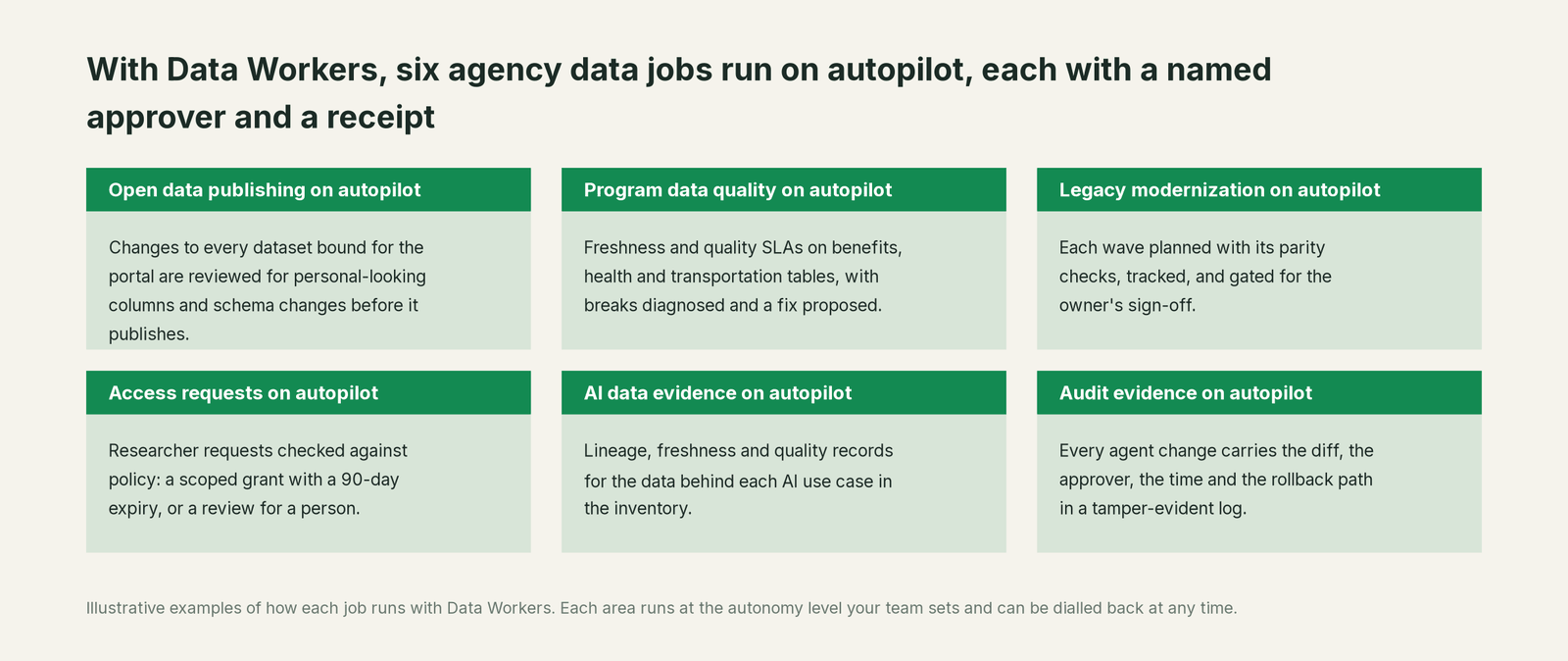
Program data owners, stewards and engineers keep every decision; checking portal refreshes by hand and assembling evidence for the inspector general leave their week. Who owns the agents covers accountability, how approvals work shows the approval flow, and will Data Workers replace my data team answers the question your team will ask first. Sibling pages cover healthcare and life sciences and financial services, and our AI for government data infrastructure guide covers the wider estate.
The alternatives agencies weigh (as of Oct 2026)
- •Build it in house or with a systems integrator. Agencies and their integrators have deep program knowledge; the hard part is everything around the agent: approvals, rollback, receipts, sovereign enforcement and offline packaging. See build it ourselves.
- •Platform-native agents in government regions. Databricks documents that Genie Code Agent mode on AWS GovCloud routes inference to Azure OpenAI in Azure Government, with customer content kept in US government cloud regions (updated Sep 11, 2026). Those agents serve their own platform well; agency data also runs through mainframes, case systems and on-premise databases they do not reach.
- •A catalog such as Microsoft Purview. It holds the inventory and classifications; Data Workers acts on that context and keeps it current. See Data Workers vs a data catalog.
- •Data observability. Monitors raise the alarm; Data Workers diagnoses, proposes the fix and verifies it. See Data Workers vs data observability.
Changing production data across systems, with approvals and evidence, inside the agency's boundary, is the job Data Workers does; what is an agentic data platform sets out the category.
The case for your CFO
The outcome is program decisions, published datasets and reports to oversight bodies built on data someone checked. Breaks surface the night a vendor release lands instead of after a citizen finds their name online, each modernization wave carries its parity checks and a completion gate the owner signs, and the AI governance board gets dated records for the data under each use case.
The risk story is short. Agents act only at the level you set per domain, from L0 manual to L4 autonomous, and program domains start at observe. Every production change waits for a named person, an unanswered request expires and escalates rather than turning into a yes, and every change leaves a receipt with the diff and the rollback path. There is zero migration: Data Workers works on top of the mainframe, warehouse, case systems and ticketing you already run. Is it safe to let AI agents change production data? and where does our data go? cover the detail.
Why now: OMB requires annual AI use case inventories and minimum practices for high-impact AI, legacy systems are retiring on fixed schedules, and data teams are not growing to match. A good first win is one open data domain at L1 observe, where the team reviews the agents' records and receipts against the bar it set, then moves it to L2 propose.
Start with a pilot: $7,500 one-time, credited in full against the first year. Scale is from $1,000 a month and Enterprise, where VPC, on-premise and air-gapped deployments sit, from $3,000 a month, billed annually, with unlimited seats, no usage meter, no markup on model spend and your own model. Details are on pricing, the ROI calculator takes your own inputs, and the ROI of agentic data operations shows the model.
The sentence for upstairs: "Data Workers checks our program and open data before anyone relies on it, keeps the evidence our oversight bodies ask for, and runs inside our own boundary."
FAQ
Is Data Workers FedRAMP authorized, GovRAMP verified or CJIS compliant? No, and we make none of those claims. Agencies deploy it inside their own authorized environment, so the agents, credentials, context graph and audit log sit within your boundary, and your security office decides how it fits your authorization to operate.
Can it run with no internet connection at all? Yes. The air-gapped install ships as an offline bundle with checksums, runs on your Kubernetes cluster with a local model through Ollama or vLLM, and turns on sovereign mode, which blocks external model calls and never falls back to a cloud provider. The full setup is in VPC or air-gapped.
Does it work with mainframes and our case management system? Mainframe extracts, Salesforce, Dynamics, Tyler and CGI platforms connect over their APIs or MCP servers today; Data Workers watches the data they produce in Snowflake, Databricks, PostgreSQL and dbt, which connect natively among 50+ connectors. See Data Workers integrations.
Is Data Workers itself a high-impact AI use case under M-25-21? Your agency makes that determination. The agents propose and apply data operations under named approval; they do not make decisions about people. Whatever the determination, every action is logged with its approver and receipt.
Can the agents change eligibility or benefits data on their own? Only at the level you set for that domain. We recommend program data at L1 observe or L2 propose, so every fix is a proposal with its diff, blast radius and rollback path, waiting for the data owner. Autonomy levels L0 to L4 explains each step.
Sources
- •Office of Management and Budget, Memoranda index, accessed Oct 2, 2026: https://www.whitehouse.gov/omb/information-resources/guidance/memoranda/
- •OMB M-25-21, Accelerating Federal Use of AI through Innovation, Governance, and Public Trust, April 3, 2025, accessed Oct 2, 2026: https://www.whitehouse.gov/wp-content/uploads/2025/02/M-25-21-Accelerating-Federal-Use-of-AI-through-Innovation-Governance-and-Public-Trust.pdf
- •OMB M-25-22, Driving Efficient Acquisition of Artificial Intelligence in Government, April 3, 2025 (listed on the memoranda index), accessed Oct 2, 2026: https://www.whitehouse.gov/wp-content/uploads/2025/02/M-25-22-Driving-Efficient-Acquisition-of-Artificial-Intelligence-in-Government.pdf
- •OMB M-26-04, Increasing Public Trust in Artificial Intelligence Through Unbiased AI Principles, Dec 11, 2025, accessed Oct 2, 2026: https://www.whitehouse.gov/wp-content/uploads/2025/12/M-26-04-Increasing-Public-Trust-in-Artificial-Intelligence-Through-Unbiased-AI-Principles-1.pdf
- •OMB M-26-14, Ensuring Effective and Efficient Agency Logging and Network Visibility, May 22, 2026, accessed Oct 2, 2026: https://www.whitehouse.gov/wp-content/uploads/2026/05/M-26-14-Ensuring-Effective-and-Efficient-Agency-Logging-and-Network-Visibility-to-Defend-Against-Evolving-Cyber-Threats.pdf
- •OMB, 2025 Federal Agency AI Use Case Inventory (summary as of April 13, 2026), accessed Oct 2, 2026: https://github.com/ombegov/2025-Federal-Agency-AI-Use-Case-Inventory
- •NIST, AI Risk Management Framework, accessed Oct 2, 2026: https://www.nist.gov/itl/ai-risk-management-framework
- •FedRAMP, homepage and marketplace counts, accessed Oct 2, 2026: https://www.fedramp.gov/
- •GovRAMP, About ("a nonprofit membership organization"; "standardized, NIST-aligned framework"), accessed Oct 2, 2026: https://govramp.org/about
- •FBI, CJIS Security Policy Resource Center (blocks automated access; confirm the current version on the page): https://le.fbi.gov/cjis-division/cjis-security-policy-resource-center
- •Snowflake, Supported cloud regions (SnowGov regions), accessed Oct 2, 2026: https://docs.snowflake.com/en/user-guide/intro-regions
- •Databricks, Databricks on AWS GovCloud (updated Sep 11, 2026), accessed Oct 2, 2026: https://docs.databricks.com/aws/en/security/privacy/gov-cloud
- •Microsoft Learn, Power BI for US Government customers (Feb 18, 2026), accessed Oct 2, 2026: https://learn.microsoft.com/en-us/fabric/enterprise/powerbi/service-government-us-overview
- •Tyler Technologies, Data & Insights, accessed Oct 2, 2026: https://www.tylertech.com/products/data-insights
- •Data Workers, Security, accessed Oct 2, 2026: https://dataworkers.io/security/
- •Data Workers, Pricing, accessed Oct 2, 2026: https://dataworkers.io/pricing/
- •Data Workers open-source repo (tool registrations), accessed Oct 2, 2026: https://github.com/DataWorkersProject/dataworkers-claw-community