The agentic data platform for insurance: bordereaux, claims, reserving and pricing data on autopilot
How Data Workers runs data operations for carriers, MGAs and reinsurers: bordereaux and claims data checked before reserving reads it, lineage for statutory and Solvency II numbers, and evidence for the NAIC AI bulletin, under named approvals.
Data Workers, the agentic data platform, runs the data operations an insurer is examined on: it checks every bordereau and claims feed before reserving and finance read it, traces statutory and Solvency II numbers back to the policy and claims source, and keeps the data evidence your AI governance program asks for. Changes go to a named approver at the autonomy level you set for each domain, every change leaves a tamper-evident receipt, and the agents run in your own environment.
In insurance a bad feed becomes a reserve, a rate filing or a supervisory return. Here is where agents earn their keep, and how the controls map to the rules your regulators cite.
Key takeaways
- •The data work the rules make expensive goes on autopilot. Bordereaux checks, claims and reserving data quality, lineage for statutory and Solvency II figures, pricing-model input checks, access requests and change records.
- •People keep the decisions. Regulated domains start at L0 manual or L1 observe and climb one domain at a time; production changes wait for a named approver, and no agent can promote its own work.
- •Evidence by default. Every change carries the diff, the approver, the time, the blast radius and the rollback path, written to a SHA-256 hash-chained audit log you can verify.
- •Your data stays in your systems. The agents run in your infrastructure on every tier with your credentials and your model key; the hosted Conductor sees workflow metadata only.
- •Controls mapped to the rule's own text. The NAIC AI bulletin, the NAIC Insurance Data Security Model Law, NYDFS Part 500 and Solvency II, with your compliance team deciding what satisfies each rule. This page is not legal advice.
The data reality in P&C, life, health and reinsurance
Insurers commonly run policy, billing and claims suites such as Guidewire PolicyCenter, BillingCenter and ClaimCenter, Duck Creek, Sapiens or Majesco, often next to a mainframe or AS/400 book that never migrated. Actuaries work in Moody's AXIS, WTW Igloo or RiskAgility, Prophet, R and Python. The warehouse sits on Teradata, Oracle or SQL Server and is moving to Snowflake or Databricks, with Informatica moving data, SAS jobs that have run for twenty years, dbt growing, and Power BI or Tableau on top. Delegated authority adds bordereaux from MGAs and TPAs, arriving as spreadsheets in each partner's own layout.
The data operations that hurt:
- •Bordereaux intake. Dozens of partners, each with its own columns and conventions, and a format change nobody announced.
- •Claims and reserving data. Payments, case reserves and claim status feed loss triangles; a quiet error moves an IBNR estimate.
- •Statutory and supervisory reporting. The annual statement and Schedule P in the US; Solvency II quantitative reporting templates in Europe; IFRS 17 lineage from policy data to the measurement model.
- •Pricing-model governance. State AI bulletins and NYDFS ask how rating and underwriting models use data; EIOPA, citing its May 2024 digitalisation report, says "AI is already used by 50% of respondent insurance undertakings in non-life insurance and by 24% in life insurance".
- •Personal data and migrations. Claimant details in claims notes, and policy-admin moves where old and new numbers must agree.
Three use cases, from first alert to receipt
1. A bordereau that changed meaning (worked example). This is an illustration, not a customer incident. A managing general agent sends its March claims bordereau on Tuesday morning. Its new template renames the Paid column to Paid to Date and reports cumulative amounts instead of the month's payments. The file loads cleanly and every dbt test passes.
| Time | System | What happened |
|---|---|---|
| Tue 09:00 | MGA bordereau | March claims file uploaded with paid-to-date amounts |
| Tue 09:20 | Snowflake | The file lands in a stage and loads to raw tables |
| Tue 09:45 | dbt Cloud | The scheduled job passes; this MGA's paid losses triple |
| Tue 09:52 | Data Workers | run_quality_check and get_anomalies flag paid losses at 3.1x the six-month baseline |
| Tue 10:05 | Data Workers | get_root_cause traces the jump to the raw table: a renamed column carrying cumulative amounts |
| Tue 10:12 | Data Workers | blast_radius_analysis finds the Q1 loss triangles, the claims dashboard and the technical provisions extract |
| Tue 10:20 | Data Workers | Proposes the change as a diff for the owner to merge: derive monthly paid from paid-to-date, plus a test, with dry-run counts and rollback |
| Tue 10:21 | Jira Service Management | create_jira_sm_ticket opens a ticket for the delegated authority team with the proposal attached |
| Tue 14:30 | Spellbook | The delegated authority data owner reviews, approves and merges |
| Tue 14:40 | dbt Cloud | The owner reruns the job after approval; totals tie to the MGA's control sheet |
| Tue 15:00 | Data Workers | Receipt written; the reserving team is notified |
| Thu 08:00 | Reserving | Q1 triangles are built from verified tables |
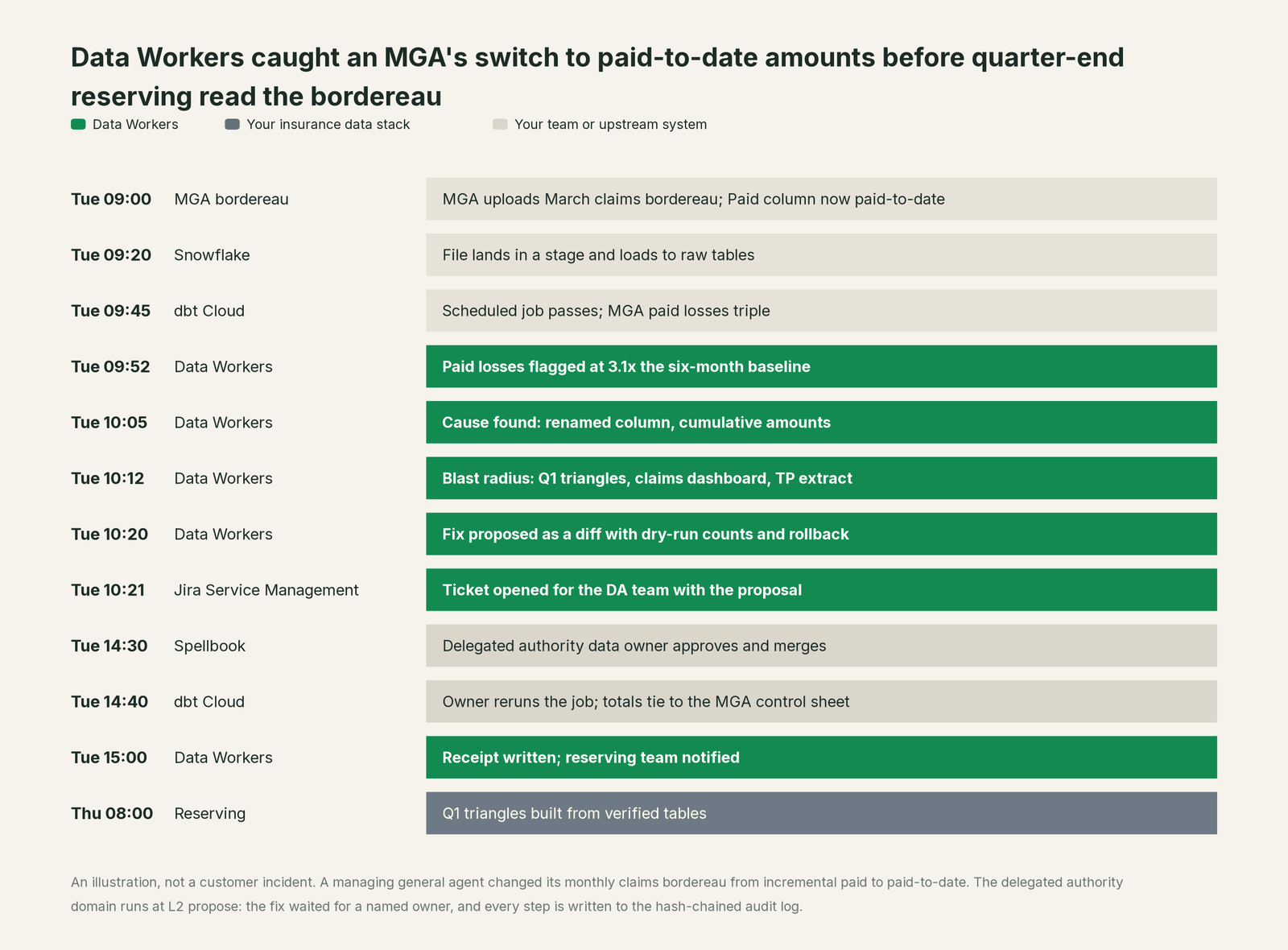
The delegated authority domain ran at L2 propose, so nothing changed until a named person approved in Spellbook (in preview). The receipt holds the diff, the approver, the timestamps, the lineage path and the rollback plan. Data Workers connects to Snowflake, dbt Cloud and Jira Service Management natively; bordereaux portals and actuarial tools connect over their APIs or MCP servers today. See Data Workers on Snowflake and Data Workers + dbt.
2. Claimant data in a claims lakehouse. ClaimCenter data lands in Databricks for a special investigations team, and an adjuster notes column carries Social Security numbers and dates of birth. Data Workers' pull request review reads column names and annotations, not values, so the data owner or the team's classification tool flags the notes column and records it as restricted. Data Workers proposes column masks as a dry run with the blast radius, and the data owner applies them through Unity Catalog or their own change process; masking is never auto-resolved. When an analyst asks for claimant fields, check_policy evaluates the request against the policies your team writes, and provision_access grants column-level access with a 90-day expiry, or grants nothing and opens request_governance_review when a person must decide. Guidewire and Duck Creek connect over their APIs today. See how Data Workers handles PII and Data Workers on Databricks.
3. Pricing-model data for the AI program. A personal auto rating model scores renewals from features built in the warehouse. run_quality_check checks the input tables for nulls, duplicate keys and missing rows, and monitor_metrics baselines your team records flag a rating factor whose values move; your model monitoring tool keeps measuring drift. When a feature source changes, trace_cross_platform_lineage shows which rating factors read it, and define_business_rule records definitions such as earned exposure with their author. The receipts and generate_audit_report give the model governance team a dated record of data currency, lineage and quality. Bias testing and the decision to refile a rate stay with your actuaries and model risk team. MLflow keeps the model record, and your team's assistant can use its API or MCP server side by side with Data Workers; the MLOps and models agent covers the detail.
Governance and regulation: the controls, mapped to the rule's text
Data Workers gives you controls and evidence; your compliance team, actuaries and auditors decide how they fit your control framework. The wider mapping is in how Data Workers helps with SOX, HIPAA, GDPR and the EU AI Act.
| Rule (source, checked Oct 2, 2026) | What the text asks | What Data Workers provides |
|---|---|---|
| NAIC Model Bulletin: Use of Artificial Intelligence Systems by Insurers (adopted December 2023; wording as reissued by Washington's OIC, Apr 22, 2024) | An AIS program covering "Data practices and accountability procedures, including data currency, lineage, quality, integrity, bias analysis and minimization, and suitability"; documentation including "evaluation of model drift" | Lineage, quality checks and baselines on model inputs (drift itself measured in your model monitoring tool), receipts and audit reports as dated documentation |
| NAIC Insurance Data Security Model Law (#668, adopted Q4 2017; state adoption varies) | Section 4D(2)(a) "Place access controls on Information Systems"; 4D(2)(i) "Include audit trails within the Information Security Program"; 4F oversight of third-party service providers | provision_access with expiry, request_governance_review, every agent action logged in a hash-chained trail; agents run inside your environment and the hosted Conductor sees workflow metadata only |
| NYDFS 23 NYCRR 500 (Second Amendment effective Nov 1, 2023; new 500.7 requirements from May 1, 2025) | 500.7(a)(1) limit access "to only those necessary to perform the user's job"; (a)(4) review access "at a minimum annually"; 500.6 audit trails | Scoped, time-bound grants; generate_audit_report access and violations reports; verify_global_hash_chain |
| NYDFS Insurance Circular Letter No. 7 (Jul 11, 2024), AI systems and external consumer data in underwriting and pricing | "comprehensive documentation for their use of all AIS, including all ECDIS relied upon"; "an up-to-date inventory of all AIS" | Lineage from each external data source to the models that read it; dated records of checks and changes |
| Solvency II, Directive 2009/138/EC (amended by Directive (EU) 2025/2, new rules from 30 Jan 2027, per EIOPA) | Article 82: processes "to ensure the appropriateness, completeness and accuracy of the data used in the calculation of their technical provisions"; Article 48(1)(c): the actuarial function assesses "the sufficiency and quality of the data" | Quality checks and SLAs on reserving and claims feeds, lineage to the QRT and technical provisions extracts, a receipt for every fix |
| EIOPA Opinion on AI governance and risk management (6 Aug 2025) | Governance across fairness and ethics, data governance, documentation and record keeping, transparency and explainability, human oversight, and accuracy, robustness and cybersecurity | Named approvals and autonomy levels for human oversight; receipts for record keeping |
Two design points matter most to a CISO. Where things run: the agents hold your warehouse credentials and model key inside your infrastructure, and the context graph, receipts and audit log are written there; Enterprise runs in your VPC, your cloud or on premises, including an air-gapped bundle (deployment options). PII: values in tool output are redacted before anything is written to the context graph. Insurers are also in scope of DORA in the EU, and the EU AI Act treats AI for risk assessment and pricing in life and health insurance as high-risk (Annex III), as EIOPA's Opinion notes; the Digital Omnibus on AI moved those high-risk obligations to 2 December 2027.
What changes for your team
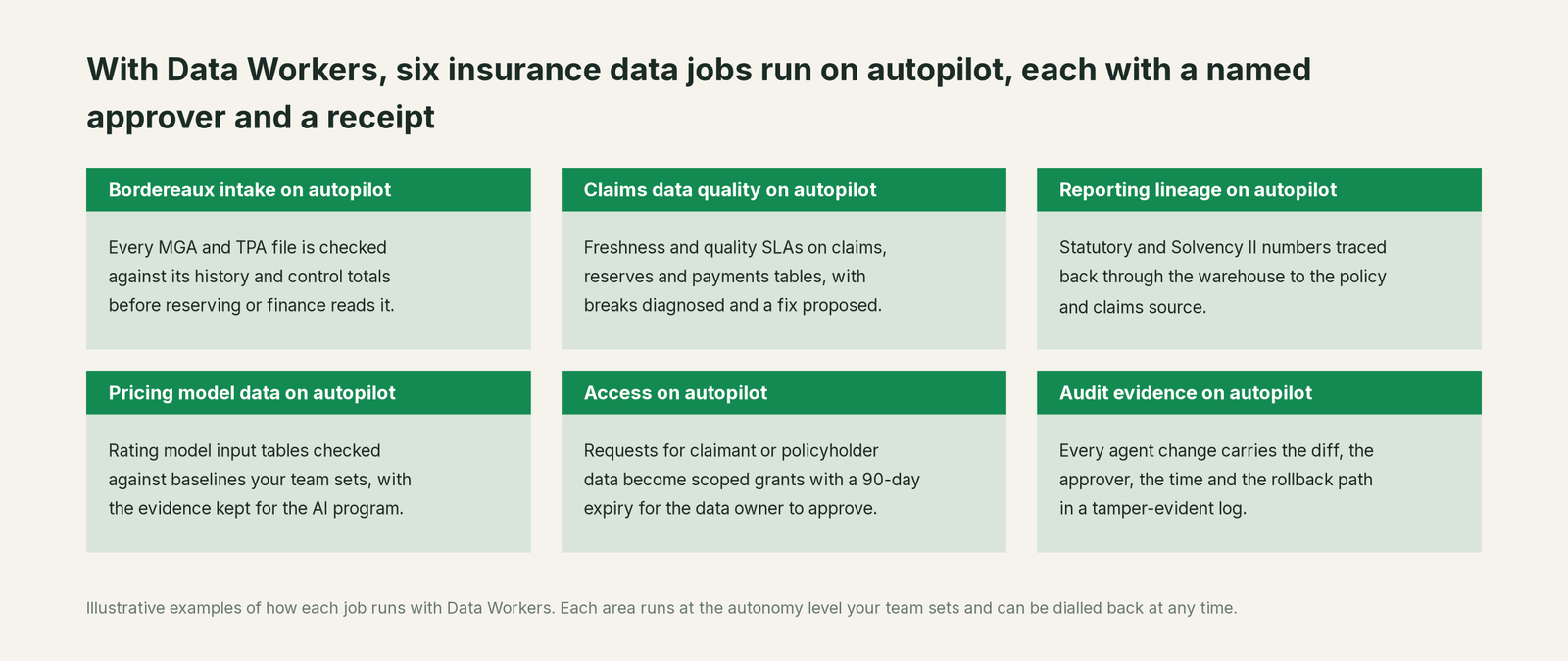
Actuaries, claims data owners and engineers keep every decision that matters. What leaves their week is chasing partner file layouts, re-running triangles and assembling lineage for a return. Who owns the agents covers accountability, and will Data Workers replace my data team answers the question your team will ask first. Sibling pages cover financial services and healthcare and life sciences, and our AI for insurance data infrastructure guide covers the wider estate.
The alternatives insurers weigh (as of Oct 2026)
- •Build it in house with coding agents and MCP servers. Insurers have capable engineering teams; the hard part is everything around the agent: approvals, rollback, receipts and context across every system. See build it ourselves.
- •Core-suite data platforms, such as Guidewire's analytics and data offerings. They know their own policy and claims model well; reserving and reporting data also runs through bordereaux, actuarial tools and the warehouse.
- •A catalog and lineage tool. It holds the glossary and lineage inventory; Data Workers acts on that context and keeps it current. See Data Workers vs a data catalog.
- •Data observability. Monitors raise the alarm; Data Workers diagnoses, proposes the fix and verifies it. See Data Workers vs data observability.
Each is sensible for its job. Changing production data across systems, with approvals and evidence, is the job Data Workers does. What is an agentic data platform sets out the category.
The case for your CFO
The outcome is reserves, returns and rate filings built on data someone checked. Bordereaux and claims breaks surface the morning they land instead of at quarter-end, and lineage for a supervisory question is a query rather than a project.
The risk story is short. Agents act only at the level you set per domain, from L0 manual to L4 autonomous, and regulated domains start at observe. In those domains every production change waits for a named person, an unanswered request expires and escalates rather than turning into a yes, and every change leaves a receipt with the diff and the rollback path. Your data stays in your systems, and there is zero migration: Data Workers works on top of the core suite, warehouse, actuarial tools and ticketing you already run. Is it safe to let AI agents change production data? and where does our data go? cover the detail.
Why now: state AI bulletins and NYDFS ask for lineage and documentation behind pricing and underwriting models, and the amended Solvency II rules take effect on 30 January 2027. A good first win is one bordereaux domain at L1 observe, where the team reviews the agents' records and receipts against the bar it set, then moves it to L2 propose.
Start with a pilot: $7,500 one-time, credited in full against the first year. Scale is from $1,000 a month and Enterprise from $3,000 a month, billed annually, with unlimited seats, no usage meter, no markup on model spend and your own model. Details are on pricing, the ROI calculator takes your own inputs, and the ROI of agentic data operations shows the model.
The sentence for upstairs: "Data Workers checks our claims and bordereaux data before reserving reads it and keeps the evidence our regulators ask for, and our data stays in our systems."
FAQ
Does Data Workers make us compliant with the NAIC AI bulletin, Part 500 or Solvency II? No product does that. Data Workers provides controls and evidence: named approvals, scoped access, privacy checks on pull requests, lineage, data baselines and a hash-chained audit trail. Your compliance team, actuaries and auditors decide how they map to your program.
Can the agents change reserving or reporting data on their own? Only at the level you set for that domain. We recommend reserving and regulatory reporting at L1 observe or L2 propose, so every fix is a proposal with its diff, blast radius and rollback path, waiting for the data owner.
Does it work with Guidewire, Duck Creek and SAS? Guidewire, Duck Creek, SAS and actuarial tools connect over their APIs or MCP servers today; Data Workers watches the data they produce in Snowflake, Databricks and dbt, which connect natively among 50+ connectors. SAS jobs keep running as they do now.
Where does policyholder and claimant data go? It stays in your systems. The agents run in your infrastructure with your credentials and your model key. The hosted Conductor receives workflow metadata only, such as table names, proposals with diffs and run records, never rows or credentials.
Does it test our pricing models for unfair discrimination? No. It checks the data behind the models: quality, baselines your team sets on the inputs, and lineage, with dated records. Bias analysis and rate decisions stay with your actuaries and model risk team.
What does a first quarter look like? One bordereaux or claims domain and one access queue at L1 observe in the first month, a move to L2 propose once the team trusts the receipts, then lineage for reporting and pricing data. What a Data Workers pilot looks like and the first 90 days walk through it.
Sources
- •NAIC, Artificial Intelligence topic page (Model Bulletin "adopted in December 2023"), accessed Oct 2, 2026: https://content.naic.org/insurance-topics/artificial-intelligence
- •Washington State Office of the Insurance Commissioner, The Use of Artificial Intelligence Systems in Insurance (WSR 24-10-025, based on the NAIC model bulletin), Apr 22, 2024, accessed Oct 2, 2026: https://lawfilesext.leg.wa.gov/law/wsr/2024/10/24-10-025.htm
- •NAIC, Insurance Data Security Model Law (MO-668), adopted 4th quarter 2017, accessed Oct 2, 2026: https://content.naic.org/sites/default/files/model-law-668.pdf
- •New York State Department of Financial Services, 23 NYCRR Part 500, accessed Oct 2, 2026: https://www.dfs.ny.gov/cybersecurity/23-NYCRR-Part-500
- •New York State Department of Financial Services, Insurance Circular Letter No. 7, Jul 11, 2024, accessed Oct 2, 2026: https://www.dfs.ny.gov/industry-guidance/circular-letters/cl2024-07
- •EIOPA Solvency II Single Rulebook, Directive 2009/138/EC Article 48 (actuarial function), accessed Oct 2, 2026: https://www.eiopa.europa.eu/rulebook/solvency-ii-single-rulebook/article-2131_en
- •EIOPA Solvency II Single Rulebook, Directive 2009/138/EC Article 82 (data quality for technical provisions), accessed Oct 2, 2026: https://www.eiopa.europa.eu/rulebook/solvency-ii-single-rulebook/article-2170_en
- •EIOPA, Solvency II (Directive (EU) 2025/2, new rules from 30 Jan 2027), accessed Oct 2, 2026: https://www.eiopa.europa.eu/browse/regulation-and-policy/solvency-ii_en
- •EIOPA, Opinion on Artificial Intelligence governance and risk management and Impact Assessment, 6 Aug 2025, accessed Oct 2, 2026: https://www.eiopa.europa.eu/publications/opinion-artificial-intelligence-governance-and-risk-management_en
- •EIOPA, Impact Assessment accompanying the Opinion on AI governance and risk management (50% non-life, 24% life, citing the May 2024 Digitalisation report), 6 Aug 2025, accessed Oct 2, 2026: https://www.eiopa.europa.eu/publications/opinion-artificial-intelligence-governance-and-risk-management_en
- •European Commission, AI Act regulatory framework (updated Aug 3, 2026): https://digital-strategy.ec.europa.eu/en/policies/regulatory-framework-ai
- •Data Workers, Security, accessed Oct 2, 2026: https://dataworkers.io/security/
- •Data Workers, Pricing, accessed Oct 2, 2026: https://dataworkers.io/pricing/