PII in logs: agents find it, your privacy owner approves the redaction
A release starts logging request bodies and personal data lands in application logs, traces and telemetry, then spreads to every store they feed. Here is how Data Workers finds it the day it ships, shows every copy, and puts a redaction rule in front of the privacy owner.
Key takeaways
- •The problem today. A release adds verbose logging and email addresses, account numbers and session tokens land in application logs, traces and metric labels. Each is copied into the SIEM, the observability tool and the security lake, and the first to notice is usually an analyst searching for something else.
- •What changes. Agents spot the new field the day it ships, find the personal data in it, list every copy and draft a redaction rule for review.
- •What stays with your people. The redaction rule itself: the privacy owner approves it, and detection engineering confirms the detection inputs it touches.
- •The result. Personal data in logs reaches an owner with the full picture within the hour, targeting that as the deployment matures, instead of surfacing at the next review.
The problem today
Logging is where personal data escapes. A developer logs a request body to chase a checkout error, an auth service prints the email in a failure message, a tracing library attaches a user ID to every span. The release is correct and the logs are wrong. OWASP's logging guidance lists access tokens, passwords, payment data and sensitive personal data as things to exclude, remove or mask before they are written.
Then the copies start. The stream goes through Kafka and Cribl or Vector into a SIEM, an observability tool and a security lake, and nobody owns a list of where one field ended up. Detection engineering needs source IPs and user IDs, so a blunt redaction rule can blind a detection. This is the privacy side of the security and observability telemetry playbook, on the shared platform described in the data platform playbook, and one workflow in the data platform teams group.
What changes with Data Workers
Agents watch the log tables you already land in your lake or warehouse. When a stream gains or changes a field, they check it for personal and sensitive data by name and by content, without sending sample values outside your network (where your data goes). They show every downstream copy and propose a redaction rule for the privacy owner. Your team applies the approved rule in the log pipeline, and the next scan confirms it worked. Agents find and propose; they do not mask or delete log data themselves.
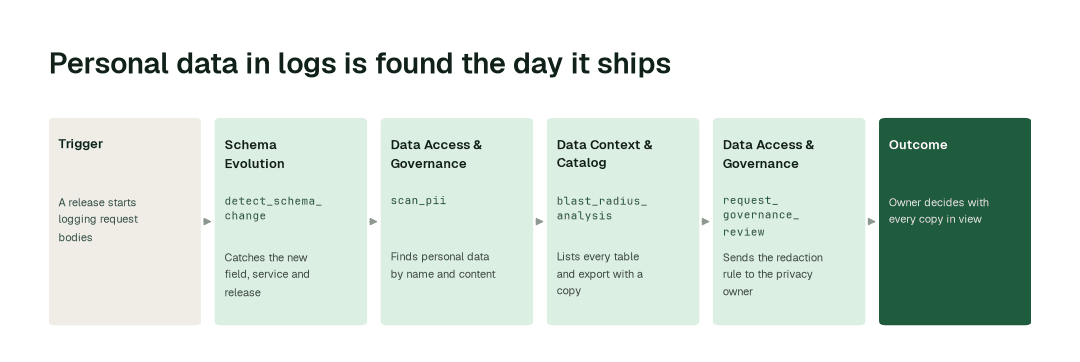
The workflow, step by step
- 1.The Schema Evolution agent calls
detect_schema_changeand catches the new or widened field in a log stream, with the service and release that changed it. How it works. - 2.The Data Access & Governance agent calls
scan_piiand checks the field and its neighbours for personal data and sensitive values, by column name and by content, then tags what it finds. PII handling. - 3.The Data Context & Catalog agent calls
blast_radius_analysisand lists every lake table, model, dashboard and export that reads the field, so the privacy office sees the full footprint. - 4.The Data Access & Governance agent calls
request_governance_reviewand sends the redaction proposal to the privacy owner, with the affected copies, the detection inputs it changes and how to undo it. How governance works.
Anything the agents write, such as the finding or the note to the service owner, is scrubbed of the personal data itself: it names the field and the release, never the value.
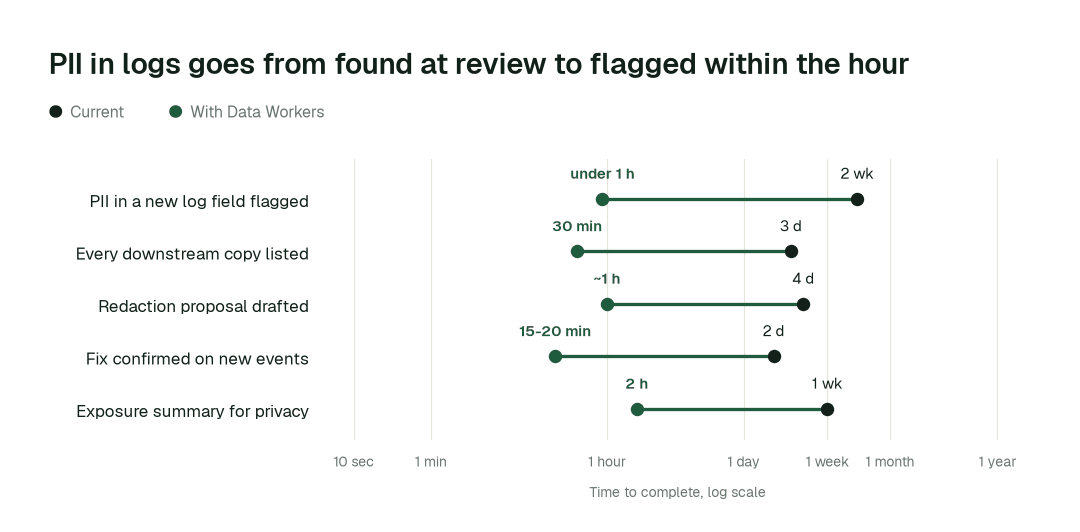
The impact metrics we move
- •New log field with personal data flagged: from about 2 weeks to under 1 h
- •Every downstream copy listed: from about 3 days to 30 min
- •Redaction proposal with affected detections: from about 4 days to about 1 h
- •Fix confirmed on new events: from about 2 days to 15-20 min
What goes on autopilot
- •New log tables and fields are scanned as they land, so a debug line that ships on Tuesday is flagged on Tuesday.
- •Sensitive columns are tagged, so lineage and access treat them differently from the rest of the stream. The wider classify, restrict and audit steps are in the PII playbook for pipelines.
- •A recurring routine re-scans the streams you name, so a regression in the next release shows up as a new finding.
Where your people stay in charge
Every redaction rule goes to the privacy owner, because it changes what the business can see and what an investigation can recover. Detection engineering confirms any rule that touches a field a detection reads, and Legal decides what happens to log data already stored, including anything under a hold. Everything starts at L1, observing only, and autonomy rises only on evidence. For the same pipelines, see SIEM cost control and detection data quality.
The pilot
- •Scope. The application and authentication log streams of five services landing in one lake or warehouse, at L2.
- •First week. Agents run at L1, observing only, and show the fields and copies they would have flagged, with receipts.
- •By week two. Scans on new fields run on their own; every redaction rule stays with the privacy owner.
- •At day 30. We review the impact metrics against your baseline, targeting:
- •New log field with personal data flagged: from about 2 weeks to under 1 h
- •Every downstream copy listed: from about 3 days to 30 min
- •Fix confirmed on new events: from about 2 days to 15-20 min
- •Cost. Start with a pilot ($7,500 one-time, credited in full against the first year). Scale is from $1,000 a month and Enterprise from $3,000 a month, billed annually, with unlimited seats, no usage meter and no markup on model spend. See pricing.