How manufacturing data teams go fully agentic and autonomous
Going fully agentic and autonomous does not mean adding a chatbot to the warehouse. For manufacturing data teams, it means climbing from agents that assist, to agents that run the routine work under your governance, to a data back office that largely runs itself: building and fixing pipelines, catching bad data before it reaches a number, keeping definitions and access governed and verifying every outcome, while people set direction and approve what matters. This is what that climb looks like, step by step.
Key takeaways
- •Who this is for. Data leaders and teams at manufacturers and industrial companies.
- •The problem today. Models for maintenance and quality degrade quietly as equipment changes.
- •What changes. Data Workers streams machine data, joins process to quality and finance, watches model drift and keeps production reports running as routines.
- •What stays with your people. Anything that moves money, a filing or a regulated number waits for a named approver.
- •The result. Teams spend their time on manufacturing decisions, not on reconciling data.
The shift
Plants run on MES, machine, quality and ERP data that rarely agree, and every investigation starts with a week of reconciliation. Models for maintenance and quality degrade quietly as equipment changes.
Data Workers streams machine data, joins process to quality and finance, watches model drift and keeps production reports running as routines.
The use cases we run in manufacturing
- •[Predictive maintenance data](/use-cases/predictive-maintenance/). Failure predictions stay accurate as equipment changes.
- •[Quality management data](/use-cases/quality-management/). Root cause takes hours, not weeks.
- •[Live production monitoring data](/use-cases/live-production-monitoring/). Shift huddles run on verified OEE.
- •[Automated production reports](/use-cases/automated-production-reports/). The morning report is ready before anyone arrives.
- •[Supplier performance data](/use-cases/supplier-performance/). Supplier reviews start from current scorecards.
- •[Yield and scrap data](/use-cases/yield-scrap/). Plants compare yield on one definition, tied to finance.
Teams we work with in manufacturing
Each team has a full playbook and a best-practice report.
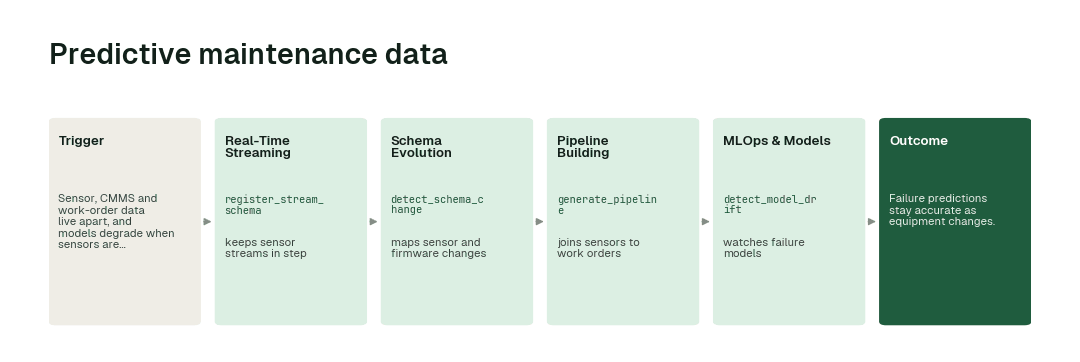
A workflow, end to end: predictive maintenance data
Agents keep sensor streams mapped, join them to work orders and watch model drift.
The impact metrics we move
- •Sensor change mapped: from about a week to ~1 h (predictive maintenance data)
- •Lot traced end to end: from about a week to 15-20 min (quality management data)
- •Machine gap caught: from about 2 hours to minutes (live production monitoring data)
- •Daily report: from about 3 hours to minutes (automated production reports)
- •Scorecard refresh: from about a month to 1 day (supplier performance data)
- •Yield report: from about a week to ~1 h (yield and scrap data)
The climb: from assisted to autonomous to agentic
Our thesis is that the data platform climbs in stages. In manufacturing: agents first assist, proposing every fix with a receipt; then routine verification, mapping and reconciliation run on their own under your governance; and finally the back office largely runs itself while people set direction.
The pilot
- •Scope. One use case from the list above, on one line of business.
- •First week. Agents run at L1, observing only, and show the fixes they would have made, with receipts.
- •By week two. The routine work above runs on its own; anything sensitive stays with a named approver.
- •At day 30. We review the impact metrics against your baseline:
- •Sensor change mapped: from about a week to ~1 h
- •Lot traced end to end: from about a week to 15-20 min
- •Machine gap caught: from about 2 hours to minutes
- •Cost. Start with a pilot ($7,500 one-time, credited in full against the first year). Scale is from $1,000 a month and Enterprise from $3,000 a month, billed annually, with unlimited seats, no usage meter and no markup on model spend. See pricing.