A playbook for data leaders at health plans and payors
If you are a data leader at a health plan or payor, this is your playbook. It covers what your team ships, where its week goes today, the use cases agents take over first, the autonomy you can safely grant in each domain, and what to show leadership after the first quarter.
Key takeaways
- •Who this is for. Data leaders and teams at health plans, Medicare Advantage and Medicaid plans and PBMs.
- •The problem today. Most analytics time goes to proving the data before anyone can use it.
- •What changes. Data Workers verifies every feed on arrival, governs the measures and definitions each program uses and holds anything that moves money or a regulatory filing for a named approver.
- •What stays with your people. Anything that moves money, a filing or a regulated number waits for a named approver.
- •The result. Teams spend their time on health plans and payors decisions, not on reconciling data.
The shift
Health plans run on claims, eligibility, provider and pharmacy data from hundreds of trading partners, and every program from payment integrity to Stars depends on it being right. Most analytics time goes to proving the data before anyone can use it.
Data Workers verifies every feed on arrival, governs the measures and definitions each program uses and holds anything that moves money or a regulatory filing for a named approver.
The use cases we run in health plans and payors
- •[Payment integrity data](/use-cases/payment-integrity/). Recovery models run on verified claims, and audits start from evidence.
- •[Cost of care data](/use-cases/cost-of-care/). Medical economics explains trend in days, not after the quarter.
- •[Stars and quality data](/use-cases/stars-quality/). Gaps are closed months before submission, with lineage ready for audit.
- •[Risk adjustment data](/use-cases/risk-adjustment/). Encounter data is right before it is submitted.
- •[Network performance data](/use-cases/network-performance/). Network teams see adequacy and performance on current data.
- •[Utilization management data](/use-cases/utilization-management/). UM metrics agree across operations, clinical and compliance.
- •[Member experience data](/use-cases/member-experience/). Service teams and AI agents see the same member.
Teams we work with in health plans and payors
Each team has a full playbook and a best-practice report.
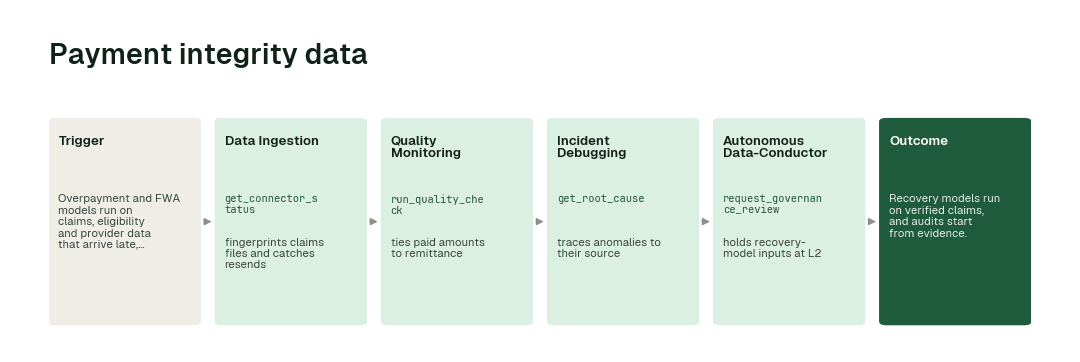
A workflow, end to end: payment integrity data
Agents keep every claims and provider feed verified on arrival, so recovery models and audit selection run on data that has already been tied out.
The impact metrics we move
- •Duplicate claim file caught: from about a week to 15-20 min (payment integrity data)
- •Monthly trend refresh: from about 2 weeks to 1 day (cost of care data)
- •Supplemental feed onboarded: from about 3 weeks to 2 days (stars and quality data)
- •Resend handled: from about a week to ~1 h (risk adjustment data)
- •Directory change reflected: from about 2 weeks to 4 h (network performance data)
- •Turnaround report: from about a week to ~1 h (utilization management data)
- •Member view refresh: from about a week to 4 h (member experience data)
The climb: from assisted to autonomous to agentic
Our thesis is that the data platform climbs in stages. In health plans and payors: agents first assist, proposing every fix with a receipt; then routine verification, mapping and reconciliation run on their own under your governance; and finally the back office largely runs itself while people set direction.
The pilot
- •Scope. One use case from the list above, on one line of business.
- •First week. Agents run at L1, observing only, and show the fixes they would have made, with receipts.
- •By week two. The routine work above runs on its own; anything sensitive stays with a named approver.
- •At day 30. We review the impact metrics against your baseline:
- •Duplicate claim file caught: from about a week to 15-20 min
- •Monthly trend refresh: from about 2 weeks to 1 day
- •Supplemental feed onboarded: from about 3 weeks to 2 days
- •Cost. Start with a pilot ($7,500 one-time, credited in full against the first year). Scale is from $1,000 a month and Enterprise from $3,000 a month, billed annually, with unlimited seats, no usage meter and no markup on model spend. See pricing.