Best practices for agentic sales data marts: a field guide for sales data product teams
The sales data mart is the most-read data product in most enterprises and the most fragile. This report lays out how the best sales data product teams are moving it to an agentic back office, practice by practice, with the old world, the new world and the numbers to watch.
Ask any sales data product manager what their week looks like and the answer is rarely the roadmap. It is the CRM change that broke the forecast, the hierarchy that no longer ties to finance, the territory file that arrived with duplicates, and the seller who stopped trusting a dashboard because it disagreed with the one their manager uses. The sales data mart is read every morning by thousands of sellers and every week by leadership. It is also rebuilt every fiscal year, reshaped every reorg and edited daily by CRM admins who never talk to the data team.
Enterprises have noticed. Software companies now run sales data as a domain in a data mesh, with Directors of Sales Data Products owning pipeline, bookings, hierarchies and the agentic applications sellers use. Health plans hire Lead Product Managers to run portfolios of sales data platforms for their distribution channels. The mandate in every posting is the same: treat sales data as a product, measure adoption, and feed AI agents that sellers trust. The trap is also the same. Without automation, the team spends its time keeping the mart alive and never ships the products it was hired to build.
Our view, as product people who have run data platforms: the work that keeps a sales data mart correct is repeatable, and agents should own it. When the back office runs itself, the sales data product team stops being a reporting function and becomes what the job descriptions promise.
The old world
It is 8:40 on the Monday after quarter close. A CRM admin split a stage on Friday. The stage-weighted forecast dropped 6% overnight, and three regional VPs have already messaged the CRO. An analyst traces it by 11:00, an engineer patches the dbt model by 14:00, the backfill finishes at 17:00 and the correction email goes out at 18:30. Meanwhile, finance and sales ops are arguing about which bookings number to put in the board deck, the territory file for next quarter is sitting in someone's inbox with 23 accounts assigned twice, and the seller-facing account agent is still recommending accounts from last year's territories. Nobody on the data team touches the roadmap this week.
The new world
Same Monday with Data Workers. The stage split was mapped by the Schema Evolution agent on Friday evening, the forecast model updated and tested by Pipeline Building, and Quality Monitoring confirmed pipeline still ties to the CRM. Autonomous Data-Conductor held the change to the forecast for the RevOps lead, who approved it from her phone on Saturday. Bookings tie to finance every morning, so there is one number for the board deck. The territory file was profiled on arrival, the duplicates traced to a merger and proposed for reassignment. The seller agent reads governed FY definitions. The data team spends Monday on the next seller-facing product.
Here is that new world as a chain of hand-offs between agents:
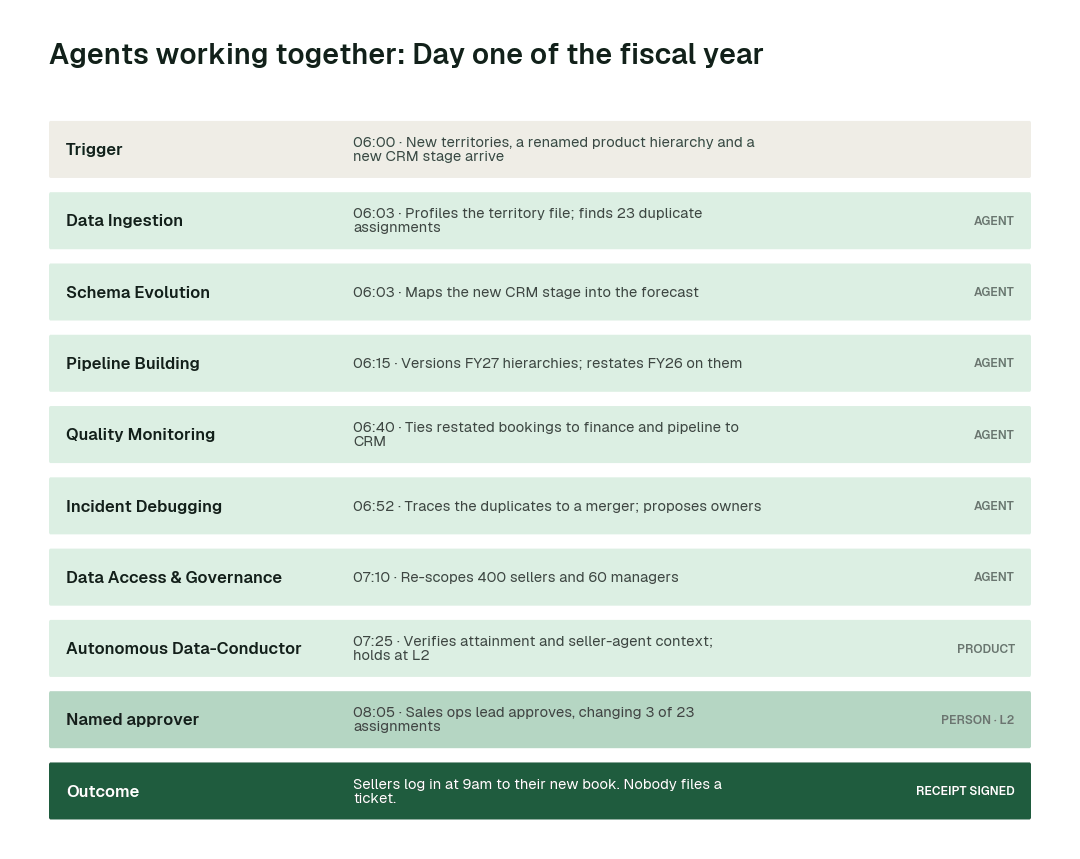
The full playbook walks through this scenario and three more use cases in depth.
The rest of this report walks through the 8 practices that make that morning possible. At a glance:
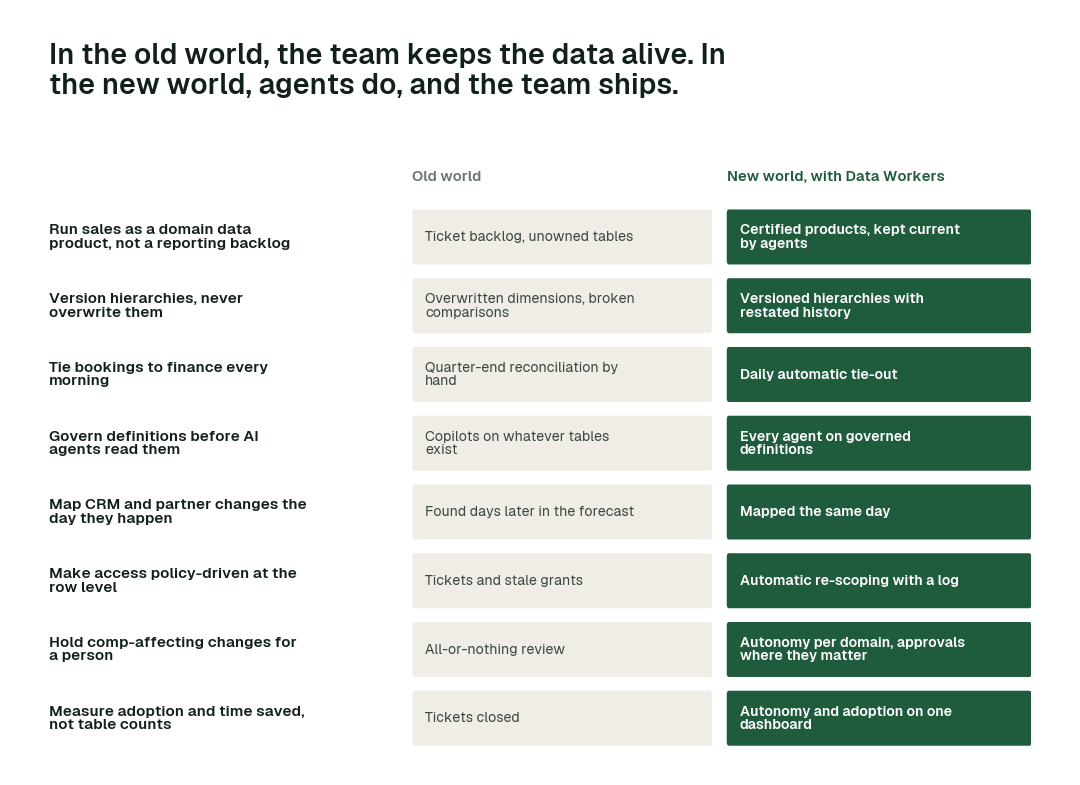
The practices, one by one
1. Run sales as a domain data product, not a reporting backlog
A backlog of report requests produces a mart nobody owns. A domain data product has an owner, a roadmap, SLAs and adoption metrics, and its outputs are discoverable and reusable.
The old world. Requests arrive as tickets, each answered with a new table or dashboard. Ownership is implicit, documentation is a wiki page from two years ago, and nobody can say which of the 400 sales tables are still used.
The new world. Data Context & Catalog registers every sales data product with owner, SLA, lineage and consumers, and keeps it current as agents change things. Autopilot enforces the standard: no certified product without an owner and an SLA. Cost Savings & Data Cleanup retires the tables nobody reads.
In practice. A sales data team inventories its mart and finds 412 tables. Agents map consumers for each, propose 140 for retirement, and register 38 certified data products with owners. The catalog becomes the product surface sellers and ops actually use.
What to measure. Share of sales data products with an owner, SLA and governed definition.
2. Version hierarchies, never overwrite them
Product, customer, territory and org hierarchies change every fiscal year and in between. Overwriting them breaks year-over-year comparisons and quietly changes historical attainment.
The old world. Finance publishes a new product hierarchy, someone overwrites the dimension table, and last year's bookings by product family change. Leadership notices in a QBR.
The new world. Pipeline Building creates a new version of each hierarchy, restates prior periods on the new structure, and writes tests that prove historical totals are unchanged. Context Wizard records which version every metric uses.
In practice. A product family is split in two. Agents map SKUs to the new families, restate FY26 on the FY27 structure, and prove FY26 totals are identical under both versions before anything publishes.
What to measure. Year-over-year comparisons that survive a reorg.
Practices like these compound. Across the routine work they cover, here is the difference in elapsed time:
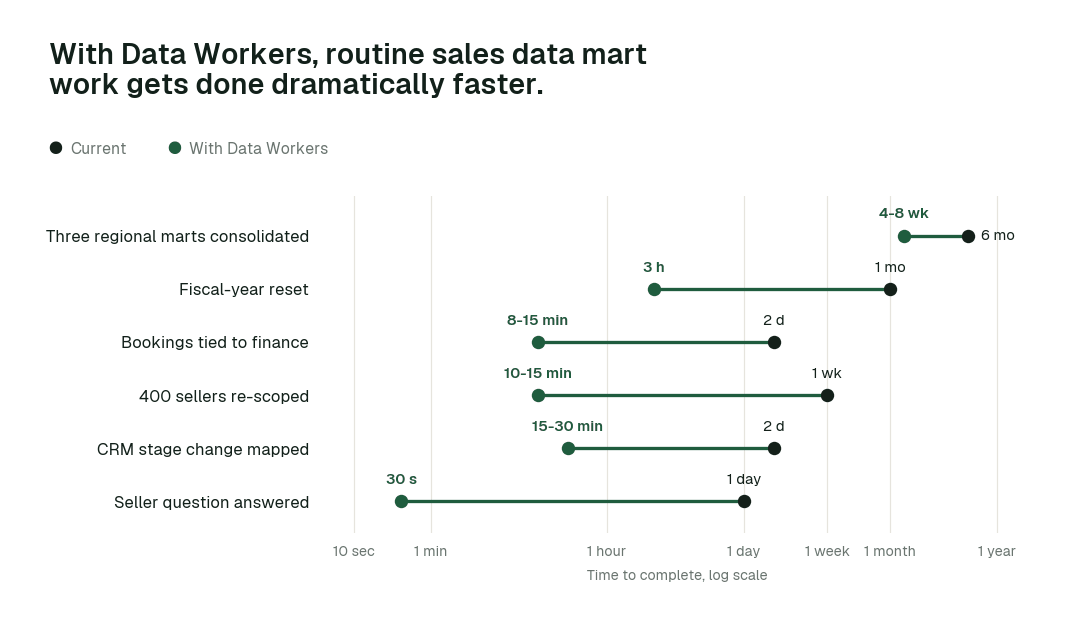
The biggest change is 400 sellers re-scoped: from about a week to 10-15 min. Work that waited in queues finishes in minutes or hours, because agents detect, fix and verify in one pass.
3. Tie bookings to finance every morning
When sales and finance disagree on bookings, every downstream product loses credibility, and the argument repeats at every close.
The old world. Reconciliation happens at quarter end, by hand, under deadline. Differences are explained in footnotes.
The new world. Quality Monitoring ties bookings to finance and pipeline to the CRM in a daily routine. Incident Debugging traces any gap to the change behind it. Conductor holds any publish that does not tie.
In practice. A billing system change delays credit memos by a day. The morning tie-out catches a 0.8% gap, traces it to the delay, and holds the attainment refresh until the memos land.
What to measure. Days per quarter where bookings tie to finance.
4. Govern definitions before AI agents read them
A seller-facing agent built on an ungoverned table spreads a wrong number to every seller at once, and trust in AI collapses faster than trust in dashboards.
The old world. Each assistant is pointed at whatever tables a team could find. Pipeline, bookings and attainment mean different things in different places.
The new world. Data Context Wizard holds one governed definition of pipeline, bookings, attainment, win rate, velocity and every hierarchy level, with provenance. Seller agents, forecasting models and dashboards all answer from it.
In practice. The CRO's copilot is asked for Q3 pipeline coverage. It answers with the governed definition, cites the source tables, and matches the forecast dashboard to the dollar.
What to measure. Agent answers that match certified dashboards.
5. Map CRM and partner changes the day they happen
CRM admins and partner systems change weekly. Each change is small; the damage compounds because it is discovered late.
The old world. A new stage, field or picklist value silently drops rows from the forecast. Partner feeds change layout and arrive half-loaded.
The new world. Schema Evolution detects every CRM and partner change, maps it into the mart, and Pipeline Building updates the models with tests. Conductor verifies the forecast before anyone opens it.
In practice. A partner-sourced deal stage is added on Thursday. By Thursday night the forecast includes it, tested and approved.
What to measure. Time from CRM change to updated, verified model.
6. Make access policy-driven at the row level
Comp, quota, territory and contact data need different rules for sellers, managers, ops and finance, and they change with every territory move.
The old world. Access is granted by ticket and revoked rarely. After a reorg, sellers can see accounts they no longer own.
The new world. Data Access & Governance re-scopes row-level access whenever territories change and logs every grant and revoke. Data Security keeps contact PII classified.
In practice. A reorg moves 60 sellers. Their access follows them the same morning, and the audit log shows every change.
What to measure. Hours from territory change to correct access.
7. Hold comp-affecting changes for a person
Speed matters, but attainment and quota feed people's pay. Trust depends on a human owning those numbers.
The old world. Either everything waits for review, or changes go straight to production and get rolled back after complaints.
The new world. Autonomy is set per domain: staging and CRM mapping at L3, hierarchies, territory, quota and attainment at L2. Agents propose with a full diff and a named approver decides.
In practice. An attainment correction affecting 14 sellers arrives with before-and-after numbers per seller. The sales ops lead approves it in one step.
What to measure. Comp-affecting changes with a named approver on record.
That balance, autonomy where work is reversible and a named approver where it matters, shows up clearly by task class:
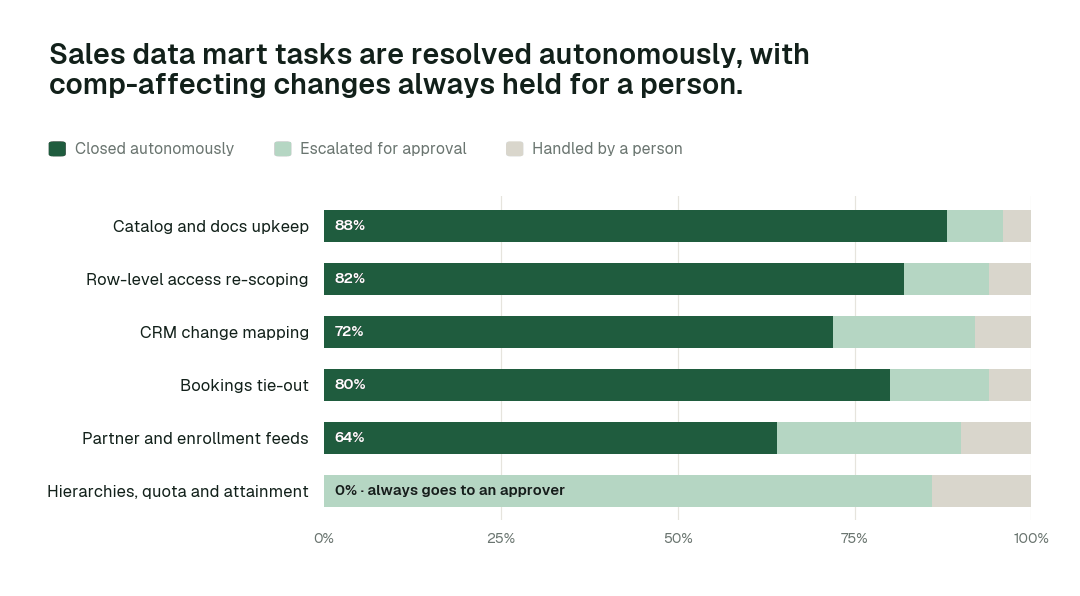
Catalog and docs upkeep closes autonomously 88% of the time. For Hierarchies, quota and attainment, autonomous closure is 0% by design: every change is proposed with a full diff and approved by a named person.
8. Measure adoption and time saved, not table counts
Sales data product leaders are judged on whether sellers use the products and whether the business moves.
The old world. The team reports tickets closed and tables built. Leadership cannot see value.
The new world. The Autopilot dashboard shows how much of each product's upkeep runs on its own, at what token cost, and what the team shipped with the time it got back.
In practice. After one quarter the team shows leadership that 70% of mart upkeep is autonomous and two new seller products shipped.
What to measure. Share of upkeep running autonomously; products shipped.
Designing the autonomy ladder
Autonomy is set per task class, not per tool. This is where we would set each class for a mature deployment, and why:
| Task class | Closed autonomously | Escalated | Handled by a person | Where we set it | Why |
|---|---|---|---|---|---|
| Catalog and docs upkeep | 88% | 8% | 4% | L4 once the receipts are clean | The work is reversible and repeatable |
| Row-level access re-scoping | 82% | 12% | 6% | L4 once the receipts are clean | The work is reversible and repeatable |
| CRM change mapping | 72% | 20% | 8% | L3: acts and keeps a rollback point | Most cases are routine; the rest escalate with evidence |
| Bookings tie-out | 80% | 14% | 6% | L4 once the receipts are clean | The work is reversible and repeatable |
| Partner and enrollment feeds | 64% | 26% | 10% | L3: acts and keeps a rollback point | Most cases are routine; the rest escalate with evidence |
| Hierarchies, quota and attainment | 0% | 86% | 14% | L2: always proposed to a named approver | The number carries accountability outside the data team |
The operating model: who owns what
Agents change who does the work, not who is accountable for it:
| Role | Owns | What the agents take off their plate |
|---|---|---|
| Director of Sales Data Products | Standards, autonomy levels per domain and which domain goes next | Assembling status, chasing owners, keeping the catalog current |
| Domain owners and approvers | Hierarchies, territories, quota and attainment | Preparing the diff, blast radius and rollback plan for every proposal |
| Data engineers | Reviewing agent proposals and building new data products | CRM stage, field and picklist changes are mapped into the mart the day they happen; bookings are tied to finance and pipeline to the CRM every morning |
The swarm behind the practices
No single agent delivers these practices. Each one is a hand-off between specialists, coordinated under the autonomy you set per domain.
| Agent | What it does on a sales data mart |
|---|---|
| Connectors and Data Ingestion | Land CRM, CPQ, billing, product usage, partner and enrollment feeds, and profile every load |
| Schema Evolution | Maps CRM stage, field and picklist changes and partner feed layouts into the mart |
| Pipeline Building | Builds and versions hierarchy, territory, quota and attainment models in dbt, with tests |
| Quality Monitoring | Ties bookings to finance, pipeline to CRM and attainment to comp every day |
| Incident Debugging | Traces a forecast or attainment discrepancy to the change that caused it |
| Data Access & Governance | Applies role-based rules to comp, quota, territory and contact data and logs every grant |
| Data Context & Catalog | Keeps every sales data product discoverable with owner, SLA, lineage and consumers |
| Cost Savings & Data Cleanup | Retires duplicate marts, stale snapshots and abandoned analyst copies |
Data Context Wizard holds one governed definition of pipeline, bookings, attainment, win rate, pipeline velocity and every hierarchy level. Dashboards, forecasting models and every seller-facing AI agent answer from the same definitions, so the agent's recommendation and the leader's dashboard never disagree. Autonomous Data-Conductor verifies the numbers that matter before the forecast call and before seller agents read them. Spellbook Data Catalog makes each sales data product discoverable for sellers, ops and analysts, in plain English.
What disappears
The clearest sign the practices are working is what stops happening:
- •The Monday forecast surprise after a CRM change.
- •Quarter-end reconciliation between sales and finance.
- •Broken year-over-year comparisons after a reorg.
- •Sellers seeing accounts they no longer own.
- •Copilot answers that disagree with the dashboard.
- •Weeks of broken dashboards at the start of the fiscal year.
The magic is not any single agent. It is that the back office simply keeps running. Bad data is caught where it enters, not where it is read. Every new table gets quality rules and documentation without anyone writing them. Access follows policy instead of a queue. Fixes are rerun, verified and explained before anyone opens a dashboard. Cost is cleaned up every week instead of every budget cycle. And every one of those actions leaves a signed receipt, so the team can see exactly what happened and roll anything back. For the people on the team, the experience is quieter mornings, fewer tickets and more time for the products the business asked for.
A product manager's scorecard
If you own this data as a product, these are the numbers to bring to every quarterly review:
- •Incidents reaching sellers or leadership per month
- •Mean time from CRM change to verified model
- •Days per quarter bookings tie to finance
- •Share of sales data products certified (owner, SLA, definition)
- •Share of upkeep closed autonomously, and its token cost
- •Seller adoption of sales data products and agents
The climb: from assisted to autonomous to agentic
Our thesis is that the data platform climbs the way analytics did, in stages, and that the hard part of data work was never knowing what to do but doing it. For enterprise sales data mart teams, the climb looks like this:
- •Assisted. Agents work alongside your team. They read the whole stack, show what needs doing and propose every fix with a receipt; hierarchies, territories, quota and attainment always go to a named approver.
- •Autonomous, under your governance. Routine work runs on its own: cRM stage, field and picklist changes are mapped into the mart the day they happen, bookings are tied to finance and pipeline to the CRM every morning, and row-level access follows territory changes automatically. Your team governs the agents instead of doing the upkeep.
- •The agentic enterprise. A sales data team that ships seller-facing products instead of rebuilding hierarchies and answering 'which number is right'. People set direction, and the platform carries it out.
You choose the altitude, every step is visible and reversible, and the pilot below is the first rung.
The pilot: how enterprise sales data mart teams start
The pilot is how your team proves the value on its own data before committing.
- •What we connect. Salesforce or Dynamics CRM; CPQ and billing; Snowflake or Databricks; dbt; Airflow or Dagster; Tableau or Looker; seller-facing AI agents, over MCP, inside your infrastructure. Nothing migrates.
- •Scope. The fiscal-year reset as a mission at L2.
- •First week. Agents run at L1 across the scoped domain. They map every pipeline, definition and lineage path and show the fixes they would have made, with receipts, so your team sees the value before anything changes.
- •By week two. CRM stage, field and picklist changes are mapped into the mart the day they happen and bookings are tied to finance and pipeline to the CRM every morning start running on reversible work. Hierarchies, territories, quota and attainment stay at L2 with a named approver.
- •At day 30. We review the impact metrics against your baseline:
- •Seller question answered: from about a day to seconds
- •400 sellers re-scoped: from about a week to 10-15 min
- •Fiscal-year reset: from about a month to hours
- •the share of catalog and docs upkeep closed autonomously, targeting 88% as the deployment matures
- •What you decide. Whether to expand to the next domain. The pilot fee is credited in full against the first year.
- •Cost. Start with a pilot ($7,500 one-time, credited in full against the first year). Scale is from $1,000 a month and Enterprise from $3,000 a month, billed annually, with unlimited seats, no usage meter and no markup on model spend. See pricing.
The pilot is the start of a longer curve:
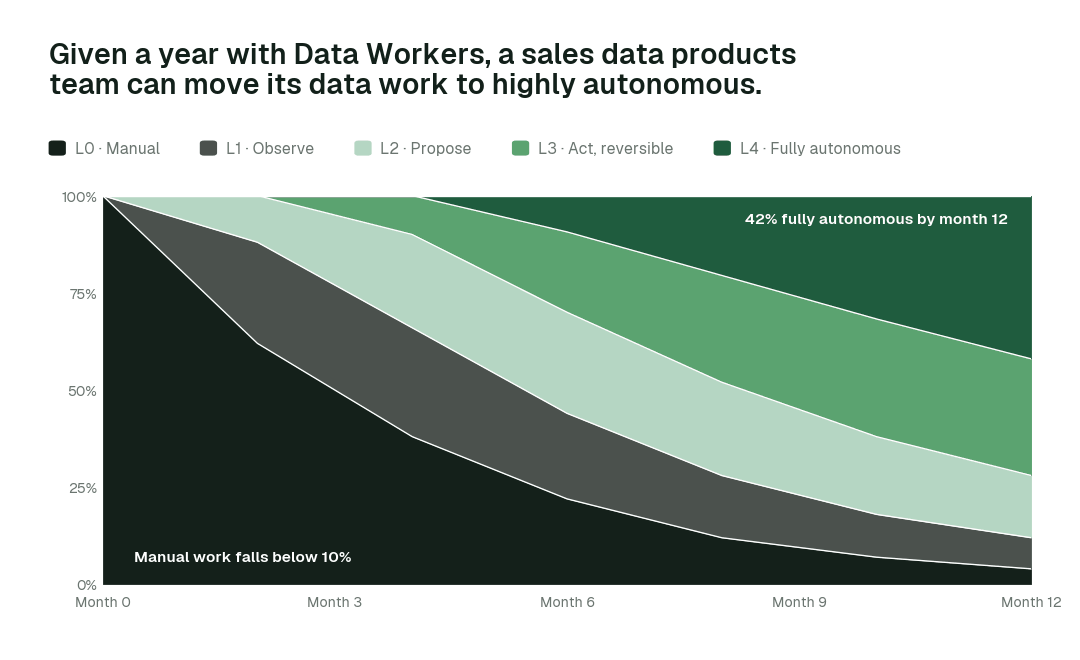
By month 12, more than 42% of agent actions run fully autonomously and manual work falls below 10%, while comp-affecting changes stay with a named approver.
Read the full playbook: Sales data product, sales data science and sales analytics platform teams