Best practices for agentic pharma commercial data: a field guide for launch and RWD teams
Commercial data is licensed, restated and argued over, and launches cannot wait. This report covers how pharma commercial data teams use agents to keep launches on schedule and numbers consistent.
Pharma commercial teams run on data they do not own: prescription, claims, specialty pharmacy and HCP data licensed from vendors, joined with CRM engagement and omnichannel data. Commercial Data Product Owners in central data and AI organizations are now responsible for turning that into launch-ready data products.
The constraints are unusual. Vendors restate history regularly, licensing terms limit what can be joined and shared, HCP masters rot, and every brand defines its KPIs slightly differently. And launch dates do not move.
The work that absorbs restatements, enforces licenses and keeps definitions aligned is repeatable. Agents should run it, so the team supports the launch instead of rebuilding its plumbing.
The old world
A new indication launches in six weeks. The launch dashboard is half-built because a vendor changed its layout, an eight-week restatement just moved NBRx by territory without explanation, legal is asking which tables include data under a renegotiated license, and two brands report different TRx for the same market.
The new world
With Data Workers, the launch data product is built as a mission weeks ahead. Restatements are detected and only the affected weeks reprocessed, with a summary of what moved. License terms are enforced on every join and share, and Spellbook shows them on each dataset. KPIs have one governed definition across brands.
Here is that new world as a chain of hand-offs between agents:
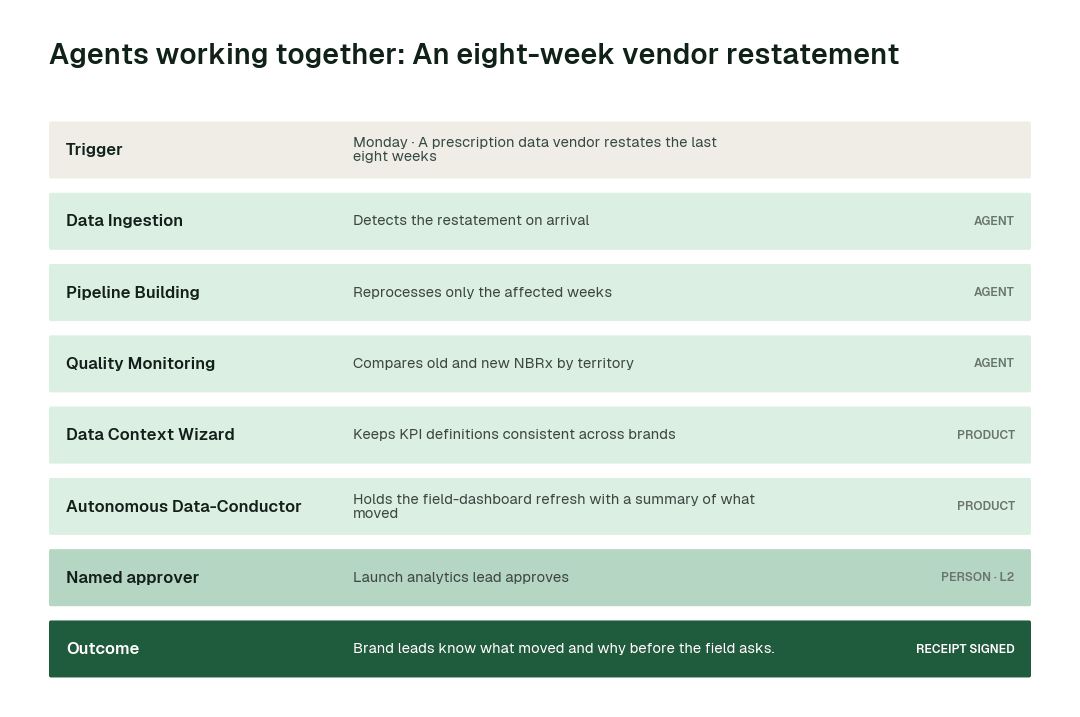
The full playbook walks through this scenario and three more use cases in depth.
The rest of this report walks through the 6 practices that make that morning possible. At a glance:
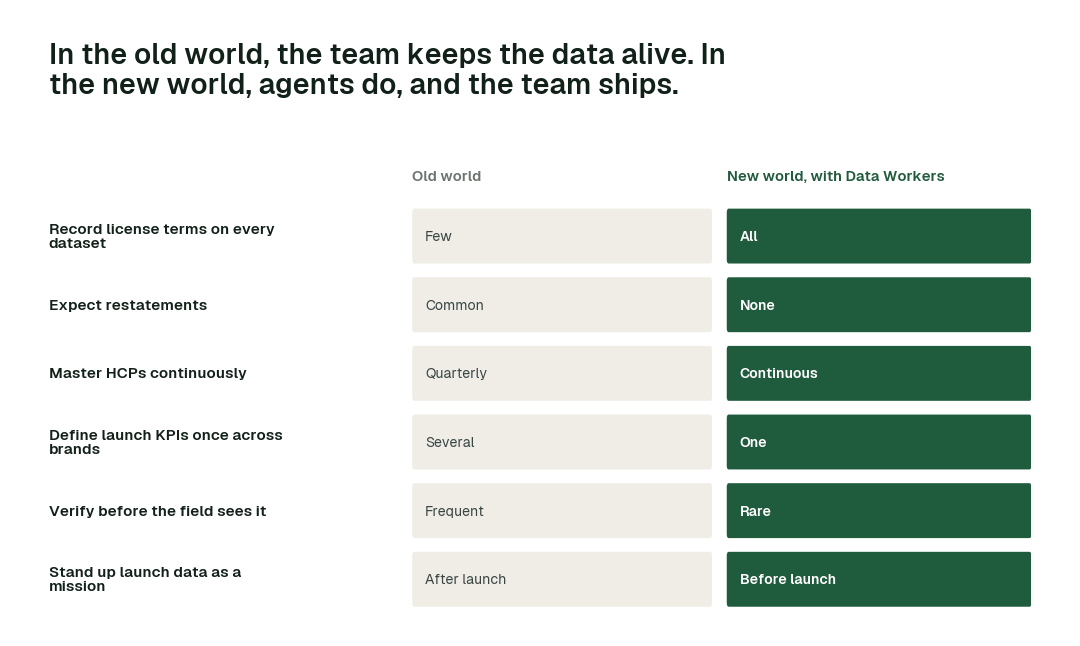
The practices, one by one
1. Record license terms on every dataset
Redistribution and retention limits have to be enforced in the data.
The old world. Terms live in contracts.
The new world. Access & Governance enforces licensing rules; Spellbook records terms on each dataset.
In practice. A renegotiated license is enforced across every table in hours.
What to measure. Datasets with license terms on record.
2. Expect restatements
Vendors restate weeks of history regularly.
The old world. Full reloads and unexplained moves.
The new world. Ingestion detects restatements; Pipeline Building reprocesses only affected weeks; Conductor explains what moved.
In practice. An eight-week restatement arrives with a territory-level summary.
What to measure. Unexplained KPI moves reaching the field.
Practices like these compound. Across the routine work they cover, here is the difference in elapsed time:
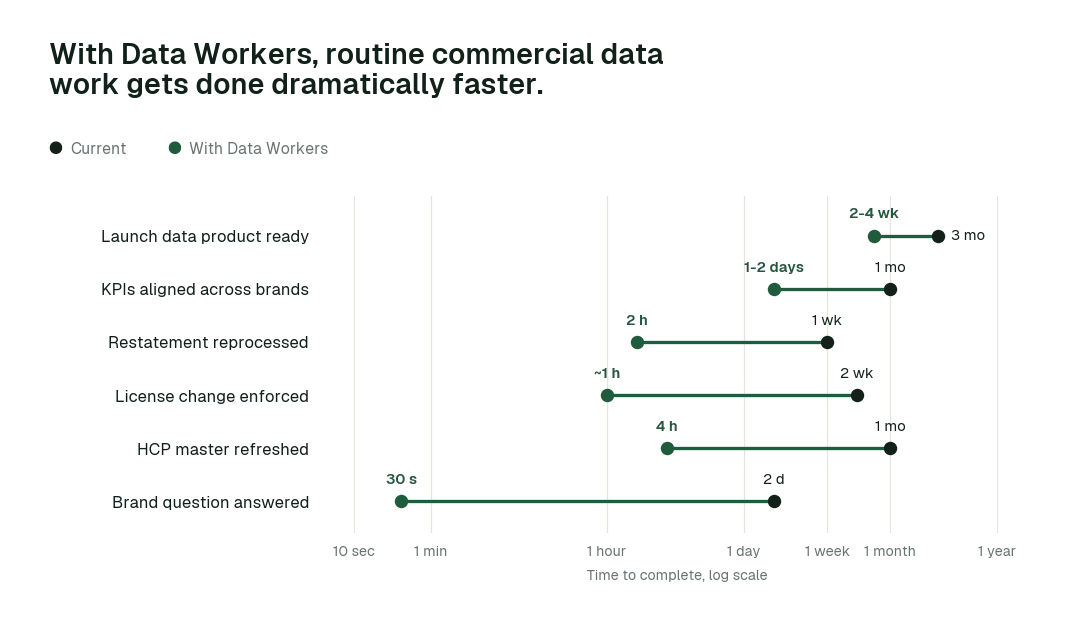
The biggest change is License change enforced: from about 2 weeks to ~1 h. Work that waited in queues finishes in minutes or hours, because agents detect, fix and verify in one pass.
3. Master HCPs continuously
Targeting lists rot as NPIs and affiliations change.
The old world. Quarterly refreshes.
The new world. A standing routine refreshes the HCP master and flags conflicts for a steward.
In practice. An affiliation change reaches targeting the same week.
What to measure. HCP master freshness.
4. Define launch KPIs once across brands
NBRx and TRx should mean the same thing everywhere.
The old world. Each brand has its own SQL.
The new world. Context Wizard holds governed KPI definitions used by dashboards, field tools and copilots.
In practice. Two brands report identical TRx for a shared market.
What to measure. Live definitions per KPI.
5. Verify before the field sees it
Field teams lose trust fast.
The old world. Refreshes publish automatically, errors and all.
The new world. Conductor verifies weekly loads and holds refreshes that move without explanation.
In practice. A vendor gap is held and explained before Monday.
What to measure. Field-facing incidents per quarter.
That balance, autonomy where work is reversible and a named approver where it matters, shows up clearly by task class:
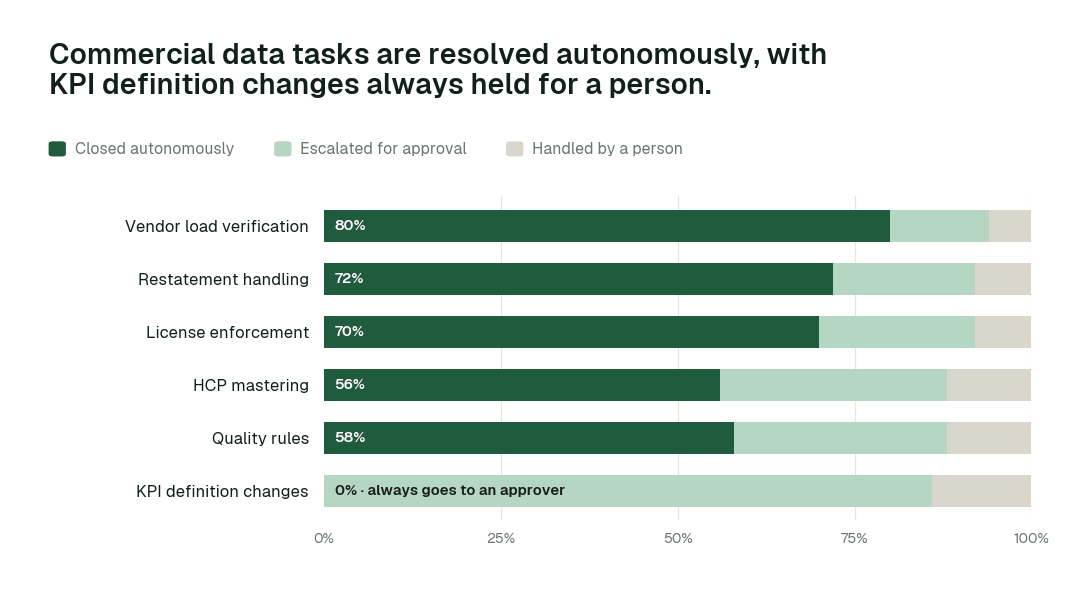
Vendor load verification closes autonomously 80% of the time. For KPI definition changes, autonomous closure is 0% by design: every change is proposed with a full diff and approved by a named person.
6. Stand up launch data as a mission
Every launch repeats the same build.
The old world. Built after launch.
The new world. Autopilot runs the build with a target date.
In practice. The launch dashboard is ready two weeks before launch.
What to measure. Days before launch the data product is ready.
Designing the autonomy ladder
Autonomy is set per task class, not per tool. This is where we would set each class for a mature deployment, and why:
| Task class | Closed autonomously | Escalated | Handled by a person | Where we set it | Why |
|---|---|---|---|---|---|
| Vendor load verification | 80% | 14% | 6% | L4 once the receipts are clean | The work is reversible and repeatable |
| Restatement handling | 72% | 20% | 8% | L3: acts and keeps a rollback point | Most cases are routine; the rest escalate with evidence |
| License enforcement | 70% | 22% | 8% | L3: acts and keeps a rollback point | Most cases are routine; the rest escalate with evidence |
| HCP mastering | 56% | 32% | 12% | L3: acts and keeps a rollback point | Most cases are routine; the rest escalate with evidence |
| Quality rules | 58% | 30% | 12% | L3: acts and keeps a rollback point | Most cases are routine; the rest escalate with evidence |
| KPI definition changes | 0% | 86% | 14% | L2: always proposed to a named approver | The number carries accountability outside the data team |
The operating model: who owns what
Agents change who does the work, not who is accountable for it:
| Role | Owns | What the agents take off their plate |
|---|---|---|
| Commercial Data Product Owner | Standards, autonomy levels per domain and which domain goes next | Assembling status, chasing owners, keeping the catalog current |
| Domain owners and approvers | KPI definition changes and anything shared externally | Preparing the diff, blast radius and rollback plan for every proposal |
| Data engineers | Reviewing agent proposals and building new data products | Vendor restatements are detected and only the affected weeks reprocessed; license terms are enforced on every join, share and retention rule |
The swarm behind the practices
No single agent delivers these practices. Each one is a hand-off between specialists, coordinated under the autonomy you set per domain.
| Agent | What it does for commercial and RWD teams |
|---|---|
| Connectors and Data Ingestion | Land vendor files and APIs, detect late or restated deliveries |
| Schema Evolution | Maps vendor layout changes into the commercial model |
| Pipeline Building | Builds launch data products and KPI models with tests |
| Data Access & Governance | Enforces licensing, redistribution and retention rules on every table and request |
| Data Security | Classifies patient-level data and enforces de-identification |
| Quality Monitoring | Checks vendor volumes, HCP match rates and KPI tie-outs |
Context Wizard holds governed definitions of NBRx, TRx, a treated patient and an engaged HCP, so every brand and copilot uses the same numbers. Conductor verifies weekly vendor loads before field teams see them. Spellbook records licensing terms on every dataset's page.
What disappears
The clearest sign the practices are working is what stops happening:
- •Launch dashboards finished after launch.
- •Unexplained restatement moves.
- •License terms tracked only in contracts.
- •Conflicting KPIs across brands.
- •Stale HCP targeting lists.
- •Full reloads for partial restatements.
The magic is not any single agent. It is that the back office simply keeps running. Bad data is caught where it enters, not where it is read. Every new table gets quality rules and documentation without anyone writing them. Access follows policy instead of a queue. Fixes are rerun, verified and explained before anyone opens a dashboard. Cost is cleaned up every week instead of every budget cycle. And every one of those actions leaves a signed receipt, so the team can see exactly what happened and roll anything back. For the people on the team, the experience is quieter mornings, fewer tickets and more time for the products the business asked for.
A product manager's scorecard
If you own this data as a product, these are the numbers to bring to every quarterly review:
- •Field-facing incidents per quarter
- •Days before launch the data product is ready
- •Datasets with license terms enforced
- •Live definitions per KPI
- •HCP master freshness
- •Share of upkeep autonomous
The climb: from assisted to autonomous to agentic
Our thesis is that the data platform climbs the way analytics did, in stages, and that the hard part of data work was never knowing what to do but doing it. For pharma commercial and real-world data teams, the climb looks like this:
- •Assisted. Agents work alongside your team. They read the whole stack, show what needs doing and propose every fix with a receipt; kPI definition changes and anything shared externally always go to a named approver.
- •Autonomous, under your governance. Routine work runs on its own: vendor restatements are detected and only the affected weeks reprocessed, license terms are enforced on every join, share and retention rule, and the HCP master refreshes continuously. Your team governs the agents instead of doing the upkeep.
- •The agentic enterprise. Brand and field teams that make early launch decisions on consistent numbers. People set direction, and the platform carries it out.
You choose the altitude, every step is visible and reversible, and the pilot below is the first rung.
The pilot: how pharma commercial and real-world data teams start
The pilot is how your team proves the value on its own data before committing.
- •What we connect. IQVIA, Symphony and specialty pharmacy feeds; Veeva CRM; Snowflake or Databricks; dbt; BI, over MCP, inside your infrastructure. Nothing migrates.
- •Scope. Launch data product as a mission.
- •First week. Agents run at L1 across the scoped domain. They map every pipeline, definition and lineage path and show the fixes they would have made, with receipts, so your team sees the value before anything changes.
- •By week two. Vendor restatements are detected and only the affected weeks reprocessed and license terms are enforced on every join, share and retention rule start running on reversible work. KPI definition changes and anything shared externally stay at L2 with a named approver.
- •At day 30. We review the impact metrics against your baseline:
- •Brand question answered: from about 2 days to seconds
- •License change enforced: from about 2 weeks to ~1 h
- •HCP master refreshed: from about a month to hours
- •the share of vendor load verification closed autonomously, targeting 80% as the deployment matures
- •What you decide. Whether to expand to the next domain. The pilot fee is credited in full against the first year.
- •Cost. Start with a pilot ($7,500 one-time, credited in full against the first year). Scale is from $1,000 a month and Enterprise from $3,000 a month, billed annually, with unlimited seats, no usage meter and no markup on model spend. See pricing.
The pilot is the start of a longer curve:
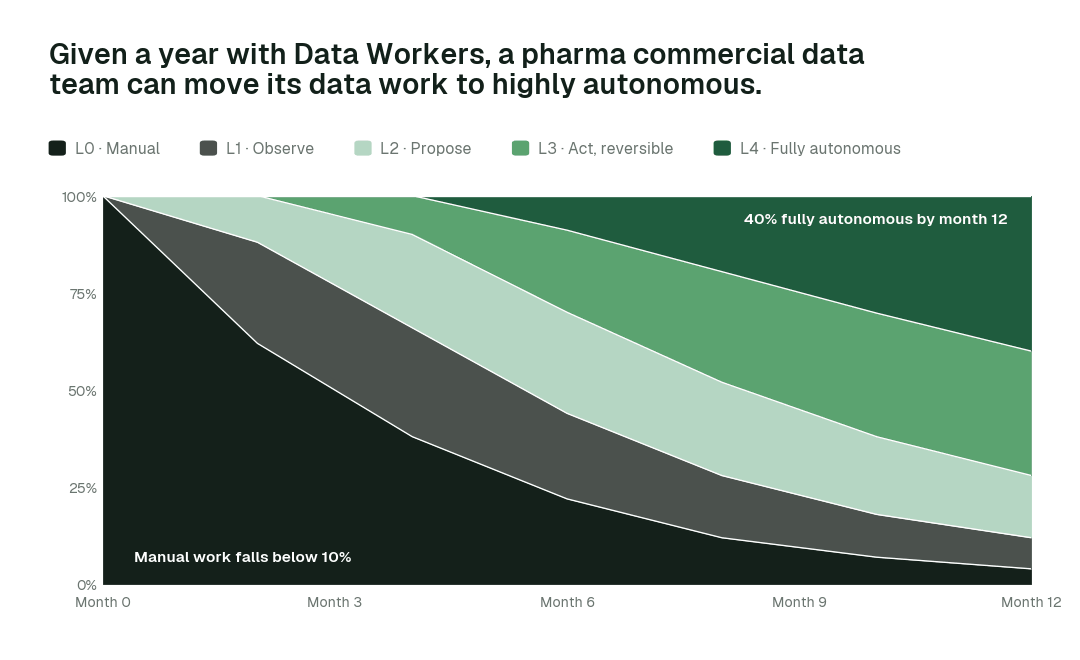
By month 12, more than 40% of agent actions run fully autonomously and manual work falls below 10%, while KPI definition changes stay with a named approver.
Read the full playbook: Commercial data product owners and launch analytics teams