You're on Metaphor: Your People Find and Discuss Data There. Data Workers Keeps It True
On Metaphor, whose technology KPMG acquired in 2025? Keep it as the place people find and discuss data in context. Data Workers does the operations work that keeps it true, behind approvals.
Your analysts don't open a ticket to learn which table holds cart conversions. They search Metaphor. Each asset page brings together three kinds of metadata: the technical kind its connectors harvest from Snowflake, dbt and Looker; the business kind your teams write down; and the social kind, which records who owns a table, who uses it and what people have asked about it. KPMG's own description of Metaphor is "a long-awaited meeting ground in a unified digital experience" for business and technology people. On April 28, 2025, KPMG announced it had acquired Metaphor's technology and intellectual property and is integrating it into its own Modern Data Platform. Where Metaphor still runs, it remains the page your people open first, and KPMG says it will bring the technology to a wider audience through its own platforms. Metaphor is where people find and discuss data in context. Data Workers does the operations work that keeps it true, behind approvals. It catches the night a table people trust goes wrong, fixes the cause where it lives, routes every change to an owner who still works there and leaves a receipt.
Key takeaways
- •Metaphor keeps its job. Search, asset pages, owners and the conversations around your data stay where your people already look. Data Workers works next to it from day one, over the API your Metaphor deployment exposes, and natively with the systems Metaphor's connectors read.
- •The ownership change has a plain answer. KPMG acquired Metaphor's technology and IP on April 28, 2025. It is integrating the technology into its own Modern Data Platform and will use it to enhance its AI tools and platforms, including KPMG Modern Data Platform and Velocity. Data Workers builds on your Metaphor deployment as it runs today and doesn't depend on that roadmap.
- •Breaks are caught in the tables. Data Workers profiles the tables behind the assets people rely on, finds the cause of a bad number and proposes the fix in the system that owns it.
- •Every change reaches an active owner. When the owner a catalog lists has left, Data Workers sees it in your identity provider and routes the fix and the owner update to someone who can approve.
- •Every change leaves a receipt: trigger, diff, blast radius, checks before and after, approver and undo path.
- •Start with a pilot on one domain, read-only first, on the ladder from L0 manual to L4 autonomous.
Metaphor is the meeting ground. Data Workers is the control plane.
Metaphor answers "which table, what does it mean, and who do I ask?" Two things under it keep changing: the tables, and the people named on them. Data Workers covers both.
Here is a Tuesday at a meal-kit subscription company. Snowplow collects web events into Snowflake, Airflow runs dbt Core every night, Looker shows the Growth Funnel Explore, and Metaphor is where analysts find fct_cart_events and the funnel tables. The growth team meets at 10:00 to decide whether to cut paid social spend. This is an illustrative example.
| Time | System | What happens |
|---|---|---|
| Mon 18:20 | Snowplow and the web app | The web team ships a redesigned cart page. The Snowplow tracker is initialized twice on it, so every add_to_cart event is sent twice with the same event_id |
| Tue 02:00 | Snowflake | The Snowplow loader lands the events in atomic.events, duplicates included |
| 03:15 | Airflow and dbt Core | The nightly DAG run builds fct_cart_events and fct_funnel_daily. Cart-to-order conversion falls from 31% to 16%. No test checks event_id for uniqueness, so every test passes |
| 03:40 | Data Workers | run_quality_check flags fct_cart_events: volume up 94% against its 28-day range, and 48% of rows sharing an event_id |
| 03:44 | Data Workers | get_root_cause and trace_cross_platform_lineage follow the duplicates back to events from the new cart page, starting Monday at 18:20. blast_radius_analysis shows fct_funnel_daily, the Looker Growth Funnel Explore and the weekly paid-media dashboard |
| 03:46 | Metaphor and Okta | Data Workers reads the owner Metaphor lists for fct_cart_events and checks the account in Okta: deactivated in July. The dbt group that holds the model names the Growth Analytics lead as its owner |
| 03:52 | Spellbook and Slack | Data Workers drafts one change set: a dbt diff that keeps one row per event_id in the Snowplow staging model, a unique test on event_id, an owner update for the dbt model, and an owner change for the Metaphor asset as a proposal for the catalog admin. The approval request reaches the Growth Analytics lead in Slack. A note goes to the web team's channel about the double tracker |
| 07:35 | Metaphor | A marketing analyst asks on the funnel table in Metaphor whether conversion really halved. The lead answers there with a link to the finding in Spellbook |
| 08:05 | Spellbook and GitHub | The lead reviews the diff and its blast radius and approves the change set. An analytics engineer merges the diff |
| 08:20 | Airflow | The analytics engineer triggers the run Data Workers drafted, rebuilding the affected models for the window since Monday 18:20; Data Workers reads its status until it succeeds |
| 09:00 | Snowflake and Looker | Data Workers verifies: zero duplicate event_id values, cart events back within range, conversion at 30.8% in the Explore; the analytics engineer reports the new test passing. Data Workers writes the receipt |
| 09:20 | Metaphor | The catalog admin applies the owner change. Data Workers reads the asset back and adds it to the receipt; the approved owner fact lands in the Context Wizard graph |
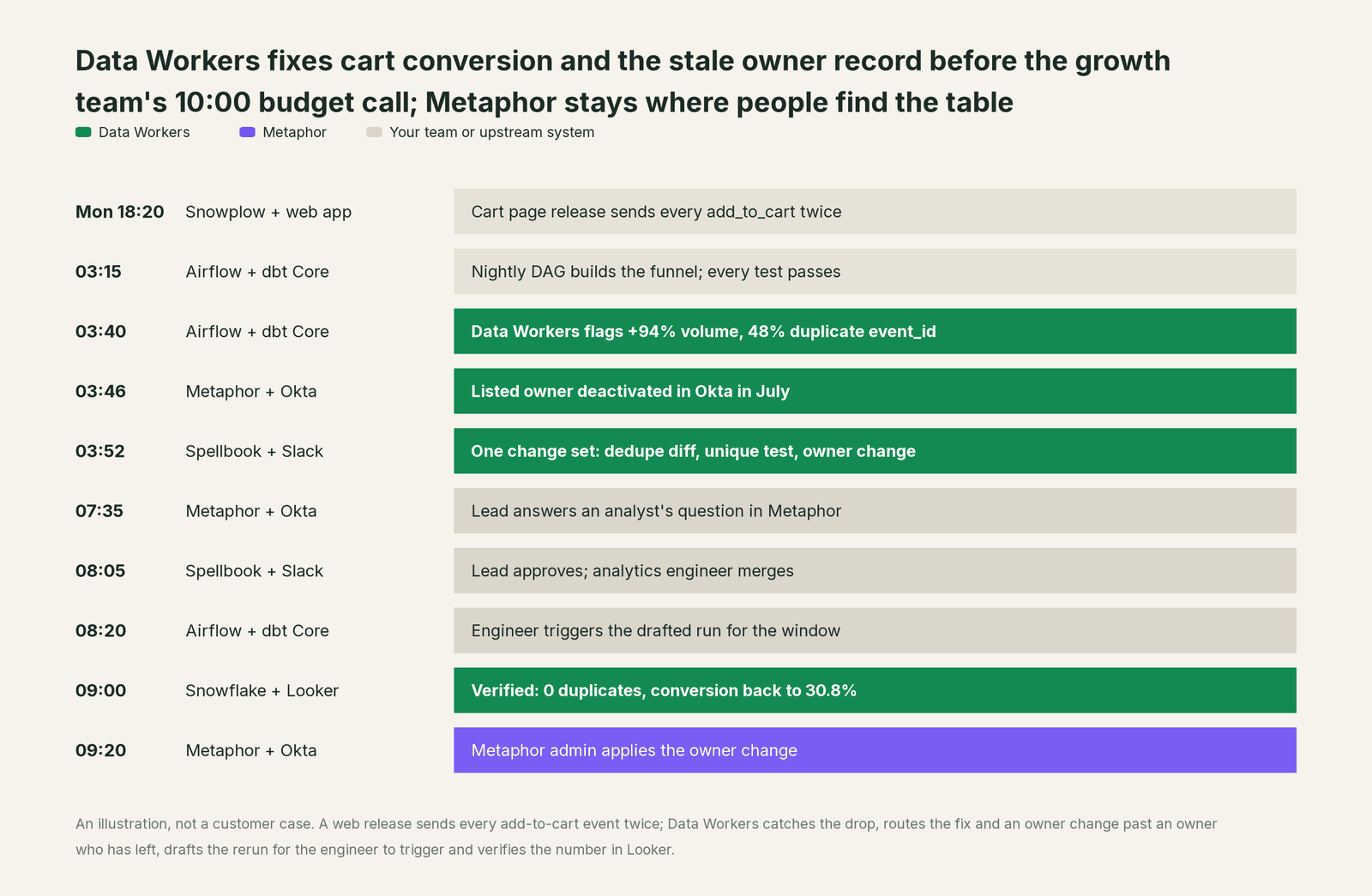
Metaphor did its job: people found the table, saw who owned it and asked their question in the open. Two facts behind the page had gone wrong: the number, inflated by a release, and the owner, gone since July. The fix lived in dbt and Airflow, which Metaphor doesn't run, and the approval needed someone still on the team. The growth team made its 10:00 call on the right number.
| Job | What Metaphor does | What Data Workers does |
|---|---|---|
| Finding data | Search and discovery over a metadata knowledge graph | Reads that graph as governed context, with provenance |
| The conversation | Keeps the questions and answers around each asset, next to its owners and usage | Brings the evidence: the finding, the lineage and the receipt link people can share there |
| Ownership | Shows who owns each asset | Checks that owner against your identity provider and routes changes to someone who can approve |
| The break | Shows harvested lineage and the monitor results its connectors bring in | Catches the bad number in the tables and finds the cause |
| The fix | Records what people know about the asset | Proposes the change where the cause lives, such as a dbt diff, and drafts the rerun |
| The catalog change | The catalog admin edits owners, tags and descriptions | Drafts them as proposals with the evidence attached |
| The proof | Holds what the asset is and who uses it | Verifies downstream and writes a receipt |
Why doesn't Metaphor just do this itself?
Because Metaphor was built to be the place where people and data meet, and that job shapes its design. Its connectors, published as an open-source Python package under Apache 2.0, extract metadata one way: schemas, descriptions, queries and profiles from the warehouse, models, tests and lineage from dbt, dashboards from Looker and Tableau, monitor results from Monte Carlo and Great Expectations, and documents from Confluence and Notion. They read; they don't change the systems they read. That is the right design for a discovery tool. It keeps the catalog neutral and leaves each system to the team that owns it.
Rewriting a dbt model, rebuilding tables through Airflow or changing a Snowflake object is a different product with a different liability: blast radius across systems, scoped credentials in each, a named owner's approval, a rollback path and downstream proof that the fix held. Those systems belong to your data team and other vendors. KPMG's plan for the technology points the same way: an "active meta layer" inside its own platforms. Data Workers is the product on the other side of that line, and it hands every Metaphor change back to the person who administers the catalog.
Every tool owns a slice. Data Workers covers the whole lifecycle
Metaphor owns its slice: the social catalog where people find and discuss data in context. Each point tool adds another console, contract and handoff. Data Workers covers the whole lifecycle with one context, one approval flow and one audit trail, and builds on what your people already keep in Metaphor.
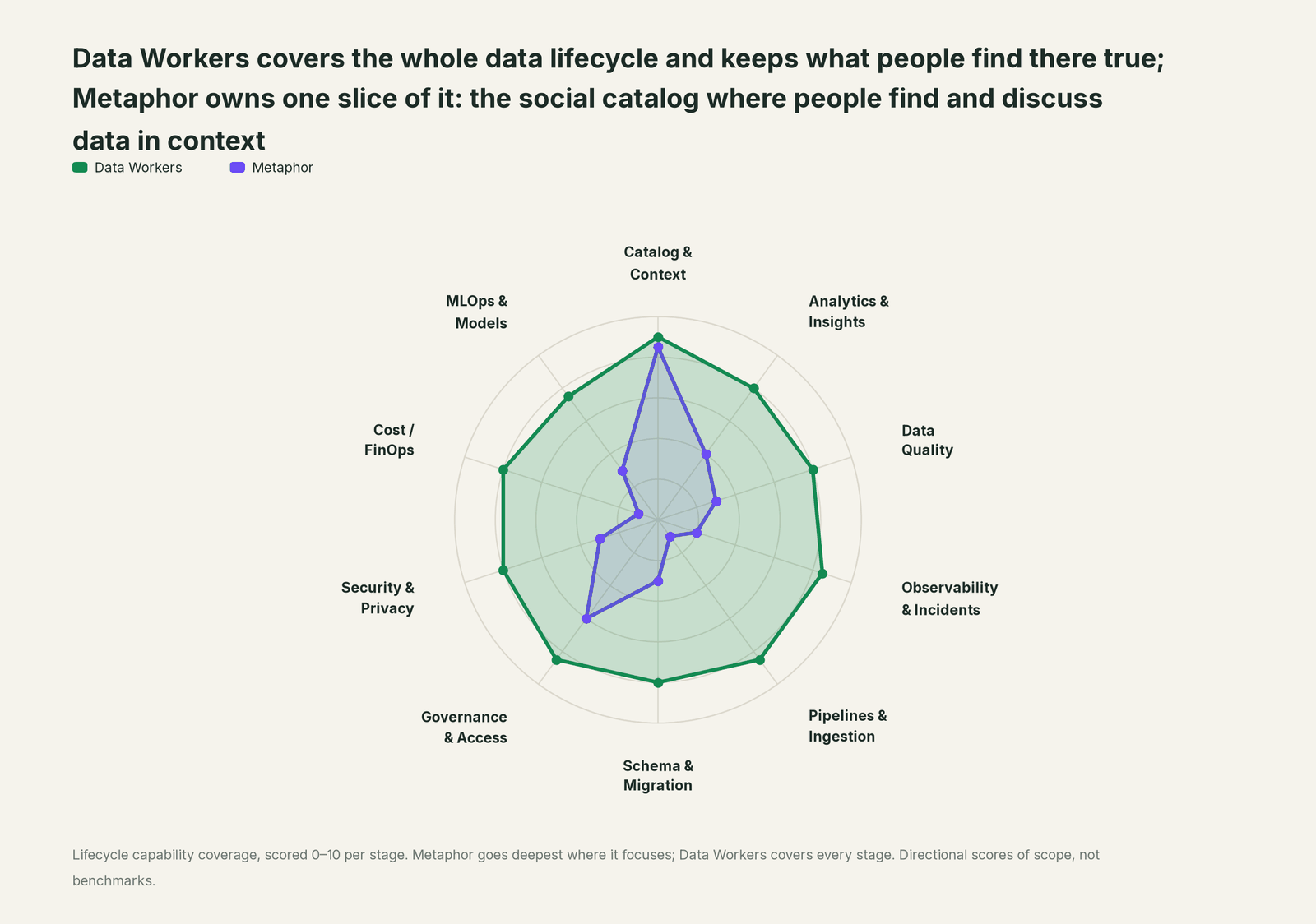
| Stage | Data Workers | Metaphor | Why we scored it this way |
|---|---|---|---|
| Catalog & Context | 9 | 8.5 | Metaphor's home stage and its highest score: search and discovery over a metadata knowledge graph that melds business, technical and social metadata, fed by connectors for warehouses, dbt, BI and documents. Scored from its last public product material (KPMG's April 2025 announcement and the connectors' February 2025 release); the catalogs that tie Data Workers at 9 also serve their context to AI agents over a public MCP server and publish releases this year. Data Workers reads Metaphor as a first-class source, with provenance. |
| Analytics & Insights | 8 | 4 | A GenAI-enhanced interface gives people visibility into data assets and live collaboration. Data Workers' Insights agent answers from governed context and checks the numbers behind the answer. |
| Data Quality | 8 | 3 | Metaphor's connectors bring in data profiles and monitor results from Monte Carlo and Great Expectations. Data Workers profiles the tables itself, finds the cause of a failure and proves the fix held. |
| Observability & Incidents | 8.5 | 2 | Lineage from the connectors shows what sits downstream. Data Workers detects, diagnoses, fixes and verifies across systems, with a receipt for every incident. |
| Pipelines & Ingestion | 8.5 | 1 | Metaphor harvests pipeline lineage from Fivetran, Informatica and Azure Data Factory; it does not run pipelines. Data Workers drafts reruns for your orchestrator, verifies them and catches source changes first. |
| Schema & Migration | 8 | 3 | Schemas are harvested into the catalog. Data Workers catches schema changes in the dbt manifest and in review, assesses their impact and plans migrations in approved waves. |
| Governance & Access | 8.5 | 6 | Ownership, tags and descriptions, with automated governance and a social layer that learns from use. Data Workers routes each fix to an owner who is still active and keeps the record current. |
| Security & Privacy | 8 | 3 | Tags and governance metadata travel with each asset. Data Workers flags new sensitive column names in pull request review and proposes masking for the owner. |
| Cost / FinOps | 8 | 1 | Query attributions help explain usage; Metaphor does not manage warehouse spend. Data Workers traces Snowflake credits to the dbt model behind them and drafts the fix for its owner. |
| MLOps & Models | 7.5 | 3 | Metaphor distributes data and AI products across teams. Data Workers keeps the data under those products and models healthy. |
How Metaphor and Data Workers work together
Your people stay where they are: Metaphor for finding and discussing data, Claude or ChatGPT for questions, Slack for the day's work. Spellbook Data Catalog (in preview) is where the data team looks: each finding, proposed change, blast radius, approver and rollback, with approval requests reaching people in Slack or email. Underneath, Data Context Wizard keeps one governed context graph, the Data-Agents Swarm does the work with more than 20 specialist agents, the Autonomous Data-Conductor runs each fix end to end (detect, diagnose, fix, review, verify, remember), and per-domain guardrails hold approvals, receipts and rollback.
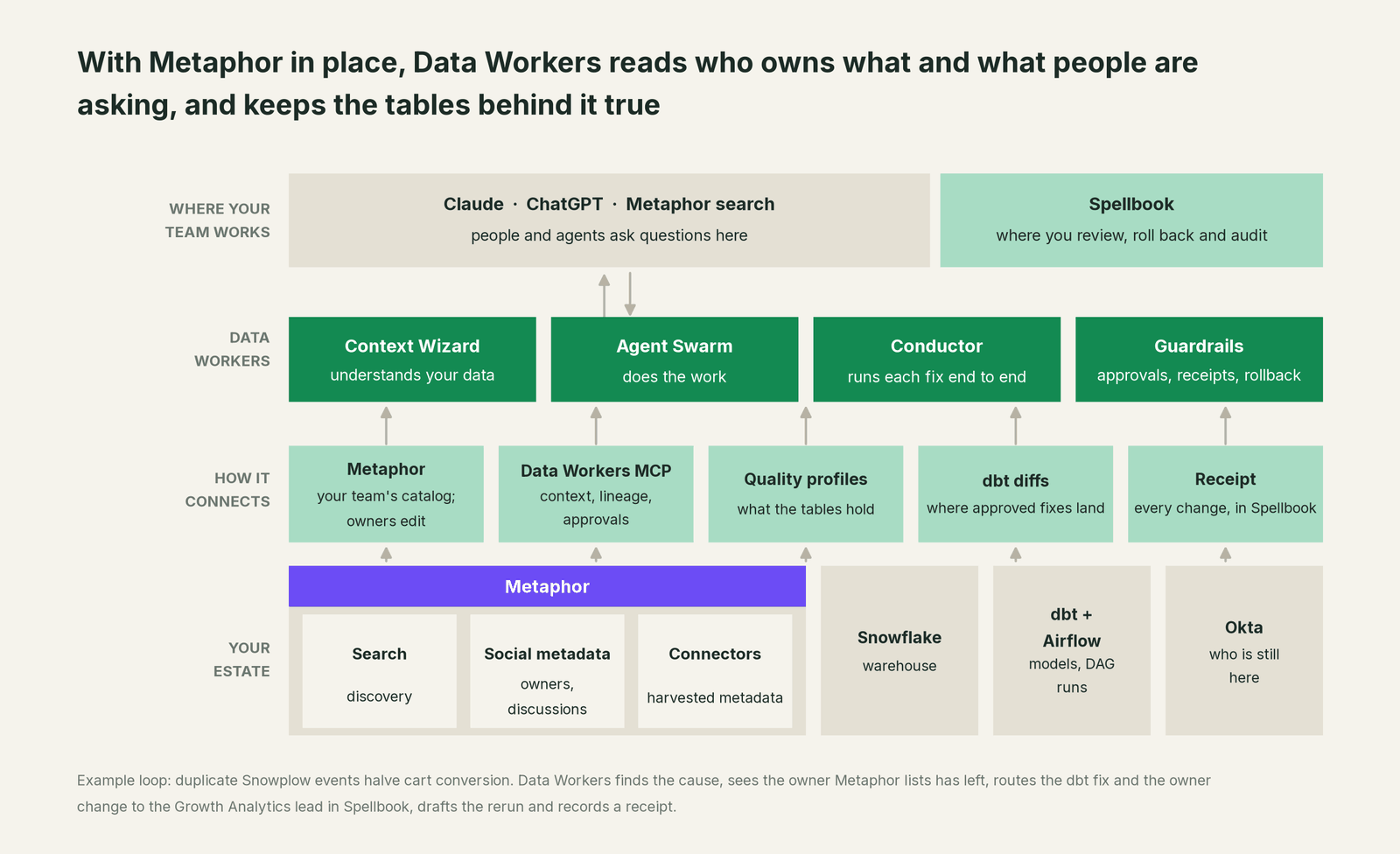
What Context Wizard does with Metaphor. It reads the owners, tags, descriptions and discussions you point it at, with provenance (which asset, who wrote it, when it was observed), and joins them to the systems Data Workers reaches natively, including Snowflake, dbt, Airflow, Looker, Okta, Slack and GitHub, among 50+ connectors. Agents get one governed view through explain_table, search_across_platforms, trace_cross_platform_lineage and blast_radius_analysis, and check_staleness flags assets whose documentation or business rules have gone stale. No agent can promote its own work to authoritative; that takes a named person.
Setup today. Data Workers connects to Metaphor over the API your Metaphor deployment exposes, with a read-only account: catalog changes are proposals the catalog admin applies. Data Workers' agents come from the open-source repository: clone it and add start-agent.sh entries to your client config, as the client setup docs show. Metaphor has no public MCP server, so the client config holds the Data Workers agents only.
// Example: .mcp.json for Claude Code
{
  "mcpServers": {
    "dw-context-catalog": {
      "command": "/path/to/dataworkers-claw-community/start-agent.sh",
      "args": ["dw-context-catalog"]
    },
    "dw-quality": {
      "command": "/path/to/dataworkers-claw-community/start-agent.sh",
      "args": ["dw-quality"]
    },
    "dw-incidents": {
      "command": "/path/to/dataworkers-claw-community/start-agent.sh",
      "args": ["dw-incidents"]
    }
  }
}
List the tools with your client's own command (/mcp in Claude Code). A data lead can then ask "which funnel tables have a quality problem, and who owns each one?" and get the quality profile, lineage and owner in one answer, with get_incident_history showing what broke before.
Where writes go. The dbt fix goes to the model owner as a diff to merge. Reruns go through Airflow: on Airflow 2 Data Workers queues the run through Airflow's REST API; on Airflow 3 the owner triggers the approved run. A rebuild over a date window, like this one, is the owner's run on either version, with Data Workers supplying the plan and checking the result. Snowplow and the web app stay with their teams: Data Workers tells them what it found and never changes the tracker. Owner, tag and description changes go to the Metaphor admin as proposals, and approved facts land in the Context Wizard graph. Okta is read: Data Workers checks who is active and changes nothing there.
One request, L0 to L4. The autonomy ladder is set per domain.
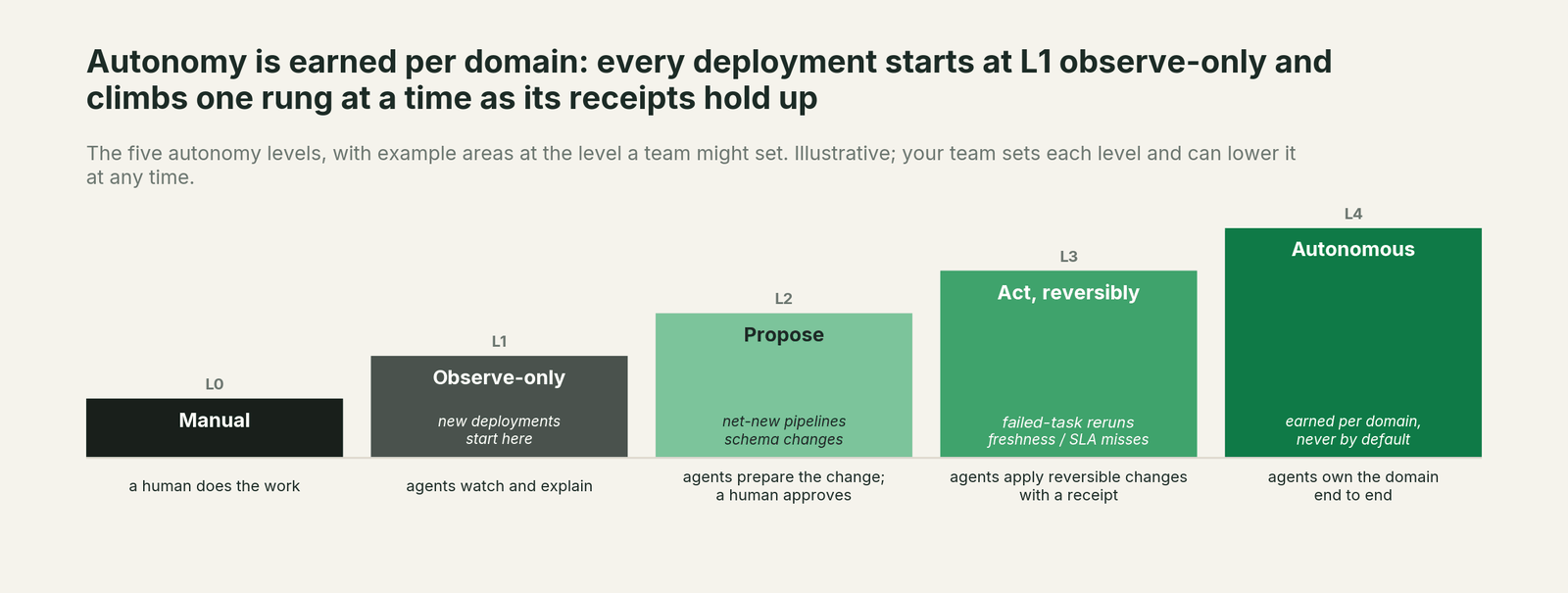
- •L0 manual. Connected, not acting. People check tables and owners by hand.
- •L1 observe. Data Workers profiles the tables behind the assets people use, reports every bad number and every listed owner who has left, and logs what each action would have needed. Nothing changes.
- •L2 propose. Data Workers drafts the dbt diff and the owner changes with their blast radius. An active owner approves before anything runs.
- •L3 act reversibly. For proven change classes, such as rerunning an affected model's DAG after a fix merges and re-profiling it, Data Workers acts on its own (on Airflow 3 the owner presses run), verifies and records it. Code changes still arrive as diffs, or as pull requests when your team turns on the GitHub pull-request target.
- •L4 autonomous. For a scoped, trusted class in one domain, Data Workers runs the loop end to end and posts the receipt for review. Catalog changes still go to the admin.
Read more on safety, approvals, who owns the agents, autonomy levels and where your data goes. The same pattern holds on data.world, Amundsen and DataHub. For the category question, see Data Workers vs a data catalog, what an agentic data platform is, the integrations list and our earlier comparison, Data Workers vs Metaphor Data.
What changes for your team
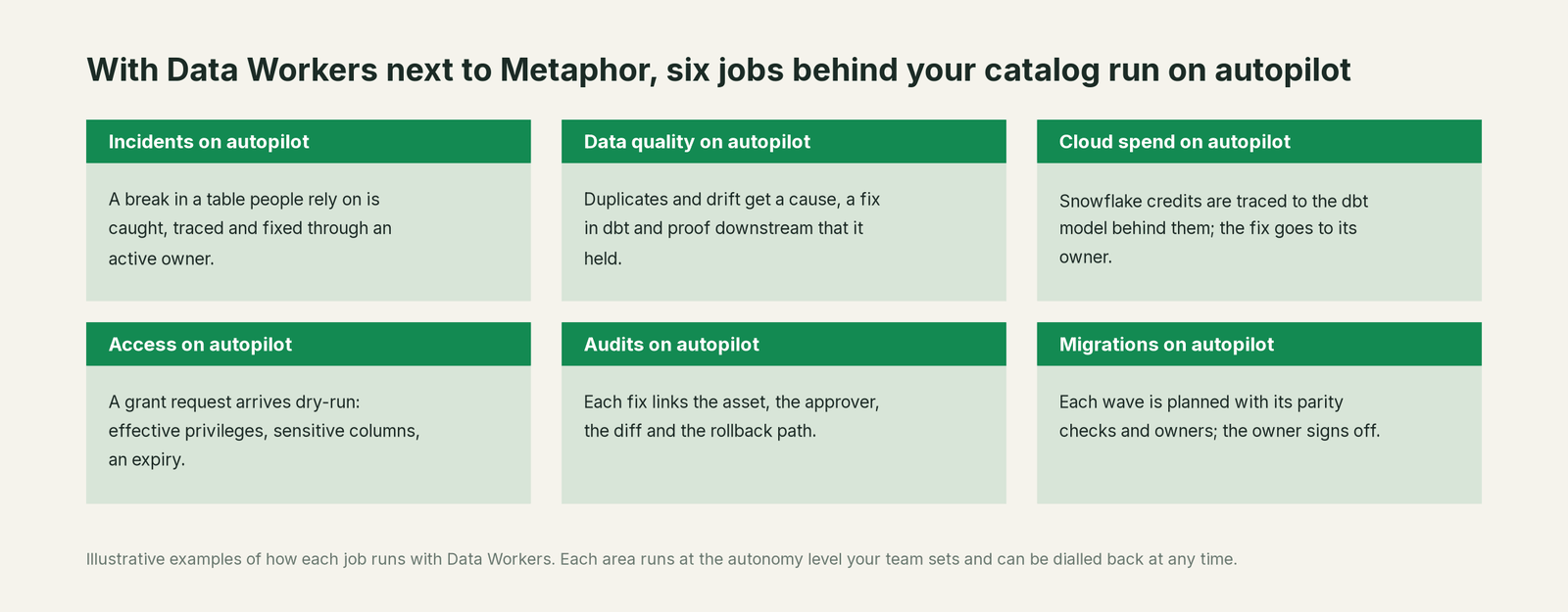
A social catalog makes people ask better questions. Someone still has to answer with evidence, fix what's wrong and keep the names current. With Data Workers, those jobs run on autopilot at the level you set.
- •Incidents. A break in a table people rely on is caught the night it lands, traced, fixed through an active owner and recorded.
- •Data quality. Duplicates and drift get a cause, a fix in dbt and a downstream check that it held.
- •Cloud spend. Snowflake credits are traced to the dbt model behind them, and the fix is drafted for that model's owner.
- •Access. A grant request arrives dry-run: effective privileges after role inheritance, the sensitive columns it would reach, any policy conflicts and a least-privilege grant with an expiry for the owner.
- •Audits. Each fix links the asset, the approver, the diff and the rollback path.
- •Migrations. When a platform moves, each wave is planned with its parity checks and owners, and the owner signs off before it closes.
The people who run Metaphor get their week back for the work only people do: deciding what an asset means, who owns a domain and which tables earn trust.
Keep Metaphor, or consolidate?
Keep Metaphor if you love it; Data Workers works with it from day one. Many teams consolidate once Data Workers runs that slice too.
Where Metaphor runs today, your people know where to look. With KPMG building the technology into its own platforms, some teams will follow it there and some will plan a move. Either way, Data Context Wizard already holds your owners, tags and discussions with provenance, and Spellbook Data Catalog can take over the catalog slice whenever you decide. If you are weighing building this layer yourself, read build it ourselves with Claude Code and MCP servers: reading a catalog is the easy part; cross-system context, approvals and rollback are the work.
The case for your CFO
The outcome: the numbers people find in your catalog are right, and every asset names someone who still answers for it. Budget calls, board packs and AI answers rest on tables someone checked last night, not on a page last edited by a person who left.
The risk story is plain. Data Workers reads Metaphor with a read-only account and proposes every catalog change to its admin. Every change in the estate shows its blast radius, goes to a named approver who is still active, lands through your existing dbt review, is verified downstream and leaves a receipt: trigger, diff, approver, checks before and after, and how to undo it. Unanswered requests expire and escalate; they never auto-grant. Autonomy is set per domain from L0 manual to L4 autonomous, and an org-wide stop halts all autonomous dispatch. The agents run in your infrastructure: your data stays in your systems, and the hosted Conductor sees workflow metadata only. Zero migration.
Why now: your catalog's future is a decision you'll make on your own schedule, and the operations around it shouldn't wait for it. The first win is one domain, read-only, with a report of every table whose numbers drifted and every listed owner who has left. What stays the same: Metaphor, your connectors, your dbt review and your people's habits. Start with a pilot; the path is on the pricing page, and the pilot is credited in full against the first year. For the numbers, see the ROI of agentic data operations.
The sentence to repeat upstairs: "Metaphor is where our people find and discuss data; Data Workers makes sure what they find is right and that every fix goes through someone who still owns it."
Getting started
Start with a pilot. Pick the domain where a wrong number costs the most, such as growth, revenue or a regulated report, connect Metaphor read-only next to Data Workers, and let it report every bad number and every stale owner for a few weeks before turning on the first fix class. The pilot path and plans are on the pricing page, and the pilot is credited in full against the first year.
FAQ
What did KPMG acquire, and what does it mean for our Metaphor install? On April 28, 2025, KPMG LLP announced it had acquired the technology and intellectual property of Metaphor. KPMG says it is integrating Metaphor's technology into its own Modern Data Platform and will use it to enhance its AI tools and platforms, including KPMG Modern Data Platform and Velocity. metaphor.io now redirects to that announcement. The announcement doesn't describe changes to existing deployments, so ask the team that supports yours about its plans. Data Workers works with your deployment as it runs today and doesn't depend on that roadmap.
Does Data Workers write to Metaphor? No. Data Workers proposes owner, tag and description changes, and your Metaphor admin applies them. The account Data Workers uses stays read-only, and approved facts land in the Context Wizard graph either way.
How does Data Workers know an owner has left? It reads the owner Metaphor lists and checks the account status in your identity provider: Okta and Entra ID are native reads. When the account is inactive, the approval goes to the owner of the dbt group or domain instead, and the owner change itself becomes a proposal.
Are Metaphor's connectors still available? The open-source metaphor-connectors package is on PyPI under Apache 2.0. Its last release, 0.14.185, came out on February 13, 2025, and its GitHub repository is no longer publicly reachable. Data Workers reads Snowflake, dbt, Looker, Tableau and the other common sources natively, so its picture of your estate doesn't depend on those connectors.
Where does our data go? The agents run in your infrastructure on every tier and hold the warehouse credentials and model key. Your data stays in your systems, and the hosted Conductor sees workflow metadata only: goals, signals, table names, proposals with diffs, run records and approval handles.
Sources
- •KPMG, "KPMG Acquires Metaphor's Technology Platform to Accelerate AI Adoption and Data Management" (Apr 28, 2025; technology and IP acquired; "integrating Metaphor's technology into its own Modern Data Platform"; enhancing its AI tools and platforms, including KPMG Modern Data Platform and Velocity; About Metaphor), https://kpmg.com/us/en/media/news/kpmg-acquires-metaphors-technology-platform.html (checked Oct 3, 2026)
- •Metaphor, metaphor.io (301 redirect to the KPMG announcement), https://metaphor.io/ (checked Oct 3, 2026)
- •PyPI, metaphor-connectors (0.14.185, Feb 13, 2025; Apache-2.0; connector and metadata table), https://pypi.org/project/metaphor-connectors/ (checked Oct 3, 2026)
- •Docker Hub, metaphordata/connectors (last updated Feb 13, 2025), https://hub.docker.com/r/metaphordata/connectors (checked Oct 3, 2026)
- •Data Workers, Data Workers vs Metaphor Data, https://dataworkers.io/resources/dataworkers-vs-metaphor-data/ (checked Oct 3, 2026)
- •Data Workers, Client setup (open-source docs), https://dataworkers.io/opensource-docs/client-setup/ (checked Oct 3, 2026)
- •Data Workers open-source repository, agent tools and start-agent.sh, https://github.com/DataWorkersProject/dataworkers-claw-community (checked Oct 3, 2026)
- •Data Workers, Spellbook Data Catalog product page, https://dataworkers.io/product/spellbook-data-catalog/ (checked Oct 3, 2026)