You're on Cloudera: It Runs Your Enterprise's Hybrid Data Estate. Data Workers Owns Whether the Data in It Is Right, Behind Approvals
Cloudera runs Spark, Hive, Impala, NiFi and Kafka across your hybrid estate. Data Workers owns whether the data in it is right: traced, fixed behind approvals, verified, with a receipt.
On Cloudera, the data estate is yours in a way few cloud estates are. Clusters run on Cloudera Base on premises, data services run on Cloudera on cloud or Cloudera Data Services on premises, and many teams still say CDP. NiFi flows pull feeds in, Kafka carries them, Spark jobs build Hive and Iceberg tables, analysts run Impala queries from Hue, and Ranger and SDX decide who may read what. On August 19, 2026 Cloudera announced Cloudera Anywhere Cloud, a hybrid data and AI platform with agentic copilots that turn plain-language requests into data workflows and infrastructure tasks. Cloudera AI adds AI Studios, including Agent Studio for multi-agent workflows, and in June 2026 Cloudera adopted Apache Polaris for open, governed Iceberg access.
The costliest Cloudera incidents finish with every job green: the NiFi flow routes, the Spark application succeeds, the Impala query returns, and a regulator still reads the wrong data because something upstream changed meaning. Cloudera runs your hybrid data estate. Data Workers owns whether the data in it is right: it checks the metrics your jobs record, traces a bad number to its cause across the systems around Cloudera, and hands the owner a fix and a run plan behind a named approval.
Key takeaways
- •Cloudera keeps its job. Clusters, NiFi flows, Spark jobs, Hive and Iceberg tables, Impala, Ranger and Cloudera AI stay as they are.
- •Green jobs get checked too. Your Spark jobs record the values that define "right", so a run that succeeds with wrong data becomes a diagnosed incident before the first consumer reads it.
- •Built on what surrounds Cloudera. Airflow, Tableau, ServiceNow and Slack connect natively; the Hive Metastore, Polaris, Impala, Ranger and Atlas over their APIs today; Cloudera's read-only Iceberg MCP server sits next to Data Workers in your assistant.
- •Changes go to a named owner. Job fixes arrive as a diff, reference data changes as a statement the owner runs, reruns queue through your orchestrator after approval, and every step leaves a receipt.
- •The same loop runs a move. For Hive tables moving to Databricks, Data Workers plans each wave with its parity checks and holds the completion gate for the owner's sign-off.
Cloudera runs your hybrid data estate. Data Workers owns whether the data in it is right.
Cloudera moves, stores and computes on the data it is given, governed and at enterprise volume. Wrong data is a different job: notice it, tie it to a change Cloudera never sees, size the damage, hold what would act on it, fix, rerun and prove the result. Here is one night at a retail bank's financial crime data team. This is an illustrative example.
The stack: the bank's payments switch publishes every payment with a two-letter channel code. A NiFi flow, payments_to_kafka, routes them to the Kafka topic payments.txn, and a Spark job lands them in the Iceberg table raw.payments_txn on Cloudera Base. An Airflow 2 DAG, aml_txn_daily, runs the Spark job txn_enrich after midnight: it joins each transaction to the Hive reference table ref.txn_channel to set channel_group and writes aml.txn_enriched. Its last task records the share of transactions with no channel group and the count per group with monitor_metrics; the team added that step, and recorded the table's consumers in Data Workers' context graph, during the pilot. The transaction monitoring system pulls aml.txn_enriched at 02:00 and runs its scenarios keyed by channel group. Tableau's "AML alert volumes" workbook reads the same table through Impala. Incidents live in ServiceNow, and approvals reach people in Slack.
| Time | System | What happens |
|---|---|---|
| Mon 18:00 | Payments switch | The bank goes live with instant payments. They carry a new channel code, IP. The launch plan covered the switch, fraud screening and the ledger; nobody asked for a row in ref.txn_channel |
| 18:05 | NiFi + Kafka | payments_to_kafka routes the new transactions like any other. Same fields, same types, a new value. The landing job writes them to raw.payments_txn |
| Tue 00:30 | Airflow + Spark | aml_txn_daily starts. txn_enrich joins Monday's 297,000 transactions to ref.txn_channel. The 18,412 instant payments find no match and are written with an empty channel_group. The Spark application succeeds |
| 00:55 | Data Workers | The metrics task records an unmapped share of 6.2% against a baseline of 0, and a Monday transaction count inside its usual band. The flag opens an incident |
| 01:00 | Data Workers + Airflow | Data Workers reads the DAG run: every task green. With the transaction count normal, diagnose_incident points away from a lost load and toward a mapping gap in enrichment; get_incident_history finds no earlier case. explain_table returns the definition and lineage of aml.txn_enriched, and blast_radius_analysis walks the context graph: the table feeds the 02:00 monitoring extract and the alert volumes workbook |
| 01:06 | ServiceNow + Slack | Data Workers opens a ServiceNow incident with the diagnosis and recommends holding the 02:00 scenario run. The approval request goes to the financial crime data owner in Slack, with the AML operations lead and the payments owner copied |
| 01:15 | Cloudera Iceberg MCP server | The engineer on call asks her assistant, over Cloudera's read-only Iceberg MCP server with a read-only Impala user, which channel codes the unmapped rows carry. Every one is IP, and the first arrived at 18:00. The payments owner confirms the launch |
| 01:25 | Transaction monitoring system | The AML operations lead holds the 02:00 run |
| 01:40 | Spellbook | The owner reviews the proposal: a statement that adds IP to ref.txn_channel in the INSTANT group, for the reference data owner to run; a diff for txn_enrich that sends any unknown code to a quarantine table and fails the task when one appears; and a run plan. She approves |
| 01:50 | Hue + Git | The reference data owner runs the statement in Hue; the engineer merges the job change |
| 01:58 | Data Workers + Airflow | Data Workers queues the approved rerun of aml_txn_daily with trigger_airflow_dag and reads the run's status. The job rewrites Monday's partition, as it does on every run |
| 02:35 | Data Workers | The run succeeds. The metrics task records an unmapped share of 0 and 18,412 transactions in INSTANT |
| 02:45 | Transaction monitoring system | The AML operations lead releases the run. At 03:00 the scenarios cover every channel, instant payments included |
| 03:30 | Spellbook + ServiceNow | Data Workers writes the receipt (cause, approvals, statement and who ran it, diff, rerun, checks, undo), linked from the ServiceNow incident, which the service desk resolves. The approved fact "channel code IP is an instant payment, group INSTANT" lands in the Context Wizard graph |
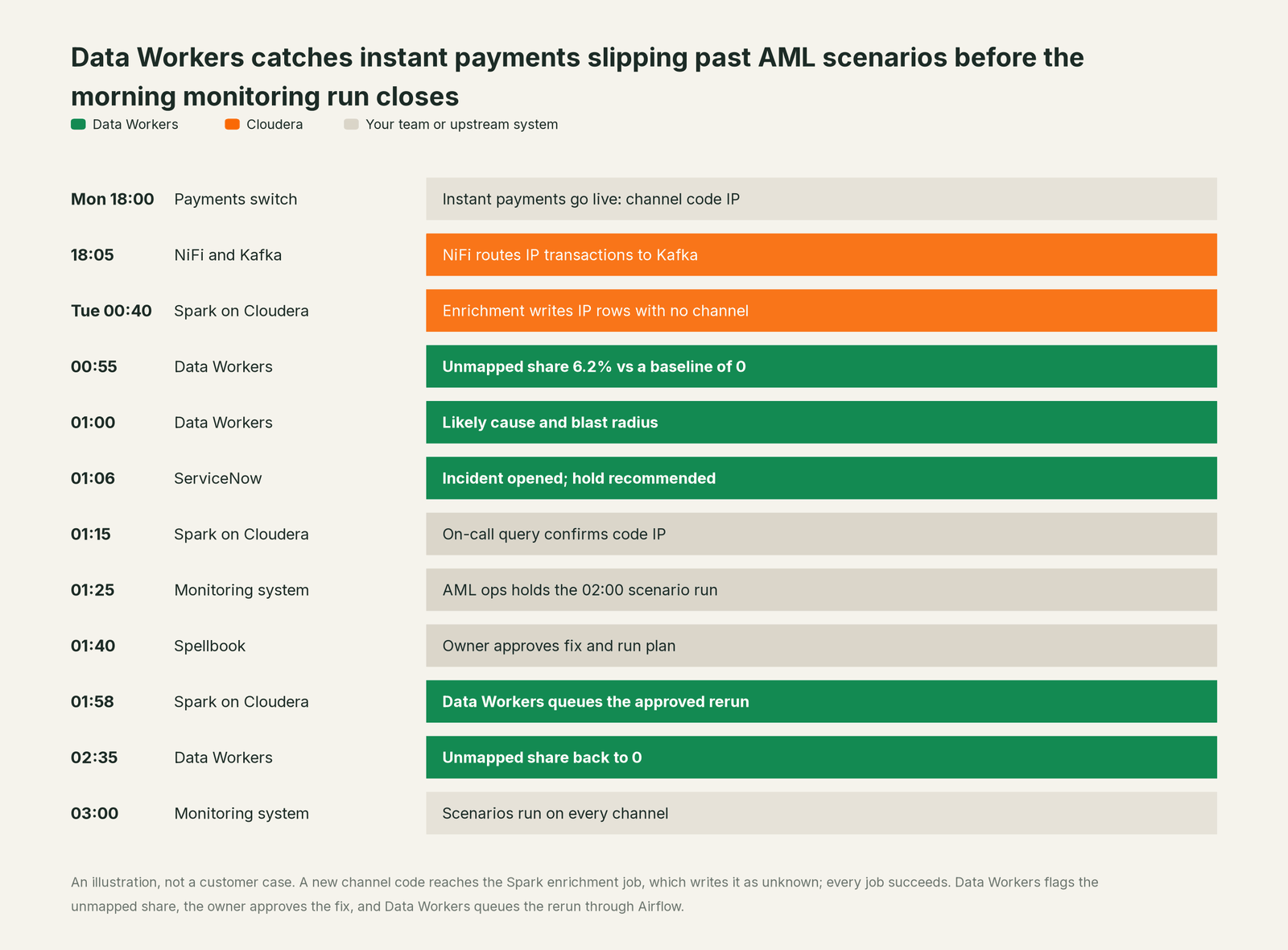
Every system did its job. Catching the problem took knowledge no platform holds: an empty channel group lets a night of payments skip the scenarios a regulator expects.
| Job | What Cloudera does | What Data Workers does |
|---|---|---|
| The run | Routes feeds with NiFi, carries them on Kafka, builds Hive and Iceberg tables with Spark, answers Impala queries | Reads the orchestrator's runs and the metrics each job records |
| The signal | Cloudera Observability and Cloudera Manager show how jobs, queries and clusters are doing | Metrics the team defines, checked against their baselines after every run, show the owner whether the data is right |
| The diagnosis | Spark history and Impala profiles show what ran and how long it took | Joins the metric, the DAG run, the table's context and the lineage into one cause, with the blast radius across extracts, scenarios and reports |
| The fix | Runs the jobs and statements the team deploys, under Ranger policy | Proposes the job change as a diff and the reference data change as a statement for the owner to approve and run |
| The rerun | Executes the Spark applications the orchestrator sends | Queues the approved rerun through Airflow and reads its status |
| The proof | Ranger audits who read and changed what inside the estate | Re-checks the job's metrics and writes a receipt: what changed, who approved it, how it was checked, how to undo it |
Why doesn't Cloudera just do this itself?
Because Cloudera is built to run a regulated enterprise's data estate anywhere it has to live, and does that very well. Its unit is the platform: clusters, engines, flows, policies and the governance layer across them. It knows txn_enrich succeeded at 00:52; it does not know that an empty channel group means a payment skipped a monitoring scenario.
Cloudera's AI is serious and getting broader. Cloudera AI brings AI Inference, AI Studios (with Agent Studio for multi-agent workflows) and AI Assistants; the Anywhere Cloud copilots turn plain-language requests into workflows; and the Mistral partnership (September 10, 2026) is set to bring private inference into customer environments, air-gapped ones included. Cloudera Data Lineage is the Octopai platform Cloudera agreed to acquire in November 2024, Taikun (acquired August 2025) brings cloud-like operations to air-gapped sites, and a Zero Copy Connector (May 2026) feeds lakehouse data into ServiceNow workflows. Cloudera publishes MCP servers on GitHub too: a read-only Iceberg server over Impala, a NiFi server that is read-only by default, and a Data Visualization server that reads and writes. All of it makes the Cloudera estate more capable.
Owning whether a number is right across a payments switch, NiFi, Spark, Airflow, a monitoring system and Tableau is its own job: metrics that define "right", blast radius, named approvals, a recorded undo and receipts an examiner can read. A platform vendor that changed reference data feeding another vendor's monitoring system would take on liability it was never designed to carry, and a team moving tables to Databricks wants an operating layer that sits with neither platform. That is Data Workers. More in is it safe to let AI agents change production data.
Every tool owns a slice. Data Workers covers the whole lifecycle
Cloudera owns running the enterprise's hybrid data estate. Each point tool adds another console, contract and handoff. Data Workers covers the whole lifecycle with one context, one approval flow and one audit trail, and builds on the Cloudera estate already there.
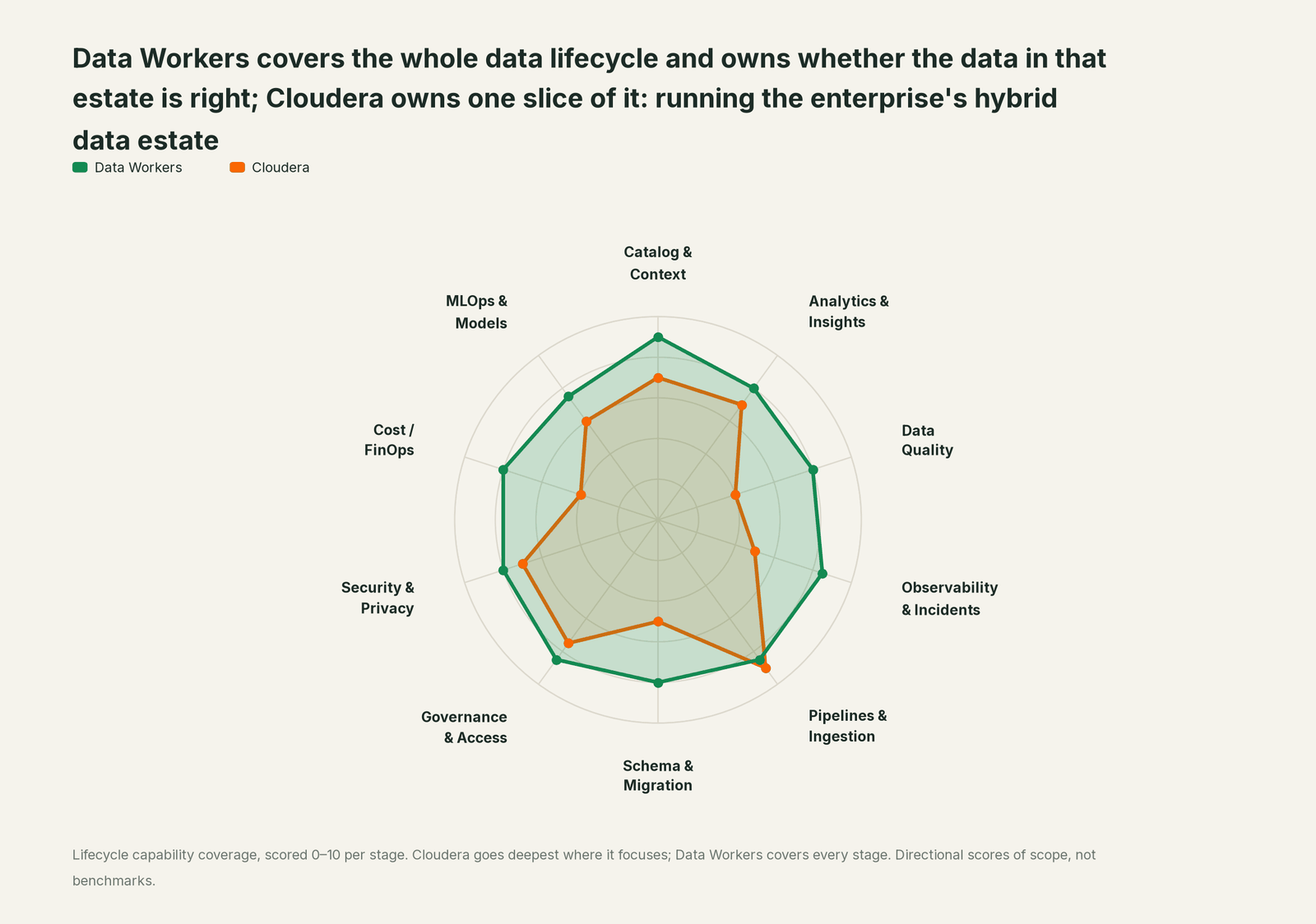
| Stage | Data Workers | Cloudera | Why we scored it this way |
|---|---|---|---|
| Catalog & Context | 9 | 7 | Data Catalog, SDX and Cloudera Data Lineage (formerly Octopai) describe what lives in the estate. Data Workers keeps one governed context graph across the systems around Cloudera. |
| Analytics & Insights | 8 | 7 | Impala, Hive and Data Visualization answer queries at scale on premises and in the cloud. Data Workers answers data questions from governed definitions on top. |
| Data Quality | 8 | 4 | Profiling and checks live in the jobs your developers write. Data Workers checks the metrics your jobs record against their baselines after every run and opens the incident. |
| Observability & Incidents | 8.5 | 5 | Cloudera Observability watches jobs, queries and clusters. Data Workers diagnoses the data incident across the feed, the jobs, the consumers and the reports, and verifies the fix. |
| Pipelines & Ingestion | 8.5 | 9 | Cloudera's home stage: NiFi, Kafka, Spark and Flink move and process data at enterprise volume across hybrid estates. Data Workers queues the approved rerun through the orchestrator. |
| Schema & Migration | 8 | 5 | Hive and Iceberg evolve the tables you define, and Replication Manager copies data between clusters. Data Workers plans moves in approved waves with parity checks and an owner's sign-off. |
| Governance & Access | 8.5 | 7.5 | Ranger and SDX enforce strong, central policy inside the Cloudera estate. Data Workers routes every data change across systems to a named approver. |
| Security & Privacy | 8 | 7 | Kerberos, Knox, Ranger audits and air-gapped deployment are mature. Data Workers leaves a receipt on every data change across systems. |
| Cost / FinOps | 8 | 4 | Cluster sizing and the NVIDIA Spark partnership shape compute spend. Data Workers traces warehouse spend to the dbt model where the estate reaches Snowflake. |
| MLOps & Models | 7.5 | 6 | Cloudera AI, AI Studios and AI Inference build and serve models on governed data. Data Workers keeps the data under those models healthy. |
How Cloudera and Data Workers work together
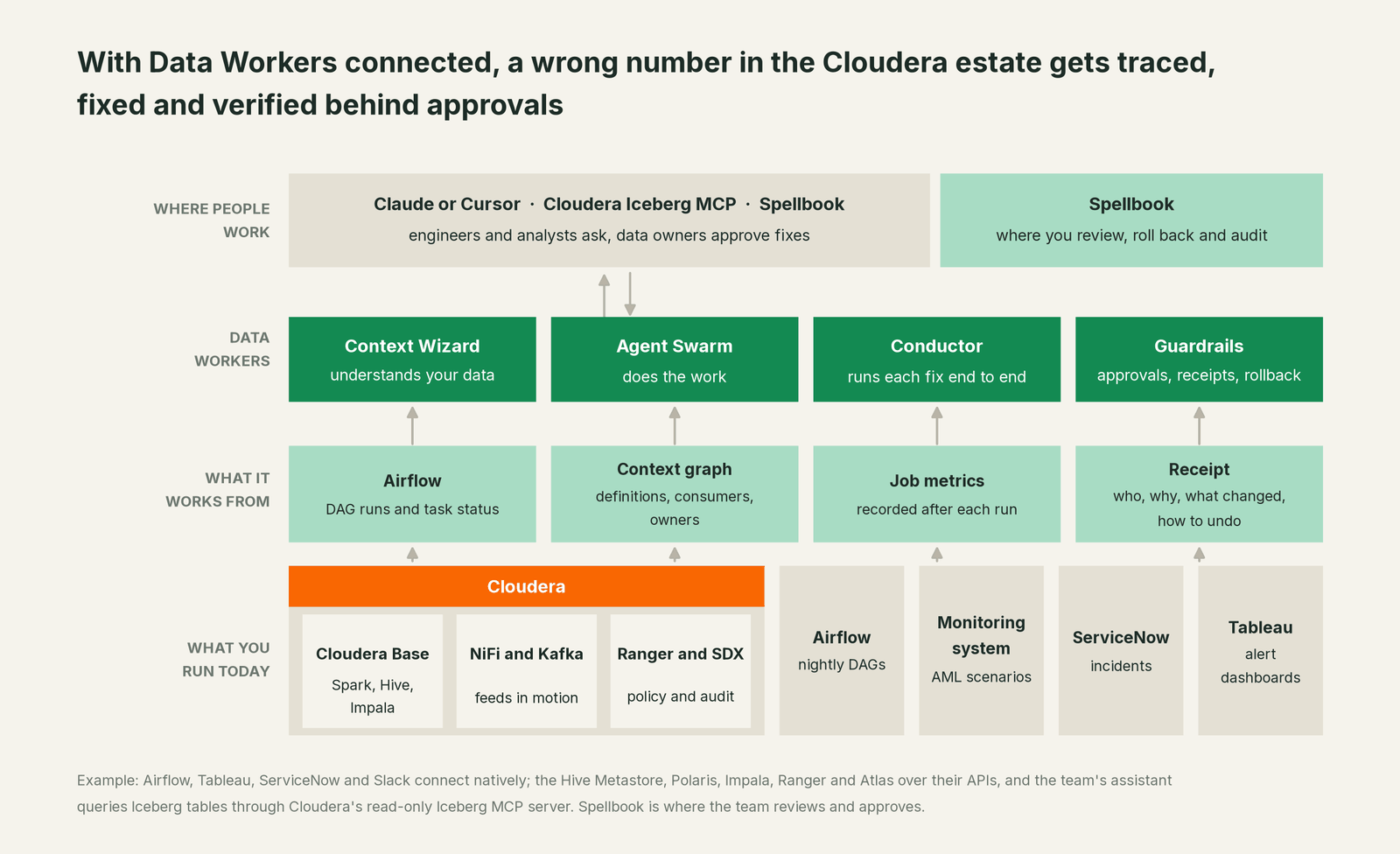
Data Workers doesn't need to sit inside your clusters to own this job. It reads Airflow (DAG runs and task instances), Tableau, ServiceNow, Slack and GitHub pull request review natively, plus the metrics your jobs record and the context graph your team builds. The Hive Metastore, Polaris catalogs, Impala, Ranger, Atlas and Cloudera Data Lineage connect over their APIs today; the full list is on Data Workers integrations. Your Spark jobs compute the values that define "right" inside the cluster and record them with monitor_metrics. Jobs, statements and Ranger policies stay with your team.
Engineers can run Cloudera's Iceberg MCP server and the Data Workers agents side by side in one assistant. Cloudera's server answers "which channel codes are in last night's unmapped rows"; Data Workers answers "what did the run do to the numbers, what does it reach, and what's the fix". Give Cloudera's server an Impala user that can only read, per read-only warehouse access for LLM agents. Data Workers' agents never call Cloudera's MCP server; they work from their own connectors. The Data Workers side follows the documented client setup: clone the open-source repo and add each agent's start-agent.sh entry to your client.
// Example: Cloudera Iceberg MCP server (per its README, read-only Impala user) plus Data Workers agents
{
  "mcpServers": {
    "cloudera-iceberg": {
      "command": "uvx",
      "args": ["--from", "git+https://github.com/cloudera/iceberg-mcp-server@main", "run-server"],
      "env": {
        "IMPALA_HOST": "<impala-coordinator-host>",
        "IMPALA_PORT": "443",
        "IMPALA_USER": "<READONLY_USER>",
        "IMPALA_PASSWORD": "<PASSWORD>",
        "IMPALA_DATABASE": "aml"
      }
    },
    "dw-incidents":  { "command": "/path/to/dataworkers-claw-community/start-agent.sh", "args": ["dw-incidents"] },
    "dw-catalog":    { "command": "/path/to/dataworkers-claw-community/start-agent.sh", "args": ["dw-context-catalog"] },
    "dw-connectors": { "command": "/path/to/dataworkers-claw-community/start-agent.sh", "args": ["dw-connectors"] }
  }
}
List the tools with your client's own command (for example /mcp in Claude Code). This incident used monitor_metrics, diagnose_incident, get_incident_history (dw-incidents), explain_table, blast_radius_analysis (dw-context-catalog), trigger_airflow_dag and create_servicenow_ticket (dw-connectors).
Through a move. Many Cloudera estates are moving some Hive tables to Databricks. The Data Migration agent plans each wave with its parity checks from the object inventory your team exports, proposes the comparison queries your team runs, tracks the results and holds the completion gate for the owner's sign-off. On the Databricks side it applies approved Unity Catalog grants. Step by step: Hive and Glue to Unity Catalog migration with parity checks and the Hadoop to Databricks migration checklist.
In production the agents run in your infrastructure, air-gapped data centers next to Cloudera Base included, and hold the credentials and model key. Your data stays in your systems; the hosted Conductor sees workflow metadata only, and sovereign mode blocks external model calls. More in where does our data go.
One incident, L0 to L4, set per domain:
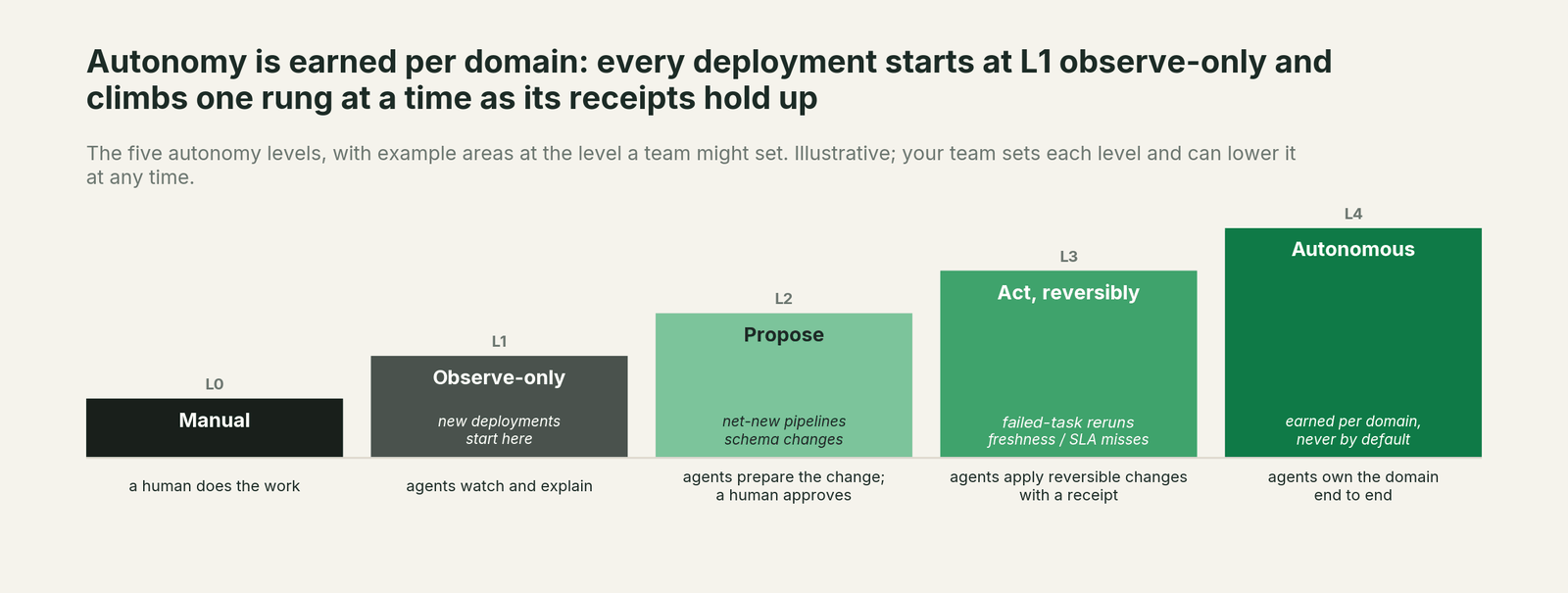
- •L0 manual. On Thursday an analyst notices instant payments never raised an alert; compliance spends a week on the lookback.
- •L1 observe. Data Workers flags the unmapped share at 00:55 with the likely cause and blast radius. Nothing changes.
- •L2 propose. It proposes the statement, the diff, the run plan and the hold; nothing moves until the named owner approves.
- •L3 act reversibly. For a class with a clean record, it queues the rerun, verifies it and sends any failed check to a person.
- •L4 autonomous. For a scoped domain, the fix waits for the owner before the 02:00 extract reads the table.
More in how approvals work.
What changes for your team
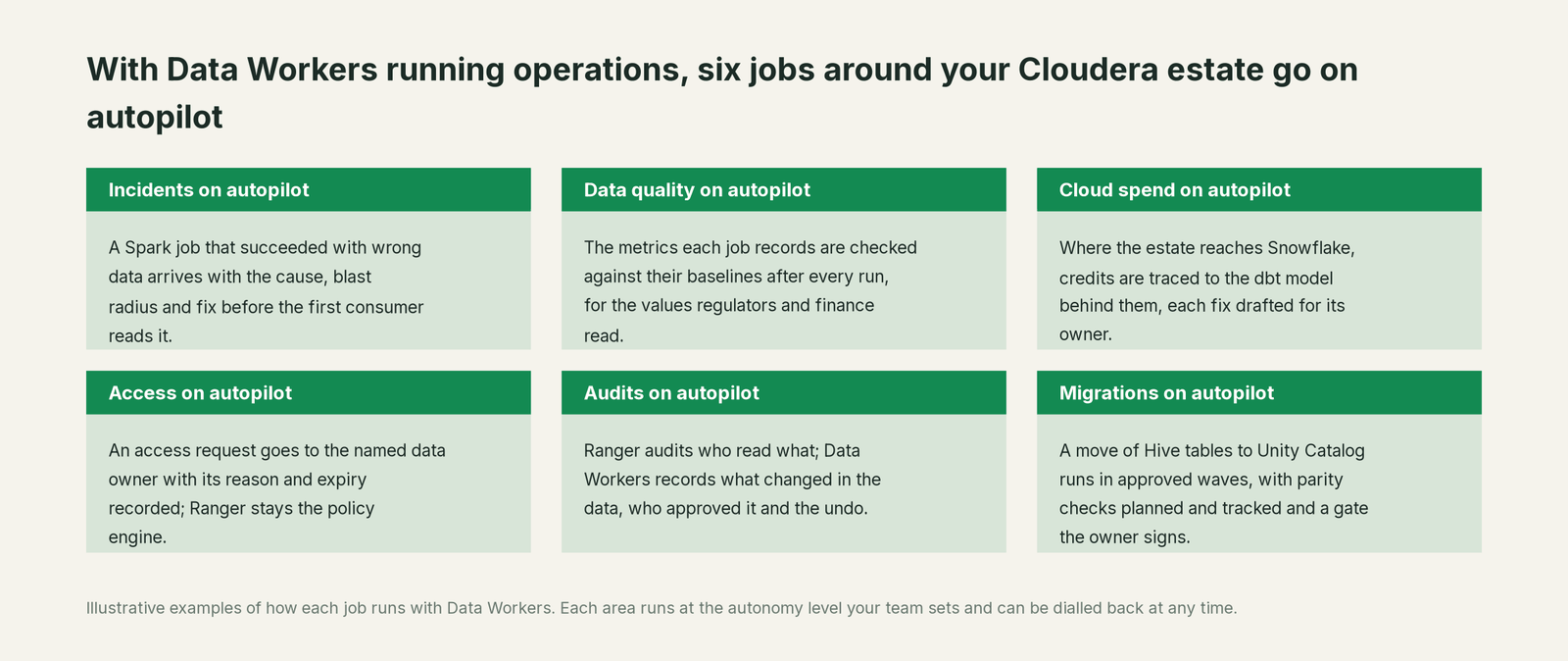
- •The platform team stops being the first suspect. A green run with a wrong number arrives with its upstream cause, so nobody asks cluster admins to prove the platform innocent.
- •Regulatory consumers get a guard. When a monitoring extract or regulatory report would read a table that just went wrong, the hold is recommended before it runs.
- •Payments, platform and compliance share one record. The same receipt sits in Spellbook Data Catalog (in preview), linked from the ServiceNow incident, ready for the next exam.
Keep Cloudera, or consolidate?
Keep Cloudera if you love it; Data Workers works with it from day one. Many teams consolidate once Data Workers runs that slice too.
Teams that keep Cloudera consolidate the tooling around it: a separate observability product, check code copied into every Spark job, runbooks that say "rerun and email compliance". Teams moving to Databricks run each wave through Data Workers. See also you're on Airflow, you're on Apache Kafka, you're on Teradata and the agentic data platform for financial services.
Weighing a build on Cloudera's MCP servers and a coding agent? Running a query is the easy part; context, approvals, undo and receipts are the work. See build it ourselves with Claude Code and MCP servers.
The case for your CFO
The outcome. When a Cloudera job delivers wrong data to a regulatory scenario or a finance report, it is caught the same night and corrected before anyone acts on it.
The risk story. At L0 and L1, agents only read. At L2 a named person approves each proposal; an unanswered request expires and escalates, never auto-grants. L3 acts on reversible changes in the domains you open; L4 is a later choice. No agent can promote its own work, an org-wide stop halts all autonomous dispatch, and every change carries a receipt with its approver, blast radius and undo.
Why now. Cloudera and the vendors around it are inviting agents in through copilots, Agent Studio and MCP servers, and many Cloudera estates now run next to Databricks or Snowflake. More agents and platforms mean more nights with green jobs and wrong data.
The first win. L1 on the Spark jobs that feed financial crime or regulatory reporting.
What stays the same. Cloudera, your clusters, NiFi flows, Spark jobs, Ranger policies, Cloudera AI, orchestrator, BI and on-call rota. Zero migration to start; a move you choose runs in approved waves, with a design target of 4 to 8 weeks per migration instead of 6 to 12 months. See the ROI of agentic data operations.
The sentence for upstairs: "Cloudera keeps running our data estate; Data Workers makes sure the data in it is right and gets problems fixed with our approval, with a receipt for every change."
Getting started
Start with a pilot. Pick the Spark jobs behind the numbers regulators and leaders read, give Data Workers read access to your orchestrator, BI and ITSM, record each table's consumers, add a metrics step for the two or three values that define "right", and run at L1 for a few weeks. Then turn on L2 for one domain, and L3 for a narrow class once the receipts earn it. The pilot path is on the pricing page, and the pilot is credited in full against the first year.
FAQ
How does Data Workers connect to Cloudera? It reads the systems around the cluster natively (Airflow, Tableau, ServiceNow, Slack) plus the metrics your jobs record. The Hive Metastore, Polaris, Impala, Ranger, Atlas and Cloudera Data Lineage connect over their APIs today.
Cloudera has an agentic copilot and Agent Studio. Why add Data Workers? Cloudera's AI builds and runs workflows and models inside the Cloudera estate, and does it well. Data Workers runs the operations job across the whole estate, including systems Cloudera doesn't own: whether a run is right, what it reached, the fix, the approval and the receipt. Teams use both.
Will Data Workers change our Ranger policies or write to our Hive tables? No. Job changes arrive as a diff for the owner to merge, data changes as statements the owner approves and runs, and reruns queue through your orchestrator after approval. Ranger stays the policy engine; access requests go to a named data owner with the reason and expiry recorded.
Our Spark jobs all succeed. How would Data Workers know the data is wrong? Your jobs record the values that define "right" with monitor_metrics after each run: the share of unmapped codes, rows per business date, totals per channel. A value outside its baseline opens an incident even when every job is green. Row-level rules stay in your own tests.
We're moving Hive tables to Databricks. What does Data Workers do in the move? It plans each wave with its parity checks, proposes the comparison queries your team runs, tracks the results and holds the completion gate until the owner signs off. The 4 to 8 week migration time is a design target.
Sources
- •Cloudera documentation home (deployment names), https://docs.cloudera.com/ (checked Oct 3, 2026)
- •Cloudera, "Cloudera Powers the Agentic AI Era with Cloudera Anywhere Cloud" (Aug 19, 2026), https://www.cloudera.com/about/news-and-blogs/press-releases/2026-08-19-cloudera-powers-the-agentic-ai-era-with-cloudera-anywhere-cloud.html (checked Oct 3, 2026)
- •Cloudera, "Cloudera Adopts Apache Polaris to Advance Open, Governed Data Access" (Jun 4, 2026), https://www.cloudera.com/about/news-and-blogs/press-releases/2026-06-04-cloudera-adopts-apache-polaris-to-advance-open-governed-data-access-for-enterprise-ai-anywhere.html (checked Oct 3, 2026)
- •Cloudera, "Cloudera Launches Workflow Data Fabric Zero Copy Connector for ServiceNow" (May 5, 2026), https://www.cloudera.com/about/news-and-blogs/press-releases/2026-05-05-cloudera-launches-workflow-data-fabric-zero-copy-connector-for-servicenow.html (checked Oct 3, 2026)
- •Cloudera, "Cloudera to Acquire Octopai's Platform to Deliver Trusted Data Across Hybrid Cloud" (Nov 14, 2024), https://www.cloudera.com/about/news-and-blogs/press-releases/2024-11-14-cloudera-to-acquire-octopais-platform.html (checked Oct 3, 2026)
- •Cloudera Data Lineage (formerly Octopai) documentation, https://docs.cloudera.com/octopai/latest/index.html (checked Oct 3, 2026)
- •Cloudera, "Cloudera Acquires Taikun to Deliver Cloud Experience to Data Anywhere" (Aug 4, 2025), https://www.cloudera.com/about/news-and-blogs/press-releases/2025-08-04-cloudera-acquires-taikun-to-deliver-cloud-experience-to-data-anywhere-for-ai-everywhere.html (checked Oct 3, 2026)
- •Cloudera, "Cloudera and Mistral Partner to Bring Specialized, Sovereign Intelligence to Enterprise Data" (Sep 10, 2026), https://www.cloudera.com/about/news-and-blogs/press-releases/2026-09-10-cloudera-and-mistral-partner-to-bring-specialized-sovereign-intelligence-to-enterprise-data.html (checked Oct 3, 2026)
- •Cloudera, AI Studios (Synthetic Data, Fine Tuning, RAG and Agent Studio), https://www.cloudera.com/products/enterprise-ai/ai/ai-studios.html (checked Oct 3, 2026)
- •Cloudera Iceberg MCP Server (read-only, via Impala), https://github.com/cloudera/iceberg-mcp-server (checked Oct 3, 2026)
- •Cloudera NiFi MCP Server (read-only by default), https://github.com/cloudera/NiFi-MCP-Server (checked Oct 3, 2026)
- •Cloudera Data Visualization MCP Server (reads and writes), https://github.com/cloudera/CDV-MCP-Server (checked Oct 3, 2026)
- •Data Workers open-source repository (tool registrations), https://github.com/DataWorkersProject/dataworkers-claw-community (checked Oct 3, 2026)
- •Data Workers client setup guide, https://dataworkers.io/opensource-docs/client-setup/ (checked Oct 3, 2026)