Actioneer vs Data Workers: Agents That Read Your Data, a Platform That Fixes It
Actioneer's agents read your data, read-only by design, and follow up with customers. Data Workers fixes the data itself, with approvals, rollback and a receipt for every change.
If you're evaluating Actioneer, you probably run a regulated consumer business: a lender, an insurer, a healthcare network or a large consumer app. Your customer data lives in a core system and an ERP, Fivetran or Airbyte lands it in Snowflake, BigQuery or Databricks, dbt builds the models, Airflow runs the DAGs and Looker or Tableau sits on top. Actioneer offers agents that read that data, answer questions about it with every fact tied to a query, and follow customers from SMS to voice to resolution. Its homepage calls them "AI agents for your customer journeys".
Those agents are only as good as the tables under them. When an upstream field is renamed at 1 a.m. and the overdue-accounts table goes wrong, someone has to find it, fix it at the source, check it and be able to show what changed. That's the job your data team owns, and it's the job this page is about.
Actioneer's agents read your data, read-only by design, and act in the customer journey. Data Workers acts on the data estate itself, so the data every agent reads is right, and every change leaves a receipt. Data Workers is the agentic data platform: a catalog that works as the control plane, one context graph across every platform, a loop that detects, diagnoses, fixes, reviews and verifies, and autonomy you set per domain. Every change is approved or reversible.
We compare products only. We leave out scores from public benchmarks, funding and team details, and stick to what each product does to your data and how each one governs and records it.
Key takeaways
- •Actioneer is a managed agent platform that runs in your cloud account. Its agents answer grounded questions over your data, monitor activity, and follow up with customers by SMS, voice, chat and WhatsApp.
- •Actioneer is read-only on data, by architecture. Its own blog says "the AI does not get write access to production systems in the first place" and logs each query with the workflow, the data touched and the output.
- •Data Workers fixes the data itself. Spellbook Data Catalog is the control plane, the Data Context Wizard keeps one graph across every system, and the Autonomous Data-Conductor runs the loop with approvals, rollback and receipts.
- •Actioneer leads on grounded answers and customer follow-up. We say so. Data Workers leads on the whole data lifecycle: quality, incidents, schema change, access, cost and migration.
- •The two meet in the warehouse. Keep Actioneer for customer journeys; Data Workers keeps the tables it reads correct.
Six things a data team gets on top of Actioneer
1. Fixes, not only findings. Actioneer's agents turn what they find into recommendations that land "in a review queue or a chat interface", and any change happens "through the client's own existing approval process". The Autonomous Data-Conductor closes that loop on the data estate: it traces the cause, has the right agent propose the fix where the problem started, and checks the result downstream once a named human approves.
2. A catalog that works as the control plane. Spellbook Data Catalog, in preview, puts every proposed change from every agent in one inbox: approve, steer, send back or roll back. Asset pages cover the whole estate, not the entities one agent needs.
3. One context graph for the estate. The Data Context Wizard builds one graph from your warehouses, dbt projects, orchestration and BI. Every fact carries its source, author, confidence and the time it was observed. Actioneer builds per-entity context stores for its agents; the Context Wizard gives every agent and every person the same view of the estate.
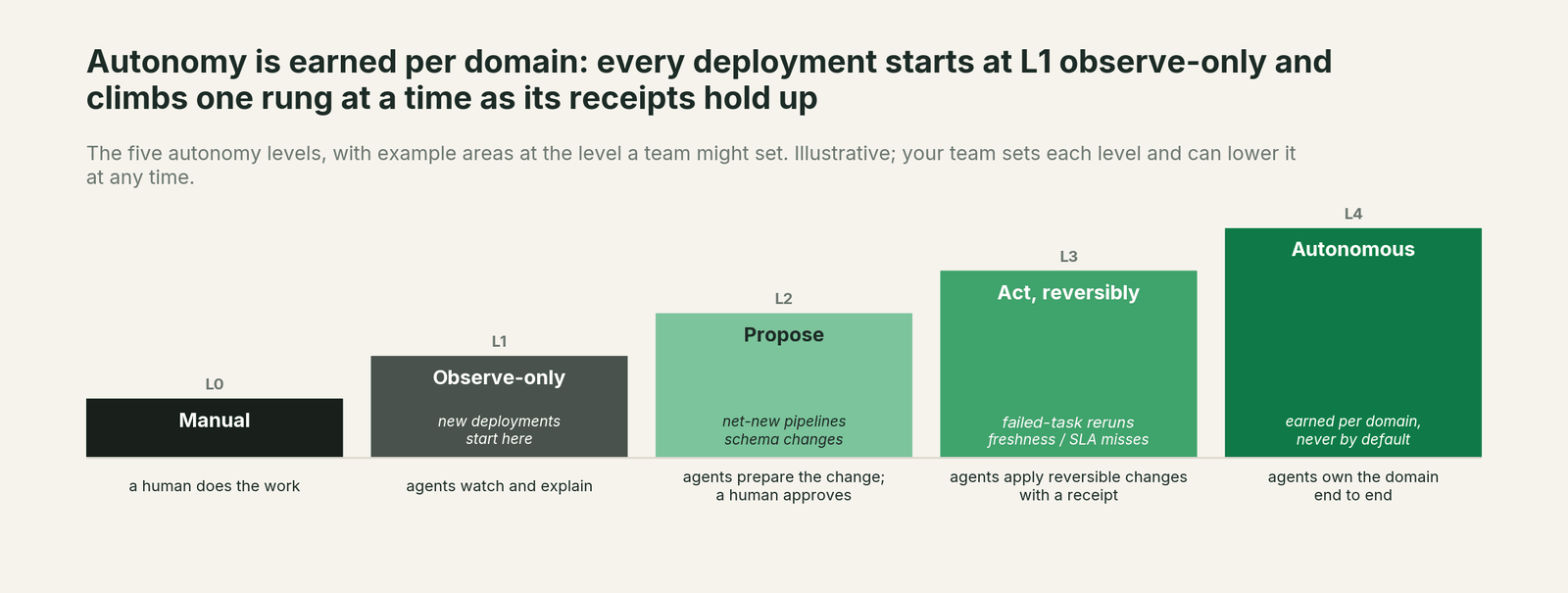
4. Autonomy per domain. You set autonomy per domain on the L0 to L4 ladder, from observe to autonomous. Actioneer fixes one setting for data, read-only, which is a sound default for an answer product and a ceiling for a team that wants the toil handled.
5. Receipts for changes, not only logs of questions. Actioneer logs what was asked, what data was touched and what came back. Data Workers records what changed, where, who approved it, the checks that ran and whether they passed, and how to undo it.
6. The back office. Least-privilege access requests behind approvals, Snowflake credits traced to the dbt model behind them with the fix drafted for its owner, legacy migrations planned in waves and parity-checked, and audit evidence built from receipts.
Behind all six are the 20+ specialist agents of the Data-Agents Swarm. Each one is an MCP server, so your team reaches them from Claude Code, Codex or Cursor.
One renamed field, one wrong table, five systems
Here is a scenario a lender running both products could run into. It's an illustrative example.
- •Mon 01:10. The loan servicing system renames
dpdtodays_past_due. Fivetran syncs it and adds the new column. The old column arrives empty. - •02:00. The Airflow DAG
collections_dailyruns dbt.fct_collectionsbuilds without error, but the overdue flag reads the old column, so a third of overdue accounts drop out. - •02:06. Data Workers' Quality agent flags the overdue count against its usual pattern on Snowflake.
- •02:09. The Schema agent links the drop to the renamed source field in the Fivetran sync.
- •02:15. The Conductor opens an incident. The Pipeline agent proposes a dbt fix as a diff. Spellbook shows the blast radius:
fct_collections, the Looker collections explore, and the outreach list that Actioneer's payment follow-up reads. - •06:40. The on-call engineer approves in Spellbook. The DAG reruns.
- •06:58. dbt tests pass and overdue counts match the source. At 07:05 the Looker explore is checked and the receipt is filed.
- •08:00. Actioneer's morning follow-up run reads the corrected list.
| Step | What Actioneer sees (per its site and blog) | What Data Workers does |
|---|---|---|
| The renamed source field | The source is connected and mapped by Actioneer's team; schema changes upstream aren't described | Schema agent catches the change in the Fivetran sync |
| The wrong table | Its critique agent checks that a query ran and returned what the agent claims; the table itself looks valid | Quality agent flags the drop against the table's pattern |
| The cause | Root-cause analysis for revenue metrics explains why a number moved | Conductor links the drop to the rename and the dbt model |
| The fix | Read-only by design: a recommendation for your own process | Pipeline agent proposes the dbt diff; one approval in Spellbook; DAG reruns |
| The record | A log of each query: workflow, data touched, output | A receipt: what changed, who approved, which checks passed, how to undo |
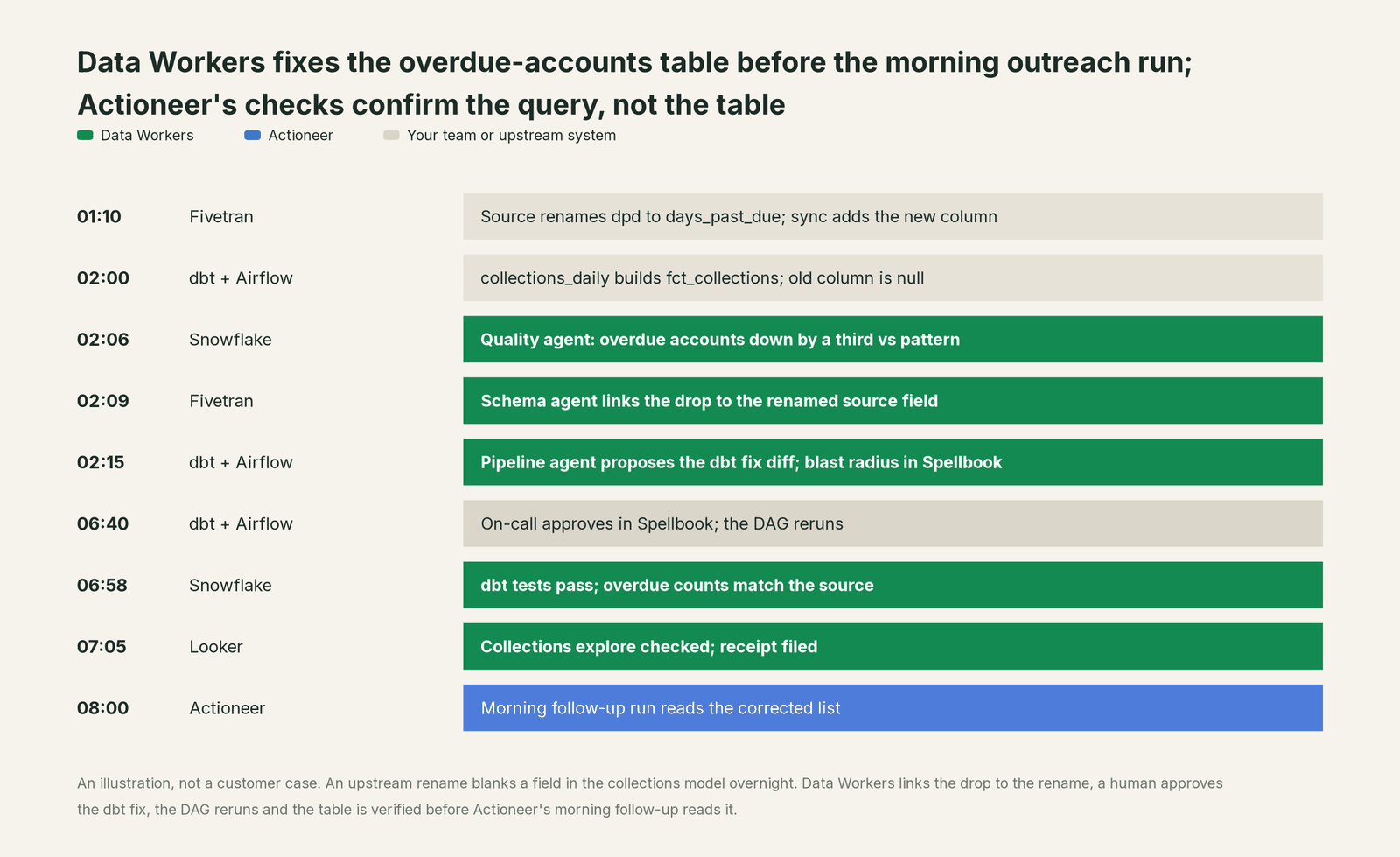
Without the fix, the 08:00 run would still have been grounded. Every fact would trace to a query, and the critique agent would confirm each query ran. The list would just be short by a third. Grounding checks the query; somebody has to own the table.
What Actioneer covers, as of October 2026
Actioneer's homepage, checked on October 2, 2026, says: "Actioneer provides AI agents for your customer journeys. Start by SMS, continue by voice, and help customers move forward." Its blog describes "Actioneer's managed AI platform", with the grounding configuration, schema mapping and harness maintenance "managed by Actioneer's team". Its docs site sits behind a login, so the statuses below come from its homepage and blog. Its research data agent is published under the names Sentinel and SCRIBE.
| Area | What Actioneer ships | Status (Oct 2026) |
|---|---|---|
| Customer-journey agents | Follow-up across SMS, voice, email, chat and WhatsApp; payments, scheduling, pharmacy and claims examples | Homepage |
| Sources | "Unify Azure, MMP, ERP, and mobile app data" | Homepage |
| Monitoring | "Monitor activity and flag changes" | Homepage |
| Grounded answers | Text-to-SQL with every fact tied to a data query | Blog (Aug 2026) |
| Critique layer | A separate agent verifies the primary agent's output against data queries | Blog (Aug 2026) |
| Context store | Per-entity current-state records with change history | Blog (Jul 2026) |
| Root-cause analysis | Explains why a revenue metric moved | Blog (Aug 2026) |
| Data access | Read-only credentials by architecture; no writes to production data | Blog (Aug 2026) |
| Writes in the journey | Sends messages, escalates to a human, writes outcomes to the ERP; corrections need specialist approval | Homepage |
| Audit | "A full audit trail: Review every decision and action, with admin access controls"; each query logged | Homepage, blog |
| Skill governance | Versioned org-wide skills with visibility into who uses what | Blog (Aug 2026) |
| Deployment | In your cloud account; choose inference region, provider and model version; on-prem for regulated BFSI | Homepage, blog |
| Privacy | Redacts personal details from transcripts | Homepage |
| Rollback | No recovery mechanism described | Not described |
| Pipelines, schema change, access, warehouse cost, migration | Not on the site or blog | Not described |
| MCP | No server or client surface | Not described |
| Pricing | Not published; sold through a conversation | Not published |
Actioneer has moved fast this year, from operational workflows for growth and risk teams to agents for customer journeys. What has stayed constant is the architecture: read the data, ground every answer, keep humans on the write.
Every tool owns a slice. Data Workers covers the whole lifecycle
Answering questions over business data is one stage of a data team's lifecycle. The same team keeps context current, checks quality, handles incidents, manages schema change and migrations, governs access, protects sensitive data, cuts spend and keeps the data under models healthy. Each point tool adds another console, another contract and another handoff. Data Workers covers the whole lifecycle with one context, one approval flow and one audit trail.
We score the same ten stages on every comparison page so you can compare tools across pages. Actioneer goes deepest on analytics and insights, its home stage.
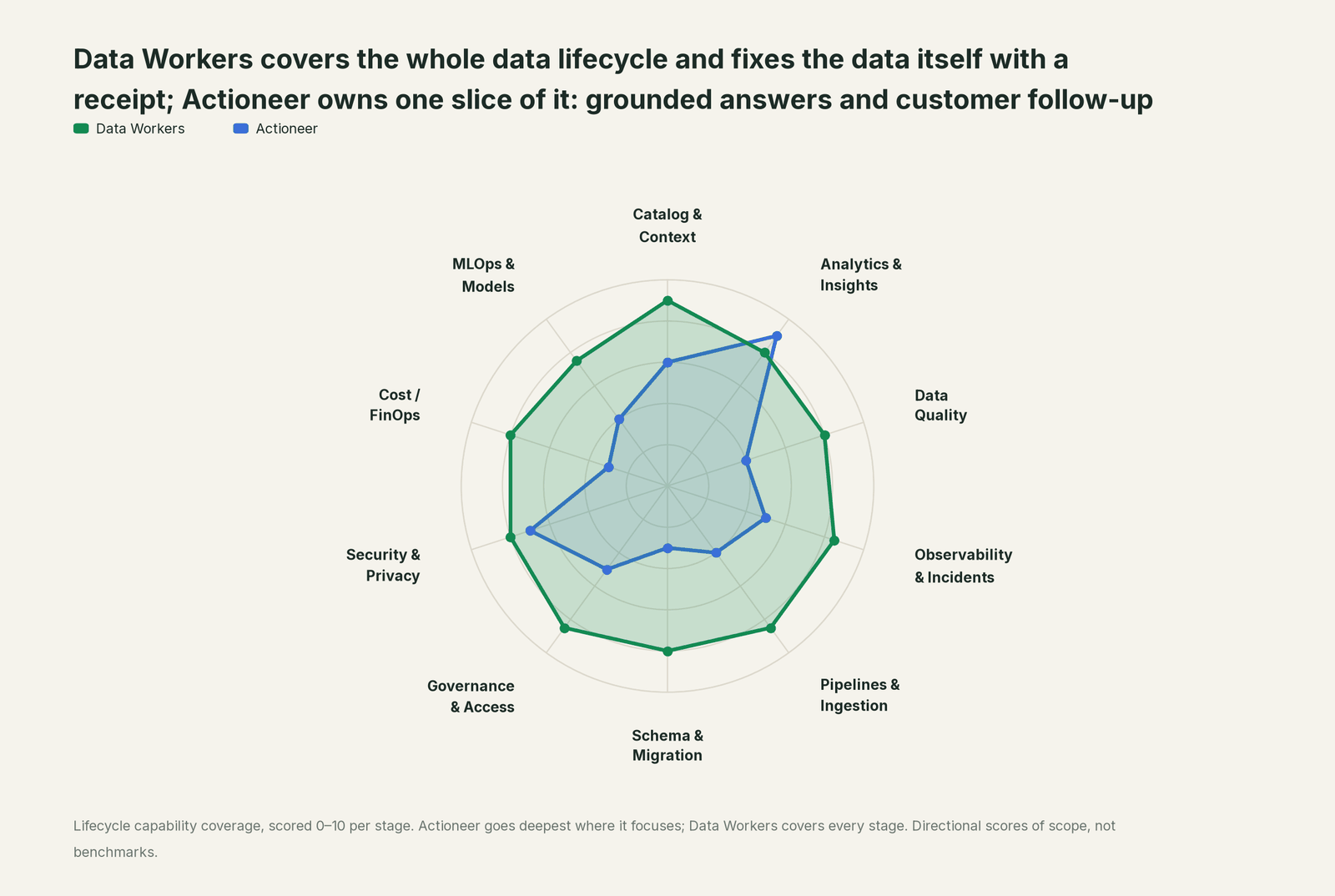
| Stage | Data Workers | Actioneer | Why we scored it this way |
|---|---|---|---|
| Catalog & Context | 9 | 6 | Actioneer keeps a per-entity context store with change history and unifies sources such as Azure, ERP and app data. Data Workers keeps one context graph across every platform. |
| Analytics & Insights | 8 | 9 | Actioneer's home stage: grounded Text-to-SQL with a separate critique agent, and root-cause analysis for revenue metrics. Data Workers answers over the same governed graph. |
| Data Quality | 8 | 4 | Actioneer's critique agent checks that a query ran and returned what the agent claims; the table under it is out of scope. Data Workers writes, runs and repairs checks behind approvals. |
| Observability & Incidents | 8.5 | 5 | Actioneer monitors activity, flags changes and explains metric moves. Data Workers opens the incident, traces it to the pipeline cause and proposes the fix. |
| Pipelines & Ingestion | 8.5 | 4 | Actioneer's team connects and maps sources as a managed service. Data Workers proposes pipeline changes as approval-gated diffs for the owner to merge. |
| Schema & Migration | 8 | 3 | Schema mapping lives inside Actioneer's grounding configuration. Data Workers catches upstream schema changes and plans migrations in waves. |
| Governance & Access | 8.5 | 5 | Actioneer governs its own agents: read-only data credentials, admin controls, skill versioning. Data Workers proposes least-privilege grants on your platforms. |
| Security & Privacy | 8 | 7 | Actioneer runs in your cloud and region, with transcript redaction and on-prem options. Data Workers adds a privacy check on pull requests and an audit trail across every agent. |
| Cost / FinOps | 8 | 3 | Actioneer reports model cost per answer. Data Workers traces Snowflake credits to the query and dbt model behind them and drafts the fix for its owner. |
| MLOps & Models | 7.5 | 4 | Actioneer lets you choose the model provider and version. Data Workers keeps the data under models healthy and connects to MLflow and W&B. |
These are directional scores of scope, not benchmarks.
Actioneer vs Data Workers on the outcomes a data owner buys
The lifecycle view shows breadth. This view scores eight outcomes a data owner pays for. Actioneer leads on two: customer follow-up and grounded answers. Data Workers leads on the other six.
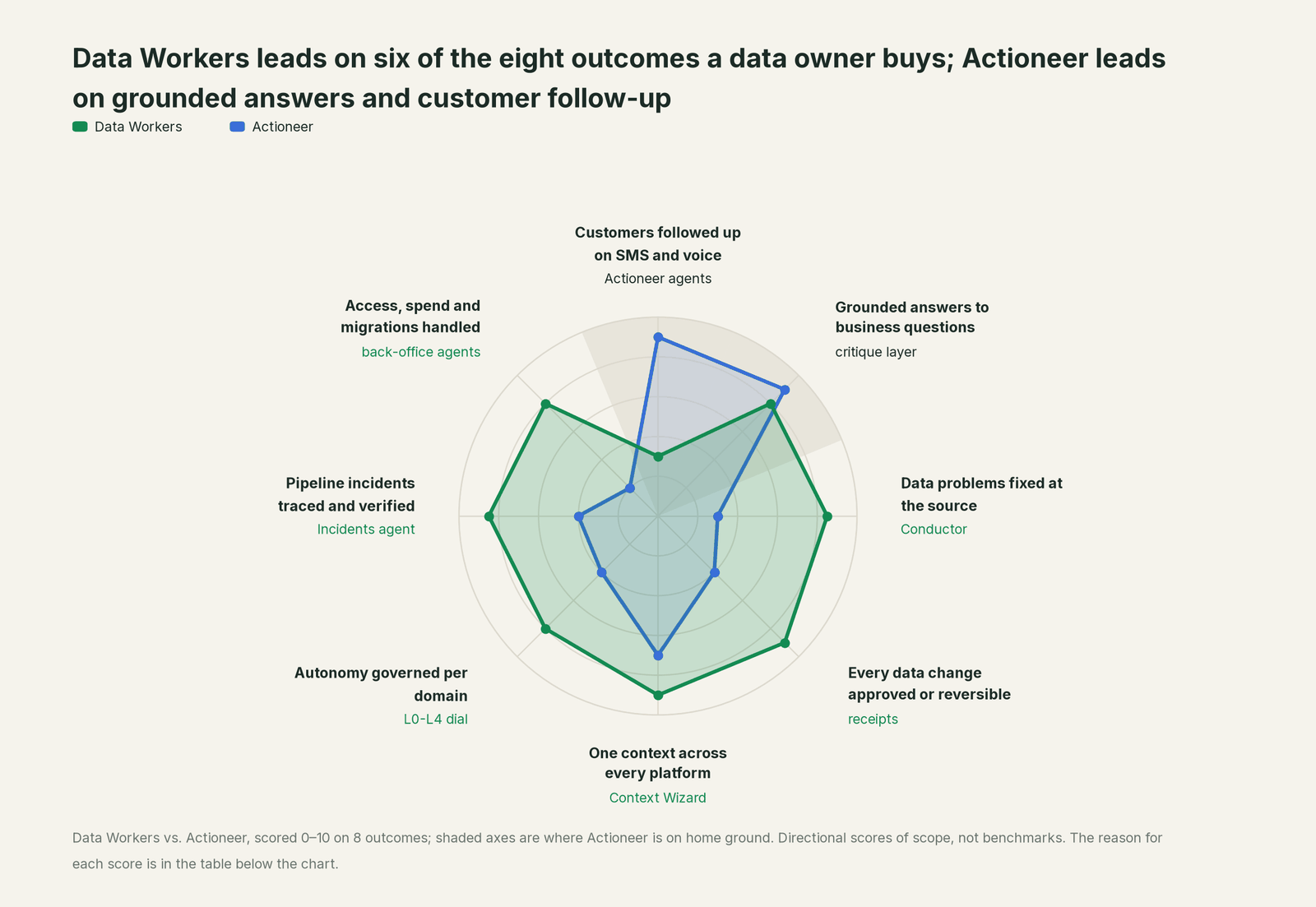
| Outcome | Data Workers | Actioneer | Why we scored it this way |
|---|---|---|---|
| Customers followed up on SMS and voice | 3 | 9 | Actioneer's home turf: agents that follow a customer from SMS to voice to resolution. Not a data-estate job; Data Workers keeps the data those agents read correct. |
| Grounded answers to business questions | 8 | 9 | Actioneer ties every fact to a data query and has a separate agent check it. Data Workers answers over the governed graph, with source and time on every fact. |
| Data problems fixed at the source | 8.5 | 3 | Actioneer is read-only on data by design and hands recommendations to your own process. The Conductor traces the cause and proposes the fix where it started. |
| Every data change approved or reversible | 9 | 4 | Actioneer avoids data writes and logs its queries; no rollback is described. Every Data Workers change is approved or reversible and leaves a receipt. |
| One context across every platform | 9 | 7 | Actioneer builds per-entity context stores for its agents. The Context Wizard keeps one graph across warehouses, dbt, orchestration and BI. |
| Autonomy governed per domain | 8 | 4 | Actioneer fixes one level on data, read-only, plus human escalation. We set autonomy per domain on the L0 to L4 ladder, and no agent approves its own work. |
| Pipeline incidents traced and verified | 8.5 | 4 | Actioneer explains why a metric moved. Data Workers links a failed load or bad table to the change that caused it and checks downstream after the fix. |
| Access, spend and migrations handled | 8 | 2 | Grants, warehouse cost and migrations don't appear on Actioneer's site or blog. Our Access, Cost and Migration agents propose changes behind approvals. |
The scores measure scope (what each side covers), not answer quality. They're our directional judgments, and we've shown the reasoning for every line.
Governance and receipts, side by side
This is the comparison that matters most, because both companies say governance is the point.
Actioneer's answer is to remove the risk at the root. On data, its agents hold read-only credentials, and "this is architecture, not policy". Each query is logged with the requesting workflow, the data touched and the output. A separate critique agent checks the primary agent's output against data queries. In the customer journey, where its agents do act, corrections wait for a specialist's approval and the evidence, approval, correction and delivery are linked in an audit trail. That's a careful, coherent design, and it suits a product whose job is answers and outreach.
Data Workers' answer is to make writes safe, because the data estate needs them. A renamed field, a missing grant or a runaway warehouse query is fixed by changing something.
| Question an auditor asks | Actioneer (per its site and blog) | Data Workers |
|---|---|---|
| Can the agent change production data? | No, by architecture | Yes, within the autonomy you set for that domain |
| Who approved the change? | Your own process, outside Actioneer, for data; a specialist, for journey corrections | A named human in Spellbook, recorded on the receipt |
| What else did it touch? | Data fields accessed per query | Blast radius across warehouses, dbt, DAGs and dashboards, computed before the change |
| Did it work? | The critique agent checks the query result | Checks run downstream after the change; pass or fail is on the receipt |
| Can we undo it? | Not described | Every change is approved or reversible |
| Can an agent approve its own work? | Not applicable on data | No; the guard sits in the write path, enforced in code |
The difference is where the record starts. Actioneer's log starts at the question. A Data Workers receipt starts at the change.
Where Actioneer stops
Each point below comes from Actioneer's own homepage or blog, checked on October 2, 2026.
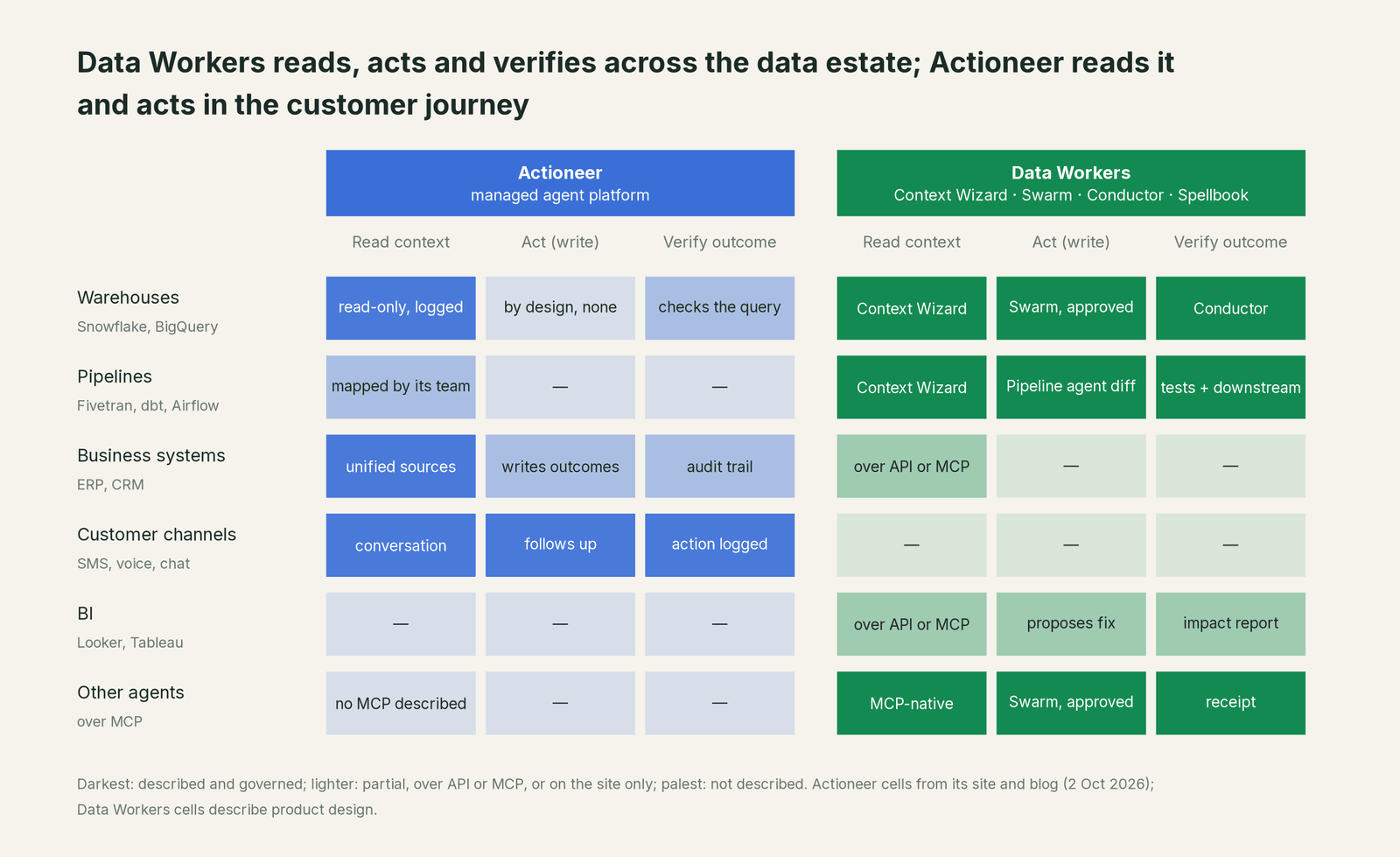
Read-only stops at the recommendation. Its blog argues that "most of the value in AI-driven data analysis was never in the writing". For a credit analyst, that's often right. For a data team, the bottleneck is the fix: the dbt change, the rerun, the grant, the check.
Grounding checks the query, not the table. Its critique agent verifies that "the data query that anchored the answer ran correctly and returned what the primary agent claims". If the table is wrong upstream, a grounded answer is grounded on the wrong table.
The pipeline is managed for you, not by an agent you govern. Schema mapping and grounding configuration are run by Actioneer's team. Upstream schema changes, dbt models and DAG runs aren't described as things its agents watch.
No rollback is described. Data writes don't happen, and for the writes its agents do make in the journey, no recovery step is described.
The back office isn't in scope. Access provisioning, warehouse cost work and legacy migration don't appear on the site or blog.
No MCP. Actioneer describes no MCP server or client, so other agents can't call it and it can't call theirs.
Why doesn't Actioneer just do this itself?
Because it chose to be read-only on data, wrote down why, and that choice is right for its job.
Actioneer sells to regulated businesses whose risk committees ask one question first: can the AI write to core systems, and who answers for it if it's wrong? Its answer, published on its blog, is that the AI never holds write credentials, so there's nothing to explain to a regulator after the fact. Every output becomes a recommendation for a human. Pair that with a managed service, where its team runs the grounding and schema mapping, and you get a product a risk committee can sign. It's a sensible business decision.
Fixing the data estate is a different product. It needs write access, scoped by blast radius across systems no single agent reads. It needs approvals that a data owner sets per domain for every agent and person, rollback for the agents that act, and receipts an auditor can read. It needs live context about every other system: the dbt project, the DAG, the dashboard, the grants. And it means taking responsibility for changes in tools Actioneer doesn't own. Doing that would mean giving up the read-only promise its buyers are paying for.
That platform is the product Data Workers is. We built the control plane first, so that writes could be safe.
Where the two overlap
| Job to be done | Actioneer | Data Workers | What we recommend |
|---|---|---|---|
| Customer follow-up across channels | SMS, voice, chat and WhatsApp agents | Not in scope | Actioneer |
| Grounded answers to business questions | Text-to-SQL with a critique agent | Answers over the governed graph | Either; keep Actioneer if your business users like it |
| Context for agents | Per-entity context stores | One graph across every platform | Data Workers for the estate |
| Monitoring | Activity monitored, changes flagged | Quality and Observability agents on every table | Data Workers for the data itself |
| Explaining a metric move | Revenue root-cause analysis | Incident traced to the pipeline cause | Both; different questions |
| Fixing the data | Recommendation to your process | Fix proposed at the source, approved, verified | Data Workers |
| Undoing a change | Not described | Approved or reversible, with a receipt | Data Workers |
| Schema changes upstream | Mapped by its team | Schema agent catches and proposes | Data Workers |
| Access requests | Not described | Access & Governance and Identity agents | Data Workers |
| Cost cleanup | Model cost per answer | Cost Savings & Data Cleanup agent | Data Workers |
| Migrations | Not described | Data Migration agent | Data Workers |
| Audit evidence | Query and action logs | Receipts for every change on every system | Both, for different records |
What it costs
Actioneer doesn't publish pricing as of October 2026. It sells a managed platform, with its team running the grounding and configuration, through a sales conversation. Ask how the managed service is priced and how cost grows as more workflows move onto it.
Data Workers publishes its rate card. The Apache 2.0 core is free. A pilot is $7,500 one-time. Scale starts at $1,000 a month and Enterprise at $3,000 a month, billed annually. Seats are unlimited, there's no usage meter, and there's no markup on model spend because you bring your own model. See pricing for what each plan includes.
The fastest first win: guard the tables your agents read
Pick the ten tables your agents read most, Actioneer's included. Turn on the Quality and Schema agents for them, propose-only. They change nothing. Each morning you see which tables drifted from their pattern, which upstream fields changed, and what each issue would reach downstream, before any agent reads it.
The second step is failed and late loads in one domain, in propose mode. Each incident lands in the Spellbook inbox with the root cause, the proposed fix and its blast radius. When your team has approved those proposals unchanged for a few weeks, move that domain up a level. The autonomous data platform playbook covers the full sequence.
What each Data Workers product adds
Autonomous Data-Conductor. The orchestrator that owns an outcome: detect, diagnose, fix, review, verify and remember. It scopes the blast radius before anything changes, routes the fix to the right agent and checks the result downstream after approval.
Data-Agents Swarm. 20+ specialist agents. Next to an answer-and-outreach platform, the ones that matter most are the Incident Debugging agent, the Schema Evolution agent, the Pipeline Building agent, the Data Change Review agent, and the back-office agents: Data Access & Governance, Cost Savings & Data Cleanup and Data Migration. The cost agent's 25 to 40% spend reduction and the migration agent's 4 to 8 week timeline are design targets.
Data Context Wizard. One governed graph across warehouses, dbt, orchestration and BI. Snowflake, BigQuery, Databricks, dbt and Fivetran connect natively; Looker and Tableau connect over their API or MCP today. Every fact carries its source, author, confidence and observed time.
Spellbook Data Catalog. The control plane for agent work, in preview. Every proposed change from every agent lands in one inbox, asset pages cover the whole estate, and an authority guard enforced in code stops any agent from approving its own work.
Autonomy guardrails and security
Actioneer handles agent risk by keeping its agents off the write path for data. Data Workers handles it by governing the write path.
- •Autonomy is set per domain, on the ladder from L1 observe through L2 propose and L3 reversible action to L4 autonomous.
- •New deployments start observe-only. You extend autonomy one domain at a time as the receipts earn trust.
- •Every write is scoped before it runs, with blast radius computed across platforms. Anything irreversible needs a named human to approve it.
- •Every change is approved or reversible and leaves a receipt: what changed and where, who approved it, the checks that ran and whether they passed, and when.
- •No agent can approve or promote its own work. The guard sits in the write path, enforced in code.
- •Least privilege. Data Workers acts with the grants you give it, through each platform's own permission system, and runs where you deploy it.
"Read-only is the safe choice. Why would we let agents write?"
For answers, read-only is a good choice, and Actioneer makes the case well. A wrong answer a human reviews is a smaller risk than a wrong write nobody reviewed.
The fixes still happen, though. Today a data engineer makes them by hand, at 2 a.m., with whatever record they remember to leave. That's a write too, with no blast radius computed, no second check and no receipt. Data Workers doesn't add risk to that. It puts the same write behind a scoped proposal, a named approver, a downstream check and a receipt, and it starts at L0, where it only observes. You decide per domain when, and whether, it moves up.
Every Data Workers agent is an MCP server, so your team reaches it from the coding agent they already use, and other agents' MCP servers feed the loop.
How it fits together
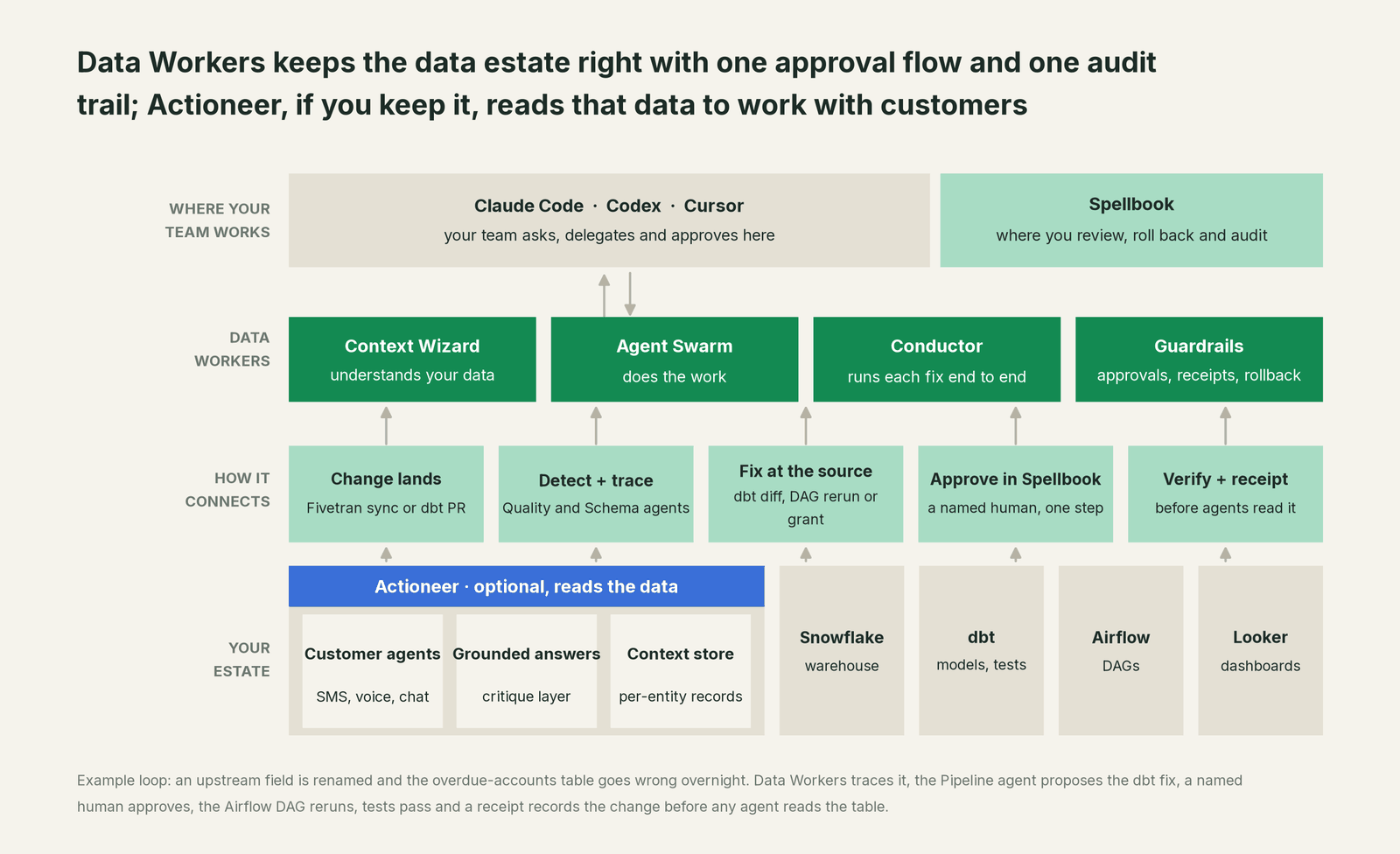
Nothing changes about how Actioneer works with your customers. Connect Data Workers to your warehouses, dbt projects and orchestrator; there's no migration and no Actioneer connector to install. The two meet in the warehouse: Data Workers keeps the tables right, and Actioneer reads them. For other agent comparisons, see Alkera, Altimate and Recce. If you also run an observability tool, see Monte Carlo vs Data Workers. For the wiring, see Data Workers with dbt, Data Workers with Airflow and the Snowflake guide.
When Actioneer alone is enough
If what you need is customer follow-up and grounded answers, and a separate team already keeps the warehouse, pipelines, access and cost in order with its own records, Actioneer covers your job. Data Workers is built for the team that owns the data those agents read, and has to fix it and prove what changed.
The case for your CFO
The outcome. More of the business now runs on agents reading your data: customer follow-up, answers, reports. The outcome Data Workers buys is that the data under them is right, and that every fix to it is approved, checked and recorded. A wrong table is caught at 2 a.m., not after a morning of outreach to the wrong customers.
The risk story. At L1 agents only observe. At L2 they propose and a named human approves. At L3 they take reversible actions in the domains you choose, and L4 is fully autonomous where you've decided it's safe. Anything irreversible always needs a person. Every change leaves a receipt with what changed, where, who approved it and which checks passed. There's no migration: Data Workers connects to the warehouse, dbt and Airflow you already run.
Why now. Agent platforms are arriving in every function, and each brings its own log. Regulators and auditors will ask for the record of changes to the data those agents use. Choose the place that record lives before every tool keeps its own.
The first win. The Quality and Schema agents on the tables your agents read, propose-only, in the first weeks.
What stays the same. Your warehouse, dbt, Airflow and BI. Actioneer keeps working with your customers, and your team keeps its coding agent as the way in.
The pilot path. Start with a pilot (pricing). The $7,500 pilot is credited in full against the first year.
The sentence to repeat upstairs: "Actioneer keeps its agents read-only on our data and logs what they asked; Data Workers is how the data itself gets fixed, with one approval inbox and a receipt for every change across every system."
FAQ
What is the Actioneer alternative for a data team? Data Workers, if the job is the data estate itself. It detects problems, fixes them at the source behind approvals, checks the result downstream and leaves a receipt, across quality, incidents, schema change, access, cost and migration. If the job is customer follow-up by SMS and voice, Actioneer does that and Data Workers doesn't.
Actioneer is read-only. Isn't that safer than an agent that writes? For answers, yes. But the fixes still happen, by hand and often without a record. Data Workers puts those writes behind blast-radius scoping, a named approver, downstream checks, rollback and a receipt, and starts every domain at observe.
Actioneer has an audit trail. What does a receipt add? Actioneer logs each query, the data it touched and the output, plus actions in the customer journey. A Data Workers receipt records a change to the data estate: what changed, where, who approved it, which checks ran and passed, and how to undo it.
Does Actioneer's critique layer catch bad data? It checks that the query behind an answer ran correctly and returned what the agent claims. A table that's wrong upstream can pass that check. Data Workers' Quality and Schema agents watch the table itself.
Can we keep Actioneer and add Data Workers? Yes. They meet in the warehouse. Data Workers keeps the tables right; Actioneer reads them. There's no connector between them to install.
Can Data Workers run in our own cloud? Yes. The core is Apache 2.0, you deploy it where you choose, you bring your own model, and it acts only with the grants you give it.
How much does Data Workers cost? Scale from $1,000 a month and Enterprise from $3,000 a month, billed annually, with a $7,500 one-time pilot. Seats are unlimited and there's no usage meter. See pricing.
Sources
Sources for Actioneer capabilities and statuses, current as of October 2, 2026: the homepage (positioning, sources, monitoring, private cloud and region, audit trail, redaction, human escalation, specialist approval), Read-Only AI Architecture for BFSI Compliance (Aug 24, 2026), Multi-Agent Critique Layers (Aug 30, 2026), AI Context Store vs Vector Database (Jul 31, 2026), How to Build Automated Root Cause Analysis for Revenue (Aug 15, 2026), the blog feed and the docs login page. Data Workers: pricing and the product pages linked above. Product names and statuses change quickly; if we've got something wrong, tell us and we'll fix it.