Revenue cycle data, run by agents
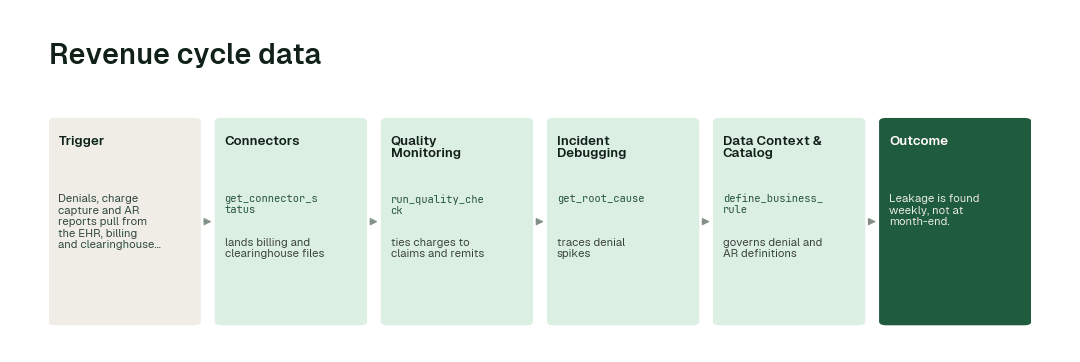
Denials, charge capture and AR reports pull from the EHR, billing and clearinghouse systems, and every month-end someone reconciles them by hand. Here is how Data Workers runs it instead.
Key takeaways
- •The problem today. Denials, charge capture and AR reports pull from the EHR, billing and clearinghouse systems, and every month-end someone reconciles them by hand.
- •What changes. Agents tie charges, claims, remits and denials together on every load and trace leakage to its source.
- •What stays with your people. Write-offs and financial reporting inputs: they hit the P&L.
- •The result. Leakage is found weekly, not at month-end.
The problem today
Denials, charge capture and AR reports pull from the EHR, billing and clearinghouse systems, and every month-end someone reconciles them by hand.
What changes with Data Workers
Agents tie charges, claims, remits and denials together on every load and trace leakage to its source.
The workflow, step by step
- 1.The Connectors agent calls
get_connector_statusand lands billing and clearinghouse files. - 2.The Quality Monitoring agent calls
run_quality_checkand ties charges to claims and remits. - 3.The Incident Debugging agent calls
get_root_causeand traces denial spikes. - 4.The Data Context & Catalog agent calls
define_business_ruleand governs denial and AR definitions.
The impact metrics we move
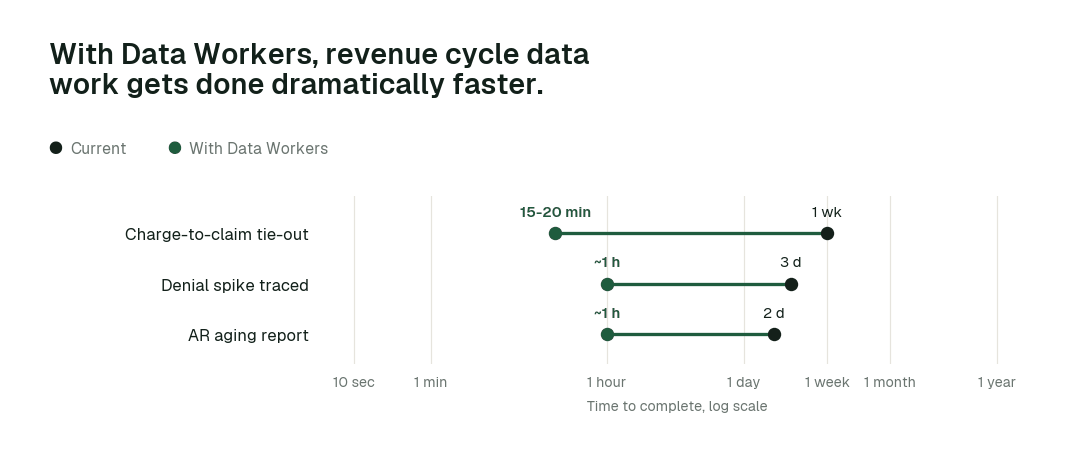
- •Charge-to-claim tie-out: from about a week to 15-20 min
- •Denial spike traced: from about 3 days to ~1 h
- •AR aging report: from about 2 days to ~1 h
What goes on autopilot
- •Charges, claims and remits are tied on every load, so leakage is visible the week it happens.
- •Denial categories are governed, so finance and RCM agree.
Where your people stay in charge
Write-offs and financial reporting inputs always go to a named approver, because they hit the P&L. Everything starts at L1, observing only, and autonomy rises only on evidence.
The pilot
- •Scope. Charge-to-remit tie-out for one hospital.
- •First week. Agents run at L1, observing only, and show the fixes they would have made, with receipts.
- •By week two. The routine work above runs on its own; anything sensitive stays with a named approver.
- •At day 30. We review the impact metrics against your baseline:
- •Charge-to-claim tie-out: from about a week to 15-20 min
- •Denial spike traced: from about 3 days to ~1 h
- •AR aging report: from about 2 days to ~1 h
- •Cost. Start with a pilot ($7,500 one-time, credited in full against the first year). Scale is from $1,000 a month and Enterprise from $3,000 a month, billed annually, with unlimited seats, no usage meter and no markup on model spend. See pricing.