Program oversight data, run by agents
Program data comes from states, contractors and legacy systems in different layouts, and oversight reports lag by quarters. Here is how Data Workers runs it instead.
Key takeaways
- •The problem today. Program data comes from states, contractors and legacy systems in different layouts, and oversight reports lag by quarters.
- •What changes. Agents map every partner file, check completeness and keep program metrics current with lineage.
- •What stays with your people. Published findings: they carry public trust.
- •The result. Oversight reports run on current, documented data.
The problem today
Program data comes from states, contractors and legacy systems in different layouts, and oversight reports lag by quarters.
What changes with Data Workers
Agents map every partner file, check completeness and keep program metrics current with lineage.
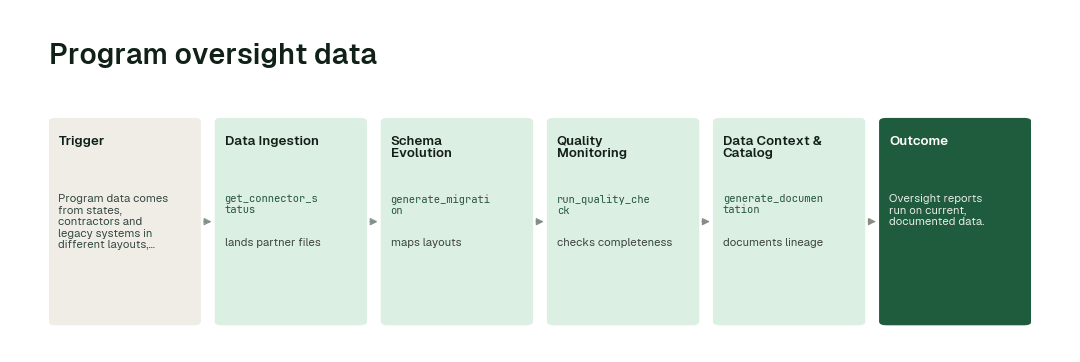
The workflow, step by step
- 1.The Data Ingestion agent calls
get_connector_statusand lands partner files. - 2.The Schema Evolution agent calls
generate_migrationand maps layouts. - 3.The Quality Monitoring agent calls
run_quality_checkand checks completeness. - 4.The Data Context & Catalog agent calls
generate_documentationand documents lineage.
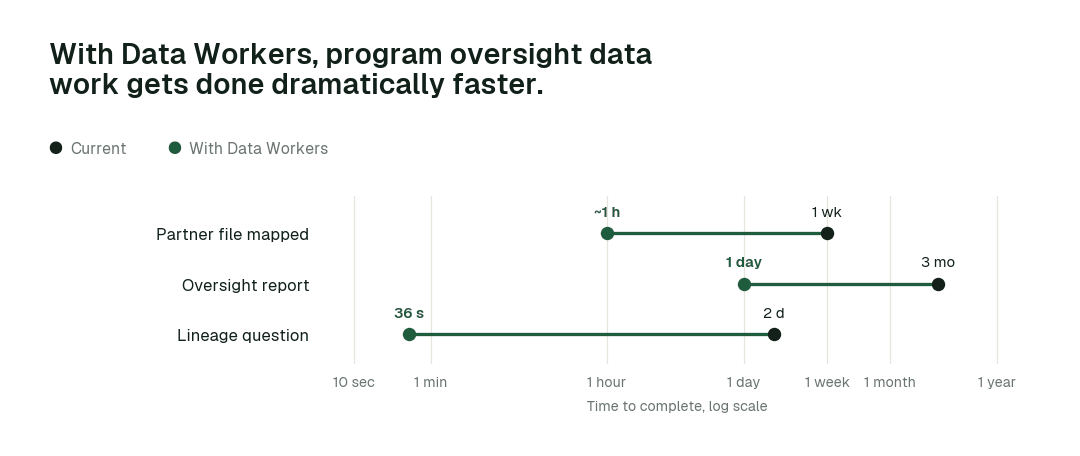
The impact metrics we move
- •Partner file mapped: from about a week to ~1 h
- •Oversight report: from about 3 months to 1 day
- •Lineage question: from about 2 days to seconds
What goes on autopilot
- •Partner files map on arrival, so no quarter is lost.
- •Lineage is generated, so oversight is defensible.
Where your people stay in charge
Published findings always go to a named approver, because they carry public trust. Everything starts at L1, observing only, and autonomy rises only on evidence.
The pilot
- •Scope. One program's partner files.
- •First week. Agents run at L1, observing only, and show the fixes they would have made, with receipts.
- •By week two. The routine work above runs on its own; anything sensitive stays with a named approver.
- •At day 30. We review the impact metrics against your baseline:
- •Partner file mapped: from about a week to ~1 h
- •Oversight report: from about 3 months to 1 day
- •Lineage question: from about 2 days to seconds
- •Cost. Start with a pilot ($7,500 one-time, credited in full against the first year). Scale is from $1,000 a month and Enterprise from $3,000 a month, billed annually, with unlimited seats, no usage meter and no markup on model spend. See pricing.
Related: The government hub · The full team playbook