Population health data, run by agents
Registries and risk scores rebuild from EHR, claims and social data monthly, and care managers work from stale lists. Here is how Data Workers runs it instead.
Key takeaways
- •The problem today. Registries and risk scores rebuild from EHR, claims and social data monthly, and care managers work from stale lists.
- •What changes. Agents keep registries current from every source and verify risk inputs before care teams act.
- •What stays with your people. Changes to cohort and risk definitions: they decide who gets care management.
- •The result. Care managers work from lists that are days old, not months.
The problem today
Registries and risk scores rebuild from EHR, claims and social data monthly, and care managers work from stale lists.
What changes with Data Workers
Agents keep registries current from every source and verify risk inputs before care teams act.
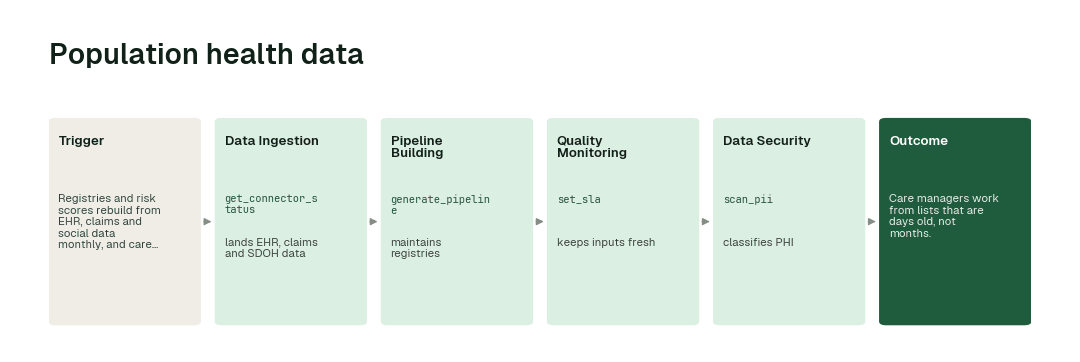
The workflow, step by step
- 1.The Data Ingestion agent calls
get_connector_statusand lands EHR, claims and SDOH data. - 2.The Pipeline Building agent calls
generate_pipelineand maintains registries. - 3.The Quality Monitoring agent calls
set_slaand keeps inputs fresh. - 4.The Data Security agent calls
scan_piiand classifies PHI.
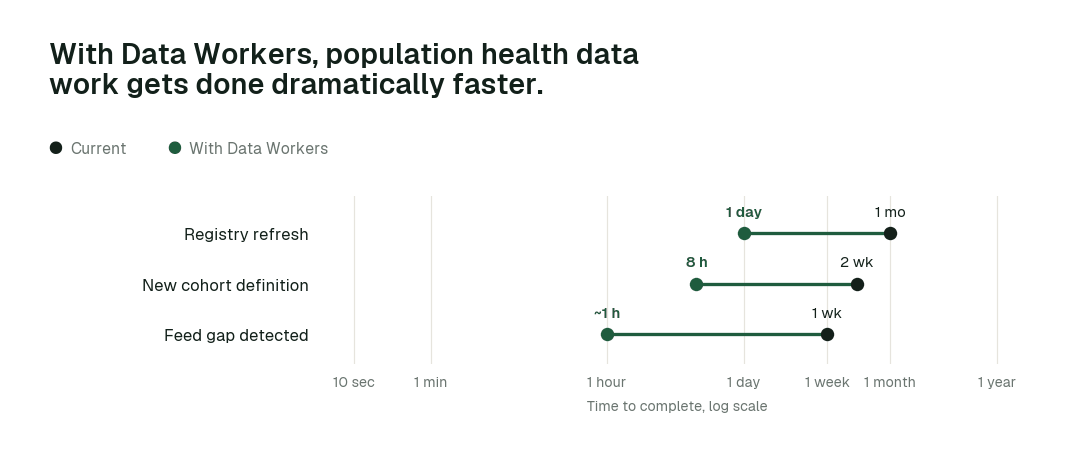
The impact metrics we move
- •Registry refresh: from about a month to 1 day
- •New cohort definition: from about 2 weeks to 8 h
- •Feed gap detected: from about a week to ~1 h
What goes on autopilot
- •Registries refresh continuously, so outreach reaches patients who need it now.
- •Risk inputs are verified before scoring, so care teams trust the list.
Where your people stay in charge
Changes to cohort and risk definitions always go to a named approver, because they decide who gets care management. Everything starts at L1, observing only, and autonomy rises only on evidence.
The pilot
- •Scope. One registry refreshed continuously.
- •First week. Agents run at L1, observing only, and show the fixes they would have made, with receipts.
- •By week two. The routine work above runs on its own; anything sensitive stays with a named approver.
- •At day 30. We review the impact metrics against your baseline:
- •Registry refresh: from about a month to 1 day
- •New cohort definition: from about 2 weeks to 8 h
- •Feed gap detected: from about a week to ~1 h
- •Cost. Start with a pilot ($7,500 one-time, credited in full against the first year). Scale is from $1,000 a month and Enterprise from $3,000 a month, billed annually, with unlimited seats, no usage meter and no markup on model spend. See pricing.