Fraud detection data, run by agents
Fraud features depend on fast transaction streams that fail often, and models score on stale data without anyone knowing. Here is how Data Workers runs it instead.
Key takeaways
- •The problem today. Fraud features depend on fast transaction streams that fail often, and models score on stale data without anyone knowing.
- •What changes. Agents keep feature tables on freshness SLAs, rerun late partitions and watch model drift.
- •What stays with your people. Model and rule changes: they decide who is blocked.
- •The result. Fraud models never score on stale features.
The problem today
Fraud features depend on fast transaction streams that fail often, and models score on stale data without anyone knowing.
What changes with Data Workers
Agents keep feature tables on freshness SLAs, rerun late partitions and watch model drift.
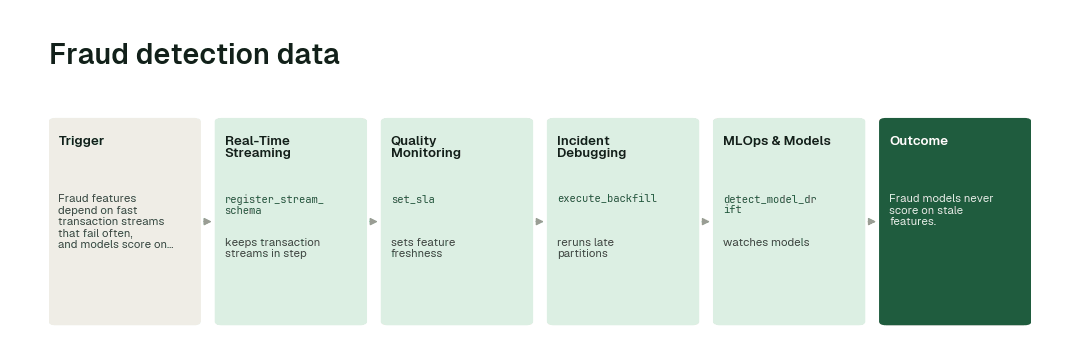
The workflow, step by step
- 1.The Real-Time Streaming agent calls
register_stream_schemaand keeps transaction streams in step. - 2.The Quality Monitoring agent calls
set_slaand sets feature freshness. - 3.The Incident Debugging agent calls
execute_backfilland reruns late partitions. - 4.The MLOps & Models agent calls
detect_model_driftand watches models.
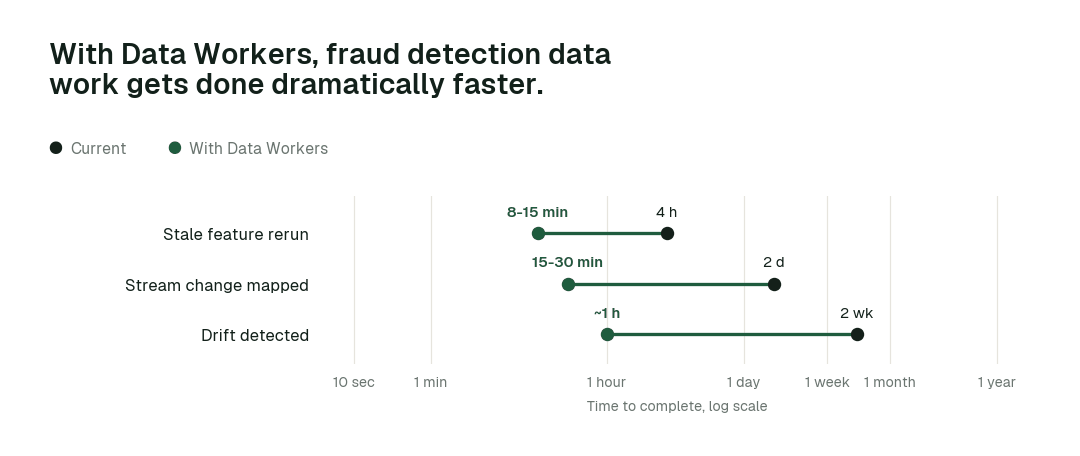
The impact metrics we move
- •Stale feature rerun: from about 4 hours to 8-15 min
- •Stream change mapped: from about 2 days to 15-30 min
- •Drift detected: from about 2 weeks to ~1 h
What goes on autopilot
- •Feature tables run on SLAs, so models see fresh data.
- •Drift is watched continuously, so degradation is caught early.
Where your people stay in charge
Model and rule changes always go to a named approver, because they decide who is blocked. Everything starts at L1, observing only, and autonomy rises only on evidence.
The pilot
- •Scope. Feature freshness for one model.
- •First week. Agents run at L1, observing only, and show the fixes they would have made, with receipts.
- •By week two. The routine work above runs on its own; anything sensitive stays with a named approver.
- •At day 30. We review the impact metrics against your baseline:
- •Stale feature rerun: from about 4 hours to 8-15 min
- •Stream change mapped: from about 2 days to 15-30 min
- •Drift detected: from about 2 weeks to ~1 h
- •Cost. Start with a pilot ($7,500 one-time, credited in full against the first year). Scale is from $1,000 a month and Enterprise from $3,000 a month, billed annually, with unlimited seats, no usage meter and no markup on model spend. See pricing.
Related: The financial services hub · The full team playbook