Delivery performance data, run by agents
On-time metrics depend on scan, route and customer data that disagree, so every region reports a different OTD. Here is how Data Workers runs it instead.
Key takeaways
- •The problem today. On-time metrics depend on scan, route and customer data that disagree, so every region reports a different OTD.
- •What changes. Agents verify scans per hub, govern the OTD definition and trace misses to cause.
- •What stays with your people. Customer-facing SLA reports: contracts depend on them.
- •The result. One on-time number across regions.
The problem today
On-time metrics depend on scan, route and customer data that disagree, so every region reports a different OTD.
What changes with Data Workers
Agents verify scans per hub, govern the OTD definition and trace misses to cause.
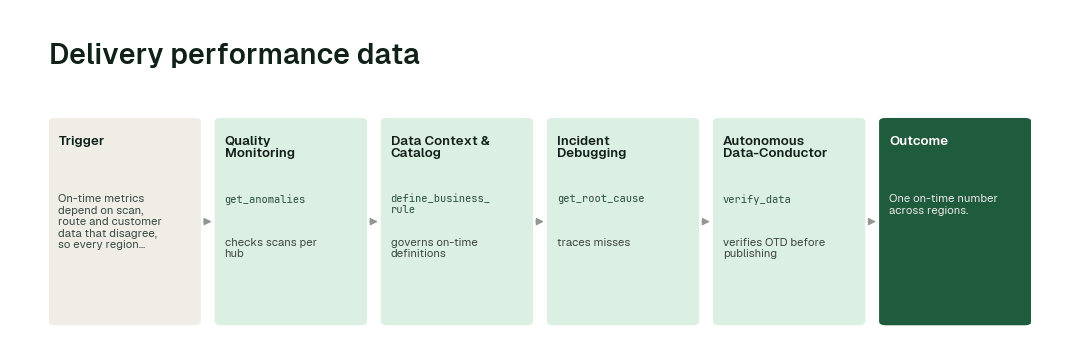
The workflow, step by step
- 1.The Quality Monitoring agent calls
get_anomaliesand checks scans per hub. - 2.The Data Context & Catalog agent calls
define_business_ruleand governs on-time definitions. - 3.The Incident Debugging agent calls
get_root_causeand traces misses. - 4.The Autonomous Data-Conductor calls
verify_dataand verifies OTD before publishing.
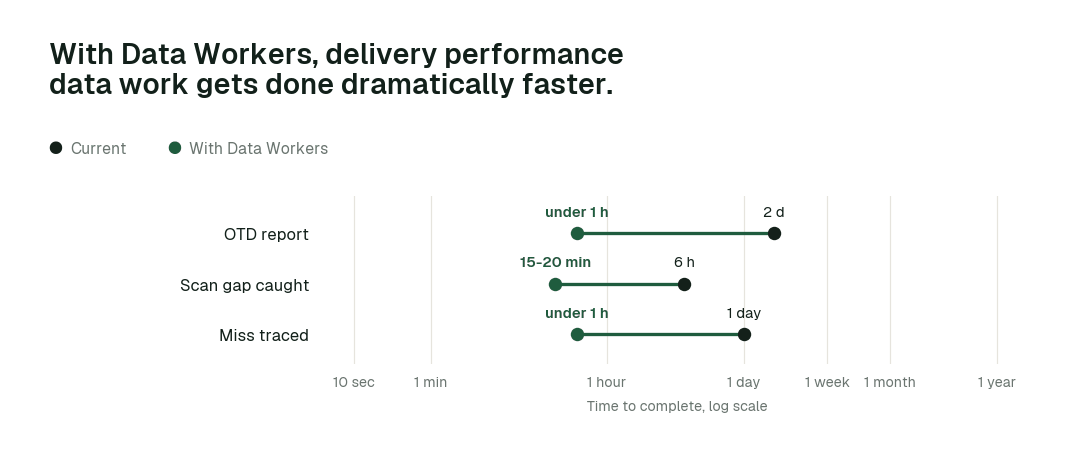
The impact metrics we move
- •OTD report: from about 2 days to under 1 h
- •Scan gap caught: from about 6 hours to 15-20 min
- •Miss traced: from about a day to under 1 h
What goes on autopilot
- •Scans are checked per hub, so OTD is never computed on gaps.
- •OTD is governed, so regions agree.
Where your people stay in charge
Customer-facing SLA reports always go to a named approver, because contracts depend on them. Everything starts at L1, observing only, and autonomy rises only on evidence.
The pilot
- •Scope. OTD for one region.
- •First week. Agents run at L1, observing only, and show the fixes they would have made, with receipts.
- •By week two. The routine work above runs on its own; anything sensitive stays with a named approver.
- •At day 30. We review the impact metrics against your baseline:
- •OTD report: from about 2 days to under 1 h
- •Scan gap caught: from about 6 hours to 15-20 min
- •Miss traced: from about a day to under 1 h
- •Cost. Start with a pilot ($7,500 one-time, credited in full against the first year). Scale is from $1,000 a month and Enterprise from $3,000 a month, billed annually, with unlimited seats, no usage meter and no markup on model spend. See pricing.