Churn and renewal risk data, run by agents
Usage, support and billing signals live apart, so risk is found at renewal. Here is how Data Workers runs it instead.
Key takeaways
- •The problem today. Usage, support and billing signals live apart, so risk is found at renewal.
- •What changes. Agents join usage, support and billing per account, keep risk features fresh and watch model drift.
- •What stays with your people. Customer-facing actions: they affect relationships.
- •The result. Risk surfaces months before renewal.
The problem today
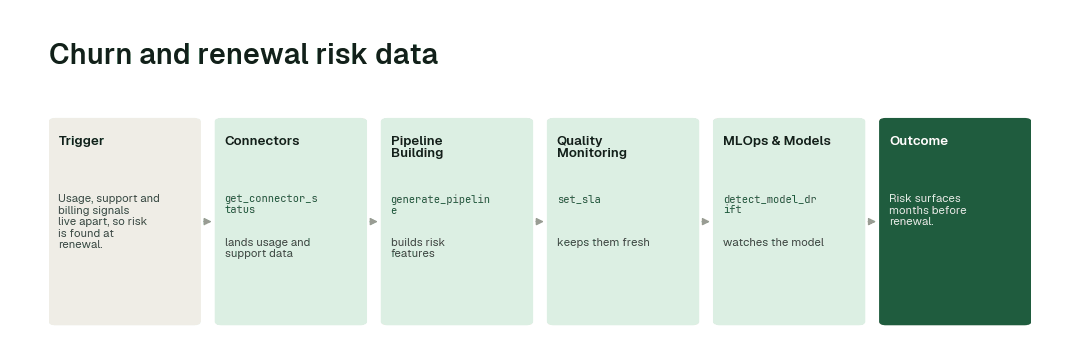
Usage, support and billing signals live apart, so risk is found at renewal.
What changes with Data Workers
Agents join usage, support and billing per account, keep risk features fresh and watch model drift.
The workflow, step by step
- 1.The Connectors agent calls
get_connector_statusand lands usage and support data. - 2.The Pipeline Building agent calls
generate_pipelineand builds risk features. - 3.The Quality Monitoring agent calls
set_slaand keeps them fresh. - 4.The MLOps & Models agent calls
detect_model_driftand watches the model.
The impact metrics we move
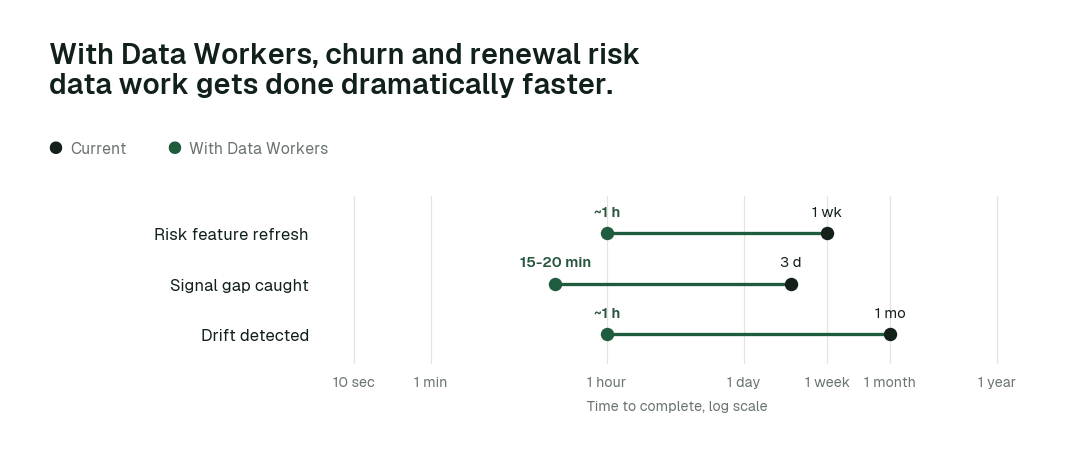
- •Risk feature refresh: from about a week to ~1 h
- •Signal gap caught: from about 3 days to 15-20 min
- •Drift detected: from about a month to ~1 h
What goes on autopilot
- •Risk features stay fresh, so signals are current.
- •Drift is watched, so scores stay trustworthy.
Where your people stay in charge
Customer-facing actions always go to a named approver, because they affect relationships. Everything starts at L1, observing only, and autonomy rises only on evidence.
The pilot
- •Scope. Risk features for one segment.
- •First week. Agents run at L1, observing only, and show the fixes they would have made, with receipts.
- •By week two. The routine work above runs on its own; anything sensitive stays with a named approver.
- •At day 30. We review the impact metrics against your baseline:
- •Risk feature refresh: from about a week to ~1 h
- •Signal gap caught: from about 3 days to 15-20 min
- •Drift detected: from about a month to ~1 h
- •Cost. Start with a pilot ($7,500 one-time, credited in full against the first year). Scale is from $1,000 a month and Enterprise from $3,000 a month, billed annually, with unlimited seats, no usage meter and no markup on model spend. See pricing.
Related: The sales and revenue page · The full team playbook