Carrier and lane analytics data, run by agents
Carrier events, rates and tenders arrive from dozens of partners in different formats, so lane performance is always a month behind. Here is how Data Workers runs it instead.
Key takeaways
- •The problem today. Carrier events, rates and tenders arrive from dozens of partners in different formats, so lane performance is always a month behind.
- •What changes. Agents map every carrier feed, join rates to actuals and keep lane metrics current.
- •What stays with your people. Carrier scorecards shared externally: contracts depend on them.
- •The result. Lane performance is current for every procurement cycle.
The problem today
Carrier events, rates and tenders arrive from dozens of partners in different formats, so lane performance is always a month behind.
What changes with Data Workers
Agents map every carrier feed, join rates to actuals and keep lane metrics current.
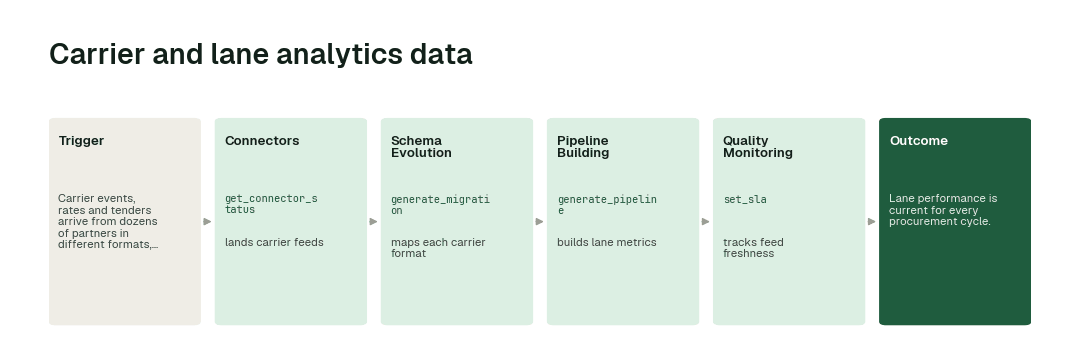
The workflow, step by step
- 1.The Connectors agent calls
get_connector_statusand lands carrier feeds. - 2.The Schema Evolution agent calls
generate_migrationand maps each carrier format. - 3.The Pipeline Building agent calls
generate_pipelineand builds lane metrics. - 4.The Quality Monitoring agent calls
set_slaand tracks feed freshness.
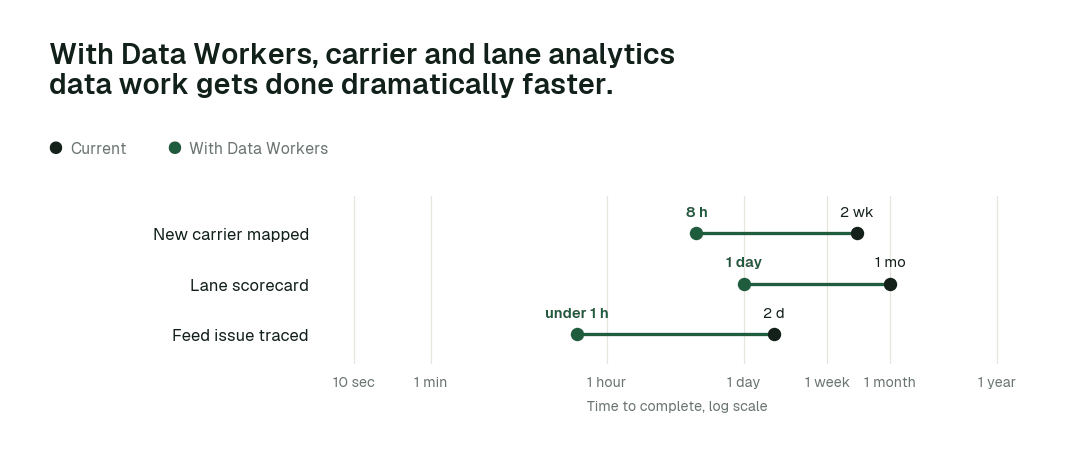
The impact metrics we move
- •New carrier mapped: from about 2 weeks to 8 h
- •Lane scorecard: from about a month to 1 day
- •Feed issue traced: from about 2 days to under 1 h
What goes on autopilot
- •Carrier formats map on arrival, so no carrier is left out.
- •Lane metrics refresh daily, so bids use current data.
Where your people stay in charge
Carrier scorecards shared externally always go to a named approver, because contracts depend on them. Everything starts at L1, observing only, and autonomy rises only on evidence.
The pilot
- •Scope. Top 20 carriers' feeds.
- •First week. Agents run at L1, observing only, and show the fixes they would have made, with receipts.
- •By week two. The routine work above runs on its own; anything sensitive stays with a named approver.
- •At day 30. We review the impact metrics against your baseline:
- •New carrier mapped: from about 2 weeks to 8 h
- •Lane scorecard: from about a month to 1 day
- •Feed issue traced: from about 2 days to under 1 h
- •Cost. Start with a pilot ($7,500 one-time, credited in full against the first year). Scale is from $1,000 a month and Enterprise from $3,000 a month, billed annually, with unlimited seats, no usage meter and no markup on model spend. See pricing.