Immuta vs Cyera, and where the Data Security agent fits
Immuta enforces data access policy. Cyera finds sensitive data and exposure. Data Workers runs the request queue and turns each sensitive-data finding into a tagged, masked fix through their engine, with a receipt for every change.
Immuta decides who may see which rows and columns. Cyera finds where the sensitive data lives and who can reach it. Data Workers runs the work between them: it works the access request queue, turns each newly classified column into a proposed tag and fix as pipelines change, and routes every grant through the engine you already trust.
Here is the estate most buyers of these two tools run. Snowflake or Databricks holds the governed data, with Unity Catalog or Snowflake Horizon underneath. Fivetran lands Salesforce and Postgres, dbt builds the models, Tableau or Power BI sits on top. Immuta owns access: subscription policies decide who can query a data source, data policies mask columns tagged Discovered.PII, and data consumers ask for access through the Request app. Cyera owns posture: it scans cloud, SaaS and warehouse stores, classifies what it finds and raises issues when sensitive data sits somewhere exposed.
Both vendors moved fast on agents this year. Cyera released Cyera MCP on March 24 and launched Agent Guardian on August 3. Immuta announced agentic data access (private preview), Intents (public preview) and requests inside the AI harness on September 22. Both products are excellent at their job, and neither is built to change the dbt model that leaked a column or walk a request through lineage before a steward signs it.
Data Workers is the agentic data platform for that work. Its pull request review flags new columns whose names look sensitive, its Data Access and Governance agent simulates and routes every grant, and every change is approved or reversible and leaves a receipt. Immuta keeps deciding access, Cyera keeps watching risk, and Data Workers works through both.
Key takeaways
- •Two different jobs. Immuta is a policy engine for data access across Snowflake, Databricks, Starburst and more. Cyera is a data security platform that discovers, classifies and scores exposure across cloud, SaaS and on-prem stores.
- •Both stop where the data team's work starts. Immuta's AI explains policies and recommends determinations; the policy author makes the change. Cyera remediates exposure in the stores it scans and routes the rest to Jira, ServiceNow or a SOAR tool.
- •Data Workers runs the queue and the fix. It takes Cyera's or Immuta's classification of a new column, or flags the column name in pull request review, proposes the tag through Immuta, proposes the fix to the pipeline that exposed them, and briefs every access request with its effective privileges and the sensitive columns it would open.
- •Keep both, or consolidate a slice. Data Workers connects to Immuta over its API and to Cyera over its MCP server or API today, and routes grants through the platform's own engine.
- •One platform for the rest of the lifecycle. Quality, incidents, schema changes, cost and migrations, with one context, one approval flow and one audit trail.
If you run one of these two tools today, the single-tool guides go deeper: You're on Immuta shows how Data Workers builds on Immuta's policies, and You're on Cyera does the same for Cyera's findings. For the catalog side of governance, read Unity Catalog vs Spellbook Data Catalog.
The two tools at a glance
| Immuta | Cyera | |
|---|---|---|
| What it calls itself | The authorization layer for data access | The Data, Identity and AI Security Platform |
| Buyer | Data governance, data platform, privacy | CISO, data security, privacy |
| Home ground | Attribute-based access policy enforced natively in the data platform | AI-native discovery and classification across cloud, SaaS and on-prem |
| AI features | Policy explainer, review assist, Comply AI chat; agentic data access (private preview); Intents (public preview) | Cy assistant, Agent Guardian (Aug 2026), Cyera MCP (Mar 2026), Automation Center |
| Agent interface | API (agents request ephemeral roles through it) | MCP server over DataPort, plus API and workflow integrations |
| Where it stops | Recommends; policy changes stay with the author | Remediates exposure in scanned stores; data pipeline fixes stay with the data team |
| Role | The bouncer with the guest list | The security guard with the floor plan |
Immuta: access policy as the authorization layer
What it is. Immuta calls itself "the authorization layer for data access," for "every human and every agent." Policy authors write attribute-based subscription and data policies once, and Immuta enforces them natively inside Snowflake, Databricks Unity Catalog, Starburst and other platforms. The Request app (formerly Marketplace) takes access requests, including from Alation, Atlan, Collibra, Unity Catalog or Snowflake Horizon, and provisions approved access natively in the platform. Data identification tags sensitive columns inside Snowflake and Databricks, and classification frameworks map those tags to sensitivity.
Where it's strong. Policy at scale. Immuta's ABAC model lets one rule such as "mask columns tagged Person Name" replace thousands of hand-made grants, and its v2026.2.1 self-managed release (September 22) added guardrail subscription policies and reveal policies that manage masking exceptions separately from masking rules. It also has a careful design for AI agents reading data. In the agentic data access model (private preview), an agent asks Immuta's API for an ephemeral role that combines the requesting user's entitlements with the agent's own, and the role is dropped when the task ends or its TTL expires. Intents (public preview) scope access to a declared business task and tie every query to it in the audit record. Review assist recommends approve, temporary approve or deny from the pattern of past steward decisions, with a risk level and a pre-filled justification.
Where it stops. Immuta's AI features work on metadata and recommend. Its own documentation says the Policy explainer "does not activate, deactivate, or change the content of any policy; those changes are always made manually by the policy author." Review assist learns from past human decisions, and the steward decides. Object sync and autoscan catch new columns and tag them, so Immuta's policies follow schema changes. When a column arrives through a dbt change that copied raw PII into a mart, Immuta masks it once it carries the tag; fixing the model that copied it belongs to the data team.
The role swap. Immuta is the bouncer with the guest list: nobody gets in without matching the policy. Data Workers keeps the guest list current and walks each new guest's request to the door with their paperwork done.
Cyera: sensitive data and exposure, everywhere
What it is. Cyera is a data security platform built on agentless discovery and AI-native classification. It scans cloud providers, SaaS apps, databases and file systems, including AWS, Azure, GCP, Snowflake, Databricks, Microsoft 365, Google Workspace, Salesforce and ServiceNow, and links sensitive data to identities, access paths and exposure. Products on its platform page: DSPM, Omni DLP, Cyera Identity for non-human identities, and Agent Guardian.
Where it's strong. Breadth and precision of discovery across structured and unstructured data, including content regex rules miss, such as contracts and source code. Its remediation is direct where Cyera has reach: guarded, single-action steps to revoke public or organization-wide access, remove public sharing, mask sensitive data in plain text, apply MIP labels or delete files, with previews and audit trails. The Automation Center (February 2026) turns findings into repeatable workflows routed to Tines, Torq, ServiceNow and Jira.
On agents, Cyera ships the most in this group. Cyera MCP (March 24, 2026) lets an AI tool query Cyera's DataPort, "a managed Snowflake data warehouse that centralizes your organization's security data," for sensitive data locations, access paths and exposure. Agent Guardian (launched August 3, 2026, at Black Hat) inventories agents and MCP servers, holds them to policy at runtime and red-teams them, and Cyera Endpoint, launched alongside it, extends those guardrails to local agents on employee devices. Cyera Identity governs non-human identities, from service accounts to AI agents, under one policy. Cy, its assistant, added deeper investigation across DSPM and DLP on August 12.
Where it stops. Cyera's agent work is security work: inventory agents, guard them, investigate exposure, close sharing. Its MCP server answers questions about security data. The cause of a warehouse exposure usually sits in the data team's stack: a dbt model that passes a field through, a Fivetran connector that started syncing a new column, a grant someone added for a one-off project. Cyera routes those to an owner, through its integrations or the Remediation Center workspace for data owners (June 2026), by design, because changing pipelines and warehouse grants is a different blast radius and a different buyer.
The role swap. Cyera is the security guard with the floor plan: it knows every room where valuables sit and which doors are open. Data Workers is the facilities crew that rebuilds the leaky wall and updates the plan.
One incident, seven systems
Here is a day any Immuta and Cyera shop will recognize. It's an illustrative example.
- •09:05. A Salesforce admin adds a tax ID field to the Account object for a billing project.
- •10:00. Fivetran syncs the new column into Snowflake. A dbt model selects
*from the staging table, sodim_customernow carries raw tax IDs. - •10:40. Cyera flags unmasked tax IDs in
dim_customer, a table that 140 analysts can query. - •13:10. An analyst asks for
dim_customerin Immuta's Request app for a churn study. - •The Tableau churn dashboard reads
dim_customerevery hour.
| Step | What Immuta and Cyera see | What Data Workers does |
|---|---|---|
| New field lands through Fivetran and dbt | Immuta's object sync detects the new column and autoscan tags it if an identifier matches | Flags the new column name in the dbt pull request as a likely tax ID and traces it through the dbt model to every downstream table and the Tableau dashboard |
Exposure in dim_customer | Cyera raises an issue with the identities that can read it and routes it to the owner | Proposes the tag through Immuta's API and an approval-gated dbt diff that hashes the field at staging, with blast radius attached |
| Masking applied | Immuta's existing "mask PII" data policy covers the column as soon as it carries the tag | Verifies downstream that the column now reads masked for roles outside the policy, and records the check |
| Analyst request | The Request app shows the request; review assist may suggest a decision | Dry-runs the grant: effective privileges after role inheritance, the sensitive columns it would reach, policy conflicts, and a least-privilege or time-boxed recommendation in the steward's brief |
| Close | Immuta provisions on approval; Cyera sees the exposure gone on its next scan | Saves one receipt: what changed, who approved, the masking check and the request decision |
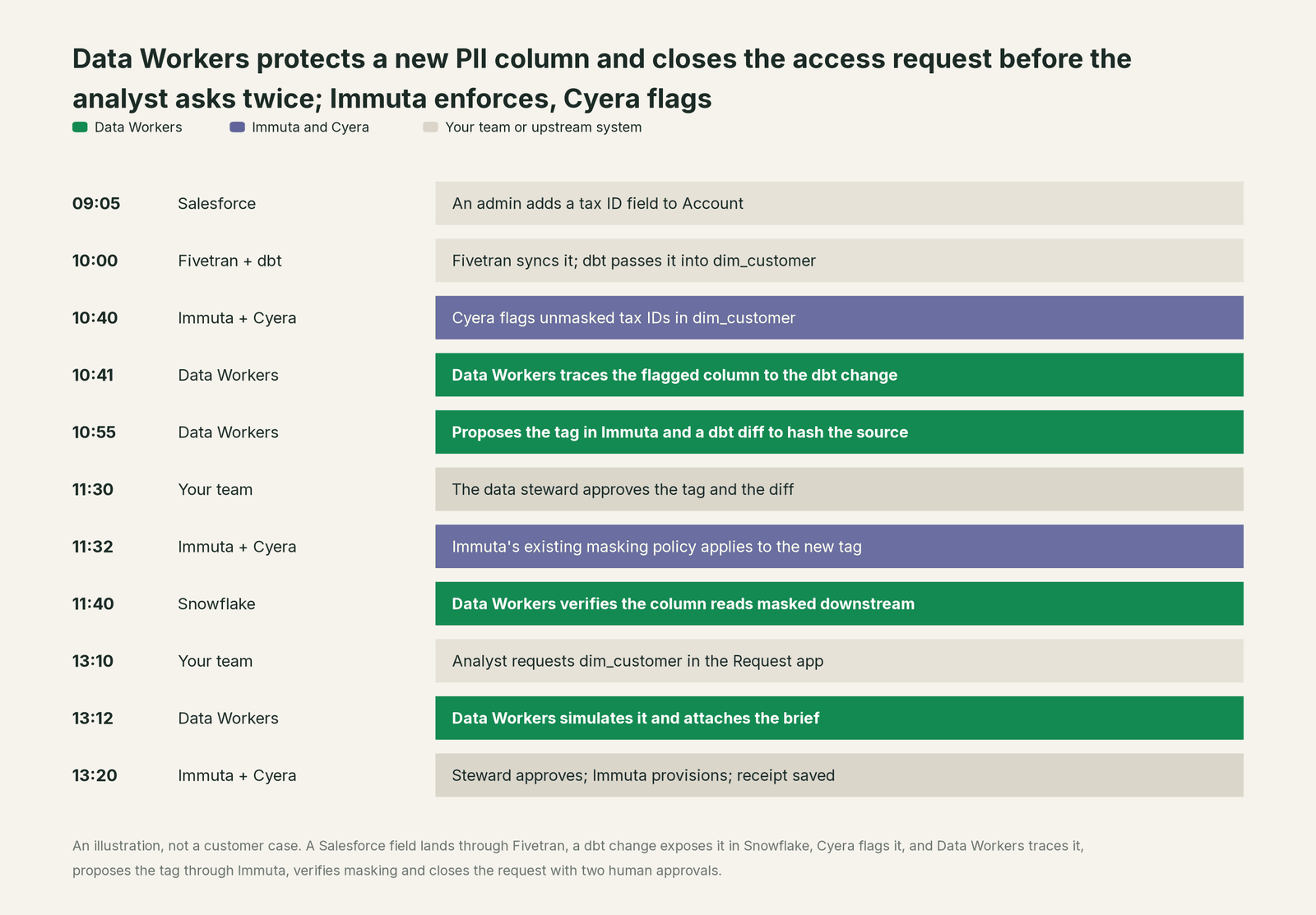
Both tools did their job well here: Cyera caught the exposure and Immuta enforced the policy. The difference is the work between 10:40 and 13:20. Without Data Workers, that's a security analyst, a governance lead and a data engineer trading tickets. With it, the steward makes two decisions with the evidence in front of them.
Why doesn't Immuta or Cyera just do this itself?
Because each built a great product for one job, and each made a careful call about risk.
Immuta is a policy decision point. Its value is that one engine decides every request the same way, which is why its AI explains and recommends rather than editing policies. A governance product that rewrote its own rules, or reached into dbt to change a model, would undermine the separation of duties its buyers pay for. Its agent work points the same way: agents get narrow, short-lived roles, and the engine stays the authority.
Cyera sells to the CISO. Its reach is wide and read-mostly by design: an agentless scanner that can see almost everything is easy to approve because it changes little. Where it does act, it acts on exposure it can see directly, like sharing links, files, labels and masking. Rewriting a dbt project, re-running a Fivetran sync or changing a warehouse role hierarchy would put Cyera inside the data team's change process, with a different approver and a different liability.
Writing to production data across systems is a different product category. It needs blast-radius scoping before every change, approvals that vary by domain, rollback, a receipt an auditor can read, context about every other system in the estate, and responsibility for changes inside tools the vendor doesn't own. That's the product Data Workers is. Immuta still decides access and Cyera still scores risk; Data Workers does the work around those decisions.
One platform across the data lifecycle
Access and security are two stages of a data team's lifecycle. Each point tool adds another console, another contract and another handoff. Data Workers covers the whole lifecycle with one context, one approval flow and one audit trail.
We score the same ten stages on every comparison page. Immuta leads on Governance & Access and Cyera leads on Security & Privacy, each scoring above Data Workers on its home stage. Data Workers covers all ten.
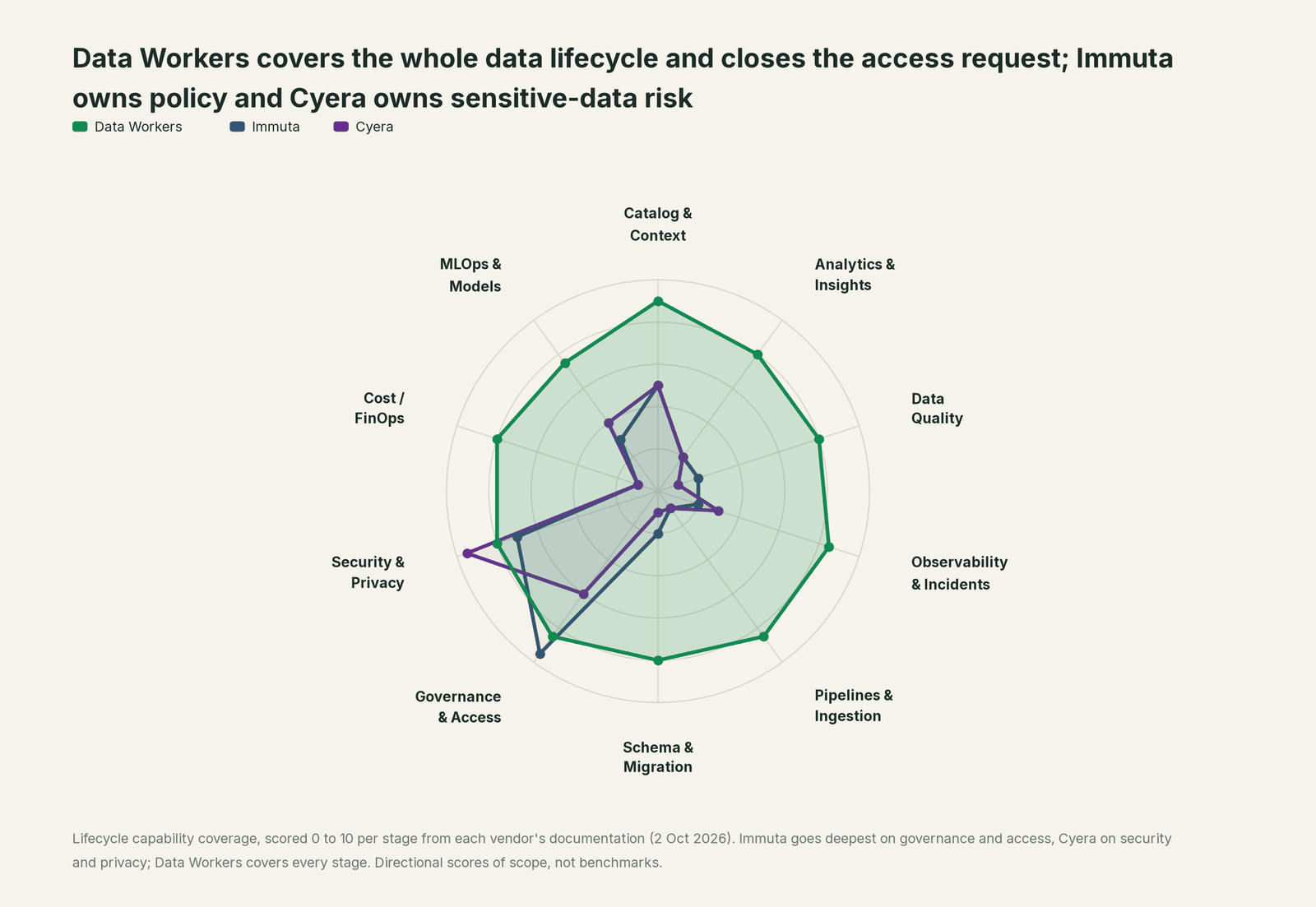
| Stage | Data Workers | Immuta | Cyera | Why we scored it this way |
|---|---|---|---|---|
| Catalog & Context | 9 | 5 | 5 | Immuta keeps tags, domains and data products and ingests catalog tags; Cyera inventories data stores. Data Workers keeps one context graph across warehouses, dbt, orchestration and BI. |
| Analytics & Insights | 8 | 2 | 2 | Both answer questions about access and risk, through Comply AI chat and Cy. Data Workers answers business questions over the governed graph. |
| Data Quality | 8 | 2 | 1 | Neither checks data correctness. Data Workers writes, runs and repairs checks and dbt tests. |
| Observability & Incidents | 8.5 | 2 | 3 | Cyera tracks security incidents and Access Trail activity. Data Workers runs data incidents from detection to verified fix. |
| Pipelines & Ingestion | 8.5 | 1 | 1 | Both work after the data lands. Data Workers proposes the dbt model fix as a diff behind approval and reruns the job. |
| Schema & Migration | 8 | 2 | 1 | Immuta autoscans new columns when object sync sees them. Data Workers catches schema changes in pull request review and the dbt manifest diff, scores their blast radius, generates migrations with rollback SQL for the owner to apply, and plans platform moves. |
| Governance & Access | 8.5 | 9.5 | 6 | Immuta's home: ABAC policy, Request app, review assist, agentic access. Cyera governs identities and agents. Data Workers simulates and routes grants through your engine. |
| Security & Privacy | 8 | 7 | 9.5 | Cyera's home: AI-native classification, exposure scoring, DLP, agent security. Immuta identifies and masks in-platform. Data Workers flags sensitive column names in pull request review, proposes tags and checks masking. |
| Cost / FinOps | 8 | 1 | 1 | Neither manages warehouse spend. Data Workers traces Snowflake credits to the dbt model behind them and drafts the fix for its owner. |
| MLOps & Models | 7.5 | 3 | 4 | Immuta governs agent access to data; Cyera guards AI agents at runtime. Data Workers checks the upstream data that feeds features and training sets; MLflow and W&B connect over their APIs, and the owner retrains. |
The scores measure scope, what each product covers, not answer quality. They're directional scores of scope, not benchmarks, and the reasoning is shown so you can check every line.
Access and security, outcome by outcome
The lifecycle view shows breadth. This view shows the eight outcomes a data leader pays for when sensitive data and access requests meet, and which product delivers each one.
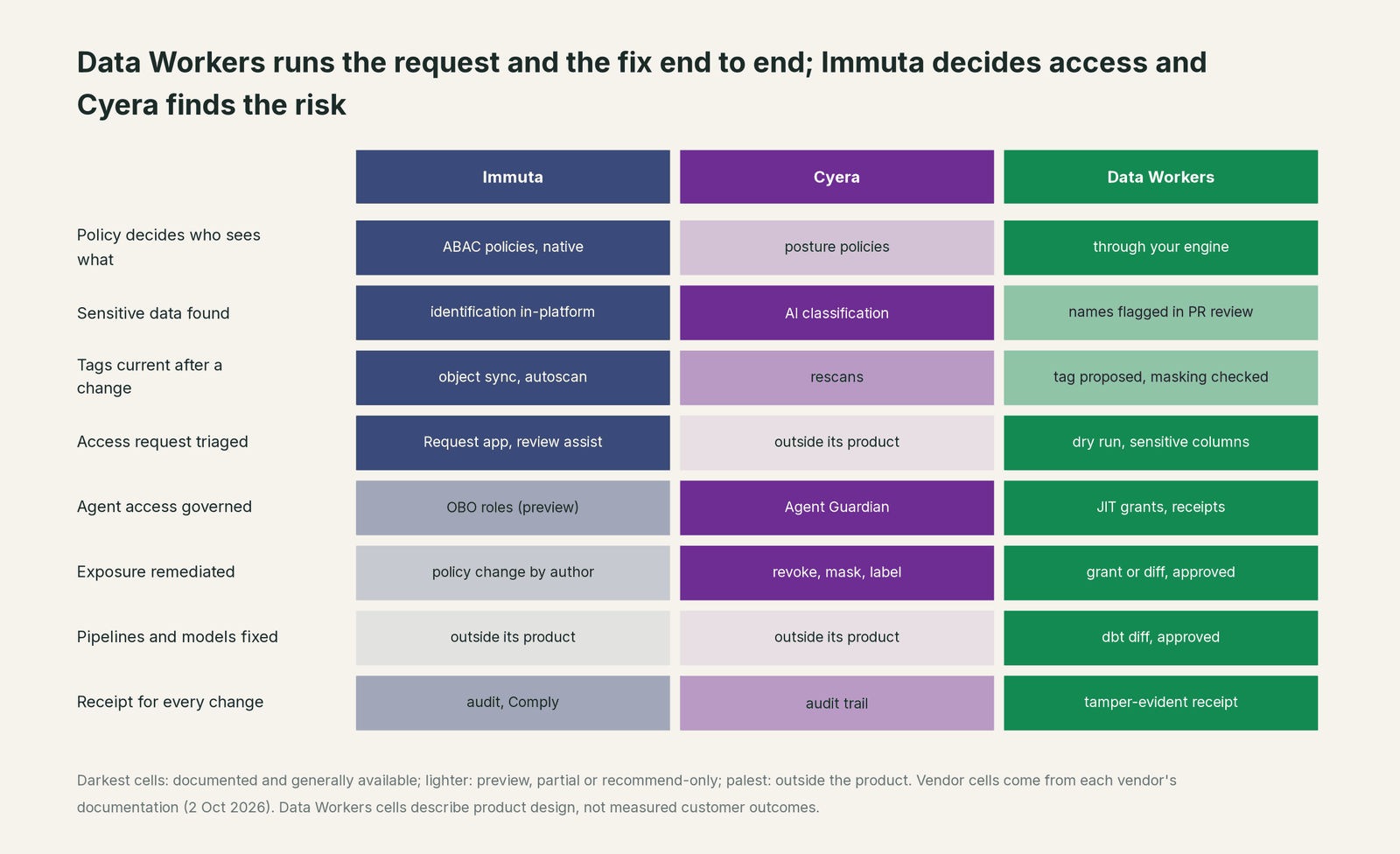
On "Agent access governed," both vendors do serious work, and Data Workers respects it: its agents act only with the grants you give them. On "Pipelines and models fixed," both stop by design, and that row is the clearest reason to add Data Workers.
How Data Workers works with Immuta and Cyera
With Immuta. Data Workers connects to Immuta over its API today and treats Immuta as the policy engine of record, by design, with no second permission system beside it. When Cyera or the steward classifies a new column, Data Workers proposes the tag in Immuta so Immuta's existing data policies apply. When a request arrives, Data Workers prepares the brief: who is asking and why, the effective privileges, the sensitive columns the grant would reach, any policy conflict, and a time-boxed option for one-off requests. The steward decides in Immuta, Immuta provisions in the platform, and Data Workers records the receipt.
With Cyera. Data Workers connects to Cyera over its MCP server or API today and reads its issues as the start of the loop. A Cyera finding on a warehouse table starts the same chain: confirm the classification, trace the column through lineage to its source, propose the fix where it was introduced, and verify downstream after approval. Cyera keeps scanning and sees the exposure gone on its next pass.
On the platforms directly. Where you don't run a separate policy engine, the Data Access and Governance agent proposes each grant for Unity Catalog, Snowflake or BigQuery through that platform's own permission engine: after approval it applies Unity Catalog grants directly and hands Snowflake and BigQuery grants to the platform owner to apply. Grants are least-privilege and can be time-boxed, with the revoke scheduled at expiry. Emergency break-glass access always needs a reason and a named approver, is never auto-approved and expires within hours.
Keep both, or consolidate a slice
Keep them and add Data Workers. This is the natural starting point. Your policies are written, your stewards know the Request app and your security team trusts Cyera's classification. Reasons to keep each one for the long run:
- •Immuta if you enforce attribute-based policy across several platforms, rely on its masking and row-level controls, or plan to use its agentic access and Intents for AI agents reading data.
- •Cyera if your sensitive data spreads across SaaS, file shares and email as much as warehouses, or your security team runs DLP and agent runtime protection from one console.
Consolidate a slice once Data Workers runs it too. For warehouse-centric teams that want one approval flow and one audit trail, the governance agent proposes and reviews grants through the permission engines of Unity Catalog, Snowflake and BigQuery, applying approved Unity Catalog grants directly. When that covers what you need for a domain, you can narrow a tool's scope there and keep it where it's strongest.
Either way, your data stays in your systems; the hosted Conductor sees workflow metadata only. The agents run in your infrastructure and store metadata and PII-redacted facts about your data, not copies of your tables. For the full deployment story, see where does our data go and how Data Workers handles PII.
The case for your CFO
The outcome. Access requests close with the evidence a steward needs, and new sensitive columns are tagged on approval and masked by your existing policies the day they are classified instead of at the next audit. Your governance and security teams spend their time on decisions, not on assembling context across four tools.
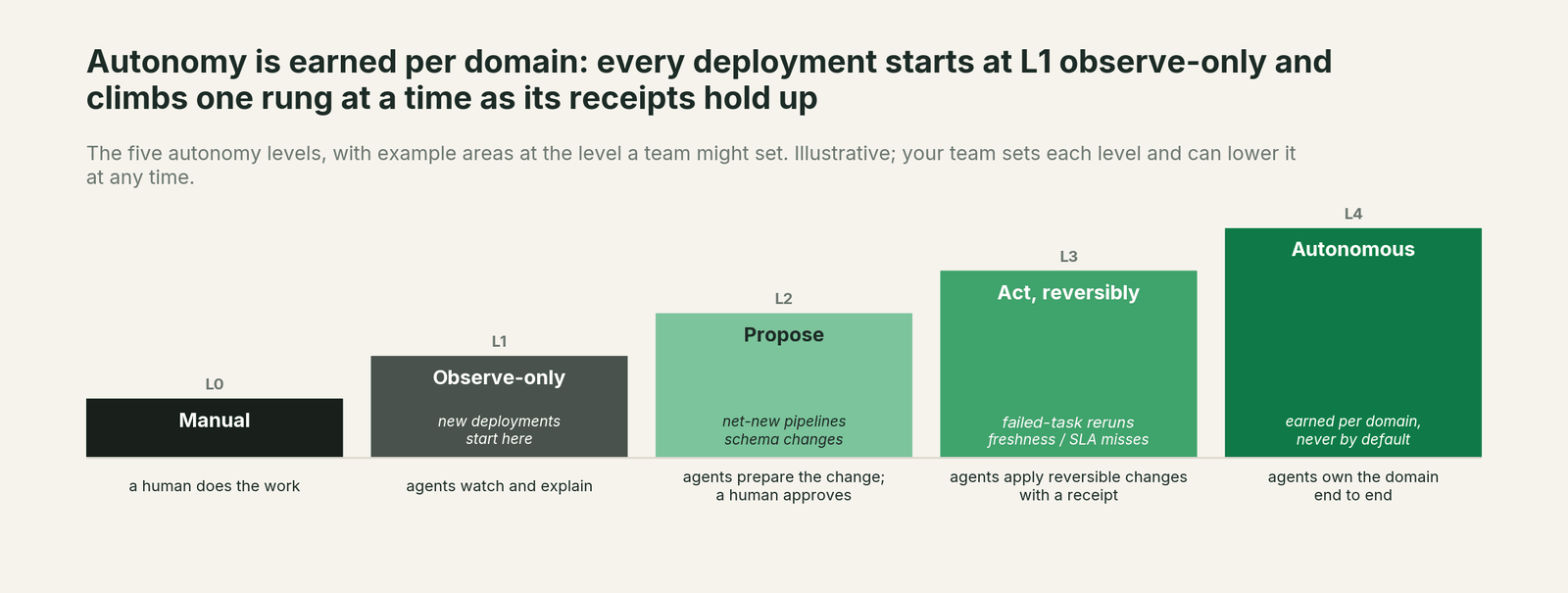
The risk story. Data Workers starts at L1 observe: it reads and reports. At propose (L2), every tag, grant and pipeline fix is a draft a person approves. At act reversibly (L3), it runs only changes it can undo, such as a time-boxed Unity Catalog grant, in domains you've moved up. Autonomous (L4) is a per-domain choice, never a default. Every receipt records who or what acted, why, what it touched and how to undo it. Zero migration: your data stays where it is.
Why now. Both vendors shipped agent features this year because AI agents multiply data requests. More requests reach the same stewards, and more pipelines change faster than scans run. The queue and the drift grow together.
The first win. Pick the domain with the longest request queue, such as the finance marts, and run it in propose mode. Each request arrives with a brief (purpose, sensitive columns in scope, blast radius, a time-boxed option) while stewards still decide in Immuta, and Data Workers turns that domain's Cyera issues into proposed fixes. Once stewards accept the briefs as-is for a few weeks, move routine time-boxed grants there to act reversibly.
What stays the same. Immuta's policies and Request app, Cyera's scans and workflows, your platform grants and the people who approve.
The path. Start with a pilot. See pricing; the pilot is credited in full against the first year.
The sentence to repeat upstairs: "Immuta decides who sees the data and Cyera tells us where the risk is; Data Workers does the work between them, so requests close and new sensitive columns are protected the day they land, with a receipt for each."
What each Data Workers product does here
Data-Agents Swarm. The Data-Agents Swarm is 20+ specialist agents. Here three matter most. The Data Security agent guards the agents themselves: it blocks prompt-injection strings at the graph write gate and backs the two-person kill switch, while sensitive-data findings come from Cyera, your classification tool or pull request review. The Data Access and Governance agent checks policy, dry-runs grants, proposes least-privilege and just-in-time grants and can require an acknowledged purpose for regulated data. The Identity agent records every grant and its expiry in a ledger and proposes revokes for the owner.
Autonomous Data-Conductor. The Autonomous Data-Conductor owns the outcome across agents: detect, diagnose, fix, review, verify and remember. A Cyera issue or an Immuta request starts the loop.
Data Context Wizard. Data Context Wizard builds one governed graph from your warehouses, dbt manifest, orchestration and BI metadata, so the agent tagging a column knows every table and dashboard downstream of it.
Spellbook Data Catalog. Spellbook Data Catalog (in preview) is the control plane for agent work. Every proposed tag, grant and fix lands in one inbox to approve, steer, send back or roll back, and an authority guard enforced in code stops any agent from promoting its own work.
Autonomy guardrails and security
Data Workers lets agents act on your estate under graded, reversible control. For the full safety model, read is it safe to let AI agents change production data.
- •Autonomy is set per domain. Time-boxed grants on low-sensitivity marts can run at L3 while anything touching PII stays at L2.
- •Every grant is dry-run first, with effective privileges after role inheritance, reachable sensitive columns, policy conflicts and a least-privilege, time-boxed recommendation.
- •Every action is approved or reversible, and leaves a tamper-evident receipt you can export to your SIEM or audit tooling.
- •No agent can promote its own work. This is enforced in code, not left to a prompt.
- •Least privilege. Data Workers acts with the grants you give it, through each platform's own permission system or through Immuta.
Data Workers supports your compliance program with evidence: receipts, audit exports and a ledger of every grant and its expiry for your access reviews. Your compliance determinations stay with your team and your auditors.
"Both of them ship agents and MCP now. Doesn't that close the gap?"
It closes part of it, and the progress is real. With Immuta's agentic data access, an analyst's agent gets a narrow, short-lived role instead of a shared service account. With Cyera MCP in Claude or Cursor, a security engineer can ask which identities can reach sensitive financial data and get a structured answer.
Both of those govern or inform an agent. The data team's work is still to do: classify the new column, fix the model that exposed it, verify the masking, brief the request, record the result. An engineer can stitch that together with several MCP servers on their own credentials, one case at a time, with no domain gates, clean rollback or shared record. Data Workers gives you that operating model, and every Data Workers agent is itself an MCP server your coding agent can call next to Cyera's. If you're weighing that build yourself, read build it ourselves with Claude Code and MCP servers.
FAQ
Immuta vs Cyera: which one do I need? They answer different questions. Immuta answers "who may see this data, and how is it masked?" across your data platforms. Cyera answers "where is our sensitive data, and who or what can reach it?" across cloud, SaaS and on-prem. Many regulated enterprises run both, owned by governance and security respectively.
Isn't native Unity Catalog or Snowflake Horizon policy enough? For a single platform with a small policy set, often yes. Immuta earns its place when you enforce the same policy across several platforms or need request workflows, review assist and agentic access. Data Workers works either way: through Immuta where you run it, and through the Unity Catalog, Snowflake or BigQuery permission engine where you don't. Our RBAC vs ABAC guide covers the policy models.
Will Data Workers bypass Immuta's policies? No. Where Immuta is the policy engine, Data Workers proposes tags and files requests through Immuta's API, and Immuta provisions access. Data Workers' own service account gets only the grants you give it.
Does Data Workers replace Cyera? For SaaS, file shares, email and endpoint DLP, keep Cyera. For warehouse-centric data, keep Cyera's classification too; Data Workers works each finding's fix upstream, so it closes faster.
How does Data Workers keep tags current after a change? When a pull request adds or renames a column, its review flags names and annotations that look sensitive; it reads names, not values. Cyera, Immuta identification or the steward classifies what the column holds, and Data Workers proposes the tag through your catalog or Immuta and checks that the masking policy applies.
How is Data Workers priced? The Apache 2.0 core is free. The pilot is $7,500 one-time, credited in full against your first year. Scale starts at $1,000 a month and Enterprise at $3,000 a month, billed annually, with unlimited seats, no usage meter and no markup on model spend. See pricing.
Sources
Vendor capabilities and statuses are current as of October 2, 2026, from each vendor's own documentation and pages.
Immuta: home page (checked Oct 2, 2026), The Authorization Layer (Sep 22, 2026), Provision, Comply, Agentic Data Access, agentic data access introduction and reference guide (private preview), Intents (public preview), review assist, access provisioning, Immuta's AI features, data identification, v2026.2 release notes (v2026.2.1, Sep 22, 2026), features in preview.
Cyera: home page and platform (checked Oct 2, 2026), DSPM, Enriched Classification, Remediation, Cyera Identity, Agent Guardian and launch announcement (Aug 3, 2026), Cyera MCP (Mar 24, 2026) and Cyera MCP blog, New in Cy (Aug 12, 2026), Automation Center (Feb 5, 2026), latest releases (Remediation Center, Jun 16, 2026), pricing.
Product names and statuses change quickly. If we've got something wrong, tell us and we'll fix it.