Data Workers vs Keebo: Cutting the Cost Inside the Models, Without Breaking the Dashboards
Keebo tunes warehouse settings on its own and leaves SQL and dbt fixes to your team. Data Workers drafts the model fix, checks the dashboards it feeds, applies after approval and keeps a rollback.
Keebo is a Snowflake and Databricks cost optimizer that tunes warehouse settings on its own and leaves query and dbt model fixes to your team; Data Workers is the Autonomous Agentic Data Platform, whose agents draft the model fix, check every dashboard it feeds, apply it after approval and keep a rollback. For a platform lead cutting the warehouse bill without breaking a dashboard, Data Workers wins because most of the bill is written in the models, and Keebo's own page says it only recommends there.
Data Workers exists to reduce your data ops to zero. Its Autonomous Data Conductor runs the detect, diagnose, fix, review and verify loop across the whole platform, directing every agent, with a dial per domain that goes from observe-only to fully autonomous. Keebo automates one slice of that platform: warehouse settings.
Keebo turns warehouse settings on its own and does it carefully. The larger share of most Snowflake bills sits in the SQL and dbt models that run on those warehouses, and for that share Keebo's own page says "Workload Intelligence recommends. Your team decides what to implement."
This page is for the platform lead whose job is to cut the warehouse bill this quarter without a single executive dashboard going wrong. For that job, the product that drafts the model fix, checks every consumer and keeps the rollback does more of the work than the product that tunes the knob. If you already run Keebo and want to build on it, read You're on Keebo.
Key takeaways
- •Data Workers takes the whole platform toward autonomous operation: cost, incidents, schema change, quality and access in one loop. Keebo automates one slice of it.
- •Keebo is autonomous on warehouse settings: size, auto-suspend and scaling, inside guardrails. Its page says it "does not alter your data, tables, clustering keys, or queries."
- •For query and model cost, Keebo recommends. Its Workload Intelligence page: "Your team decides what to implement." The rewrite, the test and the risk stay with your engineers.
- •Keebo's guardrails watch the warehouse (latency, queue time, queue depth). Dashboard freshness and correctness are outside what its pages describe.
- •Data Workers traces Snowflake credits to the query and dbt model behind them, drafts the fix for the model's owner, lists every model and dashboard downstream, applies after one approval, re-validates and keeps a receipt with rollback.
- •For the cost-without-breakage job, Data Workers is the piece to own first. Keebo can keep tuning the warehouse underneath.
What Keebo does well
Keebo sells autonomous optimization for Snowflake and Databricks. Its Warehouse Optimization page says "Keebo adjusts warehouse compute settings, chiefly size, auto-suspend, and scaling behavior." It "monitors latency, queue time, and queue depth" and "automatically backs off to prevent performance impact," and turning it off "simply returns control to your team." It works from metadata, "never sees query text or result data," and "operates outside the query path," which makes it easy for a security team to approve. Its home page states a "27%" average cost saving, Keebo's own figure. Keebo announced a $15 million raise in October 2022 (PR Newswire). Few products in the data stack change production settings unattended with a guardrail between the change and the business. Keebo does, on the knob it was built for.
The four tests
We apply the same four tests to every vendor in this series. Here they are scored for the job this page names: removing cost from the queries and models without breaking what reads them.
| Test | Keebo | Data Workers |
|---|---|---|
| 1. Executes the fix | On warehouse settings, yes, unattended. For queries and models, "Workload Intelligence recommends. Your team decides what to implement" (Workload Intelligence). | The owning agent drafts the model or query change and dry-runs it; the Conductor applies it after one named approval. |
| 2. Verifies at the consumer | Guardrails monitor "latency, queue time, and queue depth" (Warehouse Optimization). No check of downstream models or dashboards is described. | After the change, affected tables and downstream models are re-validated against quality and contract assertions; the traced dashboards are listed in the receipt. |
| 3. Receipt with undo | Backoff and an off switch for settings; an audit log of settings changes users make (audit logs). Model rewrites are your team's, so their undo is too. | Every change ships with a receipt (what changed, why, blast radius) and rollback. |
| 4. Works across tools and clouds | Snowflake and Databricks. Its pages do not mention dbt, Airflow or BI tools. | Snowflake, Databricks, BigQuery, dbt, Airflow and BI joined in one context graph. |
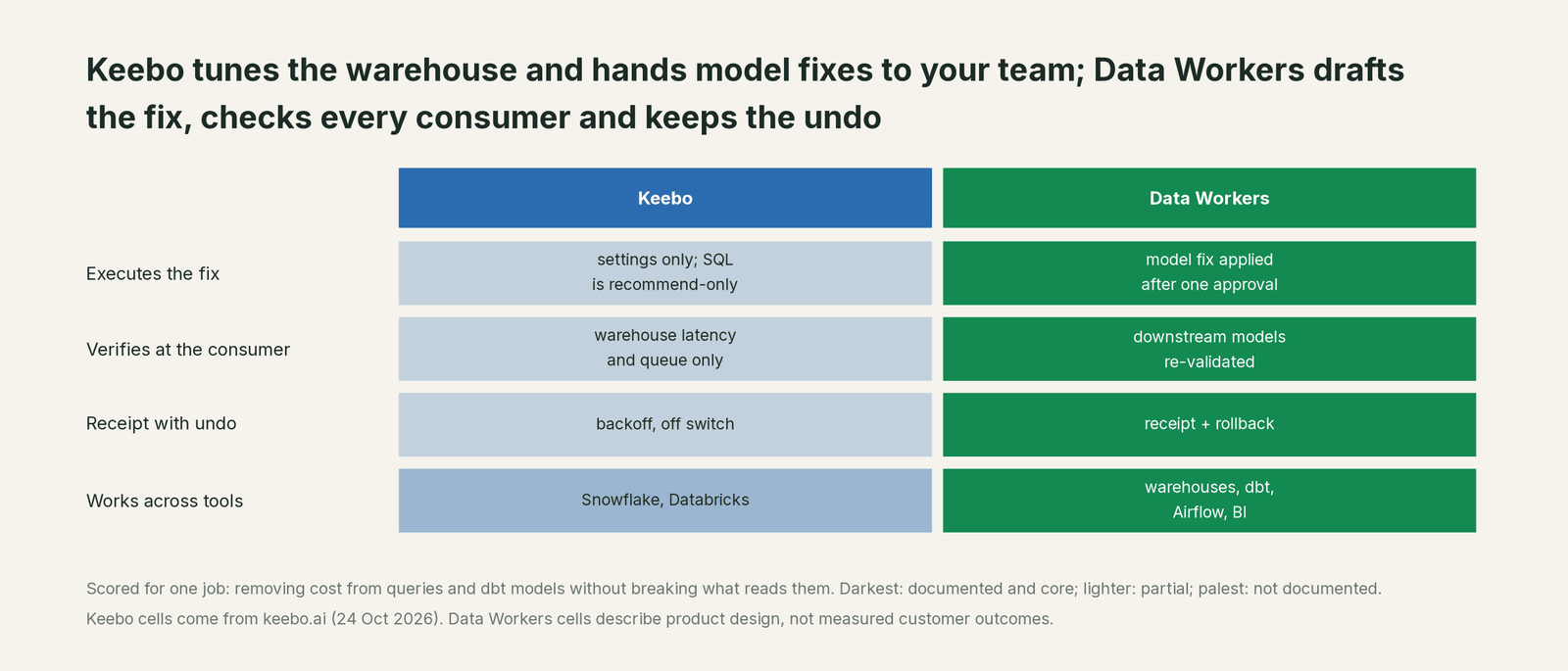
Their claim beside their documentation
Keebo's home page promises to keep "SLA-compliant performance while removing wasted compute." Its pages are exact about how. The autonomous part is three settings on the warehouse. The query part is advisory: Workload Intelligence will "see which queries, warehouses, and tables are costing you the most," "identify unused and unread tables" and detect "inefficient queries," and then "your team implements the fixes." Keebo states the split itself: "Autonomous change is the job of Keebo Warehouse Optimization."
So the marketing word, autonomous, is accurate for one action class and does not extend to the SQL. That matters because a warehouse controller can only make a heavy query cheaper by giving it less compute, and less compute on a heavy model means it finishes later. Keebo's guardrails catch that as latency or queueing on the warehouse. A dbt model that now lands at 07:40 for an exec dashboard that refreshes at 07:00 is a different failure, and its pages describe no check for it.
On the Agentic Data Engineering Index, for the job this page names, query and model cost, Keebo grades L1, suggest, from its own pages. Data Workers sits at L3 on incidents, data quality and schema and change review: it applies after approval and leaves a receipt with rollback, and each domain's dial goes up to fully autonomous when you choose.
Why doesn't Keebo just do this itself?
Because the metadata-only design is the reason it is easy to buy. A product that "never sees query text" cannot rewrite a query, and a product that "operates outside the query path" cannot test what a rewritten model produces. Rewriting a dbt model means reading its SQL, knowing which twelve models and three dashboards read it, running the change against real data, getting the model owner's sign-off and keeping a way back. That needs code access, lineage across tools and an approval trail. Keebo chose to stay out of that, and for a warehouse tuner it is the right call.
How Data Workers does it
Data Workers is the Autonomous Agentic Data Platform, and cost is one domain on the Conductor's dial. The Conductor ships observe-only; you open each domain as the receipts pile up, and the dial goes to fully autonomous. Four parts carry the cost job.
- •The Cost Savings and Data Cleanup agent in the Data-Agents Swarm attributes spend, finds unused data and right-sizes within budget. It traces Snowflake credits to the query and dbt model behind them and drafts the fix for the model's owner. Unused tables, idle compute and duplicate pipelines are cleaned up only after a dependency check against lineage.
- •The Data Context Wizard holds the cross-tool graph: which models, DAGs and dashboards read the thing being changed.
- •The Autonomous Data Conductor applies the change after one named approval, re-validates the affected tables and downstream models against quality and contract assertions, and retries or escalates on a failed check. The same loop handles incidents and schema changes, so a cost change that does break something is caught by the system that made it.
- •Spellbook Data Catalog is the inbox where the owner approves, sends back or rolls back, with the full trace.
The Cost agent is designed to reach a 25 to 40% cut in warehouse spend; your pilot measures your number on your data. For the safety model, read is it safe to let AI agents change production data.
One model, two paths
This is an illustration, not a customer case. Stack: Snowflake, dbt Core, Airflow, Looker, with Keebo tuning TRANSFORM_WH.
| When | Keebo plus your team | Data Workers |
|---|---|---|
| Mon 09:00 | Workload Intelligence ranks fct_sessions, a full-refresh dbt model rebuilt hourly by Airflow, as the most expensive workload on TRANSFORM_WH. A recommendation is filed. | The Cost agent attributes the same credits to fct_sessions and names the owner. |
| Mon 09:30 | The recommendation joins the sprint backlog. The model keeps rebuilding hourly. | The agent drafts an incremental materialization with a three-day lookback for late events and dry-runs it against the last seven days of partitions. |
| Mon 10:00 | Keebo keeps tuning TRANSFORM_WH size and auto-suspend inside its latency guardrail. The model SQL is unchanged. | The Context Wizard lists the blast radius: four downstream models, two Looker explores and the weekly exec dashboard. |
| Mon 11:15 | Waiting. | The owner reads the diff, the row-count comparison and the blast radius in Spellbook and approves. |
| Mon 12:00 | Waiting. | The Conductor applies the change. The next runs are re-validated on keys, row counts and the session metric baseline. The receipt records cause, change, approver and rollback. |
| Three weeks later | An engineer rewrites the model as incremental, forgets late-arriving events, and merges after dbt test passes. | Credits for the model have been lower for three weeks. |
| The next Monday 07:00 | Looker's weekly active users drops 4%. Finance asks in the exec review. Two engineers spend the afternoon tracing it to the lookback. | No event. |
The cost on the left is three weeks of full-refresh credits plus a wrong number in an exec meeting. Keebo did its job throughout. Its job stops at the warehouse.
Which one the platform team should own first
If your bill is driven by the models, and your constraint is that nothing downstream may break, Data Workers is the better choice. It does the part Keebo hands back to your team: the rewrite, the dependency check, the approval, the verification and the undo. It does it in the same loop that already runs incidents, quality and schema change, so a cost change cannot quietly break a dashboard. Own Data Workers first; Keebo can keep tuning warehouse settings underneath, and the sibling page You're on Keebo covers that setup.
FAQ
Is Data Workers an alternative to Keebo?
For model and query cost, yes. Keebo's page says it "does not rewrite or modify your queries" and that "your team decides what to implement." Data Workers drafts the model fix, applies it after approval and verifies what reads it. Its Cost agent also right-sizes warehouses within budget.
Can I keep Keebo and add Data Workers?
Yes. Keebo keeps tuning size, auto-suspend and scaling; Data Workers takes the cost inside the models, plus incidents, quality, schema change and access, in one loop.
How do I know a cost change didn't break a dashboard?
The receipt lists the downstream models and dashboards traced before the change, and the affected tables and models are re-validated after it. A failed check retries or escalates, and rollback is on the receipt.
Is Keebo's 27% figure comparable to the 25 to 40% target?
No. Keebo's is its own stated average; ours is the Cost agent's design target. Measure both on your account.
The outcome
Reduce your data ops to zero. Keebo automates one slice, the warehouse knob. For a platform lead asked to cut the Snowflake bill without a wrong number reaching the exec team, Data Workers is the better choice because it fixes the cost where it is written, in the models, proves at every consumer that nothing broke, and runs that loop alongside incidents, quality and schema change, with a per-domain dial up to fully autonomous.
Sources
- •Keebo home page ("27%" average cost savings, "never sees query text or result data", "operates outside the query path", SLA-compliant performance), https://keebo.ai/ (checked Oct 24, 2026)
- •Keebo, Warehouse Optimization (settings levers, "does not alter your data, tables, clustering keys, or queries", guardrails, backoff, off switch), https://keebo.ai/platform/warehouse-optimization/ (checked Oct 24, 2026)
- •Keebo, Workload Intelligence ("Workload Intelligence recommends. Your team decides what to implement."; "Autonomous change is the job of Keebo Warehouse Optimization"), https://keebo.ai/platform/workload-intelligence/ (checked Oct 24, 2026)
- •Keebo docs, Snowflake audit logs, https://docs.keebo.ai/warehouse-optimization/snowflake-audit-logs (checked Oct 24, 2026)
- •PR Newswire, "Keebo Raises $15 Million" (Oct 2022), https://www.prnewswire.com/news-releases/keebo-raises-15-million-launches-automated-warehouse-optimization-to-reduce-cloud-data-warehousing-costs-301654278.html (checked Oct 24, 2026)
- •Agentic Data Engineering Index (grade scale), https://dataworkers.io/agentic-data-engineering-index/ (checked Oct 24, 2026)
- •Data Workers product pages: Autonomous Data Conductor, Data Context Wizard, Spellbook Data Catalog, Data-Agents Swarm (Cost Savings and Data Cleanup agent) (checked Oct 24, 2026)